



Channels with fewer than 50 videos get more views on new uploads than channels with 1,000+ in 8 out of 11 niches. In education, the gap is 18x. In gaming and science, it's above 11x. The mechanism is the accumulation of dead content that causes the algorithm to narrow the audience pool. The good news is that dead content is fixable. We measured this across 20,000 channels, 11 niches, and four channel-size tiers. Here's what the data shows and how to act on it.
What the Data Shows
Across most niches, channels with fewer published videos get more views on new uploads than channels with large catalogs. The gap varies by niche – in some it’s dramatic, in others it partially reverses.
- In gaming, entertainment, education, and science, the decline is steep and consistent: more videos in the archive, fewer views on new uploads.
- In beauty, business, and food, channels with 200–500 videos outperform those with 50–200. Mid-size archives in these niches pull ahead.
- The biggest total drop is in education: channels with under 50 videos get 95% more new-video views than channels with 1,000+.
- Gaming, science, travel, and entertainment each show drops of 90–93% from the smallest to the largest archive bucket.
- The under-50 video bucket has the highest median new-video views in 8 of 11 niches in the dataset.
The figures above reflect the 100K–1M monthly views segment – the largest and most evenly distributed tier in the dataset, and the one most relevant to working creators.

All 20,000 channels were actively publishing at least one video per month and had at least six months of channel history. Shorts are excluded from the archive count, since they operate under different algorithmic logic. "New-video views" throughout this article means median views per day across all videos published in the last three – not total lifetime views.
|
Niche |
Views: under 50 |
Views: 1,000+ |
Gap |
|---|---|---|---|
|
Education |
41,548 |
2,256 |
18.4x |
|
Science & Tech |
39,436 |
2,814 |
14.0x |
|
Gaming |
44,558 |
3,799 |
11.7x |
|
Travel |
54,225 |
4,760 |
11.4x |
|
Entertainment |
43,910 |
4,280 |
10.3x |
|
Kids Entertainment |
20,739 |
2,181 |
9.5x |
|
Food & Drink |
39,989 |
4,395 |
9.1x |
|
Home & DIY |
23,577 |
2,671 |
8.8x |
|
Health & Fitness |
22,979 |
3,733 |
6.2x |
|
Business |
27,219 |
6,124 |
4.4x |
|
Beauty |
46,799 |
13,540 |
3.5x |
Got slow views? Let's see what to fix.
Archive drag is one explanation. Packaging, traffic routing, and retention mechanics are three others. Most channels have a combination – and they're hard to see from inside your own Studio. We've found the actual blockers across 3,000+ channels. → Find what's off.
Why Do New Video Views Fall as Archives Grow?
The data pattern reflects two compounding forces.
How YouTube’s satisfaction system reads a growing archive
YouTube's recommendation system matches videos to viewers based on predicted satisfaction. The signals it uses are consistent:
- Click-through rate
- Average view duration
- Watch time
- And post-video engagement. When a viewer clicks a video and leaves quickly, the system registers a mismatch between that content and that viewer. When that pattern repeats — the same viewer, or viewers with similar profiles, consistently rejecting a channel's content when it's recommended — the system stops routing those audience segments to that channel.
YouTube's own documentation describes this directly: long-term channel performance is affected "if a particular viewer consistently stops watching videos from a channel when they are recommended, or if viewers increasingly engage with content from other channels on YouTube."
The same documentation confirms that a single video underperforming doesn't produce this effect. What produces it is a sustained pattern of viewer rejection.
Dead content: the mechanism that's fixable
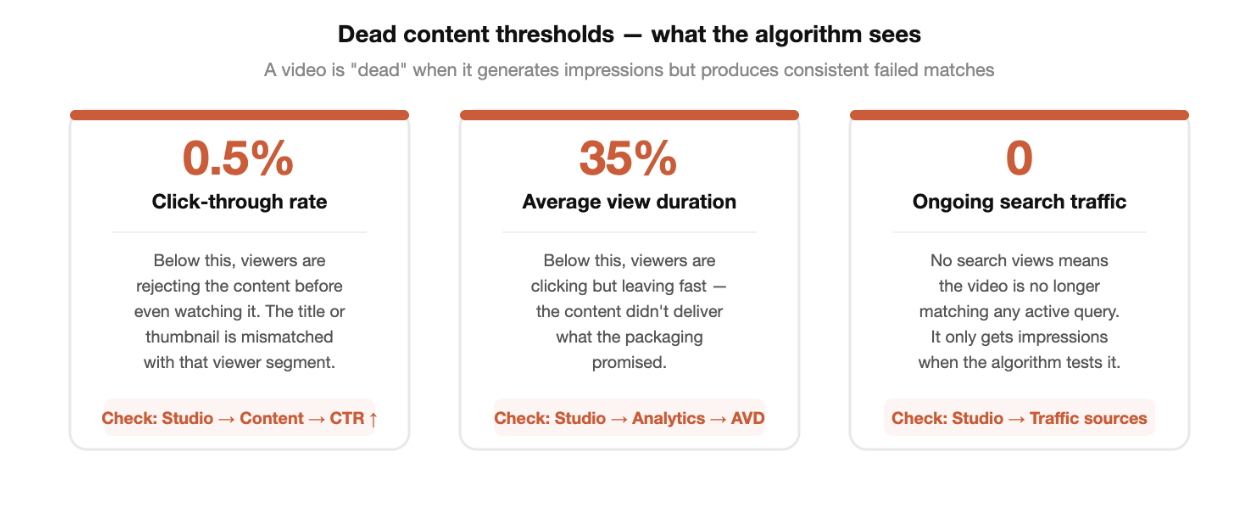
Dead content is not just old content. It's videos that currently generate impressions but produce poor engagement signals: CTR under 0.5%, average view duration under 35%, little or no ongoing search traffic, minimal comments or shares. These videos continue to appear in Browse and Search. Every time a viewer clicks and leaves early, the system registers another failed match for those viewer segments. The more videos produced that pattern, the more audience segments get trained away from the channel over time.
The size of the effect scales with the proportion of dead content, not with archive size alone. A channel with 200 videos — 180 strong, 20 dead — has fewer failed-match signals accumulating than a channel with 200 videos where 60 are dead.
Why do the niches divide into two groups?
The same mechanism plays out at different rates depending on how fast content ages.
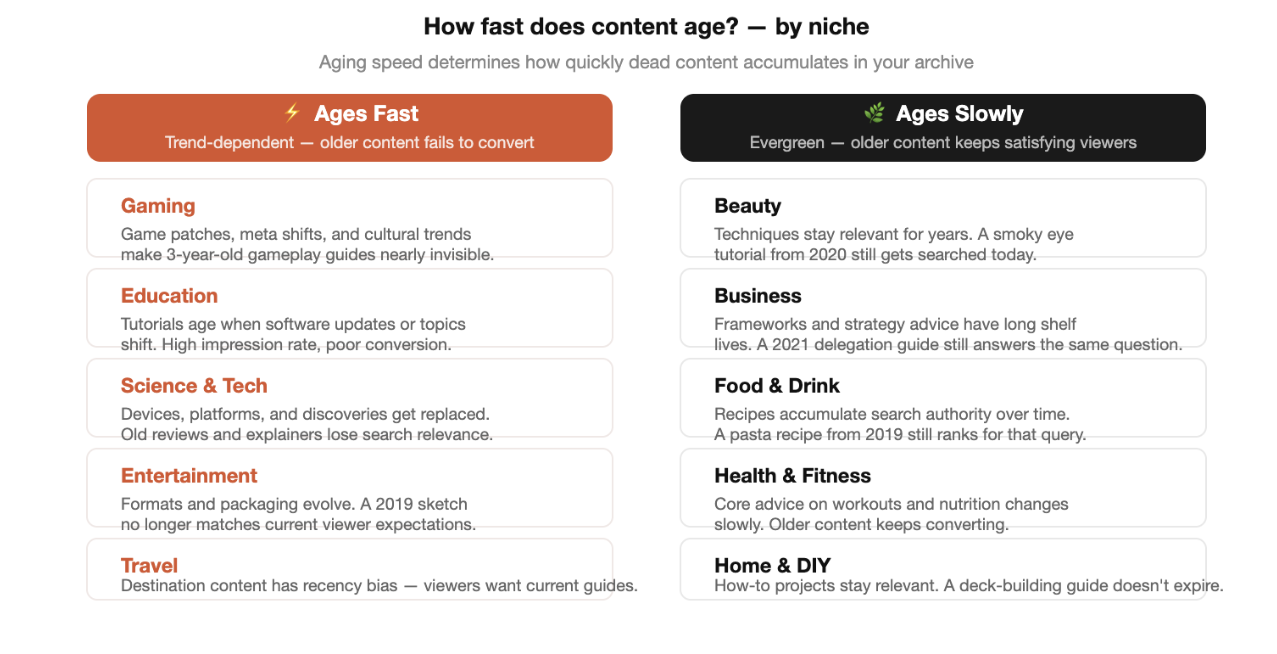
Gaming, education, science, and entertainment produce content with a short relevance window. A 2019 tutorial for discontinued software, a video about a phone nobody buys, a guide for a game no one plays — these still receive impressions because the algorithm tests them, but they convert poorly. Viewers click and leave. Those failed matches accumulate across a large archive and progressively narrow the audience pools available for new uploads.
Business, beauty, and food produce content with a much longer relevance window. A delegation framework from 2021 still answers the same question today. A smoky eye tutorial from 2020 still gets searched. In these niches, older videos continue generating satisfied viewers rather than failed matches — and that sustained positive signal is what produces the mid-archive recovery at 200–500 videos that the data shows.
Archive Effect by Niche. Jump Straight to Yours
The direction is the same across all 11 niches, yet the magnitude is very different.
- Gaming
- Science & tech
- Food & cooking
- Fitness
- Beauty
- Travel vlogs
- DIY & home
- Business & finance
- Entertainment
- Kids & animation
- Education
Does Archive Size Affect Gaming Channel Views?
Gaming channels with fewer than 50 videos get nearly 12 times more views on new uploads than those with 1,000+. It’s one of the steepest proportional drops in the dataset – and the penalty starts early.
By the time a gaming channel crosses 200 videos, new-video views have already fallen 82% from the <50 baseline. The curve does flatten past 500, but the damage is mostly done.
Gaming audiences are format-loyal.
A viewer who subscribed for a specific game or playstyle from 2021 may have stopped engaging entirely as the channel evolved. That subscriber is still counted but generates no watch time, no positive signals, and occasionally generates a "not interested" signal when the algorithm surfaces older videos to them. A large gaming archive is a record of format evolution — and most of those earlier videos have accumulated low satisfaction signals that depress the algorithm's read of the channel.
100K–1M segment.
|
Archive size |
Median new-video views/day |
|---|---|
|
<50 |
44,558 |
|
50–100 |
24,273 |
|
100–200 |
11,800 |
|
200–500 |
8,030 |
|
500–1,000 |
6,305 |
|
1,000+ |
3,799 |
At that point, the question is how to manage the archive.
Gaming channels that identify and address videos with sub-0.5% CTR and under-40% average view duration have recovered meaningful new-video distribution. The data reflects the average channel — not the ones actively managing their archive. As our research on video length by niche shows, the highest engagement in gaming comes from 20–30-minute formats. Many older gaming archives are dominated by shorter formats with weaker retention curves, compounding the dead-content problem.
What should gaming channels do?
If your archive is past 200 videos, run a content audit. Sort by click-through rate in YouTube Studio — any video below 0.5% CTR published more than 12 months ago is a candidate for re-optimization. You don't have to delete it. Also cross-reference with average view duration. Under 35% AVD combined with low CTR and no search traffic in the Traffic Source report is a dead-content signal. For a full walkthrough of the self-audit process, see how to do a YouTube channel audit.
How Archive Size Shapes New-Video Views for Travel Channels?
Travel channels with fewer than 50 videos have the highest absolute new-video views of any niche in the dataset – 54,225 median views per day. By 1,000+ videos, that falls to 4,760.
The 100–500 range shows the flattest slope in travel – new-video views hold relatively stable between 100–200 and 200–500 videos.
This likely reflects the search-driven nature of travel content: destination-specific videos accumulate ongoing search traffic, providing a floor under new-video views that gaming or entertainment content doesn’t have.
100K–1M segment
|
Archive size |
Median new-video views/day |
|---|---|
|
<50 |
54,225 |
|
50–100 |
28,476 |
|
100–200 |
15,314 |
|
200–500 |
14,373 |
|
500–1,000 |
9,414 |
|
1,000+ |
4,760 |
Travel channels at large archive sizes are typically long-running, established vloggers with substantial direct-traffic and returning-audience bases. Those returning viewers hold new-video view counts up despite the archive drag.
What should travel channels do?
Travel archives are naturally evergreen – a video about a destination published three years ago can still drive views today. That’s why the priority here is identifying which older videos have stopped performing and are generating weak engagement signals. In YouTube Studio, check the Traffic Source report for older videos: videos still receiving search traffic are worth keeping even if CTR looks low. Prioritize metadata refreshes there. Review the bottom quartile of your archive by CTR every six months. To keep viewers watching longer, check our analysis on retention optimization.
Does a Larger Archive Hurt Entertainment Channels?
Entertainment channels show a consistent, near-linear decline across all archive sizes – the most evenly spread drop among the niches that see the biggest absolute losses.
Entertainment content ages differently from gaming or education. A sketch or commentary video from 2019 isn’t necessarily low quality – but it reflects different packaging, topics, and formats than current content. Large entertainment archives tend to include a significant volume of content that no longer matches current viewer expectations, accumulating low engagement without being obviously bad.
100K–1M segment
|
Archive size |
Median new-video views/day |
|---|---|
|
<50 |
43,910 |
|
50–100 |
29,041 |
|
100–200 |
18,678 |
|
200–500 |
11,959 |
|
500–1,000 |
8,372 |
|
1,000+ |
4,280 |
What should entertainment channels do?
The gradual decline means there’s no emergency at 200 or 300 videos. The priority shifts at 500+: run a retention audit on your archive. Videos with under 30% average view duration and low click-through rates are diluting your recommendation signals. Refresh them before the aggregate effect compounds. For channels with a defined format (sketch, commentary, reaction) where older content is structurally similar to current output, playlist organization and internal linking via end screens and cards can route viewers from old content toward new uploads, improving session signals without removing any videos.
Archive size may be the same – something else is different. We'll put your channel next to the right benchmarks and show you the specific gap, not a generic checklist. → Show me the gap.
Does Archive Size Affect Education Channel Views?
Education channels show the steepest total decline in the entire dataset. Channels with fewer than 50 videos have 95% more views on new uploads than those with 1,000+.
Education content has high shelf life – a tutorial from four years ago can still rank in search today. But the engagement signals on older education videos drop as newer, better-produced alternatives appear and viewer behavior on the topic shifts.
A large education archive often includes videos that get impressions but don’t convert well, accumulating weak satisfaction signals that suppress recommendation rates across the channel.
100K–1M segment
|
Archive size |
Median new-video views/day |
|---|---|
|
<50 |
41,548 |
|
50–100 |
14,845 |
|
100–200 |
8,381 |
|
200–500 |
3,740 |
|
500–1,000 |
2,545 |
|
1,000+ |
2,256 |
100K–1M segment.
The steepness of this curve means quality control matters more here than in almost any other niche.
We worked with a legal education channel that was publishing 386 videos in one period and earning $743 in revenue. After restructuring its approach, the channel published 165 videos in the next period – 57% fewer.
Revenue grew 141%. Watch time grew 175%. Subscribers grew 224%. The algorithm recommended the channel more aggressively because each video was holding viewers better. Watch time more than doubled on 57% fewer uploads.
What should education channels do?
A retention audit is urgent past 100 videos. Look for content with under 40% average view duration and no ongoing search traffic — outdated tutorials that no longer rank can be refreshed or unlisted. The steepness of the education curve means dead content hits harder here than in almost any other niche. For the full analytics walkthrough, see how to identify weak points in your YouTube videos.
How Archive Size Affects Science Channel Performance
Science and tech channels follow the same steep pattern as education, losing 93% of new-video views from the smallest to the largest archive bucket – but with a notable mid-archive plateau.
The flat slope from 100–200 to 500–1,000 videos is distinct from most other niches. Science and tech content tends to accumulate search traffic on specific topics for longer than entertainment or gaming – deep-dive videos on technical subjects stay relevant. That provides a floor under new-video views in the mid-archive range that eventually gives way at 1,000+.
100K–1M segment
|
Archive size |
Median new-video views/day |
|---|---|
|
<50 |
39,436 |
|
50–100 |
14,503 |
|
100–200 |
9,984 |
|
200–500 |
8,587 |
|
500–1,000 |
7,821 |
|
1,000+ |
2,814 |
What should science and tech channels do?
Past 500 videos, start with metadata refreshes before considering unlisting. Updated titles, descriptions, and tags address the most common dead-content problem in this niche: older videos that originally ranked for search queries that have since changed how users phrase them. A video titled in 2020 for a now-outdated search pattern may still be technically accurate but invisible to current search traffic. A/B testing thumbnails and titles on your lowest-CTR videos is the right first move, not unlisting. For channels past 1,000 videos, also check which videos still drive meaningful search traffic in the Traffic Source report — those are worth protecting even if their engagement metrics look weak.
Does a Large Fitness Archive Hurt New-Video Performance?
Fitness channels show a steady decline across all archive sizes, losing 84% of new-video views from <50 to 1,000+ videos.
The curve slows significantly after the initial drop. Fitness content has strong evergreen characteristics – workout and nutrition advice doesn’t age out as quickly as gaming or entertainment. But the competitive density in fitness means older content gradually loses search and Browse placement to newer, better-optimized alternatives.
100K–1M segment
|
Archive size |
Median new-video views/day |
|---|---|
|
<50 |
22,979 |
|
50–100 |
11,025 |
|
100–200 |
9,073 |
|
200–500 |
7,320 |
|
500–1,000 |
6,018 |
|
1,000+ |
3,733 |
As our research on posting frequency shows, fitness channels peak at 2–5 videos per month — one of the strongest penalties for over-posting in the dataset. Channels managing both the quality ceiling on new uploads and the posting frequency together outperform those focused on either alone.
What should fitness channels do?
The most common archive problem in fitness is not dead content per se — it's outdated packaging on otherwise strong content. A workout video from 2021 with a low-energy thumbnail and a title that doesn't reflect current search behavior may still hold viewers well once clicked, but it rarely gets clicked. A metadata refresh on your 30–50 lowest-CTR videos is more valuable than unlisting. A/B thumbnail testing on archived fitness content routinely recovers meaningful CTR. Do a metadata pass every 12 months on the bottom quartile of your archive by CTR before considering any removals.
Does a Large DIY Archive Hurt New Uploads?
Home and DIY channels follow a steady, consistent decline – 89% total from the smallest to the largest archive bucket. The biggest single drop is early; the curve flattens past 200 videos.
100K–1M segment
|
Archive size |
Median new-video views/day |
|---|---|
|
<50 |
23,577 |
|
50–100 |
14,756 |
|
100–200 |
10,970 |
|
200–500 |
7,756 |
|
500–1,000 |
4,479 |
|
1,000+ |
2,671 |
A DIY channel we worked with saw total views fall 9% in one period – a platform traffic slowdown – while revenue still grew 20%. The channel didn’t change its posting frequency. Instead, they focused on changing what was behind each video: longer runtime (20–25 min shifted to 25–30+ min), stronger thumbnails, and metadata translated into 50+ languages.
Watch time grew 7.6% – 18,206 extra hours – despite fewer total views. The algorithm rewarded the depth signal, not the volume. Full case here.
What should DIY channels do?
DIY content tends to be project-specific and evergreen – a deck-building tutorial from four years ago still ranks for the same searches. The priority is keeping older, high-traffic videos current: refreshed thumbnails, updated descriptions, and pinned comments addressing any information that’s changed. Active metadata management is more valuable in DIY than cleanup.
Does Archive Size Affect Kids’ Entertainment Views?
Kids' entertainment has the most unusual curve in the entire dataset. The 100–200 video bucket is an anomaly: new-video views there are lower than at any other archive size – lower even than channels with 500–1,000 videos.
The pattern suggests that channels in this range are in a difficult transitional zone: too large to benefit from a fresh channel’s exploratory distribution window, but not yet large enough to have built the catalog depth that sustains larger kids’ channels.
Kids’ content is catalog-driven. Young audiences rewatch the same content repeatedly, generating compounding watch-time signals. Channels with 500+ videos have more catalog depth to sustain that loop. Channels at 100–200 are mid-build: enough older content to have accumulated weak engagement signals from early videos, without yet enough catalog volume to compensate.
100K–1M segment
|
Archive size |
Median new-video views/day |
|---|---|
|
<50 |
20,739 |
|
50–100 |
10,761 |
|
100–200 |
2,293 |
|
200–500 |
4,967 |
|
500–1,000 |
4,735 |
|
1,000+ |
2,181 |
What should kids' channels do?
If you’re in the 100–200 video range, the data supports prioritizing upload frequency to push through the transitional zone. A larger catalog – if content quality holds – appears to improve algorithm performance in kids' content. The goal is to reach 200+ videos with consistent quality. For channels already past 500, the priority is content quality and retention metrics, not archive cleanup.
Kids’ channel views not where they should be?
We've worked with kids' channels from 11K subscribers to 138M — and the problems are usually structural, not just content quality. Our team will tell you exactly what's suppressing your distribution. → Find what's off.
Does a Larger Beauty Archive Actually Help?
Beauty is one of three niches in the dataset where the relationship between archive size and new-video views is not a straight line down. The 100–200 bucket is the low point – then views partially recover.
That recovery – from 8,000 views at 100–200 to 16,000+ views at 200–500 – is the most striking pattern in the beauty niche. Channels with 200–500 videos get nearly double the new-video views of beauty channels at 100–200 videos. Channels at 1,000+ are still outperforming those at 500–1,000.
The explanation is likely search authority accumulation.
A large, well-organized beauty archive with strong thumbnails and consistent metadata – foundation reviews, tutorials for specific techniques, evergreen how-tos – generates ongoing search traffic that routes viewers to the channel, including new uploads.
Channels that reach 200–500+ videos with quality intact appear to benefit from that accumulated presence. The ones that stall at 100–200 may have built volume quickly without the same quality control, accumulating enough dead content to suppress distribution without enough earned search authority to compensate.
100K–1M segment
|
Archive size |
Median new-video views/day |
|---|---|
|
<50 |
46,799 |
|
50–100 |
20,889 |
|
100–200 |
8,696 |
|
200–500 |
16,882 |
|
500–1,000 |
11,420 |
|
1,000+ |
13,540 |
What should beauty channels do?
If you’re in the 100–200 video range and views feel suppressed, an archive audit is the priority – look for videos with poor CTR and low average view duration and either refresh their metadata or restructure the content with playlists, en-screens and translated metadata. The channels that push past 200 videos with quality intact appear to recover. The ones that don’t tend to stay stuck in the trough.
Does Archive Size Affect Business Channel Views?
Business is the second exception. The 50–100 bucket shows the sharpest proportional drop of any niche at that stage – but then the curve recovers substantially before declining again.
Business channels at 200–500 videos achieve views nearly double those of business channels at 50–100, despite having a much larger archive. This is the strongest mid-archive recovery in the dataset.
The business niche runs on expertise signaling. A creator with 200–500 well-produced, topic-specific videos on business strategy, finance, or entrepreneurship has built topical authority that generates consistent search traffic – and that authority routes viewers to new uploads as well. A business channel at 50–100 videos is often still establishing its positioning and hasn’t built the authority base that sustains distribution.
100K–1M segment
|
Archive size |
Median new-video views/day |
|---|---|
|
<50 |
27,219 |
|
50–100 |
7,979 |
|
100–200 |
9,465 |
|
200–500 |
13,172 |
|
500–1,000 |
10,077 |
|
1,000+ |
6,124 |
What should business channels do?
If you're in the 50–100 video range and views feel low, the data suggests this isn’t primarily an archive problem – you haven’t yet accumulated the topical authority that larger business archives build. Consistent publishing on a clearly defined topic cluster is the priority. If you’re past 500 videos and views are declining, that’s when a content audit makes sense: A metadata refresh is the first move — updated titles built around current search intent, descriptions with updated examples, and playlists organized by topic cluster. How to identify weak points using analytics walks through the diagnostic steps.
Does a Larger Recipe Archive Help or Hurt New-Video Views?
Food and cooking is the third exception. Like beauty, the mid-archive range outperforms the early trough.
Food content is highly searchable: recipe-specific titles accumulate search traffic over time, and channels with deep recipe libraries appear to benefit from that accumulated discoverability in their distribution of new content. The decline past 500 videos suggests the dead-content drag eventually outweighs the archive authority advantage.
The recovery from 100–200 to 200–500 – from 9,558 to 13,526 – mirrors the beauty pattern.
100K–1M segment
|
Archive size |
Median new-video views/day |
|---|---|
|
<50 |
39,989 |
|
50–100 |
13,034 |
|
100–200 |
9,558 |
|
200–500 |
13,526 |
|
500–1,000 |
6,764 |
|
1,000+ |
4,395 |
What should food and cooking channels do?
Build the archive with recipe specificity in mind – a video about a garlic pasta recipe accumulates search authority that benefits the whole channel more than a general cooking tips video. If you’re past 500 videos and new-video views are falling, audit for high-impression, low-CTR videos: often these are recipe videos with thumbnails or titles that no longer match how viewers search for that dish. Food and cooking content is also one of the strongest fits for metadata translation, since recipes are inherently searchable in any language, and for MSN distribution, which can add a second revenue stream from existing content.
So… Should You Just Delete Old Videos?
No.
Deleting or unlisting videos changes the archive-size variable, but it doesn’t automatically improve new-video views. The mechanism implies that having more underperforming videos is the main issue, not just having more videos in general. A channel with 500 high-performing videos may get better new-video distribution than one with 100 mixed-quality videos.
It’s better to do this first:
Step 1: Identify which videos are dead
Open YouTube Studio → Content → sort by CTR ascending. Any video under 0.5% CTR and older than 12 months goes on the triage list. Cross-reference with average view duration: under 35–40% AVD combined with no search traffic in the Traffic Source report confirms dead content.
One exception: low CTR with meaningful search traffic is a packaging problem, not a dead-content problem. Fix the title and thumbnail. Don't unlist it.
Step 2: Metadata refresh
Rewrite the titles and descriptions around how viewers currently search for the topic. Replace the thumbnail. Update the description with fresh internal links and chapter markers. Add end screens pointing to related strong videos.
Give it 60–90 days — YouTube re-tests videos after metadata changes. A/B test title and thumbnail variants instead of guessing at one version.
If the content is still relevant but feels dated, add a pinned comment acknowledging what's changed: "The software UI has changed since this was filmed — updated version here: [link]."
Step 3: Playlist restructuring and internal linking
Dead videos sitting mid-playlist break session quality and viewers drop into weak content after watching something strong. Remove triage-listed videos from playlists and reorganize so your strongest videos play first.
Add end screens and cards on high-performing videos pointing toward other strong content. The channel audit guide covers this in full.
Step 4: Thumbnail cleanup at scale
Thumbnails age badly. A 2019 thumbnail built on clickbait conventions — exaggerated expressions, heavy text, low resolution — suppresses CTR even on strong content. A complete thumbnail replacement on a 7M-subscriber kids' channel drove a 4.99x jump in recommendations and 6.6x revenue growth. The content didn't change. Full case here.
For archives past 200 videos, audit the worst-performing quartile by CTR and refresh those thumbnails before considering any removals.
Step 5: Unlist — only after steps 1–4
After a full refresh cycle with no improvement: under 0.5% CTR, under 35% AVD, no search traffic, no playlist role worth keeping — unlist. It removes the failed-match signal from Browse and Search while keeping the video recoverable via direct link.
Three rules before unlisting:
- Don’t unlist videos with search traffic, even if CTR looks low. Search-driven views produce positive signals and carry SEO equity.
- Never unlist in bulk. Work through each video individually. Mass changes introduce volatility that makes it impossible to read what's working.
- Spread changes over weeks, not days.
Archive Size Strategy Matrix
|
Niche |
When to audit |
First move |
Confidence |
|---|---|---|---|
|
Education |
Past 100 videos |
Metadata refresh on aging tutorials |
High |
|
Gaming |
Past 200 videos |
CTR audit; thumbnail refresh on lowest performers |
High |
|
Kids Entertainment |
At 100–200 transitional zone |
Push through with quality uploads; don't thin the archive |
Medium |
|
Science & Tech |
Past 500 videos |
Metadata refresh on lowest-CTR videos first |
Medium |
|
Entertainment |
Past 500 videos |
Retention audit; thumbnail + title refresh on the worst quartile |
Medium |
|
Travel |
Every 6 months, regardless of size |
Check search traffic first; refresh packaging on high-impression, low-CTR videos |
Medium |
|
Health & Fitness |
Past 300 videos |
Thumbnail + title metadata pass; A/B testing on lowest performers |
Medium |
|
Home & DIY |
Past 200 videos |
Thumbnail refresh on high-impression, low-CTR videos; metadata updates |
Medium |
|
Beauty |
At 100–200 trough; past 500 |
Archive audit; metadata refresh + playlist reorganization |
Medium |
|
Business |
Past 500 videos |
Identify non-ranking content; metadata refresh first |
Medium |
|
Food & Drink |
Past 500 videos |
Recipe-specific metadata audit; update titles for current search intent |
Medium |
Confidence = reliability of the pattern in the data across different channel sizes within the segment.
Key Takeaways
- Smaller archives correlate with more views on new uploads in 8 out of 11 niches. The relationship is negative across the dataset – but the mechanism is channel maturity and dead-content drag, not archive size itself.
- The biggest drops happen early. In most niches, the steepest decline happens in the first two archive transitions – from <50 to 100 videos. The curve flattens significantly past 200–500 videos.
- Three niches show mid-archive recovery. Beauty, business, and food & drink show partial recovery at 200–500 videos. Archive quality accumulates search authority in these niches, and that authority benefits new uploads.
- Dead content is the mechanism. Videos with low CTR and poor average view duration suppress the channel’s overall recommendation health, not just their own individual performance. Addressing dead content addresses the root cause.
- Kids’ entertainment has an anomaly at 100–200 videos. Channels in that bucket have dramatically lower new-video views than channels in adjacent buckets – likely a transitional phase where the channel is too large for fresh-channel distribution but hasn’t yet built catalog depth.
- Unlisting is better than deleting. And metadata refresh is often better than unlisting. The goal is to improve the signal quality of the archive, not to reduce its size.
What Should You Do Now?
The data shows the pattern - what works on the large scale of 20,000 channels. We can say what will work best for you only after we take a look at your channel.
Our team has done this across 3,000+ channels – with deep Studio access, a 450K-channel training dataset, 1 trillion views analyzed, and 21 in-house AI diagnostic tools. The audit covers your full channel across 10 dimensions: packaging, retention, traffic sources, competitor gaps, format mix, revenue structure, audience behavior, risk signals, growth projection, and a ranked action plan.
What you get:
- A structured report across all 10 performance pillars
- A 30-day action plan ranked by impact — what to fix first, and what each move should move
- A 45–60-minute live walkthrough with a senior AIR strategist