


In most niches, channels that combine YouTube Shorts with long-form content have more subscribers than channels that post long-form only. We learned that from AIR's 18,000-channel dataset across 11 niches and four channel-size segments.
But the advantage is not universal. It flips in gaming, science, and entertainment at scale, and disappears almost entirely in travel and DIY. Whether YouTube Shorts will help your channel depends on what you make and how large you already are.
The debate has run for years. One camp says YouTube Shorts attract dead subscribers, or worse, that YouTube Shorts will ruin your channel entirely. The other says YouTube Shorts are the fastest discovery engine available.
Both sides argue from personal experience. We wanted to find out why both camps keep being right about different channels. Here's what 18,000 channels told us.
Do YouTube Shorts Help or Hurt Subscriber Growth?
In many niches, channels that mix YouTube Shorts with long-form content have more subscribers than channels that post long-form only. But the advantage is uneven, and it depends on your size, niche, and how you use YouTube Shorts.
- In fitness, food, business, and education, mixing Shorts in correlates with more subscribers
- In gaming, entertainment, and science, mono-long channels tend to show higher median counts.
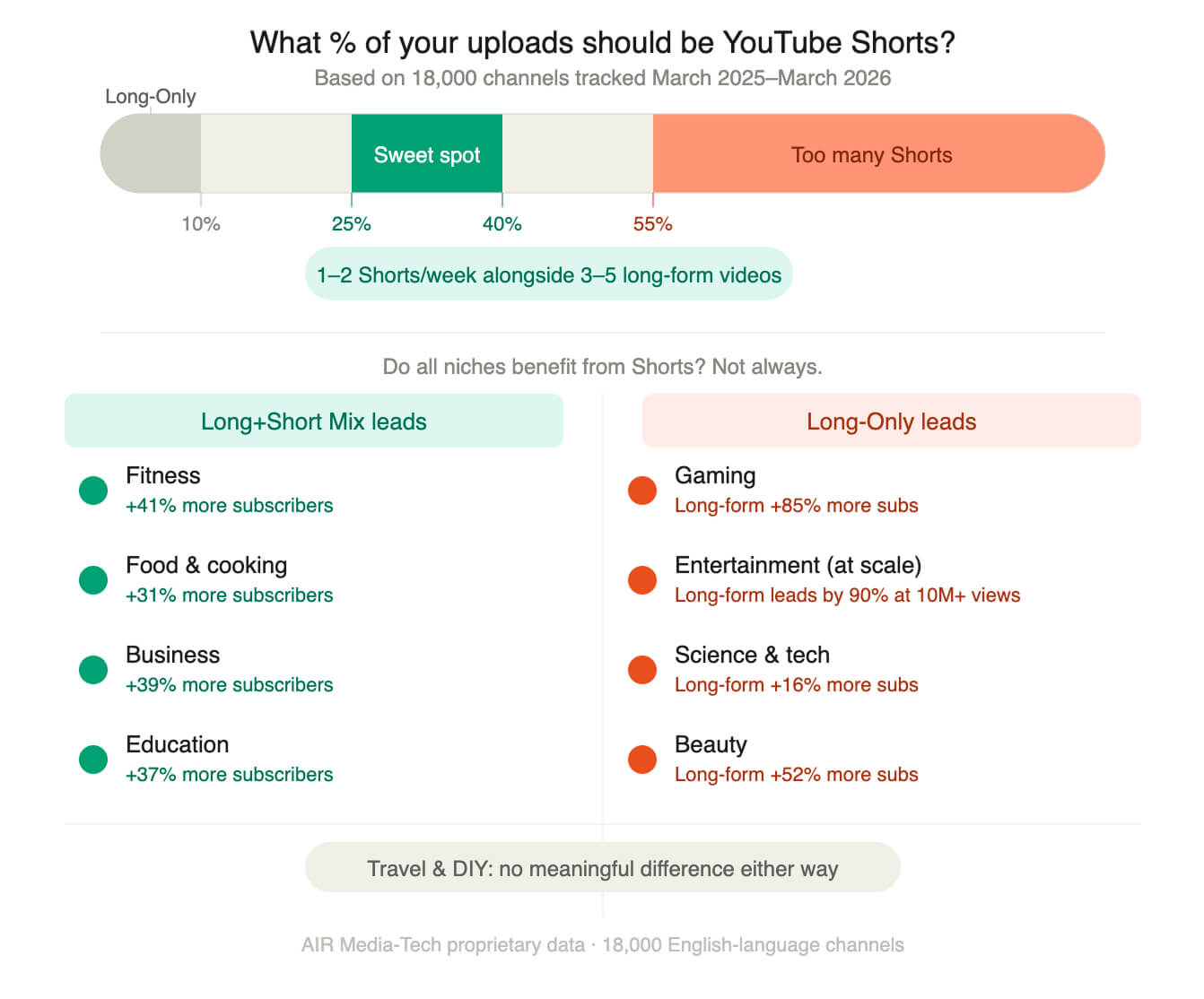
- The optimal Shorts ratio sits between 25% and 40% of total uploads.
- Above 55%, Shorts start crowding out the content audiences subscribed to, and long-form performance drops. Below 10%, you're essentially in the Long-Only group.
- That 25–40% range works out to roughly 1–2 YouTube Shorts per week alongside 3–5 long-form videos — a sustainable load for most channels.
- For specific guidance on posting cadence, the math on frequency is a separate question.
Why This YouTube Shorts Debate Keeps Going in Circles
The Shorts debate resurfaces every few months. A new creator goes viral with an "I tested Shorts for 90 days" video, while another one posts that YouTube Shorts killed their channel, and the cycle starts again.
The problem is that everyone draws conclusions from a sample size of one.
A creator who added YouTube Shorts and saw long-form views drop has real evidence, but only about their channel, their niche, their audience, and that specific quarter. A creator who credits YouTube Shorts for 10x growth has equally real evidence that means equally little at scale.
What's been missing is a study large enough to answer the real question: do YouTube Shorts kill your channel, or do they help it?
That's what this research is.
- We tracked 18,000 English-language YouTube channels from March 2025 through March 2026 across 11 niches and four size segments.
- Each channel posted at least 40 videos and 10 long-form videos during that period.
- We split them into three groups — Long-Only (under 10% Shorts), Long+Short Mix (10–70%), and Transitional (shifted strategy mid-year) — and measured median subscriber count per group. Median, not mean, because one viral outlier can pull an average far from what's typical.
- One limitation: this is correlational data. Channels with more subscribers may simply be more active creators who also happen to post Shorts. We widened the sample to 18,000 channels to reduce that noise as much as possible.
The YouTube Shorts Strategy Matrix for 2026
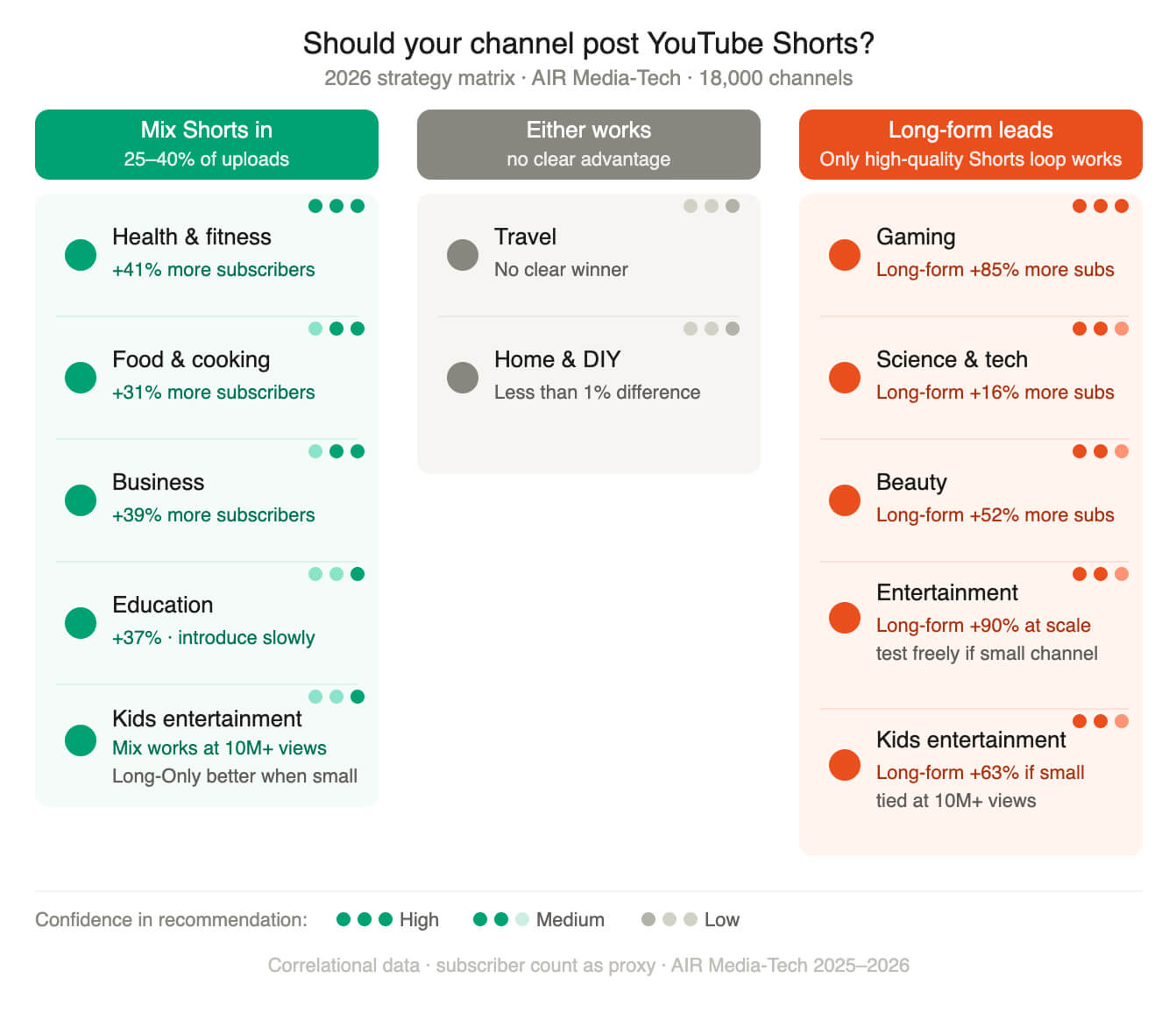
YouTube Shorts won't ruin your channel — as long as you keep them between 25–40% of your uploads in niches like fitness, food, business, and education. For gaming, science, or beauty, specific execution tactics can still make Shorts work in your favor. Just don't cross 55% — that's where long-form audiences start to thin out regardless of niche.
|
Niche |
Recommended strategy |
Confidence |
|---|---|---|
|
Gaming |
Long-Only |
High |
|
Science & Tech |
Long-Only |
Medium |
|
Entertainment |
Long-Only (at scale) / test freely (small) |
Medium |
|
Beauty |
Long-Only (test cautiously) |
Medium |
|
Kids Entertainment |
Long-Only (small) / either (large) |
Medium |
|
Health & Fitness |
Long+Short Mix (25–40% YouTube Shorts) |
High |
|
Food & Drink |
Long+Short Mix (25–35% YouTube Shorts) |
Medium |
|
Business |
Long+Short Mix (25–35% YouTube Shorts) |
Medium |
|
Education |
Long+Short Mix (introduce slowly) |
Medium |
|
Travel |
Either |
Low differentiation |
|
Home & DIY |
Either |
Low differentiation |
And across all niches, one consistent rule: don't make abrupt strategy pivots. Gradual integration outperforms cold pivots in every segment we measured.
Can YouTube Shorts help you?
Maybe not. Show us your channel, and will tell you what will work for sure, as we did for 3,000+ channels.
Request the channel auditWhat’s the Best YouTube Shorts Ratio?
Among channels that benefit from the Long+Short Mix, the median Shorts ratio is:
- Fitness: ~37%
- Food & Drink: ~27%
- Business: ~29%
- Kids Entertainment: ~37%
- Home & DIY: ~33%
- Travel: ~27%
- Education: ~38%
For gaming, science, beauty, and entertainment at scale — the data favors Long-Only. But if you add Shorts in the 25–40% range and execute them correctly for your channel, you can still benefit.
YouTube Shorts Strategy by Niche in 2026
Below are 11 niches across four channel-size segments. Where Long+Short Mix leads, channels have up to 41% more subscribers. Where Long-Only leads, the gap reaches 85% — which also means almost nobody in those niches is doing Shorts right yet.
Tactics and cases for each niche are below.
Jump to Your Niche
The data breaks down differently by niche. Click yours to go straight to the numbers and recommendations.
- Entertainment
- Gaming
- Health & fitness
- Food & cooking
- Business
- Beauty
- Education
- Kids entertainment
- Science & tech
- Travel
- Home & DIY
Should Entertainment Channels Post YouTube Shorts?
At a small scale, both strategies are within 2% of each other, effectively identical. At 1M–10M monthly views, long-form-only channels have 17% more subscribers. At 10M–50M, that gap reaches 90%.
- At 100K–1M, Long-Only and Long+Short Mix channels are nearly identical — 73,600 versus 72,400.
- At 1M–10M, Long-Only leads at 214,000 versus 183,000 for Long+Short Mix.
- At 10M–50M, Long-Only widens the gap to 2,220,000 versus 1,170,000 for Long+Short Mix.
Entertainment rewards established identity. At scale, audiences follow the creator, not the format. Long-Only entertainment channels tend to be more recognizable and built around a specific persona. YouTube Shorts can dilute that. For a smaller channel still building awareness, the difference is negligible, and experimentation costs little.
|
Segment |
Long-Only median subs |
Long+Short Mix median subs |
|---|---|---|
|
100K–1M |
73,600 |
72,400 |
|
1M–10M |
214,000 |
183,000 |
|
10M–50M |
2,220,000 |
1,170,000 |
|
50M–100M |
7,140,000 |
6,030,000 |
That said, the aggregate data doesn't tell the full story. We worked with a Canadian entertainment channel at just 11,000 subscribers with decent content but flat growth. When we built a deliberate YouTube Shorts strategy — defining content pillars, batching Shorts around rising topics, and treating each Short as a traffic gateway into their long-form catalog — Shorts views grew from 169,724 to 615,683 in one quarter. Total watch time grew 624%.
Shorts weren't replacing long-form performance. They were feeding it. New viewers arrived through YouTube Shorts and stayed for the full videos. Without that routing built in from the start, the result would have looked completely different.
What should entertainment channels do?
Small entertainment channels can experiment with YouTube Shorts freely — the data shows almost no difference at that size. Larger channels should treat YouTube Shorts as a secondary discovery tool at most. For ideas on what types of YouTube Shorts work best, explore our guide on 13 types of YouTube Shorts that go viral.
Should Gaming Channels Post YouTube Shorts?
Gaming channels that post long-form only have 85% more subscribers than those that mix in YouTube Shorts. It’s the biggest gap in the dataset.
- In the 100K–1M range, Long-Only channels hold a median of 70,100 subscribers against 37,850 for Long+Short Mix — nearly double.
- At 1M–10M, Long-Only reaches 270,500 versus 163,500 for Long+Short Mix.
- At 10M–50M, Long-Only at 1,710,000 versus Long+Short Mix at 1,055,000.
The 50M–100M tier is the only exception: Long+Short Mix channels here showed slightly higher median subscribers (4,430,000 vs. 3,030,000). But that's a sample of 35 channels combined. At the scale where most gaming creators operate, the numbers favor long-form.
Gaming audiences build loyalty around specific play styles, games, and creator personalities. Long sessions — let's plays, commentary, deep dives — earn that loyalty. YouTube Shorts in gaming attract casual viewers who don't convert to long-form. The bridge from a gaming Short to a 40-minute let's play is a harder sell than the bridge from a fitness Short to a full workout program.
|
Segment |
Long-Only median subs |
Long+Short Mix median subs |
|---|---|---|
|
100K–1M |
70,100 |
37,850 |
|
1M–10M |
270,500 |
163,500 |
|
10M–50M |
1,710,000 |
1,055,000 |
|
50M–100M |
3,030,000 |
4,430,000 |
The aggregate numbers mask something important, though.
The dataset can't show the quality of the YouTube Shorts or whether a proper funnel was ever set up. Gaming channels that post YouTube Shorts:
- Without configuring the Related Video field
- Without a verbal CTA
- And without structuring each Short as an open loop
They run a parallel channel with no connection to their core audience.
In that setup, the aggregate data is right — YouTube Shorts don't help. But a gaming channel that uses YouTube Shorts as tightly engineered highlight clips, each one pointing directly to the full session, can pull in viewers who would never have found the channel through search or Browse. The data reflects the average gaming channel's execution, not the ceiling of a well-built funnel.
What should gaming channels do?
The data doesn't support a heavy YouTube Shorts investment for gaming channels. If you test YouTube Shorts at all, keep them under 20% of your upload count. Configure the Related Video field on every Short to point directly to the long-form video it came from. Without that bridge, Short views stay isolated from your long-form growth entirely. Read more on how to build the Short-to-long-form bridge.
Views stall, and you don't know why?
A sudden plateau almost always has a specific cause — a packaging issue, a classification signal, a technical flag invisible in standard Studio views. We've resolved this pattern hundreds of times. We'll tell you exactly what happened and what to do next. → Get clear answers.
YouTube Shorts Strategy for Fitness Channels
Fitness channels that mix in YouTube Shorts have 41% more subscribers than long-form-only channels. It is the strongest case for the Long+Short Mix in the data:
- At 100K–1M monthly views, Long+Short Mix fitness channels show 120,000 median subscribers versus 84,900 for Long-Only.
- At 1M–10M, it's 376,500 for Long+Short Mix versus 307,000 for Long-Only.
- The 10M–50M tier shows the most dramatic split: Long+Short Mix at 7,160,000 versus Long-Only at 1,190,500 — though the sample is just 15 channels combined, so treat that number as directional.
The format alignment matters here. A 30-second workout demo, a quick form check, a single habit tip — these are complete units of value. They work as YouTube Shorts. They attract viewers who want more, and the "more" naturally exists in long-form workout plans, diet guides, and transformation videos. The Short and the long form aren't competing. They serve different stages of the same viewer's journey.
|
Segment |
Long-Only median subs |
Long+Short Mix median subs |
|---|---|---|
|
100K–1M |
84,900 |
120,000 |
|
1M–10M |
307,000 |
376,500 |
|
10M–50M |
1,190,500 |
7,160,000* |
*Small sample (15 channels combined). Treat as directional.
What should fitness channels do?
Build each YouTube Short to leave something unresolved: show the result, tease the method, mention the full program. The verbal CTA at the end should be direct: "Full workout in the linked video." Keep YouTube Shorts in the 25–40% range by upload count. For guidance on structuring YouTube Shorts that convert, this breakdown covers the mechanics.
Do YouTube Shorts Help Cooking YouTube Channels?
Food and cooking channels that mix in YouTube Shorts have 31% more subscribers at smaller sizes, but at 10M+ monthly views, long-form-only channels pull 47% ahead.
- At 100K–1M: Long+Short Mix at 104,000 subscribers versus Long-Only at 79,400.
- At 1M–10M: Long+Short Mix at 250,000 versus Long-Only at 227,000.
- At 10M–50M: Long-Only leads at 1,960,000 versus 1,330,000 for Long+Short Mix — the only tier where Long-Only leads in food, though sample sizes are small.
A quick recipe result, a technique in 45 seconds, a satisfying cook: food YouTube Shorts work because they deliver complete value in a short window while leaving the full recipe, the backstory, and the detailed method in long-form. The appetite for more is structurally built into the format.
|
Segment |
Long-Only median subs |
Long+Short Mix median subs |
|---|---|---|
|
100K–1M |
79,400 |
104,000 |
|
1M–10M |
227,000 |
250,000 |
|
10M–50M |
1,960,000 |
1,330,000 |
What should cooking channels do?
For most cooking channels (especially at sub-10M monthly views), the data supports mixing YouTube Shorts in. Aim for one to two YouTube Shorts per week alongside three to four long-form videos. At scale (10M+ monthly views), the data is less clear, and Long-Only leads in the limited sample.
Should Business YouTube Channels Post YouTube Shorts?
Business channels that mix in YouTube Shorts have 39% more subscribers, and that holds at both size tiers we tracked.
- At 100K–1M: Long+Short Mix at 106,000 versus Long-Only at 76,350.
- At 1M–10M: Long+Short Mix at 228,000 versus Long-Only at 163,500.
Business YouTube Shorts tend to work as hooks: a single framework, one contrarian take, a 60-second breakdown of a principle that the long-form video explores in depth. The audience is actively searching for knowledge, and a YouTube Short that genuinely delivers a useful insight builds enough trust to drive a click to long-form. The key word is genuinely. Business audiences have low tolerance for content that doesn't deliver.
|
Segment |
Long-Only median subs |
Long+Short Mix median subs |
|---|---|---|
|
100K–1M |
76,350 |
106,000 |
|
1M–10M |
163,500 |
228,000 |
What should business channels do?
Business channels should lean toward the Long+Short Mix. Keep YouTube Shorts content substantive — a genuine insight, not just a hook with no payload. A YouTube Short that wastes 45 seconds and delivers nothing does more damage in this niche than in entertainment, because the audience came for expertise and won't return for content that wastes their time.
Getting outpaced by other channels?
There's a specific reason — and it's in your data. Our team will pinpoint it across 10 angles using a 450K-channel dataset and tell you exactly what to fix.
Run the channel auditShould Beauty YouTubers Post YouTube Shorts?
Beauty presents a case that goes against the general trend. Long-form-only beauty channels have 45–52% more subscribers than those mixing in YouTube Shorts.
- At 100K–1M: Long-Only at 251,500 subscribers versus Long+Short Mix at 173,000.
- At 1M–10M: Long-Only at 345,000 versus Long+Short Mix at 227,000.
Beauty audiences at mid-tier appear to build loyalty around in-depth tutorials, reviews, and get-ready-with-me content that YouTube Shorts cannot replicate. A 30-second beauty Short can go viral without converting anyone to the core audience, someone who watches a one-minute makeup hack is not necessarily the viewer who will commit to a 25-minute foundation review. The subscription signal and the short-view signal are disconnected in this niche.
|
Segment |
Long-Only median subs |
Long+Short Mix median subs |
|---|---|---|
|
100K–1M |
251,500 |
173,000 |
|
1M–10M |
345,000 |
227,000 |
The aggregate data points one way, but the dataset can't capture how the YouTube Shorts are built.
A beauty Short that shows only the finished look is a dead end. It satisfies the viewer and gives them no reason to click through. A beauty Short that reveals one step and stops before the full tutorial creates a gap the viewer needs to close. The difference isn't niche-level. It's execution-level.
What should beauty channels do?
Don't add YouTube Shorts reactively. If you test them, start at low volume (one Short per week) and watch whether long-form watch time and subscriber conversion hold steady. If they dip, pull back. If they hold, scale gradually.
Should Education YouTube Channels Use YouTube Shorts?
Education channels that mix in YouTube Shorts have 37% more subscribers at smaller sizes, narrowing to 12% at mid-size.
- At 100K–1M: Long+Short Mix at 113,000 versus Long-Only at 82,200.
- At 1M–10M: Long+Short Mix at 395,000 versus Long-Only at 354,000.
Education audiences appear especially sensitive to identity shifts. They subscribe to a specific teacher's approach, and an abrupt change in content type reads as instability.
|
Segment |
Long-Only median subs |
Long+Short Mix median subs |
|---|---|---|
|
100K–1M |
82,200 |
113,000 |
|
1M–10M |
354,000 |
395,000 |
What should education channels do?
YouTube Shorts work well in education as a discovery tool: a concept introduced, a question posed, a single fact demonstrated in 60 seconds. Use the Related Video field to link directly to the full lesson. Don't overhaul your content identity in a single quarter.
Do YouTube Shorts Help Kids' YouTube Channels?
Kids' content is one of the most unusual cases in the dataset. Long-form-only kids' channels have 63% more subscribers at a small scale. The gap disappears entirely at 10M+ monthly views — both strategies tie.
- At 100K–1M, Long-Only kids' channels outperform Long+Short Mix (60,100 versus 36,750).
- But at 10M–50M, both groups show identical median subscribers: 1,440,000 for both.
- At 50M–100M, Long-Only slightly edges Long+Short Mix (4,185,000 versus 4,045,000).
YouTube operates under stricter restrictions for kids' content: no community posts, limited comment engagement data, constrained recommendation signals. YouTube Shorts may offer one of the few remaining discovery surfaces for kids' channels. But at smaller sizes, the audience loyalty mechanics clearly favor established, recognizable long-form formats kids return to repeatedly.
|
Segment |
Long-Only median subs |
Long+Short Mix median subs |
|---|---|---|
|
100K–1M |
60,100 |
36,750 |
|
1M–10M |
189,500 |
173,000 |
|
10M–50M |
1,440,000 |
1,440,000 |
|
50M–100M |
4,185,000 |
4,045,000 |
That said, the aggregate data obscures some of the most dramatic YouTube Shorts results we've seen. They came from channels that had already built a solid long-form foundation first.
- One kids' channel network we worked with went from 24 million views to 299 million in a single quarter — a +1,140% jump — after we recommended pushing YouTube Shorts alongside daily moderation and a pre-New Year frequency increase. Before, the network was search-driven, with YouTube Shorts at 6.6% of all traffic. After, Shorts drove 81.8% of all views. Revenue grew 386%.
- A separate partner, a 7.5M-subscriber kids' channel, published 23 YouTube Shorts in a quarter where it had published zero before, simultaneously cutting long-form output almost in half — and revenue grew 33.6% on 5.5% more views, because YouTube Shorts routed the right audience into a catalog it was already there to watch.
Both cases share something the aggregate data can't reflect: the YouTube Shorts were backed by compliance cleanup, content quality work, and audience routing. The dataset says kids' channels don't get a clear lift from YouTube Shorts. These cases say channel structure and funnel setup matter at least as much as niche.
What should kids’ channels do?
Small kids' channels should prioritize long-form quality over YouTube Shorts volume. As Jason Vlogs' Ali Kaplan told us in an exclusive interview, "Creating Shorts worked well for viewership. But it hasn't worked well, looking at the overall channel's revenue." At scale, both strategies are viable, and the data doesn't pick a winner.
Do YouTube Shorts Help Science YouTube Channels?
Science and tech channels consistently favor the Long-Only strategy. Long-form-only channels have 16% more subscribers at mid-size. At 10M+, the gap is significant.
- At 100K–1M: Long-Only at 90,600 versus Long+Short Mix at 88,500 — near parity.
- At 1M–10M: Long-Only pulls ahead at 284,000 versus 244,500 for Long+Short Mix.
- At 10M–50M: Long-Only at 2,080,000 versus Long+Short Mix at 312,500, though sample sizes are small.
Science audiences subscribe for depth. The audience that watches 15-minute deep dives on quantum mechanics or climate systems is there for the depth itself, not for a 60-second highlight. YouTube Shorts can attract casual viewers who don't convert. The engagement that matters (watch time, return viewers, session-starting behavior) comes from long-form in this niche.
|
Segment |
Long-Only median subs |
Long+Short Mix median subs |
|---|---|---|
|
100K–1M |
90,600 |
88,500 |
|
1M–10M |
284,000 |
244,500 |
|
10M–50M |
2,080,000 |
312,500 |
The data reflects average execution. Most science YouTube Shorts are highlight clips or experiment teases that either give away the payoff entirely or stop too abruptly to satisfy. The channels that succeed with YouTube Shorts in science treat each one as a complete micro-argument — one question answered in 60 seconds, with the complexity saved for long-form. That format serves both the YouTube Shorts algorithm (high completion rate) and the channel (viewers who want more rigor click through).
What should science channels do?
Science channels should default to long-form quality. If you produce YouTube Shorts, make them genuinely self-contained — a counterintuitive fact, a visual demonstration — not a teaser that requires long-form to pay off.
Other channels outperforming you?
They're not luckier. They've solved a structural problem you haven't found yet. We'll compare your channel against the right benchmarks and show you the specific gap and how to fix it. → Show me the gap.
Should Travel Vlog YouTube Channels Use YouTube Shorts?
No clear winner here. Long+Short Mix travel channels are 10% ahead at small scale, Long-Only 36% ahead at mid-size.
- At 100K–1M: Long+Short Mix is slightly ahead at 61,000 versus 55,500 for Long-Only.
- At 1M–10M: Long-Only slightly ahead at 270,000 versus 198,000.
- Neither gap is large enough to drive a clear recommendation.
Travel content is heavily seasonal and geographically specific. Format strategy probably matters less than content execution here. A well-produced travel YouTube Short — a location reveal, a visual moment, a time-lapse — can drive discovery without meaningfully moving the long-form audience.
|
Segment |
Long-Only median subs |
Long+Short Mix median subs |
|---|---|---|
|
100K–1M |
55,500 |
61,000 |
|
1M–10M |
270,000 |
198,000 |
|
10M–50M |
1,530,000 |
762,000 |
What should travel channels do?
Travel creators can experiment with either strategy without meaningful risk from the format decision alone. The stronger lever in travel is production quality and metadata optimization. Those improve results more reliably than format mix in this niche.
Do YouTube Shorts Help DIY and How-to YouTube Channels?
Home and DIY shows near-identical performance for Long-Only and Long+Short Mix across most segments.
- At 100K–1M: 95,100 versus 94,600. At 1M–10M: 251,500 versus 256,000.
- At 10M–50M: Long+Short Mix leads at 1,820,000 versus Long-Only at 784,500, though with a small sample.
DIY YouTube Shorts work well as teasers: the before, the final result, the single most satisfying moment of a build. The challenge is that DIY projects require context (materials, tools, sequence) that YouTube Shorts can't contain. They can attract viewers who want to see the result, but not necessarily viewers who want to replicate it themselves.
|
Segment |
Long-Only median subs |
Long+Short Mix median subs |
|---|---|---|
|
100K–1M |
95,100 |
94,600 |
|
1M–10M |
251,500 |
256,000 |
|
10M–50M |
784,500 |
1,820,000 |
We've seen this pattern confirmed in our own partner data. One crafts and creative channel had completely stalled. They had solid long-form uploads, but recommendations had cooled. We recommended starting YouTube Shorts. The creator was skeptical. In 30 days, with no other changes: views up 41.8%, revenue up 64.1%. YouTube Shorts brought the discovery. Long-form captured the monetizable watch time.
What should DIY channels do?
Either strategy works in DIY. If you already produce YouTube Shorts naturally from your project content, keep going. If you don't, there's no strong evidence in the data to justify building YouTube Shorts into your workflow specifically.
Should You Post a Load of YouTube Shorts Tomorrow?
No — and the data makes a strong case for why not.
In our 18,000-channel dataset, 1,247 channels made a radical shift toward YouTube Shorts in the three months before 2026 — moving their Shorts ratio by more than 30 percentage points in the second half of the year. The results were consistently poor across every niche and size segment we measured.
- In entertainment (100K–1M), those channels showed a median of 51,600 subscribers, against 72,400 for Long+Short Mix and 73,600 for Long-Only in the same segment.
- In gaming (100K–1M), they sat at 34,700 — roughly half the Long-Only median of 70,100. In food (100K–1M), 46,750 versus 104,000 for Long+Short Mix.
- In education (1M–10M), 56,350 — the weakest of any group at that size tier.
Why does this happen?
Two explanations fit the data, and both are probably contributing.
Algorithm disruption. When a channel dramatically shifts its content mix, the classification signals that YouTube uses to decide who to recommend the channel to change. The algorithm has learned that a certain type of viewer engages with this channel. A sudden flood of YouTube Shorts changes the content fingerprint. Distribution resets. The channel re-earns its footing from scratch — during the same period, its existing subscribers are also confused about what the channel has become. YouTube's recommendation system responds to satisfaction per session, not upload volume. An abrupt format change doesn't add a discovery surface gradually — it disrupts the existing one before the new one is established.
Selection effect. Channels that make dramatic mid-year pivots often do so because something wasn't working. Struggling channels try YouTube Shorts as a solution. Channels shifting away from YouTube Shorts are responding to a drop. The transitional group may simply be channels that were already in trouble, and the pivot didn't cause the underperformance. It just coincided with it.
We can't fully separate those two explanations. But the practical conclusion is the same either way: gradual integration outperforms cold pivots. If you're going to shift your strategy, do it over two to three quarters. Not one.
Feel like something's off but can't pinpoint it?
You're probably right. Most channels have two or three structural problems that are invisible from the inside — in packaging, traffic routing, or format mix. Our analysts have found them across 3,000+ channels. We'll find them in yours. → Find what's off.
What This Study Doesn't Tell You
- Correlation isn't causation. We don't know whether YouTube Shorts caused the performance differences or whether more active creators happen to both post YouTube Shorts and produce stronger long-form. That selection effect is real and impossible to fully control for in this design.
- Subscriber count is a proxy, not the full picture. A channel with 400,000 subscribers can dramatically outperform one with 800,000 on watch time, engagement rate, and revenue. The median subscriber data shows one dimension of channel health, not all of it.
- Quality is not controlled. Two channels with identical strategies can have wildly different outcomes based on thumbnail design, retention, topic selection, and posting frequency. The data shows broad patterns. It doesn't make strategy decisions for individual channels.
- This is a March 2025–March 2026 snapshot. YouTube's algorithm evolves continuously. Re-evaluate your strategy as the platform changes.
Key Takeaways About YouTube Shorts in 2026
In most niches, YouTube Shorts help. How much depends on your niche, your channel size, and how you build them.
- Mixing YouTube Shorts into your content correlates with a larger subscriber base in fitness, food, business, and education across most channel sizes. Gaming, science, and entertainment at scale are the exceptions — Long-Only channels lead there.
- The sweet spot is 25–40% YouTube Shorts by upload count. That's roughly 1–2 per week alongside 3–5 long-form videos. Above 55%, long-form performance starts to thin.
- Niches where YouTube Shorts underperform in the data often reflect wrong execution, not a hard ceiling. Our cases show gaming channels with 624% watch time growth, kids' channels going from 24M to 299M views in a quarter, and a creative channel adding 64% revenue in 30 days — all through YouTube Shorts. The data describes the average channel. Not the ceiling.
- The reason YouTube Shorts underperform on most channels is structural. No Related Video field configured. No verbal CTA. No open loop. Shorts feed views accumulate with no connection to the long-form catalog. The content can be good — the routing just isn't there.
- Build each YouTube Short as an entry point, not a standalone piece. Show the result, withhold the method. Answer the surface question, point to the deeper one. Every YouTube Short should leave the viewer with something unresolved that only your long-form closes.
- YouTube Shorts need a bridge. Configure the Related Video metadata field on every Short, add a verbal CTA in the final three seconds, and structure each Short as an incomplete answer that only long-form closes. Getting from 0.04% to 0.5% Shorts-to-long-form conversion is worth more than doubling your upload frequency. Here's how the bridge is built in practice.
What Move to Make Now?
We don't know until we see your channel.
The data above shows patterns across 18,000 channels. Your channel is one channel — with its own niche positioning, audience behavior, content quality, traffic source split, and growth ceiling. A pattern that holds for 70% of channels in your niche doesn't tell you which 30% you're in.
Let us dig into it. Our team dissects channels across 10 angles — packaging, retention, traffic sources, competitor gaps, format mix, revenue structure, audience behavior, risk signals, growth projection, and a ranked action plan — and gives you exact steps on what will work for you, how it will work, what exactly to do, why to do it, and what to expect.
We have done this for 3,000+ channels, using a 450K-channel training dataset, with 21 proprietary AI agents that process your Studio data against niche benchmarks in days to extract insights that are impossible to get from inside your own analytics.
What you get:
- A structured report covering all 10 pillars of channel performance
- A 30-day action plan ranked by impact
- A 45–60-minute live walkthrough with your strategist