

For kids’ channels, we use different growth tactics — and they perform very differently. We’ve analyzed dozens of partner cases, and now let’s break down how to grow a kids’ channel in 2026.
Our data shows that growing a YouTube kids' channel in 2026 comes down to five things:
- Trust signal cleanup
- Multilingual expansion
- 24/7 live streaming
- Getting into the YouTube Kids app
- Escalation when the algorithm silently penalizes you.
Each of these has produced dramatic results in our partner cases: a 1017% traffic recovery from resolving a hidden algorithmic flag, a 6x revenue increase from rebuilding thumbnails alone, and a channel going from 24 million to 299 million views in a single quarter through localization and Shorts working in tandem. All of those cases are explained below.
The kids' content ecosystem on YouTube rewards operational discipline, strict adherence to quality signals, and structural optimization. We have seen channels grow by 1017% just by resolving backend algorithmic penalties, and others triple their revenue simply by optimizing their thumbnails to eliminate low-trust indicators.
Below is what we have learned from working on dozens of kids' channel cases at AIR, and what the data shows.
The Landscape: YouTube Updates on Kids' Content (Late 2025 – Early 2026)
But before deploying growth tactics, you must understand the environment. Over the past six months, YouTube has drastically refined its approach to family and youth content, making compliance and quality signaling the ultimate prerequisites for growth.
Recent platform updates:
- Strict Parental Controls on Shorts (March 2026): YouTube rolled out new features for supervised accounts, allowing parents to be far more intentional about screen time. As of March 2026, parents can set the daily Shorts Feed limit to zero. This means kids' creators cannot rely solely on the addictive scroll of Shorts to build watch time; long-form content and streams are crucial for stability.
- AI-Driven Age Detection & COPPA Enforcement: Starting in late 2025, YouTube began rolling out AI-driven age estimation to ensure COPPA and GDPR-K compliance. Mislabeling "Made for Kids" content now triggers heavy enforcement, demonetization, or compliance flags.
- Algorithmic Penalties for "Low Quality" Trust Signals: YouTube's advertiser-friendly guidelines have been updated to penalize channels that rely on manipulative tactics. Content featuring overly emotional acting (extreme surprise, crying), clickbait thumbnails that do not match the video, or deceptively educational titles is classified as low-quality and stripped of recommendations.
Practical Recommendation: Never treat your kids' channel like adult entertainment. Drama, conflict, and clickbait are fast tracks to demonetization. Audit your entire library to ensure it aligns with these new high-quality principles.
Our team recently got back from Dublin, where Google and YouTube announced even more news for kids creators, including their $20 million global teen digital well-being initiative.
Before the Tactics: The Questions We Hear Most
It’s hard to find a single partner across 3,000+ channels who hasn’t asked us these questions. So, let us answer them first.
Why is my kids' channel not getting recommended?
This is the most common and most misunderstood situation in kids' content. Standard metrics (CTR, watch time, average view duration) can all look healthy while recommendations collapse. In one of our cases, a channel with 7 million subscribers saw recommendations drop 91% while CTR stayed strong and AVD was actually rising. The cause was thumbnail packaging. YouTube's system had flagged the visual style as manipulative for a children's audience. The fix was not new content. It was rebuilding the thumbnail strategy across the catalog. Views went up 2.8x and revenue 6.6x after that alone.
There are many reasons a kids' channel loses recommendations, and most of them come down to how YouTube evaluates trust and quality signals in children's content. For a broader look at how YouTube's recommendation system works and how to optimize for it specifically, the guide below goes deeper.
What is the fastest way to grow a kids' channel in 2026?
It depends on what is blocking the channel. If recommendations have dropped, trust signal cleanup is the most important fix. The cases below show recoveries happening within 30 days of catalog and thumbnail work. If the channel is healthy but plateauing, multilingual expansion through MLA audio tracks is consistently the highest-leverage structural move. One kids' network went from 24M to 299M views in a single quarter once Portuguese and Spanish tracks started compounding across the portfolio.
If uploads are performing but revenue is inconsistent, 24/7 streaming tends to stabilize and multiply it fast. Our partner, DONA JP, went from streams generating 23% of revenue in July to 83% in September. Heidi & Zidane Arabic had streams accounting for only 27% of traffic but over 55% of revenue — live content monetized far above its raw view share. The pattern across all our streaming cases is the same: streams keep the channel algorithmically active between uploads, which strengthens how new videos get distributed.
How do you get on the YouTube Kids app?
The channel has to meet safety, quality, and age-appropriateness standards, and the path to getting evaluated is not straightforward to navigate independently. The practical route is through a certified YouTube partner with direct access to internal review teams, who can prepare the channel before submission and pass it directly to the YouTube Kids team for evaluation.
Very few creators can get on the app on their own, but YouTube Kids is worth it. For Baby Ben en Español, for example, getting into the app produced a 396% increase in monthly views, and 67.4% of all traffic came from YouTube Kids within one quarter. The app, for the right channel, becomes the dominant traffic source.
4 Tactics to Grow a YouTube Kids Channel. Where to Start?
This study describes 4 tactics, but not every channel needs all four at once. Here is how to read your situation.
If recommendations have dropped and you cannot explain why, start with Tactic 1. This is especially true if surface metrics like CTR and average view duration still look healthy. That mismatch is the clearest signal that something in the channel's trust profile has changed. Thumbnail cleanup and catalog moderation have produced the fastest recoveries in our cases, often within 30 days. If the channel has been cleaned and distribution still has not recovered, that is when a certified partner escalation becomes the right next step.
If the channel is healthy but growth has plateaued, start with Tactic 2. The next audience is usually already reachable through the existing library. Multilingual expansion through MLA audio tracks is consistently the highest-leverage move for kids' content, because the format travels globally and dubbed versions frequently outperform the original on retention. Start with five proven videos across five to seven languages, let the engagement data narrow it down, and scale from there.
If uploads are performing but revenue is inconsistent or not scaling with views, start with Tactic 3. A 24/7 stream built from existing evergreen content does not require new uploads and can begin stabilizing revenue within weeks. The secondary effect — keeping the algorithm warm between uploads so new videos get faster distribution — is often worth as much as the stream revenue itself.
If the channel is doing well but not appearing in the YouTube Kids app, run Tactic 4 in parallel with whatever else is in progress. YouTube Kids access is not a content strategy. It is a distribution unlock that works independently of the other three tactics and can become the channel's dominant traffic source once approved.
When more than one of these applies, the order above is also the priority order. Fix what is broken before trying to scale what is working.
And now, let’s dive into tactics.
Tactic 1: Rebuilding Algorithmic Trust Signals: Thumbnail Compliance, Moderation & YM Cleanup
YouTube’s kids-content rules are built around one simple idea: content for children must be safe, honest, and enriching. In practice, that means kids’ videos should promote positive behavior, learning, curiosity, creativity, problem-solving, and inclusion.
The opposite is risky. YouTube Kids policies do not allow deceptive, sensational, or clickbait content, including low-quality kids and family content that uses manipulation to attract children’s attention. YouTube also restricts overly commercial content, misleading packaging, and videos that appear suitable for kids but include themes that are not appropriate for them.
For creators, this means thumbnails, titles, descriptions, scripts, and even character emotions must be reviewed as quality signals. Based on AIR’s kids-content quality guide, the biggest recurring risk areas are exaggerated emotions, scary or negative imagery, misleading thumbnails, unsafe behavior, excessive commercial focus, unhealthy food focus, adult-like themes, and metadata that overpromises what the video actually delivers.
34 YouTube Rules for Quality Kids Content
Download the PDF and use it as a pre-publish checklist for thumbnails, scripts, metadata, and full-channel audits before your next upload.
When Strong Metrics Were Not Enough
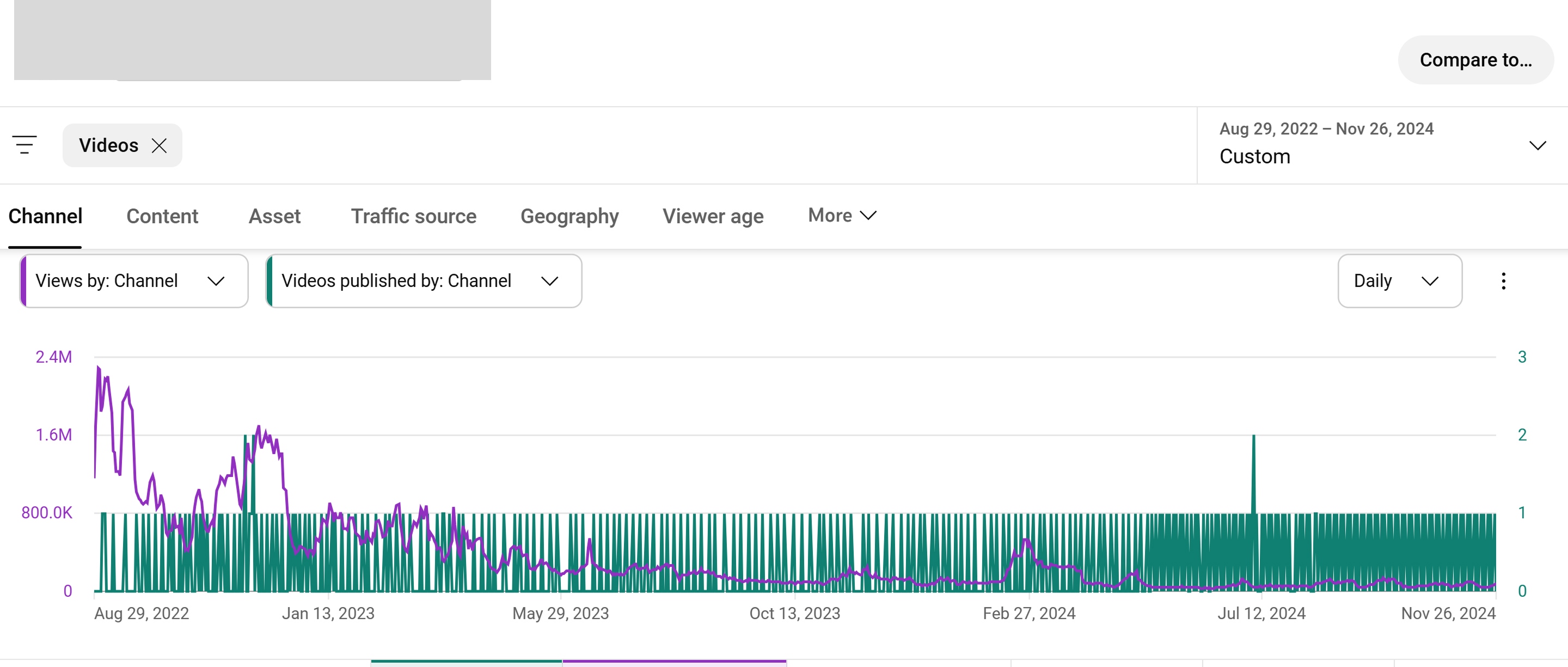
One of our partners, an Arabic-language kids’ channel with around 7 million subscribers, looked healthy on the surface. Posting was consistent, CTR stayed strong, and average view duration was even higher than before.
But the distribution layer had collapsed.
Recommendations were down 91%. New uploads were barely picked up by the algorithm. Older videos still received some recommendations, but almost every new long-form upload received only 1–5% of traffic from recommendations. Only one new video from that year broke through, and it was a vertical short.
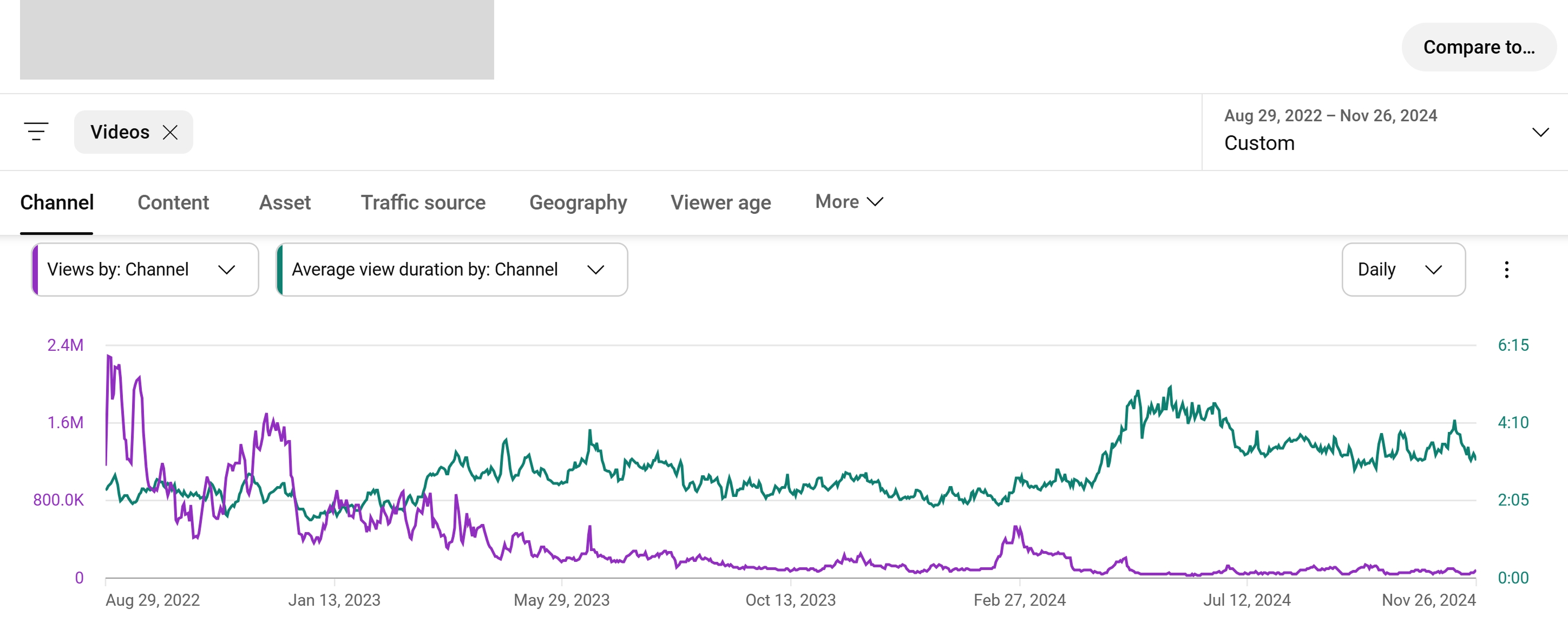
The team first escalated the issue through certified YouTube support. YouTube confirmed that the issue had existed and said it had been fixed. But the channel still did not recover. Recommendation traffic remained stuck around 2–3%, and some videos had almost no suggested-feed visibility.
So the team moved from platform escalation to full channel diagnostics.
The audit found the real issue: the thumbnails had started sending low-quality signals. Many used clickbait-style kids imagery: exaggerated open mouths, distorted facial expressions, overdramatic emotions, and visuals that felt manipulative rather than trustworthy.
For kids’ content, this is especially risky. YouTube’s systems evaluate whether a video looks safe, honest, and age-appropriate before pushing it deeper into recommendations.
The team rebuilt the thumbnail strategy around safer kids-content principles:
- We removed exaggerated emotional faces so the thumbnails no longer looked manipulative or overly dramatic.
- We replaced distorted expressions with more natural reactions that felt safer and more trustworthy for kids’ content.
- We moved away from clickbait-style framing so the thumbnails matched the actual videos more clearly.
- We rebuilt the visuals around positive, easy-to-understand scenes that fit better in kids’ recommendation environments.
- We updated thumbnails across the catalog because the goal was not just to improve single videos but to rebuild channel-level trust.
The result after thumbnail cleanup:
- Views – 2.8x
- Recommendations – 4.99x
- Watch time – 7.97x
- Revenue – 6.6x
The key lesson: a kids’ channel can have good CTR and strong AVD but still lose recommendations if thumbnails send low-trust signals.
Content Moderation as a Growth Trigger
Another creator with a Spanish-language kids’ channel had a different problem. Traffic fell sharply across the whole channel, not only on a few weak uploads. The top videos were no longer driving stable growth, and the decline affected the broader catalog.
The first step was a traffic review. AIR investigated the traffic pattern, cleaned low-trust signals across the catalog, and escalated the case to YouTube with a structured evidence pack documenting the recommendation decline. As a certified YouTube partner, AIR can work directly with YouTube partner support on complex moderation and distribution issues, including cases tied to internal safety and trust systems used in kids’ content recommendations. The YouTube team reviewed the channel internally, but no clear technical issue was found.
So, the AIR team moved to moderation: reviewing the catalog and changing or removing videos that could look low-quality to YouTube’s systems.
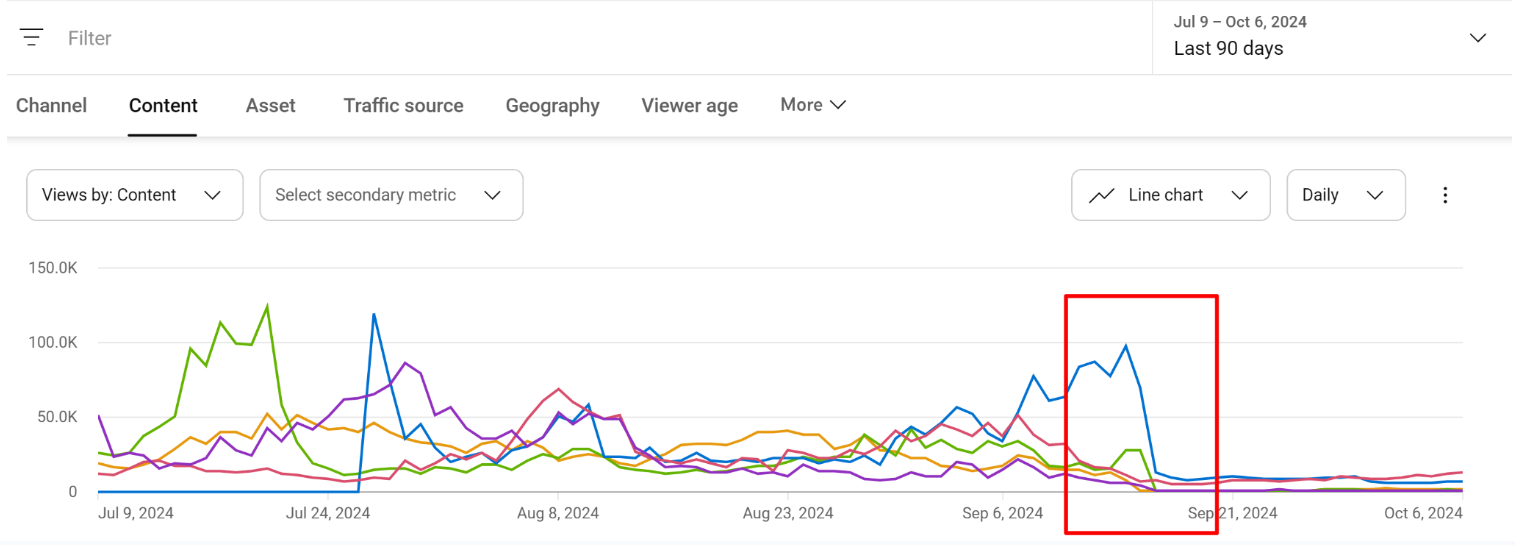
This is where many kids’ creators make a mistake by only fixing new uploads. But if the problem is channel-level trust, the old catalog matters too. One weak cluster of questionable videos can affect how YouTube evaluates the broader channel environment.
The moderation work focused on content that could appear unsafe, low-quality, misleading, or not fully aligned with kids' content expectations. Some videos were changed; others were removed.

After moderation, the channel saw a sharp recovery across multiple videos:
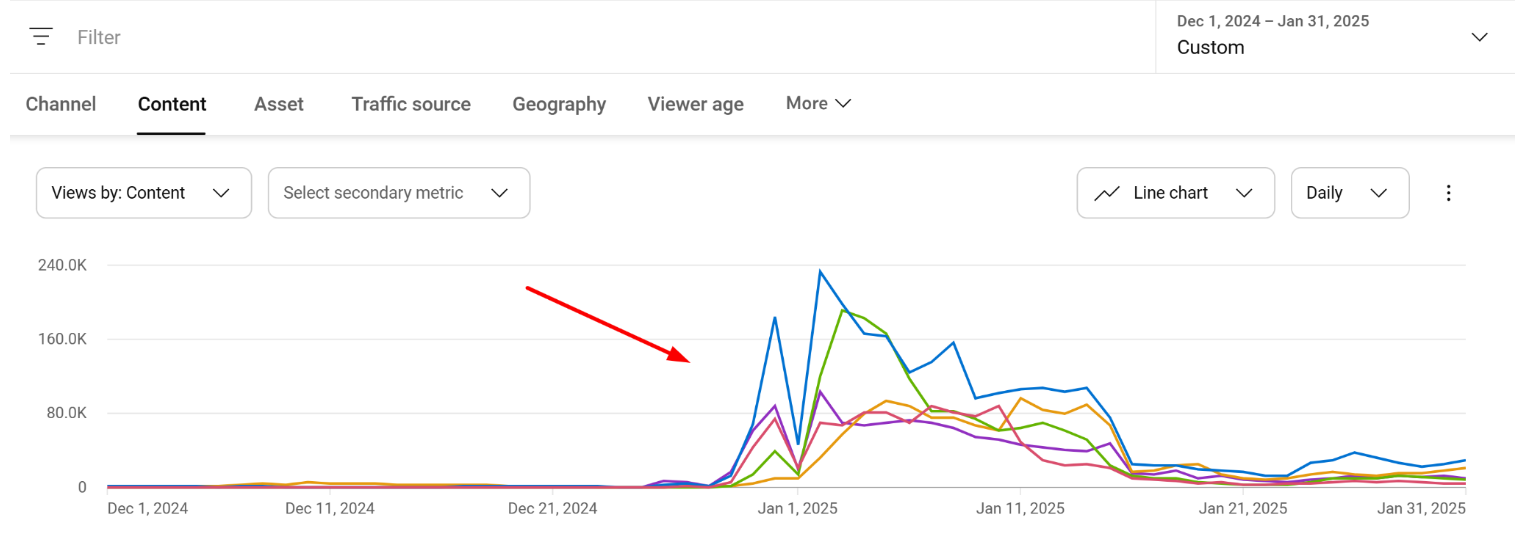
The recovery was dramatic when comparing the 30 days before and after the improvement.
|
Metric |
30 days before |
30 days after |
Growth |
|
Views |
9.23M |
59.70M |
+547% |
|
Revenue |
$8,503 |
$18,816 |
+121% |
|
Watch time |
2.50M hours |
12.23M hours |
4.9x |
The post-moderation period generated 59.7M views, 12.2M watch hours, and $18.8K in estimated partner revenue, compared with 9.2M views and $8.5K before the recovery.
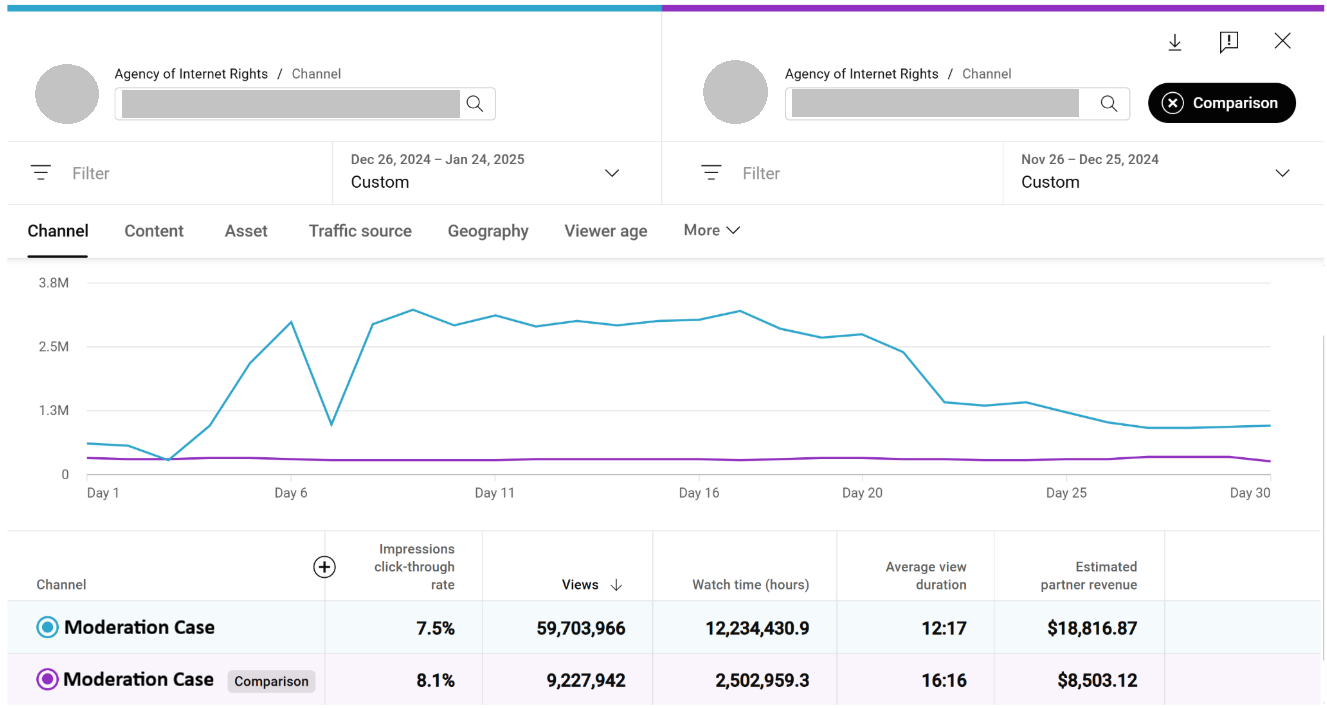
The average view duration was actually lower after the traffic surge, which is normal when reach expands massively. But total watch time, views, and revenue all grew. That means the channel did not just improve retention quality; it regained distribution.
The lesson: moderation is not only about avoiding strikes. For kids’ channels, moderation can rebuild algorithmic trust and reopen recommendation traffic.
Yellow Monetization Cleanup: When Policy Fixes Unlock Growth
Yellow Monetization issues are not just a revenue problem. For kids’ channels, they can also point to deeper trust-signal issues: misleading packaging, sensational thumbnails, risky scenes, or content that YouTube reads as low-quality for children.
In another kid's case, there was a larger YM problem. AIR worked through 223 Yellow Monetization issues, submitting appeals and coordinating with YouTube’s review/security teams. 205 issues were successfully resolved. After the cleanup, the channel improved across key metrics compared with the previous month:
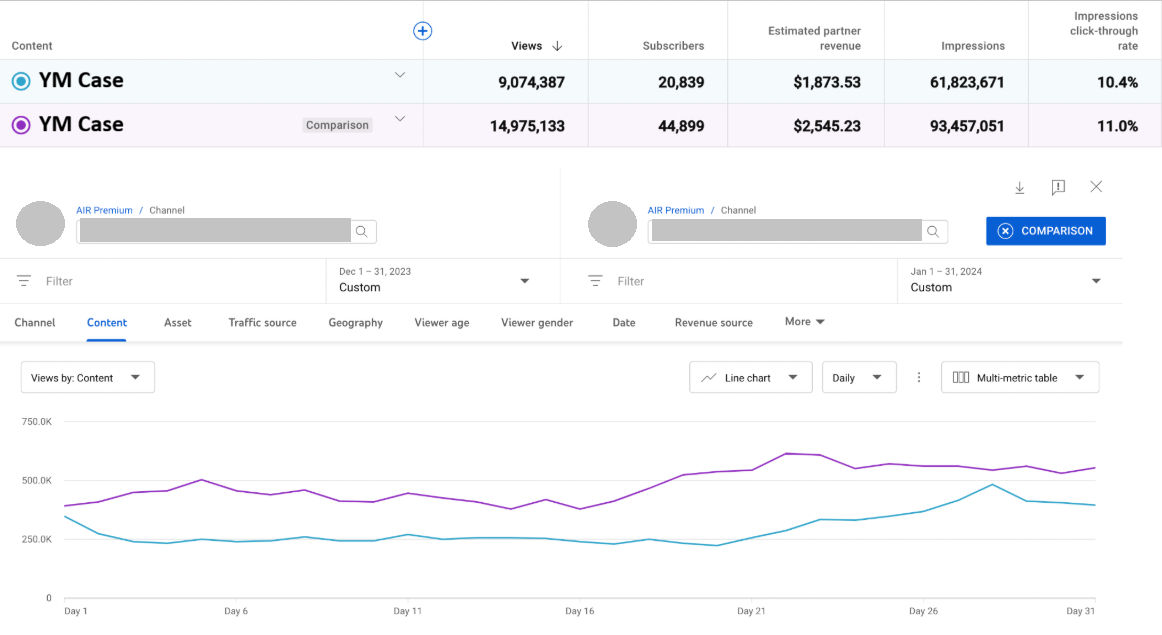
We can see that the next-month comparison showed a strong recovery:
|
Metric |
Before cleanup |
After cleanup |
Growth |
|
Views |
9.07M |
14.98M |
+65% |
|
Subscribers |
20.84K |
44.90K |
+115% |
|
Revenue |
$1,873.53 |
$2,545.23 |
+36% |
|
Impressions |
61.82M |
93.46M |
+51% |
|
CTR |
10.4% |
11.0% |
+0.6 pp |
After YM cleanup, the channel grew from 9.07M to 14.98M views month over month. Subscribers more than doubled, impressions rose by 51%, and revenue increased by 36%, showing that monetization cleanup can also support broader distribution recovery.
Shorts Feed traffic and recommendations also grew after the YM cleanup, showing that policy cleanup can support both monetization and distribution.
The lesson: Yellow Monetization should not be treated as a small backend issue. For kids’ channels, resolving YM at scale can restore revenue, improve channel health, and help YouTube re-evaluate the content as safer and more trustworthy.
The 2026 Workflow
The best workflow is not just “change thumbnails.” It is a structured trust signal audit.
|
Step |
What to do |
What to measure |
|
#1. Diagnose the drop |
Check Suggested, Browse, Shorts Feed, impressions, and new-upload pickup |
Traffic-source shifts, impressions, upload velocity |
|
#2. Compare surface metrics |
Review CTR, AVD, watch time, upload consistency, and revenue |
CTR, AVD, retention, revenue trend |
|
#3. Audit packaging |
Review thumbnails, titles, descriptions, and tags |
Exaggerated emotions, clickbait, mismatch, and keyword stuffing |
|
#4. Clean risky content |
Change, unlist, delete, or repackage weak catalog items |
Scary scenes, unsafe behavior, misleading concepts, YM patterns |
|
#5. Resolve monetization issues |
Fix the Yellow Monetization videos and appeal after improvements |
YM count, appeal success, restored revenue |
|
#6. Track recovery |
Watch Suggested, Browse, Shorts Feed, impressions, and revenue |
Distribution recovery, monetization recovery |
|
#7. Prevent recurrence |
Build internal rules for thumbnails, metadata, content, and YM checks |
Fewer repeat issues, stronger new-upload pickup |
For kids’ channels, growth is about making the whole channel look safe, honest, monetizable, and high-quality enough for YouTube to keep recommending it. Our kids channel experts can take a look at your channel and explain what needs to be changed. Just request a channel audit, and we’ll help you remove the blockers.
Tactic 2: Multilingual Expansion & MLA Audio Cross-Seeding
For YouTube Kids channels, the next growth market is often already inside the existing library.
The videos are there. The characters are there. The repeatable formats are there. What is missing is usually language access: the right audio, metadata, thumbnails, and channel structure.
That is why we treat multilingual expansion as a distribution tactic in 2026.
YouTube’s own product direction supports this. Multi-language audio lets you upload dubbed tracks to the same video, translated titles and descriptions help videos surface for viewers in other languages, and YouTube has also been piloting localized thumbnails. On average, YouTube says creators uploading MLA tracks saw more than 25% of watch time come from non-primary-language views.
But MLA is not the only option.
MLA vs. Localized Channels vs. Cross-Seeding
These are not competing strategies. The strongest kids’ networks use them together.
|
Model |
What it does |
Best use case |
What the data tells us |
|
Multi-language audio on main videos |
Adds dubbed tracks to one video URL |
Fast global testing, stronger shared video signals |
Works best when dubs keep or improve retention |
|
Separate localized channels |
Builds a full channel for one language or region |
Long-term market ownership, local brand presence |
Works when there is enough content volume and upload consistency |
|
MLA audio cross-seeding |
Reuses proven dubs across several channels/videos in the ecosystem |
Scaling winning languages faster |
Highest leverage because one dubbing asset can create views in multiple places |
The key thought: separate channels help prove demand, but MLA cross-seeding helps multiply that demand.
That is exactly what happened with Vania Mania Kids. AIR supported an ecosystem with localized channels in Spanish, German, Polish, French, Indonesian, Arabic, Turkish, and more. But one of the most valuable discoveries was reusing localized audio tracks across the ecosystem.
In one early test, Portuguese dubbing from a localized channel was added as an audio track to existing high-performing channels and generated nearly 5 million additional views in 6 months.
What We Learned From the Vania Mania Case
The Vania Mania data is useful because it shows three different outcomes from the same broader tactic: localization plus operational cleanup.
|
Channel |
Views change |
Revenue change |
Suggested traffic change |
What this actually means |
|
770M → 820M, +6% |
+23% |
+1% |
The main channel was already huge, so percentage growth was naturally smaller. The important signal is that revenue grew almost 4x faster than views, meaning monetization and language infrastructure improved. |
|
|
57M → 40M, -30% |
+393% |
32K → 3.75M suggested views, +11,568% |
This is the strongest proof that views alone can mislead. Total views fell because Shorts traffic dropped, but revenue exploded, and Suggested recovered from almost nothing. The channel became commercially healthier. |
|
|
31.7M → 43.5M, +37% |
+60% |
21.2M → 30.1M, +42% |
This is the cleanest localization-growth pattern: views rose, revenue rose faster, and Suggested grew faster than total views. YouTube was routing the channel better. |
The main conclusion: not every localized channel should be judged by raw views.
Vania Mania Indonesian is the best example. The channel lost low-efficiency traffic, recovered Suggested distribution, and made almost 5x more revenue. That is a traffic-quality shift.
The MLA Case: Retention is the Real Test
A separate Kids channel shows why MLA works only when the dub is good enough.
The team started with 5 videos and 11 test languages. After comparing “Views by Country” with “Audio Track Enabled,” the strongest languages were narrowed down. Then the team localized new premieres and around 70% of the back catalog, so viewers had more than one dubbed video to watch.
The result was 125.5M additional views in 5 months, with dubbed tracks generating more than 30% of total views.
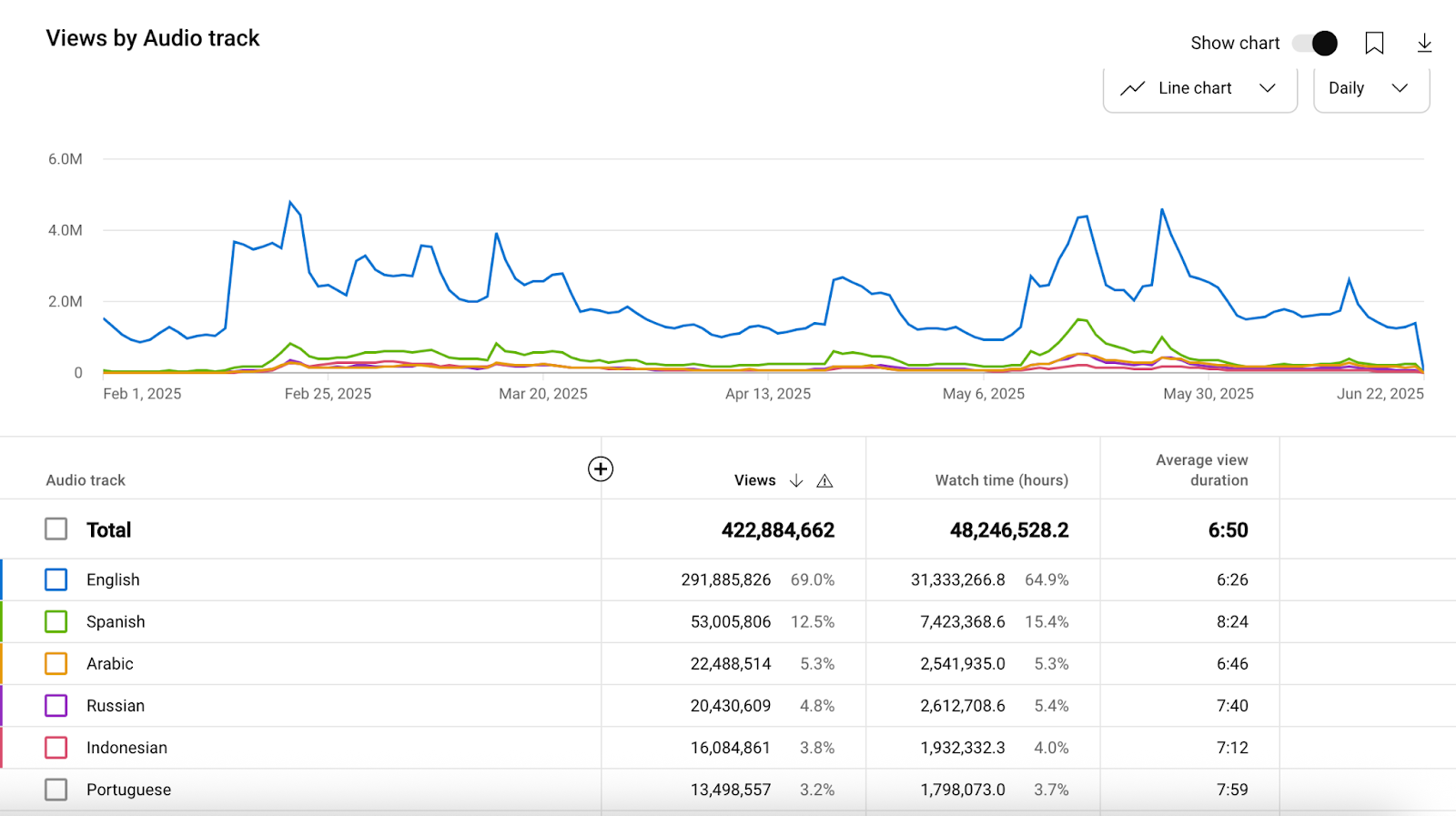
The most important numbers on this analytical snapshot are the average view duration:
|
Audio track |
Views |
AVD |
AVD vs English |
|
English |
291.9M |
6:26 |
Baseline |
|
53.0M |
8:24 |
+31% |
|
|
13.5M |
7:59 |
+24% |
|
|
16.1M |
7:12 |
+12% |
|
|
22.5M |
6:46 |
+5% |
So the takeaway is simple: the dubbed versions did not weaken retention — they improved it.
That means these viewers were not just clicking because the video was available in their language. They were watching longer because the localized version felt more natural and easier to follow.
For kids' content, that is crucial. If the dub feels wrong, children leave fast. Here, the opposite happened: several localized tracks became more engaging than the original English version.
Separate Localized Channels Still Create Huge Long-term Value
MLA is powerful, but it does not replace localized channels.
Separate channels still matter when a market is big enough to justify its own homepage, upload rhythm, playlists, metadata, thumbnails, and brand positioning.
Two AIR cases prove this clearly:
|
Case |
Localized scale |
Result |
What it proves |
|
52 dubbed channels |
7.67B views, 14.56M subscribers |
Localized channels can become a global content empire, not just side channels |
|
|
18 localized channels |
436.4M views, 1.02M subscribers |
Even smaller localized networks can produce major compounding growth |
Our partner Lady Diana averaged roughly 147M views per localized channel across the 52-channel network. This case shows what happens when localization is treated as a full-scale infrastructure play:
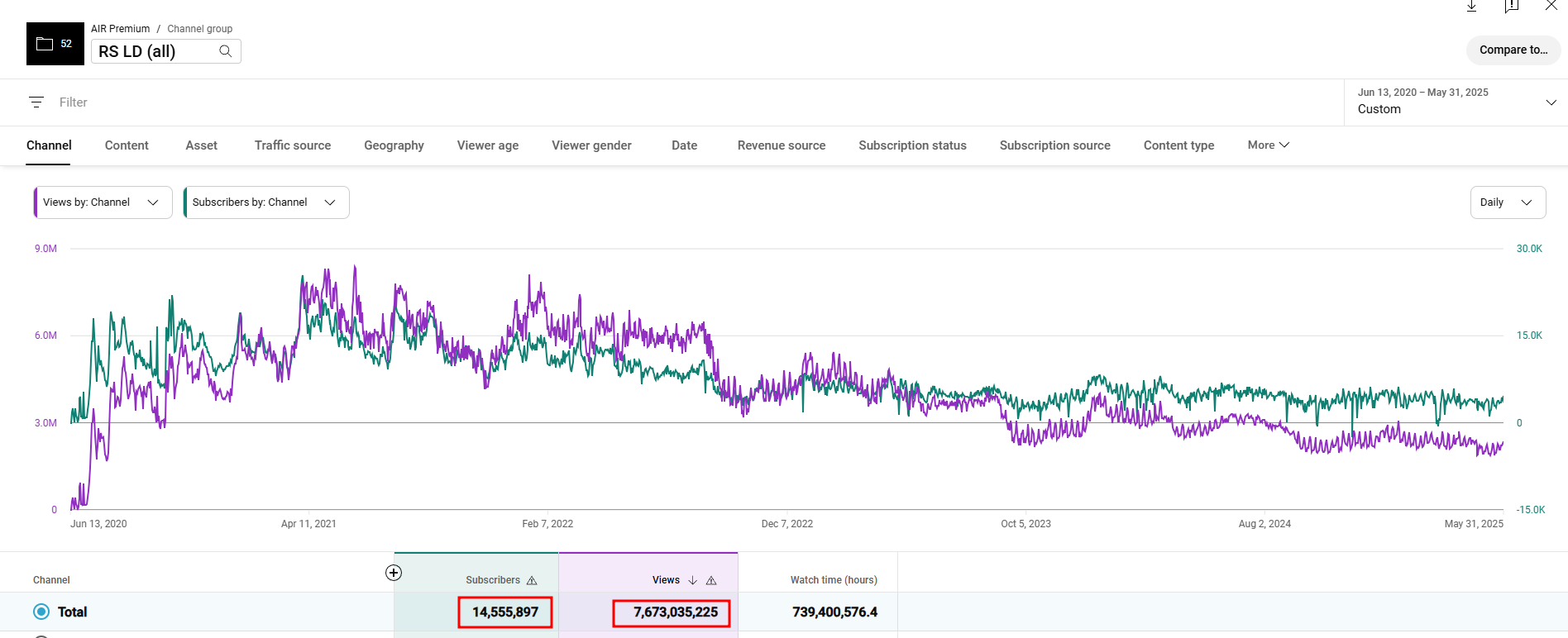
This data slice shows a full multilingual system that kept compounding over time. That is the real point: separate localized channels are not just extra distribution points. At scale, they become an entirely new layer of audience ownership.
Amelka Karamelka averaged roughly 24M views per localized channel across 18 channels. The averages are not the goal, because markets will never perform evenly. But they show the size of the opportunity when localization is treated as infrastructure.
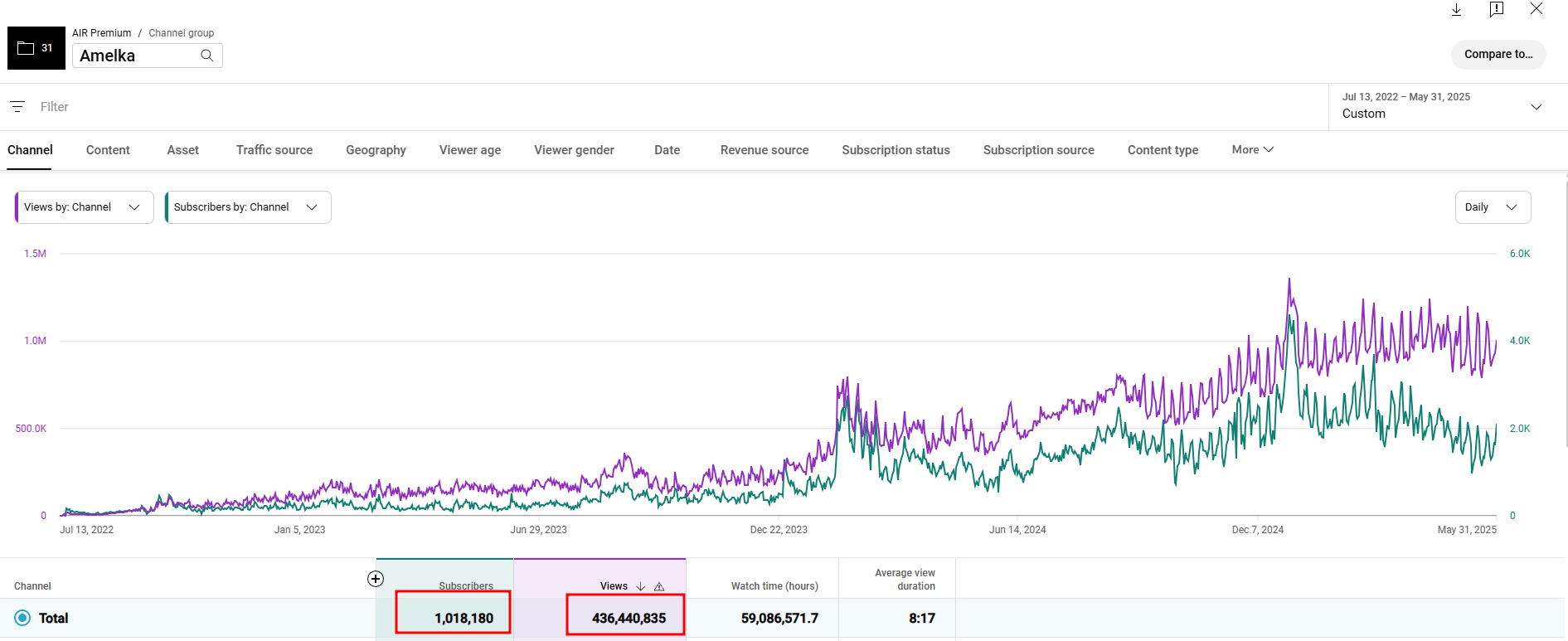
This is why the Amelka case is important. It proves that you do not need a 50-channel empire for the strategy to work. Even with a smaller localized network, the results still compound into hundreds of millions of views and more than a million subscribers. In other words, localized channel expansion is not only for the very biggest kids' brands. It can also become a serious long-term growth engine for creators operating at a lower scale.
Amelka's story has a new chapter. Its spinoff, Amelka Karamelka Dark Stories, became the first channel AIR placed on Tubi.
What we learned from working on these cases is simple:
MLA is best for fast distribution. Separate localized channels are best for market ownership. The strongest strategy uses both.
Not Every Language Has the Same Job
This localized kids’ network shows why creators should stop expecting every language to behave the same way.
At the portfolio level, views jumped from 24.1M to 299M in one quarter, a +1140% increase. Revenue grew from $6.1K to $29.5K quarter over quarter, but the mix changed completely: Portuguese became the largest revenue driver, while English lost share but still grew in absolute revenue.
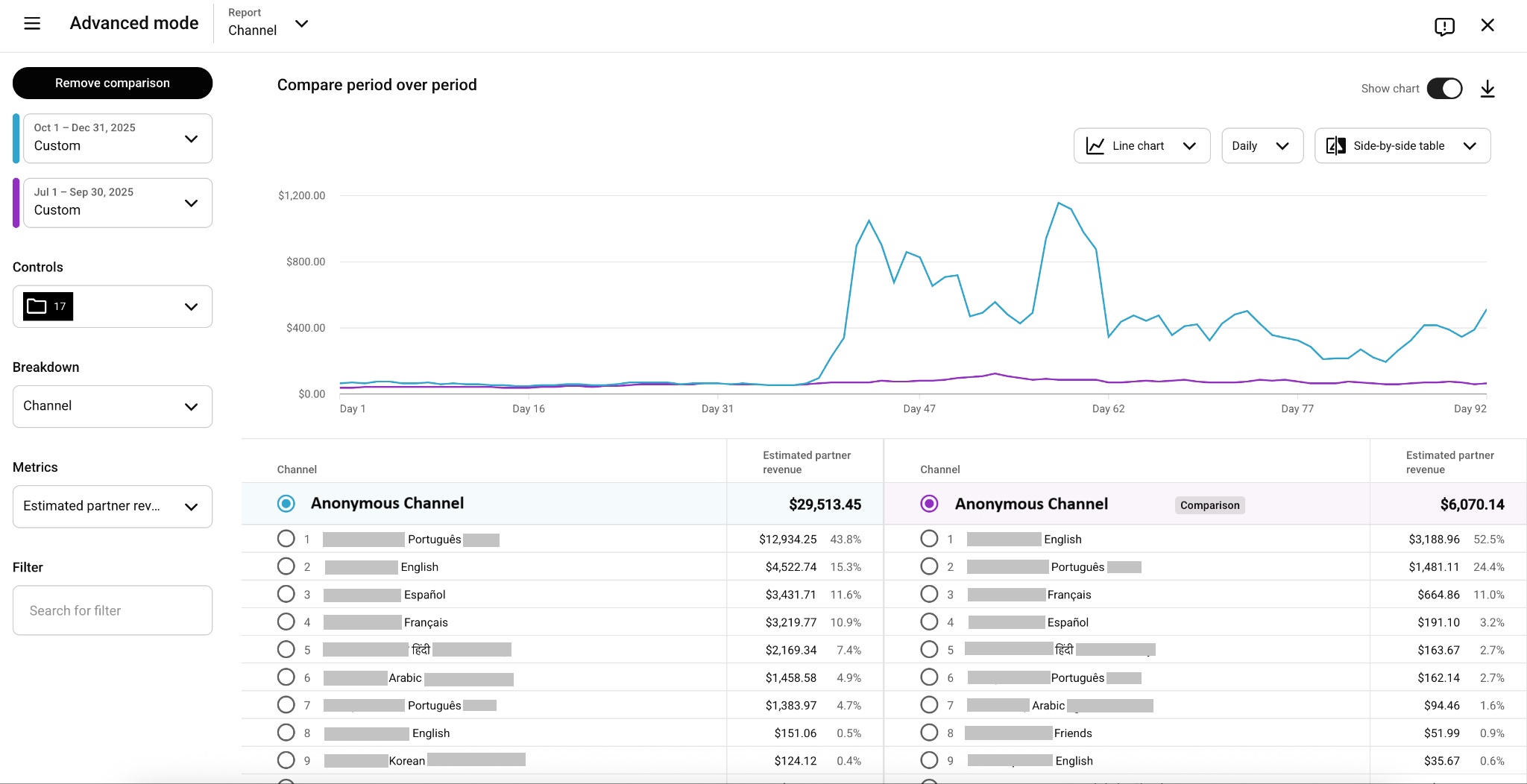
This shows that in the previous period, English was the biggest revenue contributor, generating over half of the portfolio’s revenue. In the next period, Portuguese became the top earner, generating almost 44% of the total. That does not mean English failed, but it means another market broke out harder and changed the whole portfolio structure.
That sounds like a simple success story, but the market-level data is more interesting.
|
Market |
Views |
Revenue Q3 → Q4 |
Revenue change |
What it means |
|
Total portfolio |
24.1M → 299M |
$6.1K → $29.5K |
+386% |
The whole network scaled, but growth came from different markets doing different jobs. |
|
Brazilian Portuguese |
+1962% |
~$1.5K → $12.9K |
+762% |
Reach engine and new revenue anchor. Views grew faster than revenue, but the market became the portfolio’s biggest earner. |
|
Spanish |
+703% |
$191 → $3.4K |
+1707% |
Best combined growth story: reach and monetization both improved dramatically. |
|
Hindi |
+216% |
$164 → $2.2K |
+1231% |
Monetization-efficiency story. Revenue grew far faster than views. |
|
French |
+22% |
$665 → $3.2K |
+385% |
High-value market. Small view growth, major revenue improvement. |
|
English |
-7% |
$3.2K → $4.5K |
+42% |
Fewer views, better commercial quality. Not a decline if revenue efficiency improves. |
The big takeaway: raw views do not tell the full story in a multilingual portfolio.
Portuguese was the reach engine. Spanish was the best all-around growth market. Hindi and French became monetization-efficiency plays. English lost views but still made more money, which means its audience mix became more valuable.
This is the main strategic lesson: In a multilingual kids’ portfolio, one market may be the reach engine, another may be the revenue engine, and another may be the retention engine.
The 2026 Workflow
The best workflow is sequential. Do not start by launching 20 channels blindly.
|
Step |
What to do |
What to measure |
Decision |
|
#1. Pick proven videos |
Start with videos that already have strong retention and broad visual appeal |
Current AVD, CTR, Suggested traffic |
Only localize videos that already work |
|
#2. Test several languages |
Launch MLA/subtitles across 5–7 likely markets |
Views by audio track, AVD by track, geography |
Find languages with real demand |
|
#3. Separate winners from maybes |
Rank languages by retention, watch time, and monetization |
AVD, RPM/revenue, repeat viewing |
Decide which languages deserve full dubbing |
|
#4. Localize the back catalog |
Build a viewing path, not a single dubbed video |
Session depth, Suggested/Browse growth |
Scale only when viewers can keep watching |
|
#5. Cross-seed winning tracks |
Add proven dubs across other channels/videos in the ecosystem |
Incremental views, Suggested traffic, AVD |
Reuse audio assets where they can compound |
|
#6. Build separate channels where justified |
Launch full localized channels for strong markets |
Subscribers, returning viewers, and local search |
Turn language demand into brand presence |
YouTube’s automatic dubbing can help with broader access and testing, but creator-uploaded MLA tracks still matter because quality, tone, pacing, and character emotion are especially important in kids’ content. YouTube notes that auto-dubbed tracks are marked as such, and creator-uploaded multi-language audio is a separate workflow.
Want to grow beyond one language?
AIR helps kids’ creators scale through dubbing, MLA audio, localized channels, and hybrid strategies. Contact us to find the strongest language markets for your content.
The Takeaway
Multilingual expansion is a system. The cases point to the same conclusion:
So, the practical formula for 2026 is:
Test languages on proven videos → localize enough back catalog to support sessions → build full localized channels for the strongest markets → use MLA to consolidate video signals → cross-seed winning tracks across the ecosystem.
Tactic 3: The 24/7 Live Streaming Revenue Multiplier
Live streaming is a massively underutilized tool in the kids' niche. Running 24/7 streams of pre-recorded evergreen content creates constant channel activity, pushing the channel higher in Browse features and Recommendations.
A kids’ channel does not always need more new videos to grow. Sometimes it needs a better way to repackage and continuously redistribute the library it already has.
That is exactly what 24/7 live streaming does when managed correctly.
It turns existing videos into always-on programming blocks: themed compilations, character marathons, seasonal streams, language-specific loops, and playlist-style broadcasts that keep viewers watching longer. For kids’ channels with evergreen content, this can become a major revenue multiplier.
What the Kids Cases Show
Across our cases, live streaming produced three different kinds of growth:
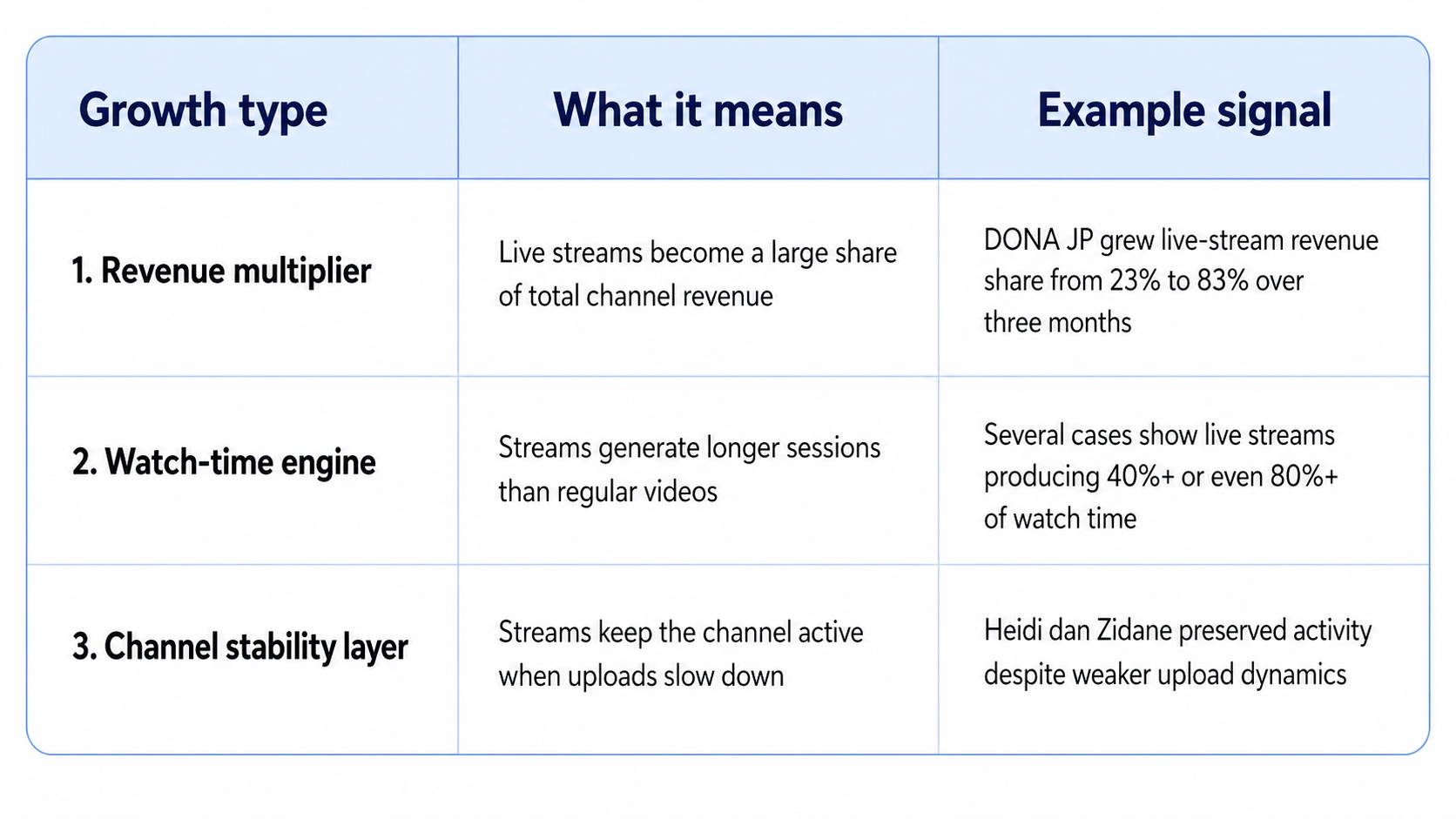
The most important point: live streams do not work only when they generate views directly. They also work when they create enough activity for YouTube to start routing more traffic to regular videos.
That is why the best streaming strategy is operational: choose the right content blocks, optimize titles and thumbnails, restart streams on schedule, monitor drop-offs, and use streams to support the whole channel.
When Live Streams Become the Main Revenue Layer
The DONA cases are some of the clearest examples of how quickly live streaming can change the revenue structure of a kids’ channel.
|
Channel |
Stream setup |
Result |
What it proves |
|
4 simultaneous streams |
After only 10 days, live streams reached 20% of total revenue. In September, they reached 60%. October was forecast at 72%. |
Streams can become a major revenue layer almost immediately when the catalog and audience are ready. |
|
|
4 simultaneous streams |
From July to September, live streams generated almost 49% of total revenue. Overall channel revenue increased by 20%. |
Localized kids’ channels can use streams as a major monetization stabilizer. |
|
|
5 simultaneous streams |
Live revenue share grew from 23% in July to 69% in August and 83% in September. Total revenue increased almost 6x. |
When the audience responds, live streams can become the dominant business model of the channel. |
The DONA JP case is especially important. From June to September, live streams generated 62.6% of estimated partner revenue, even though they accounted for 51.7% of total views. The stronger signal is watch time: live streams produced 80.7% of total watch time, with an average view duration of 7:14, compared with 1:57 for regular videos.
In three months, live streams moved from a supporting format to the main revenue driver.
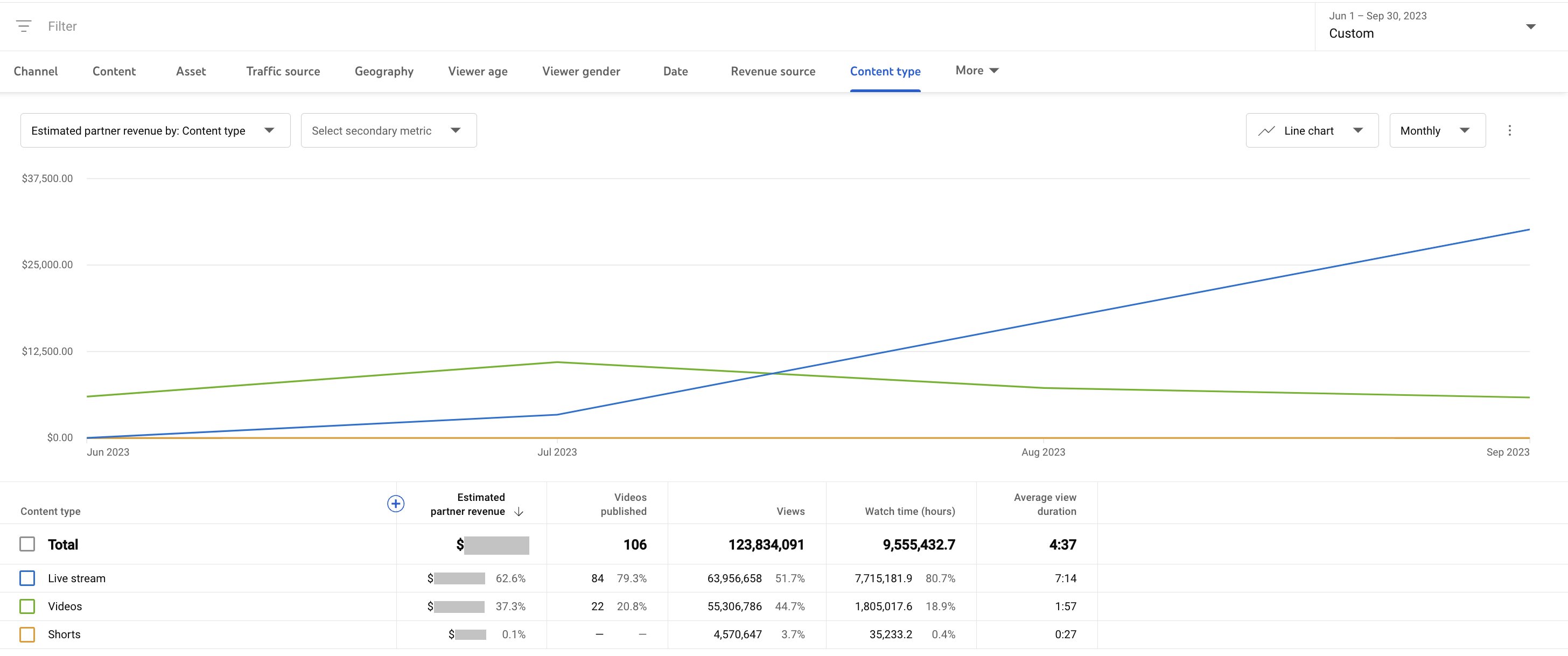
The takeaway is: This is the clearest proof that, for the right kids’ content library, 24/7 live streaming can become the channel’s main watch-time and revenue engine.
Streams as a Stability Layer
The Heidi & Zidane network shows another important pattern: streams are not only useful during growth periods. They also help when the broader channel dynamic slows down.
|
Channel |
Live-stream result |
What it means |
|
In the first year, live streams averaged around 4% of total revenue. In 2023, they generated more than 38%. |
Streams became much more important as the channel’s overall dynamics declined. |
|
|
In 2023, live streams generated more than 34% of total revenue. |
A large localized kids’ channel can use live streams as a durable revenue layer. |
|
|
In 2023, traffic split into Videos 43%, Shorts 29%, and Live streams 27%, but live streams generated more than 55% of revenue. |
Live streams may monetize far better than their raw traffic share suggests. |
The strongest pattern here is watch-time efficiency.
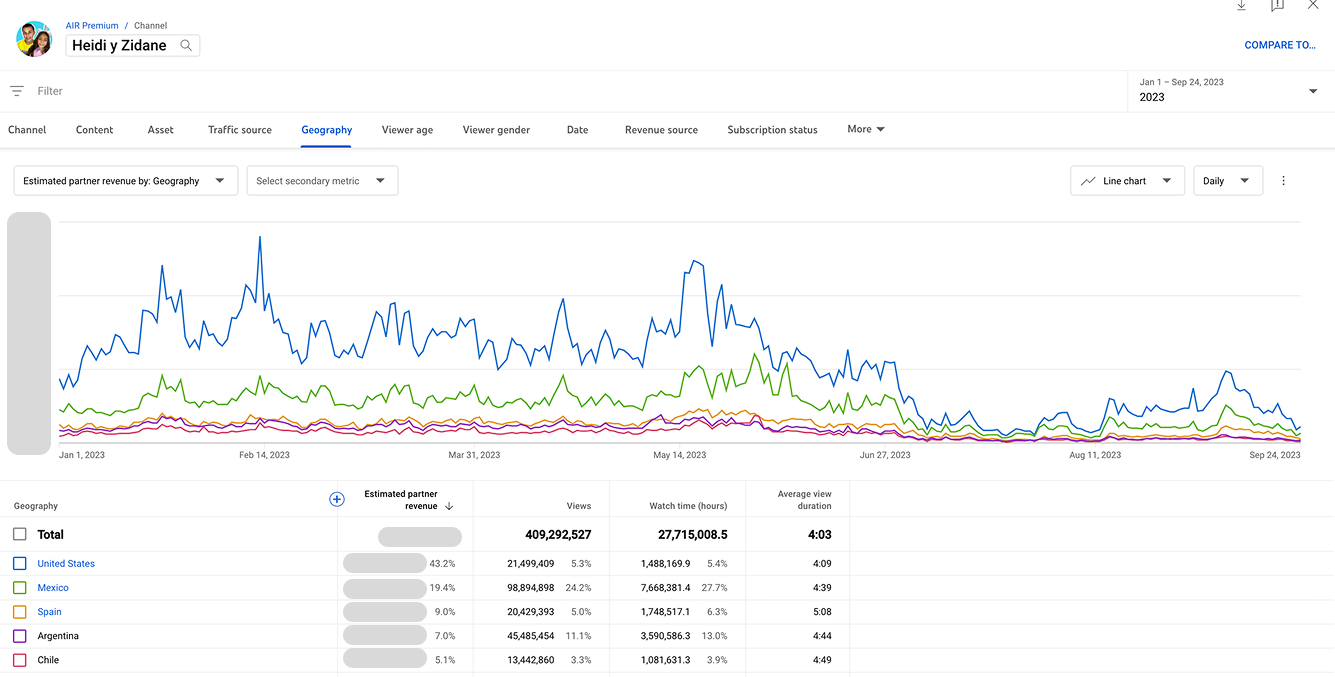
On Heidi y Zidane, regular video uploads accounted for 78.2% of views but only 57.8% of watch time, with an average view duration of 3:00. Live streams, meanwhile, generated only 18.4% of views but drove 41.9% of watch time, with a much stronger average view duration of 9:15.
The Arabic Heidi & Zidane case makes the same point even more clearly. Live streams accounted for 27% of traffic, but generated more than 55% of revenue. In other words, live did not need to win on views to win on monetization.
The takeaway is simple: 24/7 streams are not just a growth hack. They are a resilience tool. When views become less predictable, streams can protect watch time, strengthen monetization, and keep a kids’ channel commercially healthy.
Live Streams as a Recommendation Trigger
Toy For Kids [토이포키즈] shows one of the most important strategic effects of 24/7 streaming: live traffic can strengthen the performance of regular videos, not just generate its own separate views.
![A YouTube Analytics screenshot of Toy For Kids [토이포키즈] that shows a before-and-after comparison of watch time.](/storage/DqT8LzJXoeKLG9rpziN46HvRneQUsdK4wHwRAPlz.png)
In a side-by-side comparison of two similar periods — before streams (June 30–August 14, 2022) and with streams (August 15–September 29, 2022) — the channel improved across every major metric. Total views rose from 50.2M to 76.7M, an increase of 26.5M+. Watch time climbed from 2.72M hours to 4.24M hours, adding 1.52M+ hours. Impressions jumped from 200.7M to 331.9M, a gain of 131.2M+.
![A YouTube Analytics screenshot of Toy For Kids [토이포키즈] that shows a before-and-after comparison of views.](/storage/VTg37W0a13NPnIbhiLlW36PVDHiMaRrjd7aiiCOx.png)
The improvement was not driven only by direct stream traffic. In the “with streams” period, live streams accounted for just 4% of total views (3.07M), 6.3% of total watch time (265.8K hours), and 31.4M impressions. That means the majority of the channel’s performance still came from regular videos. But after live streams were introduced, the whole channel performed better. Regular videos received stronger overall distribution, suggesting that live activity helped create the kind of channel-wide momentum YouTube could respond to.
This is the real mechanism behind the case: live streams create constant audience activity, which strengthens engagement signals across the channel, and regular videos then gain more recommendation opportunities. In other words, live streaming was not separate from the VoD strategy. It acted as a trigger that helped push the broader library back into circulation.
For kids’ channels with large evergreen catalogs, this is extremely powerful. It means 24/7 streams can do more than monetize existing content. They can help re-activate the recommendation system around the whole channel and give regular uploads a stronger starting push.
Live Streaming Is Not One Strategy. It Has Several Models.
The cases show that there is no single correct number of streams.
|
Model |
What it does |
Best use case |
Risk |
|
1 stream |
Adds stable background activity without taking over the channel |
Channels with strong VoD performance that want extra watch time |
Growth may be limited |
|
3–5 streams |
Creates a full, always-on programming layer |
Large kids' channels with deep libraries |
Requires active optimization and restart discipline |
|
6–8+ streams |
Makes live streaming the dominant channel format |
Channels with rare uploads or highly loopable content |
Can cannibalize VoD if unmanaged |
|
Short-cycle streams saved as public videos |
Uses live as both stream and long-form archive |
Music, compilations, and some evergreen kids formats |
Archive quality must remain high |
Most successful kids' cases use 4–5 simultaneous streams. That appears to be the strongest middle ground: enough volume to cover multiple themes, but not so much that the channel becomes chaotic.
However, the right number depends on the channel’s structure:
- If regular videos are still strong, live should support them.
- If uploads are rare, live can become the main programming layer.
- If the channel is localized, live can help test whether the market has enough repeat viewing.
- If Shorts traffic is unstable, live can create longer sessions and more predictable revenue.
The 2026 Workflow for Kids’ Channels
The best live-streaming workflow is not “launch 24/7 and hope.” It is sequential.
|
Step |
What to do |
What to measure |
Decision |
|
#1. Audit the library |
Find evergreen videos with strong retention and low compliance risk |
AVD, retention curves, topic safety, visual clarity |
Only stream videos that can work out of context |
|
#2. Build themed streams |
Group content by character, topic, language, or viewer intent |
CTR, concurrent viewers, average view duration |
Keep themes that hold viewers longest |
|
#3. Start with controlled volume |
Launch 1–4 streams depending on channel size |
Live views, revenue share, watch time share |
Scale only if streams add traffic without damaging VoD |
|
#4. Optimize packaging |
Test stream titles, thumbnails, descriptions, and compilation order |
CTR, impressions, Suggested/Browse traffic |
Treat streams like videos, not technical loops |
|
#5. Restart strategically |
Refresh streams every few days or when activity declines |
Concurrent viewers, traffic decay, revenue drops |
Restart before the stream becomes stale |
|
#6. Route traffic back to VoD |
Use pinned content paths, playlists, end screens where available, and channel structure |
VoD views after stream growth, impressions, and returning viewers |
Make live support the full channel |
|
#7. Segment by market |
Use separate streams for strong languages or regions |
Geography, RPM, revenue share, watch time |
Build local live programming for high-value markets |
That is how a kids’ channel turns an existing library into an always-on revenue engine. Our team can set 24/7 streaming up for you. Show us your content, and we’ll find the best-fitting strategy.
Tactic 4: Getting on the YouTube Kids App
Getting into the YouTube Kids app is not just a visibility bonus. For the right kids’ channel, it can become a separate growth engine.
The reason is simple: Competition is lower, the audience is more targeted, and the platform is built specifically around safe, age-appropriate children’s content. But access is not automatic. Channels need to meet strict safety, quality, and age-appropriateness standards before they can benefit from this traffic source.
Why YouTube Kids Matters in 2026
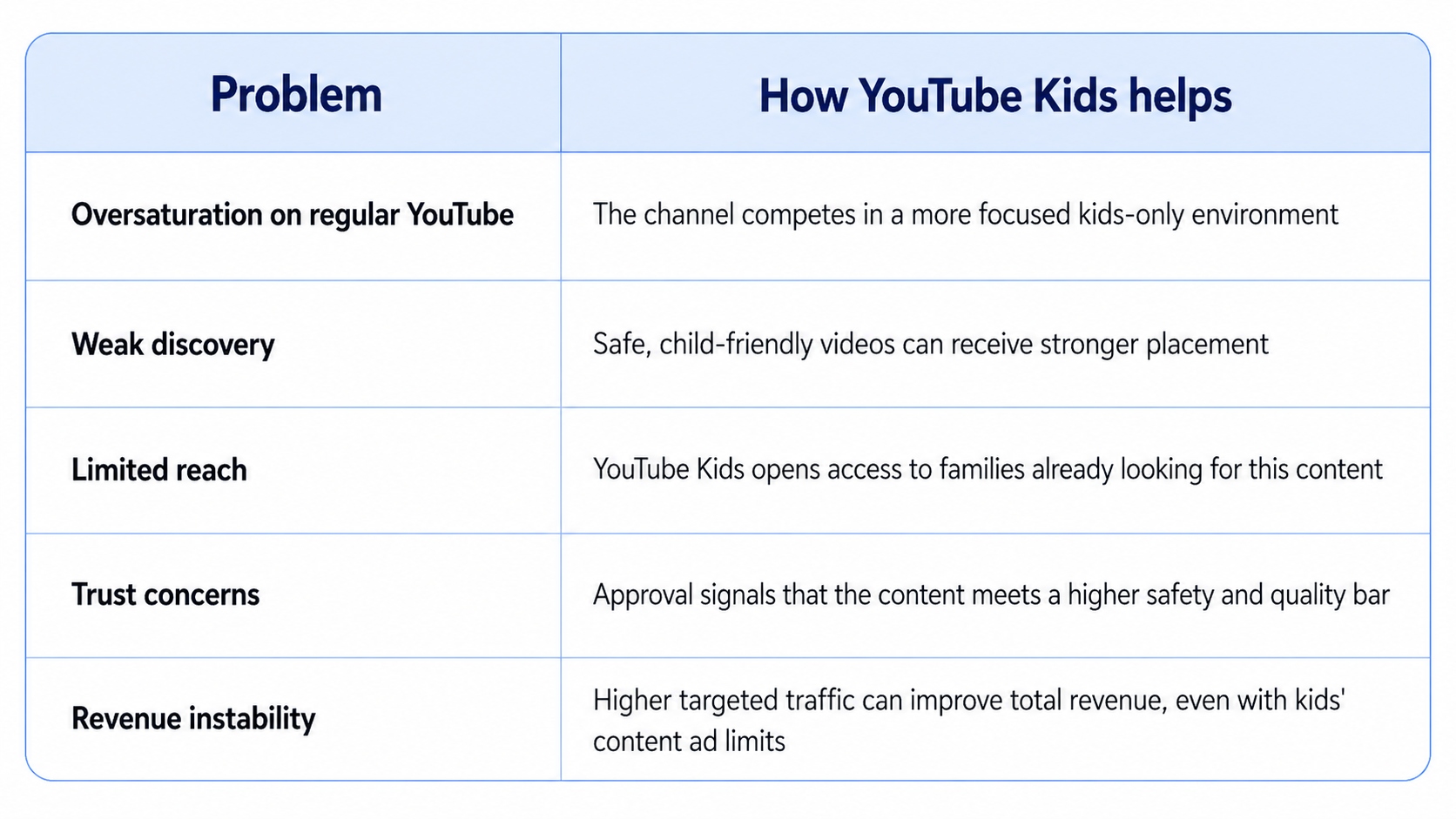
For kids’ creators, the YouTube Kids app can solve several common growth problems:
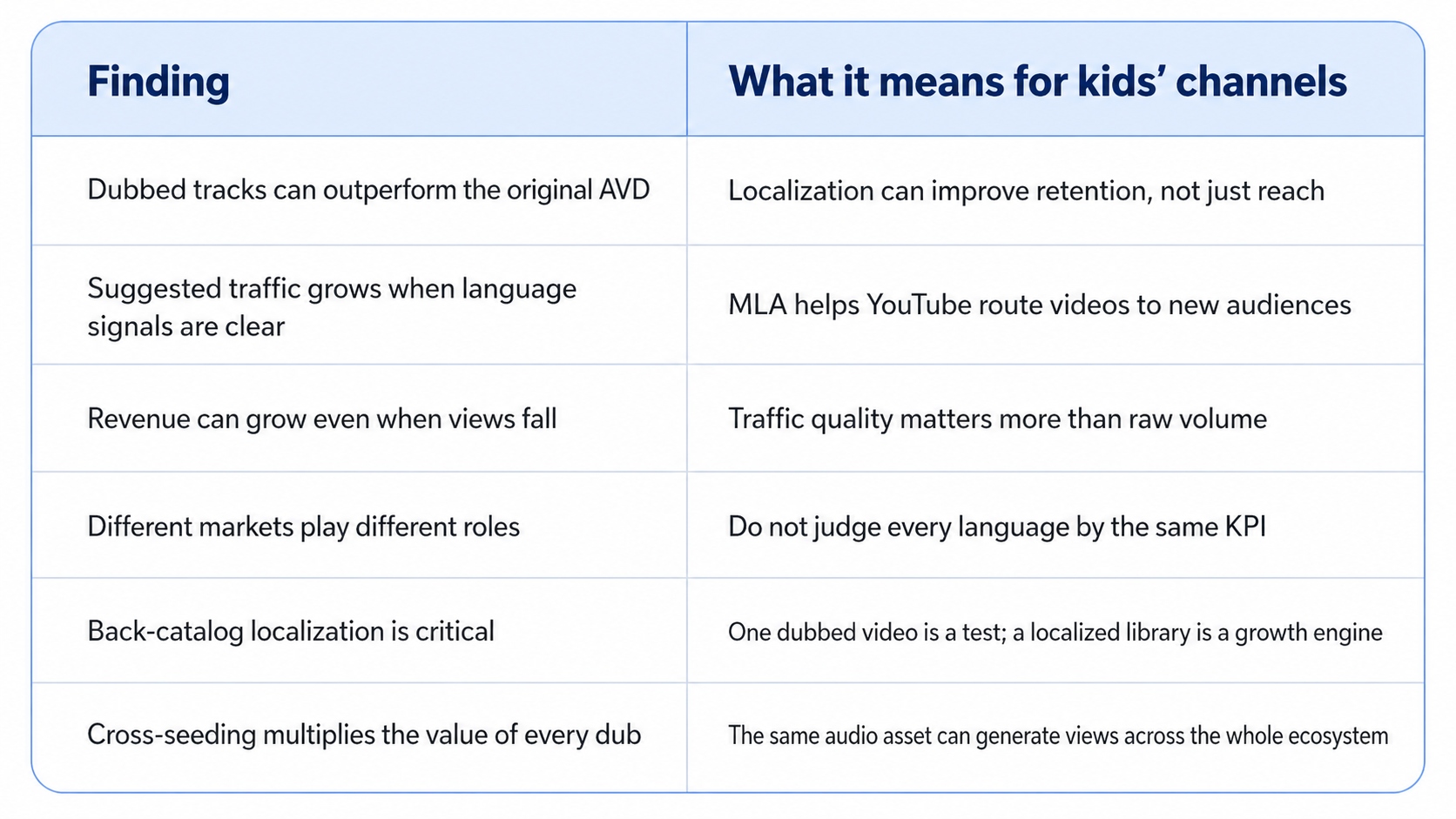
The key is that YouTube Kids is not just another traffic source. It is a quality-filtered distribution layer.
YouTube Kids Access + Shorts Growth
PlayToys and Play Dolls, two large kids channels, had the same problem: they were not appearing in YouTube Kids, had no Shorts activity, and growth was flatlining.
AIR flagged the issue to YouTube’s internal review team. About a week later, YouTube confirmed that the channels had been forwarded to the YouTube Kids team for evaluation on safety, quality, and age-appropriateness. By June 18, the channels were searchable in YouTube Kids and appeared as linked suggestions under other videos.
Once access was fixed, AIR launched Shorts as the next growth booster.
|
Channel |
Engaged views |
Total views |
Watch time |
Avg duration |
|
503K |
877K |
3.9K hours |
0:27 |
|
|
161K |
301K |
1.4K hours |
0:30 |
This came from zero Shorts activity before April 2025. YouTube Kids access can solve discoverability, while Shorts can reactivate momentum once the channel is visible again.
YouTube Kids Became the Main Traffic Driver
Baby Ben en Español already had a loyal family audience, but needed stronger reach and revenue growth.
AIR applied for YouTube Kids. One month later, the channel was live in the app.
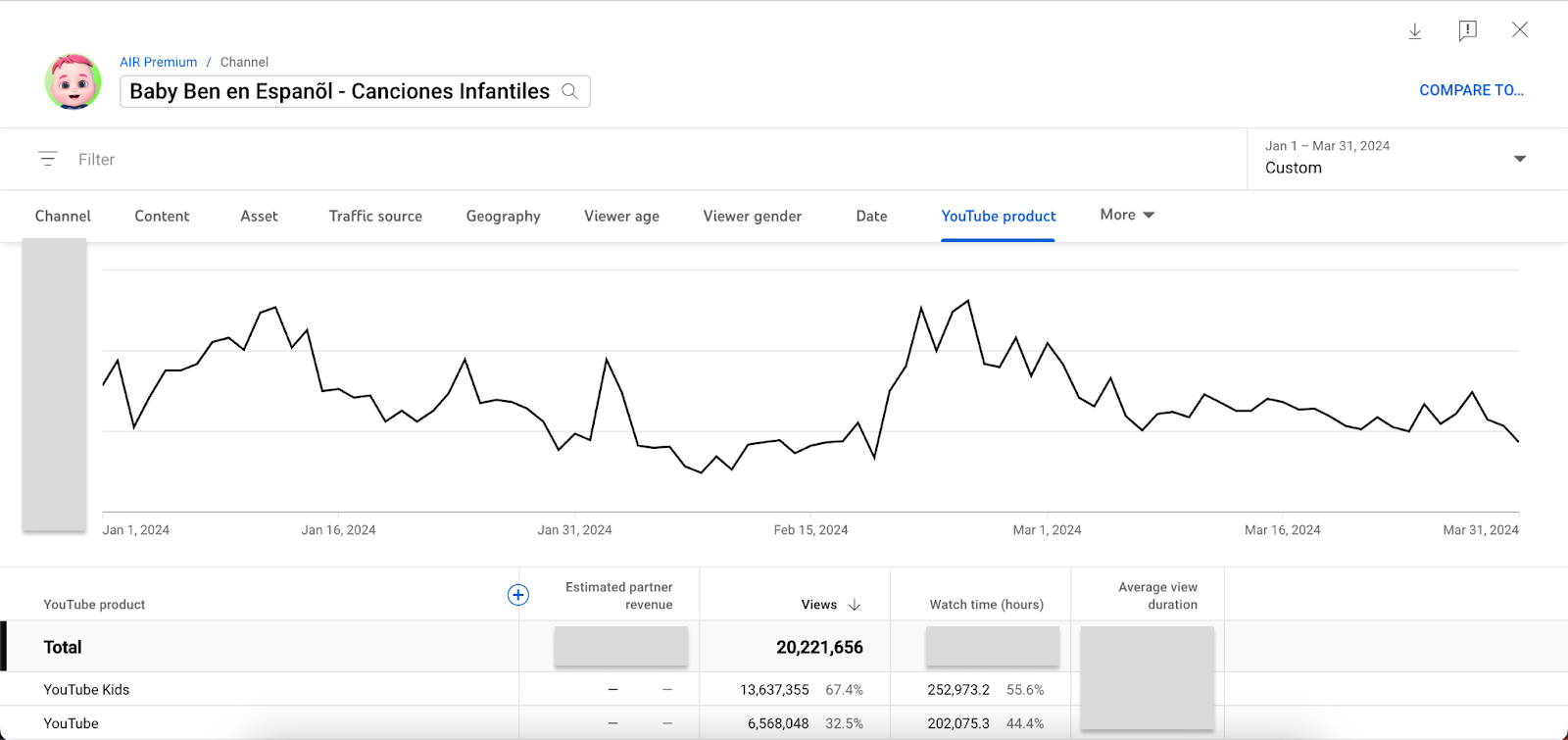
The result was immediate:
- Monthly views (+396%)
- Revenue (+110%)
- Quarterly views from YouTube Kids (67.4% of traffic)
The longer-term result was even stronger: compared with the previous quarter, total views increased by 456%, and revenue grew by 437%.
This case shows what happens when the app becomes the channel’s main discovery environment, not just an extra source.
Smaller Localized Channels Can Win on YouTube Kids Too
The YouTube Kids opportunity is not limited to the largest channels.
Baby Ben em Português was approved in January 2024. After approval, quarterly views grew from 968K to 2.3M, a 142% increase. Revenue grew by 456%, and YouTube Kids accounted for 35.3% of total views.
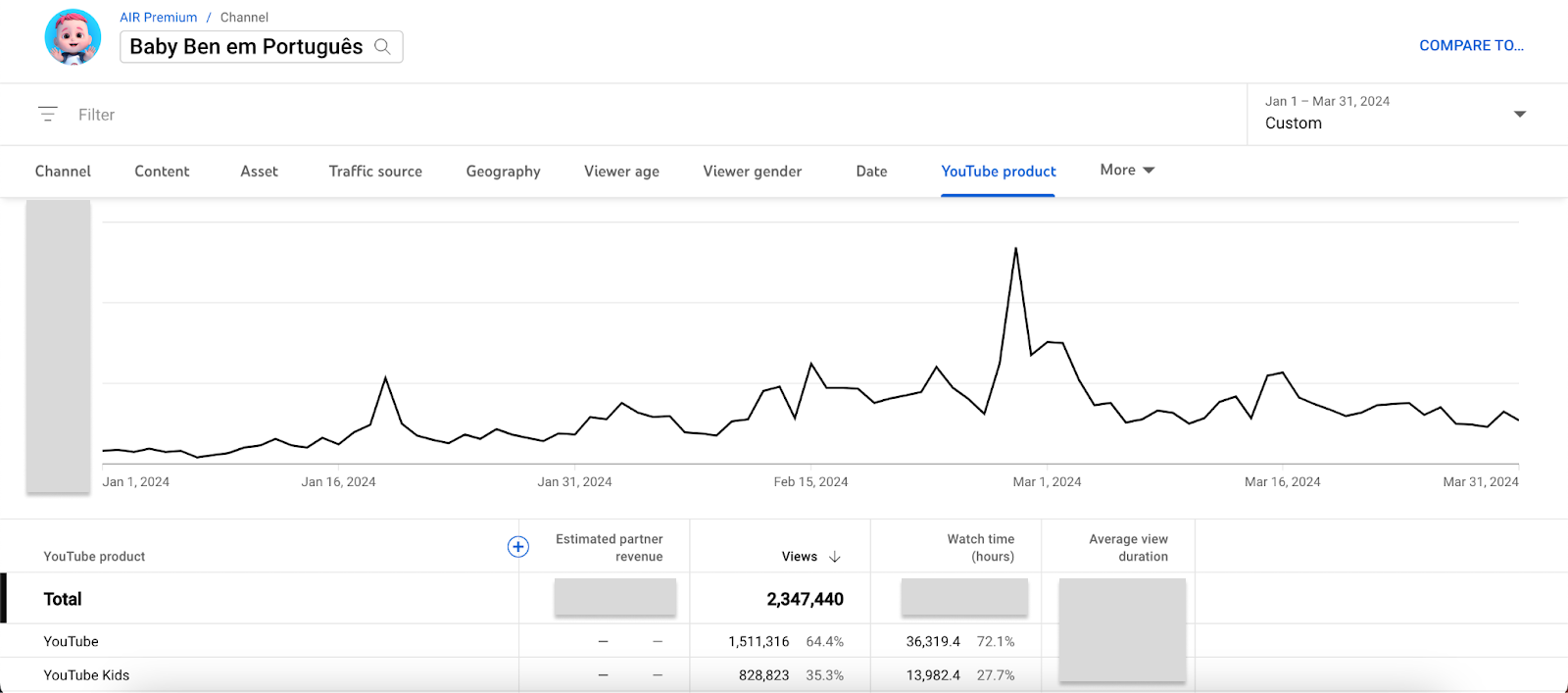
BIBO TOYS PRT saw an even sharper jump: monthly views grew from 262K to more than 5.1M after getting into YouTube Kids, a 1859% increase. Revenue grew by 253%, and YouTube Kids generated 78.3% of total quarterly views.
The takeaway: YouTube Kids can be especially powerful for localized channels because it gives them a cleaner path to families in a specific language market.
When YouTube Kids Becomes a Dominant Discovery Engine
BIBO TOYS was approved for YouTube Kids in January 2024, and the effect was immediate.
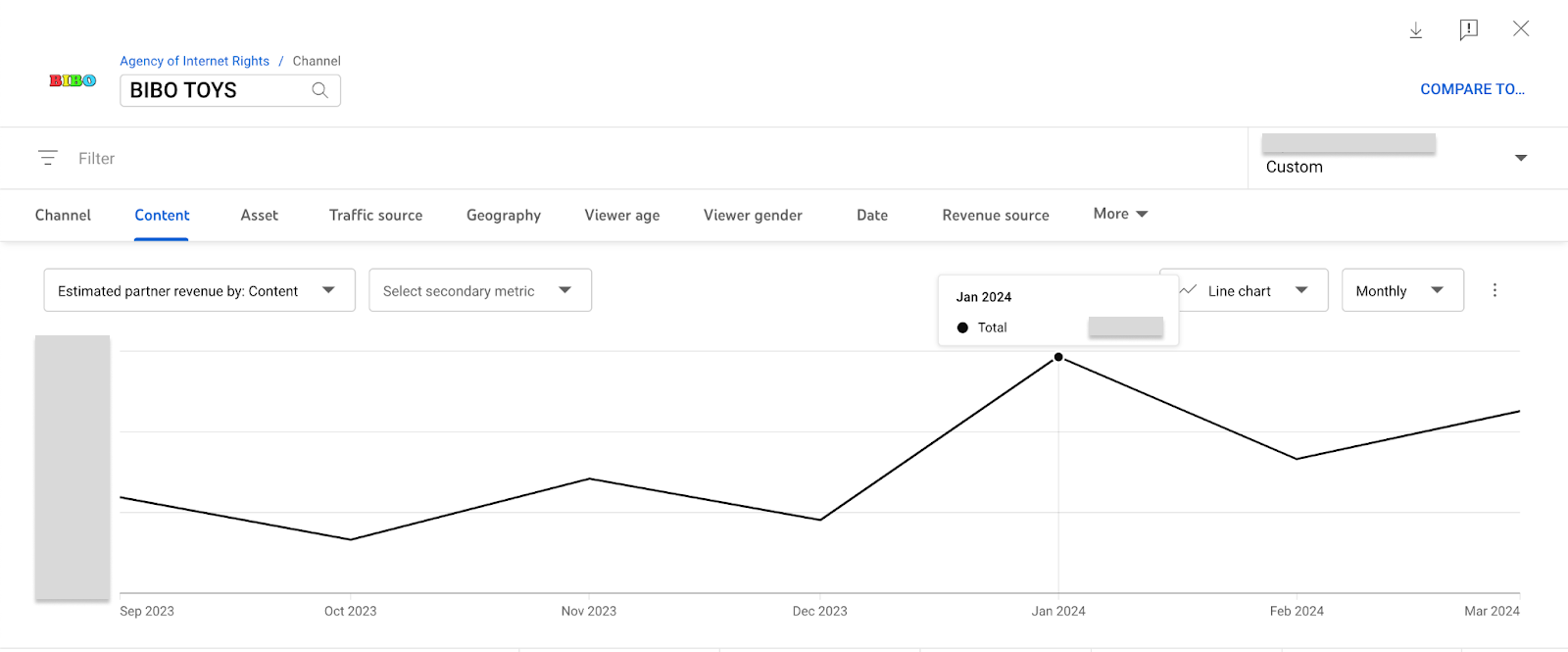
Monthly views grew from 10.3M in December to 73.4M in January, a 609% increase. Revenue grew by 227%. In the following quarter, YouTube Kids drove 67.7% of total views, with 120M views coming from the app.
This case shows that for strong kids-content libraries, YouTube Kids can become the main discovery layer.
How to Get Your Channel on the YouTube Kids App
To get into YouTube Kids, the channel has to meet safety, quality, and age-appropriateness standards, and the application process can be difficult to navigate without the right preparation.
YouTube evaluates channels against a specific set of criteria before approving them.
- Content must be genuinely made for children. Not adult content that happens to feature kids, and not misleadingly labeled.
- Thumbnails, titles, and video content must avoid sensational imagery, exaggerated emotions, clickbait framing, and anything that could be considered manipulative or unsafe for young viewers.
- The channel's overall catalog matters. A few weak or borderline pieces can affect how the whole channel is evaluated.
- Metadata must accurately reflect what the video contains, and the channel must have a consistent track record of uploads that meet kids' content quality expectations.
- Channels that have unresolved Yellow Monetization flags, active policy issues, or a history of misleading packaging are unlikely to pass without cleanup first.
AIR’s Getting on YouTube Kids service is built to handle this process from audit to approval.
Here is how the process goes:
- Content analysis — AIR reviews the channel to check whether the videos meet YouTube Kids requirements.
- Tailored recommendations — the team gives specific guidance to align content with YouTube Kids standards, including safety, quality, and engagement for young viewers.
- Application management — once the channel is ready, AIR manages the approval process to help get the channel accepted into YouTube Kids.
- Post-approval optimization — after the channel goes live, AIR helps optimize for stronger visibility, more views, and higher revenue.
You can keep focusing on content, while AIR handles the compliance, review, and application process needed to open the door to YouTube Kids.
Not Sure What’s Blocking Your Kids’ Channel? AIR Will Find It
In 2026, growing a kids’ channel is about building the right system: multilingual distribution, 24/7 live streaming, trust-signal cleanup, manual escalation when something breaks, and YouTube Kids app visibility.
That is exactly what AIR Media-Tech helps kids’ creators do.
We can help you:
- Find hidden algorithmic and compliance issues.
- Improve thumbnails, metadata, and catalog quality.
- Resolve Yellow Monetization and policy flags.
- Launch multilingual growth through dubbing and MLA.
- Build 24/7 live-streaming revenue systems.
- Escalate serious traffic problems to YouTube.
- Prepare and submit your channel for YouTube Kids.
If your kids’ channel is stuck, losing recommendations, missing YouTube Kids visibility, or not monetizing properly, reach out to us. We’ll help you find the bottleneck and build the next growth step.