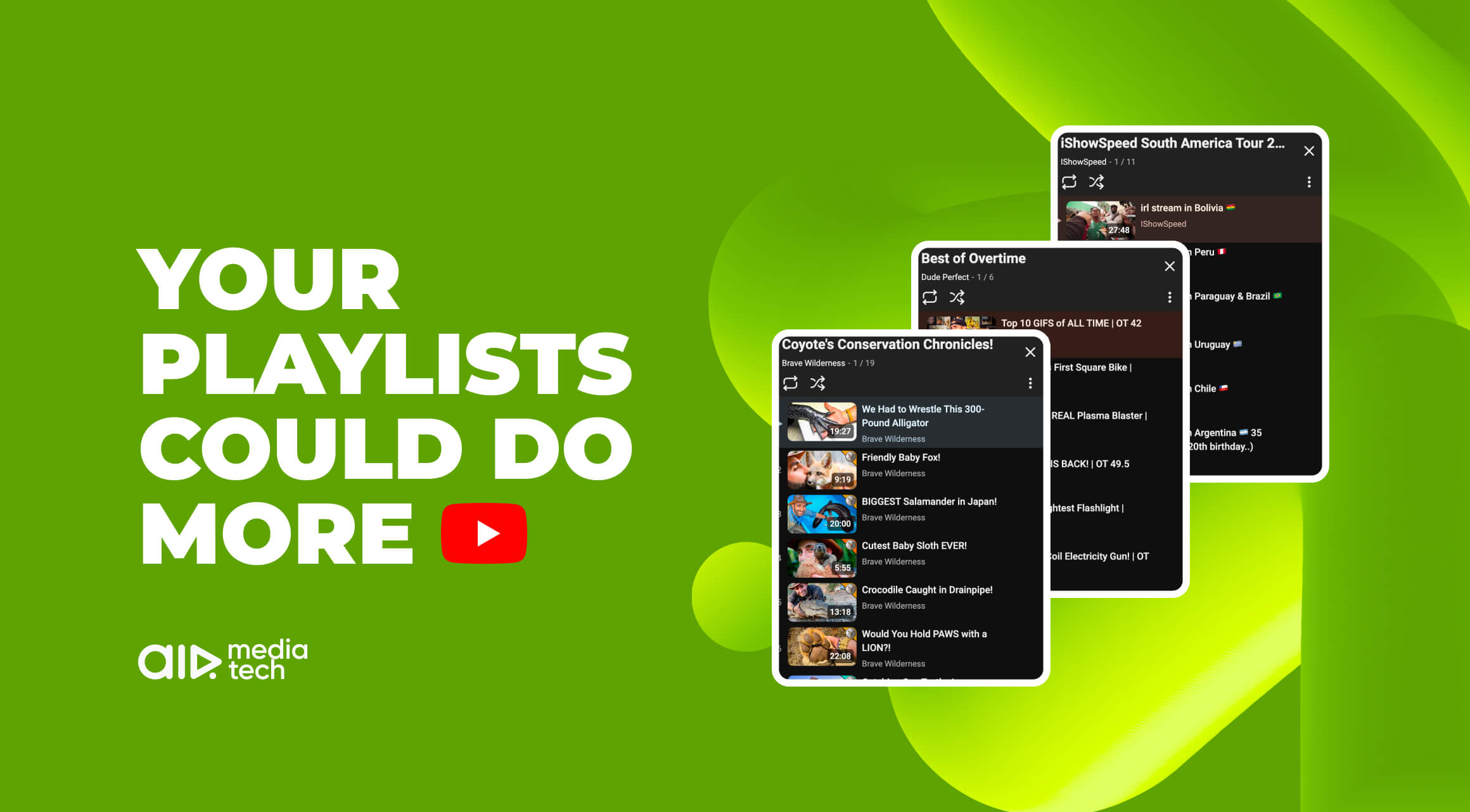

YouTube playlists are a sequence of videos that play automatically one after another. A well-structured one can keep viewers on your channel. The best sequence can be done in under 3 minutes. Stay tuned to learn how to build a YouTube playlist, what determines whether the playlist builds watch time and session depth, and how channels with structured playlists see 15-36% longer session times across the channels in AIR Media-Tech audits.
Cases When YouTube Playlists Were Done Right
The Melobies, a kids' channel audited by AIR, had playlists that weren't guiding viewers from one video to the next. After restructuring by theme (alongside thumbnail, metadata, and 24/7 streaming changes), the channel grew 917% in subscribers. Playlists alone didn't drive that number. But unstructured playlists were actively suppressing session depth on a channel where content quality was already strong.
The legal channel case ran in parallel: structural work that included adding internal playlist links to improve session flow produced +175% watch time in two months. Again, not playlists alone, but playlists as part of a system that was fixed.
What Is The Best Playlist Structure to Drive Watch Time?
Playlists are either a viewing funnel or a storage folder. Structured ones — sequenced by type, not chronology — hold viewers 15–36% longer per session across AIR's audited channels.
The Four Playlist YouTube Types and How to Sequence Each
|
Playlist type |
Sequence logic |
Thumbnail strategy |
Ideal length |
|
Educational series/course |
Problem-awareness order: broad → specific → deep dive |
Step number or topic name visible at thumbnail size |
8–15 videos per module; split into modules if longer |
|
Best-of/Start Here |
Highest CTR first, then highest AVD, then recent strong performers |
Your best-performing thumbnail or a custom-branded image |
10–20 videos max |
|
Evergreen topic library |
Most popular first (algorithmic sort), manual refinement quarterly |
Consistent visual style across thumbnails in the list |
20–40 videos; split by sub-topic when it exceeds that |
|
Narrative/vlog series |
Strictly chronological — Episode 1 plays first |
Episode number in the corner. Consistent series branding |
No limit, but each episode should have a standalone hook |
The Playlists’ Binge Mechanism: How to Make Autoplay Work for You
Autoplay moves to the next video in the playlist when yours ends. Most creators accidentally break this with a 20-second outro that signals the viewer to leave.
The fix:
- Cut the goodbye outro. As soon as the value is delivered, reference the next video verbally: "The next video in this series covers [topic]." Say it as the end screen appears.
- Sync audio and visual. The verbal reference + end screen card = two simultaneous cues to stay. Either alone is weaker.
- Link to the playlist in the video descriptions. This keeps the viewer in the playlist context even if they navigate away and come back.
The Start Here Playlist
Every channel should have one. Title it "Start Here," "New? Watch First," or "Best of [Channel Name]." Feature it first in the Playlists section on your channel homepage. New visitors who arrive from search, suggested video, or a social share find a curated path into your best content and stay to watch longer.
Populate it with 8–12 of your highest-retention videos in a logical sequence for a first-time viewer. Update it quarterly as your library grows.
When Playlists Suppress Growth (The Mistakes)
These are the patterns that show up in channel audits:
- Oldest video first. Video #1 from two years ago is often your worst performer, with the lowest production quality, lowest retention, and fewest views. It's the worst possible entry point. Leads to session drop-off before the viewer sees your current work.
- One massive playlist for everything. A 200-video general playlist confuses viewer intent and hurts how YouTube classifies your content. Break it into topic-specific playlists of 15–30 videos each.
- Private or Unlisted by accident. Check visibility quarterly. Playlists are created without setting the visibility default to Private on some creation paths.
- No description. Playlists rank in YouTube search. An empty description means the playlist is invisible to search traffic.
- Series playlist applied to unrelated videos. Official Series tells YouTube that the videos should be co-recommended. If the videos aren't related, this sends a confusing signal.
Got slow views? Let's see what to fix.
The playlist might be one of tens of fixes that can boost your channel. Packaging, traffic routing, and retention mechanics are some of them. We've found the actual blockers across 3,000+ channels, and can do it for yours → Find what's off.
How Do You Manage and Edit a YouTube Playlist?
Several updates back in 2025 have expanded what playlists can do. For example, since 2025, you can upload a custom thumbnail for any playlist directly (from your device, camera, or AI-generated). Since May 2025, collaborative playlists support upvoting (viewers can vote videos up or down, with the most-upvoted floating to the top. In June 2025, Advanced Analytics added playlist-vs-playlist comparisons, so creators could compare one playlist’s performance against another rather than reviewing them in isolation.
Here are all YouTube playlist settings in one place.
|
Setting |
Where to find it |
What it does |
|
Rename or edit description |
Playlist page → pencil icon |
Updates title and description for SEO |
|
Change default video order |
Pencil → Details → Default Video Order |
Controls what plays first for new viewers |
|
Add new videos to the top |
Three-dot → Playlist Settings → toggle |
New additions auto-sort to position 1 |
|
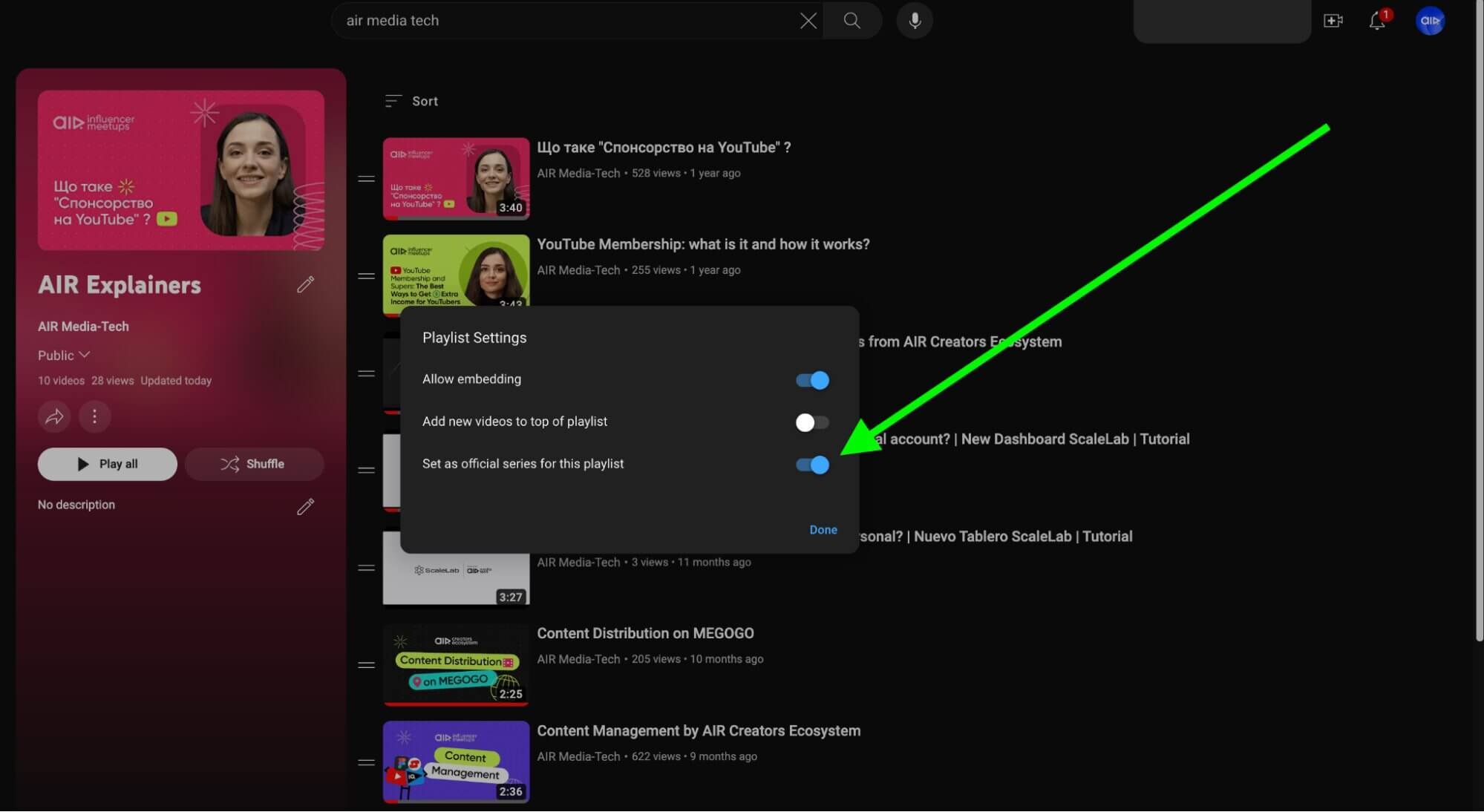
Set as Official Series |
Three-dot → Playlist Settings → toggle |
Groups videos for algorithmic co-recommendation |
|
Enable collaboration |
Three-dot → Collaborate → toggle + share link |
Let others add videos to your playlist |
|
Change visibility |
Pencil → Details → visibility dropdown |
Public/Unlisted/Private |
|
Set custom thumbnail |
Playlist page → pencil icon on thumbnail |
Upload an image, take a photo, or generate with AI |
Playlist Official Series: What It Does and When to Use It
When you mark a YouTube playlist as an Official Series (three-dot → Playlist Settings → Set as Official Series), YouTube treats the videos as a tightly connected group and is more likely to recommend them together in sequence. From YouTube's own documentation: videos in a series playlist are recommended together, and when one video ends, the next in the series is more likely to play automatically.
Regular YouTube Playlist vs the Official Series
The key practical difference is the reach of the autoplay. With a regular playlist, autoplay only works when the viewer is watching from within the playlist. With an Official Series, YouTube can recommend the next video one after another, even to someone who arrived at a single video from search or browse, without ever clicking the playlist. That's the actual upside.
|
Regular playlist |
Official Series |
|
|
A video can appear in multiple playlists |
Yes |
No. One series only |
|
Autoplay within playlist |
Yes, when the viewer enters via the playlist link |
Yes, plus YouTube may recommend the next video even when the viewer arrives at a single video directly, not through the playlist |
|
Recommendation signal |
Standard playlist grouping |
Stronger co-recommendation signal, YouTube treats videos as formally related |
|
Account requirement |
None |
Verified account required |
A video can only belong to one series playlist.
Choose which content gets the designation. Series playlists work best for structured content — courses, episodic series, multi-part tutorials — where sequence matters. Don't use it on a random collection.
How Do You Create a YouTube Playlist?
There are three paths. Pick the one that fits your workflow:
|
Method |
Best for |
Where to find it |
|
YouTube Studio → Content → Playlists → Create |
Organizing your own library from scratch |
studio.youtube.com → left menu → Content → Playlists tab |
|
Save button under any video |
Adding a single video while browsing |
Below video player → Save → New Playlist |
|
Video Details page while uploading |
Assigning a playlist at upload time |
Upload flow → Video Details → Playlists dropdown |
Step-by-Step: Creating a Playlist from YouTube Studio
- Go to studio.youtube.com → click Content in the left menu → select the Playlists tab.
- Click Create (top-right) → New Playlist.
- Enter a title. Use a keyword-rich name, not a category label. See the Title formula table below.
- Click the description field. Write 150+ characters. Primary keyword in the first sentence.
- Set visibility: Public (default for channel playlists). Unlisted only if you're embedding elsewhere and don't want it indexed.
- Click Create. The playlist is live — empty.
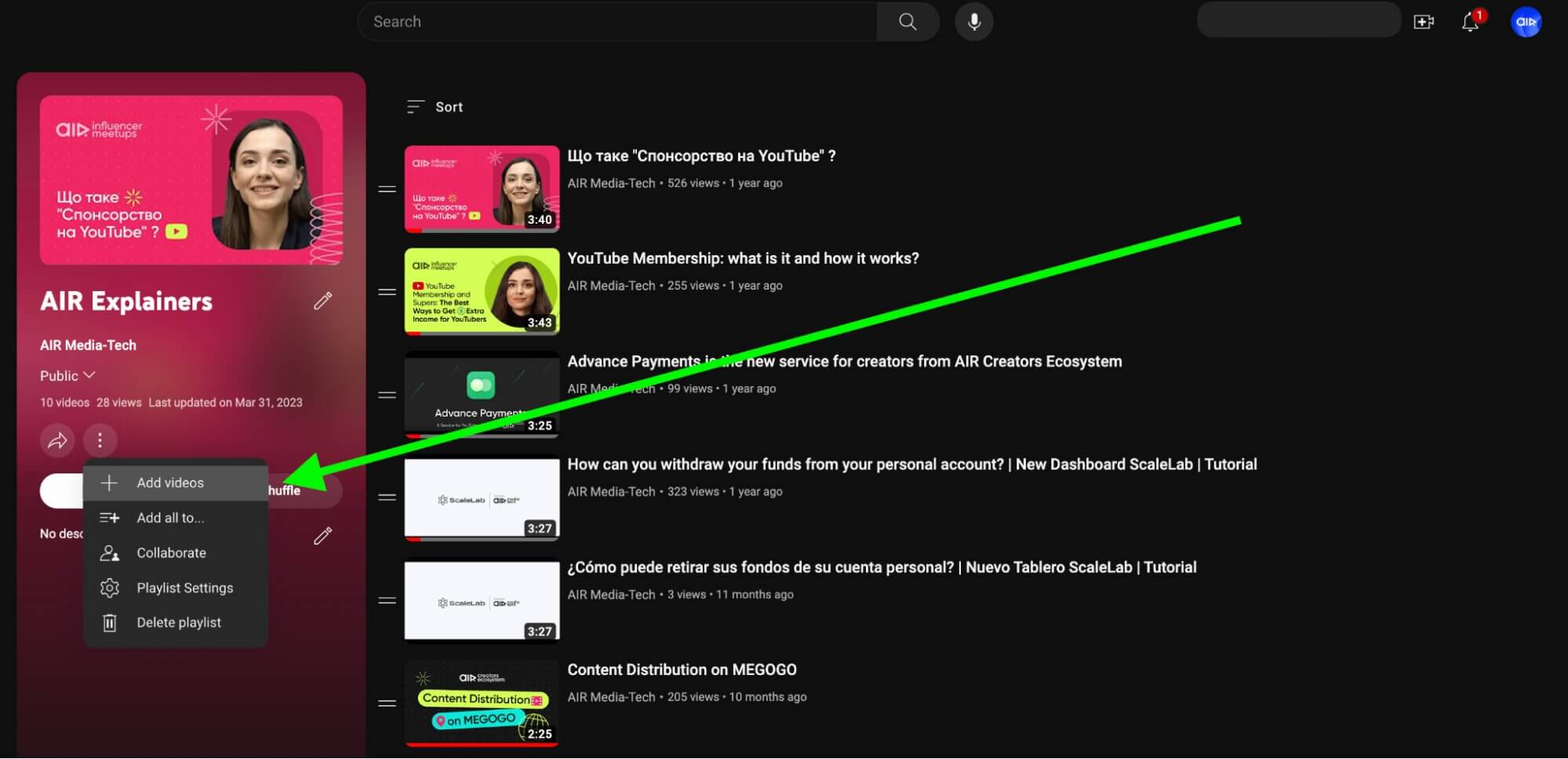
- Click Add Videos → select from the Your YouTube Videos tab. Fastest path for your own library.
![YouTube Studio Playlists tab showing a channel's playlist library with the Create menu open, arrow pointing to the New playlist option]](/storage/SRzBu67jLzOG4nq7H4F49Jxgua2xJdvSyS67UfER.jpg)
Playlists’ Title Formula: What Works vs. What Doesn't
Your playlist title has two jobs: tell the algorithm what the playlist is about and tell the viewer what they'll get.
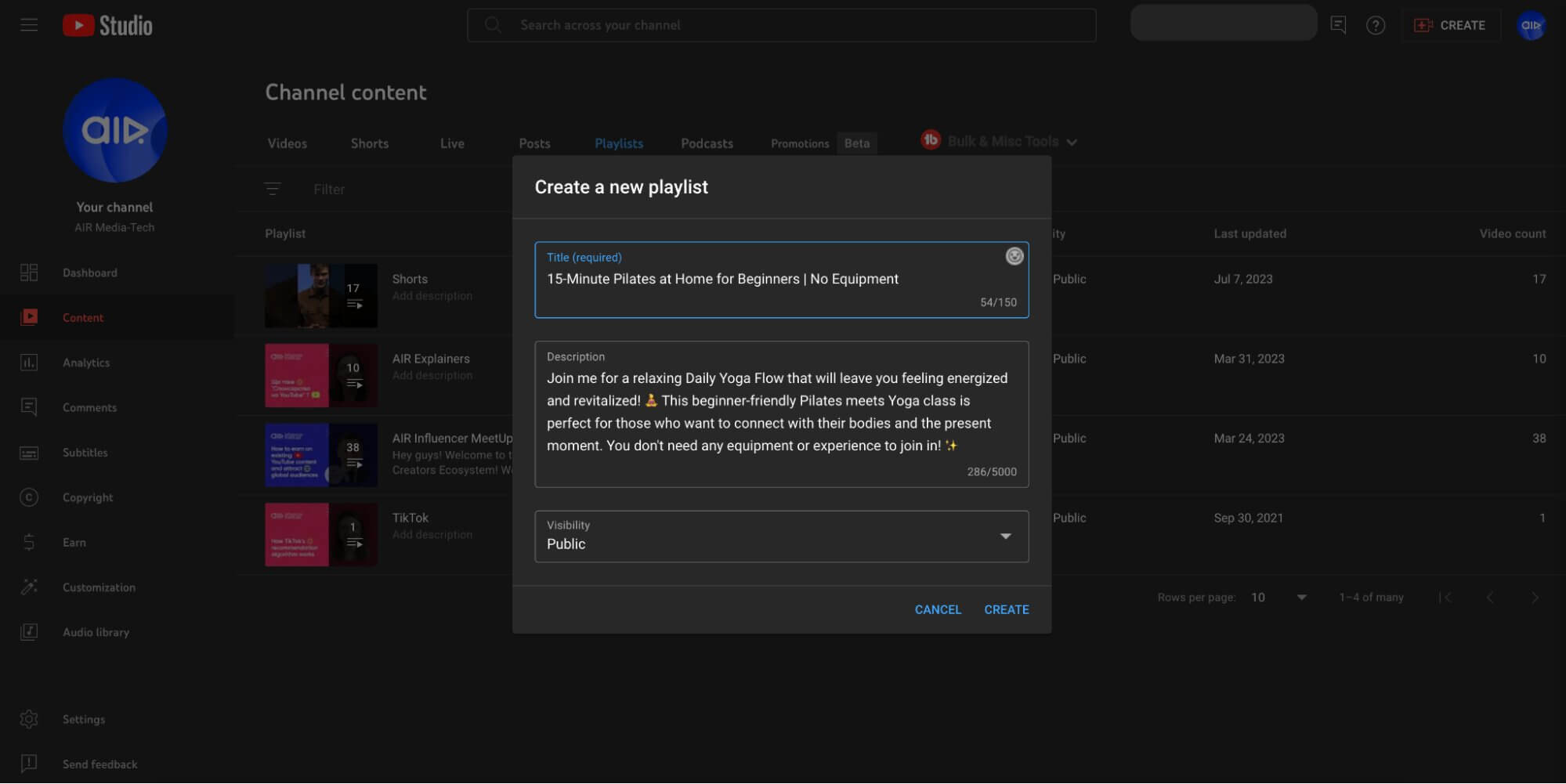
Lead with the topic keyword; follow with the specific angle or outcome. "Pilates" is a category. "15-Minute Pilates for Beginners | No Equipment" is a search result.
|
Weak playlist title |
Problem |
Strong playlist title |
Why it works |
|
"Pilates" |
No keyword, no click reason, won't rank |
"15-Minute Pilates for Beginners | No Equipment" |
Keyword-rich, sets expectations, appears in search |
|
"My Videos" |
No search value, invisible |
"How to Learn Python Fast | Full Beginner Course" |
Matches real search query, stands alone in results |
|
"Cooking Stuff" |
Zero specificity |
"Quick Weeknight Dinners Under 30 Minutes" |
Matches viewer intent, scannable on playlist page |
|
"Episode 1-10" |
Internal reference, no viewer value |
"The Complete JavaScript Series | Episode 1–10" |
Clear scope appears in 'related playlists' |
Playlist Description: What to Put in 5,000 Characters
Most creators leave this blank, which is a mistake because it might result in a ranking miss. The first 150 characters are indexed and shown in search results.
Your first two sentences need to repeat the main topic and include secondary keyword variations because YouTube's algorithm is now capable of reading semantic relationships. For the full metadata strategy, read How to Increase YouTube Recommendations with Metadata.
|
Element |
Where to put it |
Example |
|
Primary keyword |
First sentence |
"This playlist covers everything you need to create YouTube playlists that drive watch time." |
|
What the viewer gets |
Sentences 2–4 |
"Each video focuses on one tactic — setup, sequencing, SEO, analytics — so you can implement as you go." |
|
Affiliate or partner links |
After the description |
Link to tools you use or recommend |
|
Related playlists or social |
End of description |
Link to other playlist series on your channel |
Feel like YouTube stopped pushing your content?
It probably did — and there's a specific reason you won't find staring at your own Studio. Our team has found it across 3,000+ channels. We'll find it in yours.
Find what's brokenKeyword Integration Across the YouTube Playlist
Playlists rank in YouTube search independently of the videos inside them, which means every element of a playlist has its own SEO value. The table below shows where keywords belong and why. For the full keyword research process, see our YouTube SEO guide.
|
Element |
Where the keyword should appear |
Notes |
|
Playlist title |
Primary keyword, naturally |
Also appears in YouTube search results as a standalone result |
|
Playlist description (first 150 chars) |
Primary keyword in sentence one |
Indexed by YouTube and Google; shown in search snippets |
|
Individual video titles in the playlist |
Secondary keywords or variations |
Playlist-level and video-level SEO reinforce each other |
|
Playlist URL |
Auto-generated, not editable |
Share the playlist URL, not individual video URLs, for session depth |
Custom YouTube Thumbnails: What is Possible in 2026
Before late 2025, the only way to control a playlist thumbnail was to place a specific video first in the list; its thumbnail became the playlist cover. YouTube now lets you upload a custom image directly.
Three options:
- Upload from device
- Take a new photo
- Generate with AI (preset themes).
Access via: open playlist → Edit → pencil icon on the thumbnail. Account verification is required on Android.
If you don’t know how to design thumbnails and need help with that, read Top 5 AI Thumbnail Generation Tools.
Collaboration: Who Can Add Videos to Playlists and How
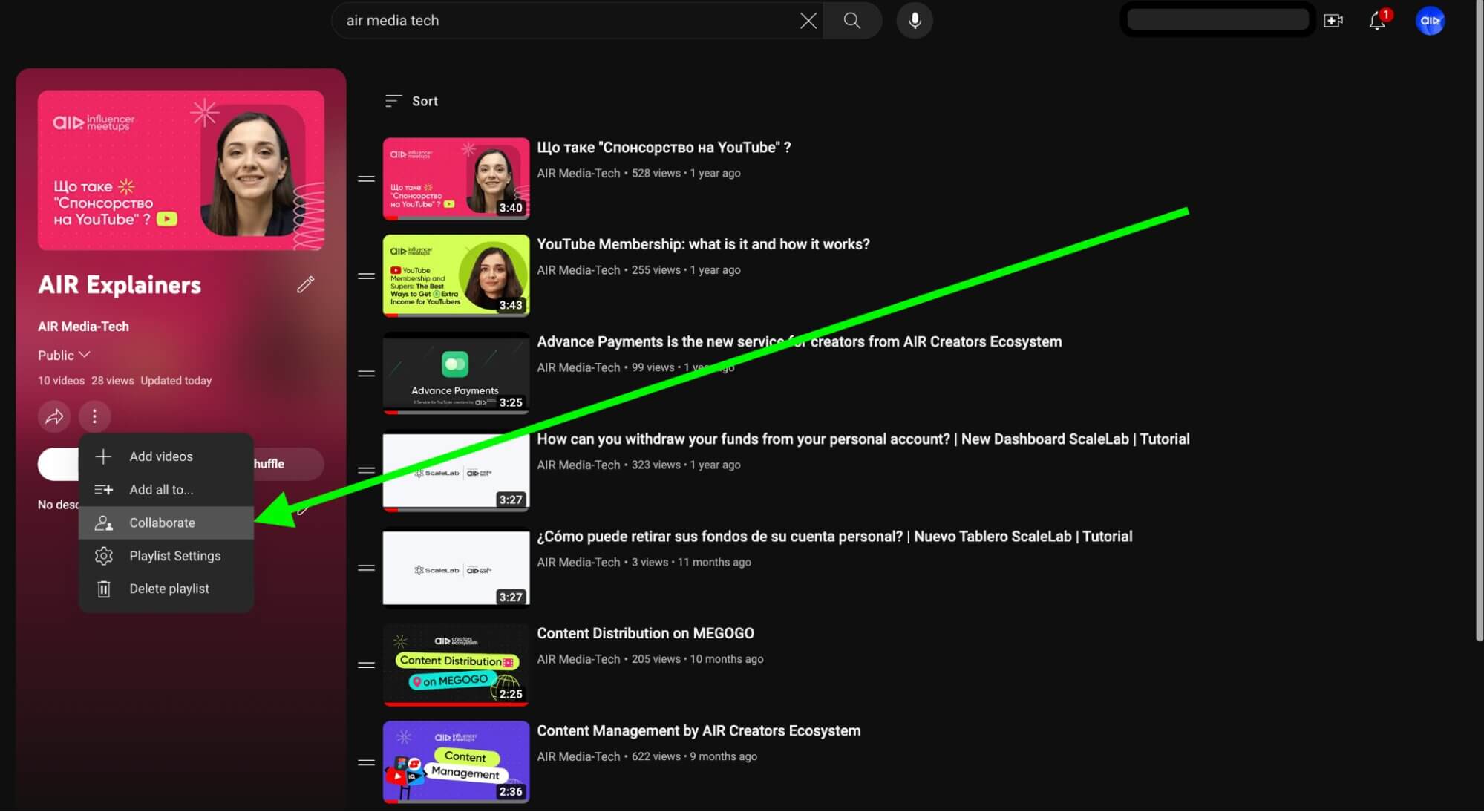
To give other people the ability to add videos to your playlists, follow this path:
Three-dot → Collaborate → enable → share the invite link.
Anyone with the link and a YouTube account can add videos. The playlist owner can disable collaboration at any time.
You can build a curated YouTube playlist with contributors from your community, co-creators, or even with another one of your channels.
How Do You Add Videos to a YouTube Playlist?
YouTube gives you three ways to add videos to a playlist:
- From the watch page while browsing. Three-dot menu under any video → Save → select or create a playlist.
- From the upload flow before a video goes live. Video Details page → Playlists dropdown → tick the target playlist.
- And from YouTube Studio, when you're organizing videos that are already published. Content → select any video → pencil icon → scroll to Playlists in the sidebar.
How Do You Add Multiple Videos to a Playlist at Once?
The method most guides skip. Essential for creators organizing a large back-catalog.
- Go to Studio → Content.
- Use the Filter bar to search by series name, keyword, or title pattern (e.g., "Tron vs").
- Click the checkbox at the top to select all videos on the current page (up to 30).
- Click Edit → Add to Playlist → select or create a playlist → Save.
- Go to page 2 → repeat. YouTube doesn't let you select across pages at the same time.
Use the filter first to narrow results. Selecting "All" on an unfiltered content tab pulls everything.
How to Remove a Video from a Playlist?
Open the playlist → three-dot menu next to the video → Remove from Playlist. It does not delete the video from YouTube; it only removes it from this playlist.
How Do You Sort a YouTube Playlist?
To sort videos in a playlist, follow the Studio path: open the playlist → pencil icon → Details → Default Video Order.
You have the option to manually arrange videos.
|
Sort option |
How it works |
Best for |
Watch time impact |
|
Manual order |
You drag each video to a position |
Any channel with a sequencing strategy |
★★★★★ — highest when based on retention data |
|
Most popular |
YouTube ranks by view count |
Mixed libraries, broad channels |
★★★★ — strong entry point for casual viewers |
|
Date published (oldest first) |
The first upload plays first |
Educational series, courses, narrative |
★★★★ — viewer follows the learning arc |
|
Date published (newest first) |
Latest content plays first |
News, vlogs, ongoing upload schedules |
★★★ — good for returning subscribers |
|
Date added (newest first) |
Most recently added plays first |
Curated collections updated regularly |
★★★ — works when curation is the value |
What is The Best YouTube Playlist Sorting Decision?
Open YouTube Studio → Analytics → filter by the playlist → sort videos by Average View Duration. The video with the highest AVD is your best funnel entry point because it keeps viewers the longest, which triggers autoplay into the next video.
Move that video to position one manually. Check it every 90 days. Your best performer changes as your library grows.
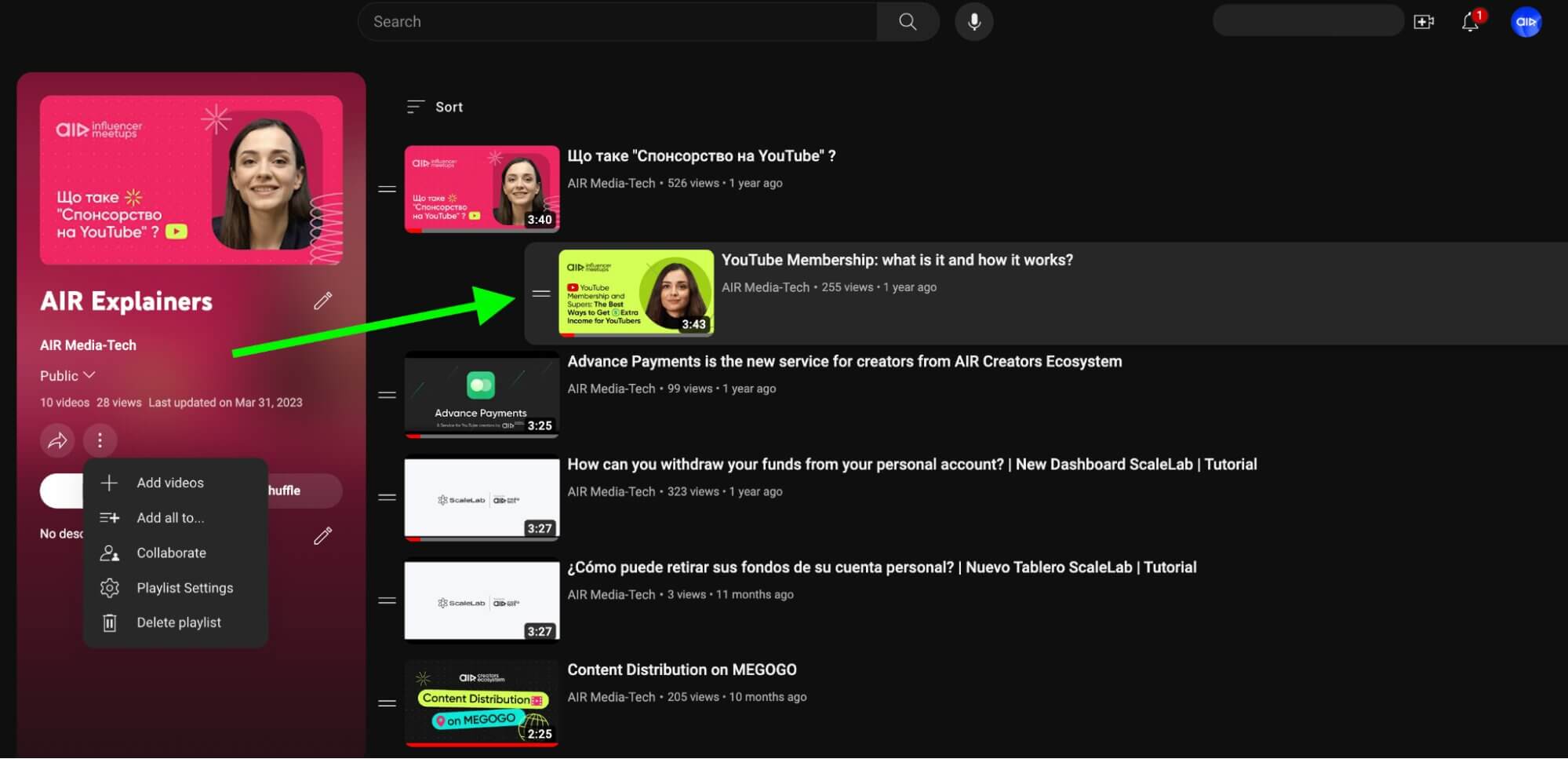
Can You Add YouTube Shorts to a Playlist?
Yes. Shorts behave identically to regular videos for playlist purposes: same add methods, same sort options, same visibility settings, and since December 2025, people can even watch Shorts on TV. On desktop and TV, Shorts in a playlist display vertically in a window rather than full-screen.
On desktop, the Shorts player doesn't always surface the Save button: if that happens, change /shorts/ to /watch?v= in the URL to open it as a standard video, then save normally. On mobile, tap the three-dot icon in the top-right corner of the Short → Save to playlist.
How to Use Shorts and Long-Form in the Same Playlist Strategy
|
Approach |
How it works |
When to use it |
|
Dedicated Shorts playlist per topic |
Shorts on one topic group → viewers who find you through Shorts feed land on a focused playlist |
Any channel producing both Shorts and long-form content on the same topic |
|
Shorts as teasers in long-form playlists |
Add a 60-second Short as video 1 or 2 in a long-form series playlist |
Educational channels where the Short answers the quick question and the long-form goes deep |
|
Separate Shorts-only playlist |
All Shorts in one public playlist for viewers who prefer short-form |
Channels where Shorts serve a different audience than long-form content |
See the full cross-format mechanics in our guide to getting videos recommended on YouTube in 2026.
Why does YouTube favor your competitors?
It's not random. They fixed something structural. We'll show you what — using data from 3,000+ channels and a 450K-channel training dataset.
Show me what to fixHow Do You Know If Your Playlists Are Working?
To see if your playlist is performing well, go to YouTube Analytics → Advanced Mode → Group by Playlist (or filter to individual playlist).
The three metrics that pay off the most:
|
Metric |
Where to find it |
What a strong number looks like |
What to do if it's weak |
|
Average views per playlist start |
Playlist analytics → Overview |
2.0+ views per start |
Move the highest-AVD video to position 1; shorten the playlist |
|
Average time in playlist (minutes) |
Playlist analytics → Engagement |
Varies by video length; compare across your own playlists |
Check if the entry video is holding viewers; resequence if not |
|
Playlist traffic source breakdown |
Playlist analytics → Reach |
Mix of Search, Browse, and Suggested |
If 90%+ is direct, the playlist isn't ranking — improve title and description SEO |
Cross-Reference Check
Compare playlist engagement against individual video data: if a video holds well on its own but drops when accessed through a playlist, the sequencing is the problem. For the full watch time strategy, read How to Increase Audience Retention on YouTube.
How Many Videos Can a YouTube Playlist Have?
Technical maximum: 5,000 videos per playlist. In practice:
|
Playlist size |
Effect on viewer behavior |
Recommendation |
|
1–9 videos |
Low perceived value; the viewer may not enter |
Build to at least 5–8 before promoting publicly |
|
10–20 videos |
Strong engagement; the viewer can binge in one session |
Optimal for most playlist types |
|
20–50 videos |
Works for structured courses or evergreen libraries |
Split into sub-playlists if topics diverge |
|
50–200 videos |
The viewer doesn't know where to start; high exit rate |
Break into focused sub-playlists of 15–30 each |
|
200+ videos |
Repeat, and shuffle features break above 200 |
Never publish a 200+ video playlist as a primary viewer destination |
Can Playlists Help Your Channel?
Maybe. But maybe something more important is missing.
We audit channels across 10 pillars (packaging, retention, traffic, niche, portfolio, revenue, audience, forecast, risks, and roadmap) and hand you a fix for all of them.
What you get:
- A structured report covering all 10 pillars of channel performance
- A 30-day action plan ranked by impact
- A 45–60-minute live walkthrough with your strategist