
How much YouTube pays after monetization follows your views, and for small channels, the views often drop in the first months. At AIR Media-Tech, we took 297 channels with under 10,000 subscribers that were earning on their own, without help from us or other YouTube experts, and looked at six months of their YouTube Studio data. The typical one earned $88 in its first full month and $32 in its sixth, as its views fell by more than half. These numbers show where small channels usually start, so you can check whether your own first months look normal.
For a small channel, most early months pay under $100. That was true in 62% of the months in the data, and about one in four channels didn't reach $100 in six months combined. What each view pays depends mostly on where the viewers are. Small channels watched mostly from the US earned about $106 a month on fewer views than the rest, nearly three times as much, and setting the channel's country to the US didn't change that.
In this guide:
- what small channels earn each month
- why views and earnings drop
- earnings by niche, viewer country and size
- what to change in the first six months
Key takeaways
- A typical small channel earned $88 in its first full month and $32 in its sixth. That's from YouTube Studio data AIR Media-Tech reviewed for 297 channels with under 10,000 subscribers, in their early months of monetization.
- 71% of small channels in the data earned less in month six than in month two. In AIR Media-Tech's data, views fell 54% while earnings per 1,000 views fell 20%.
- YouTube says monetization doesn't cut reach. Its search and recommendation system doesn't know which videos are monetized.
- 24% didn't reach the $100 payout threshold in six months. In AIR Media-Tech's data, almost a third of small channels crossed it in the first month, 55% within two.
- Viewer country sets the rate, not your channel settings. Small channels watched mostly from the US earned $3.46 per 1,000 views and about $106 a month, nearly three times as much as the rest.
How Much YouTube Pays After Monetization, Month by Month
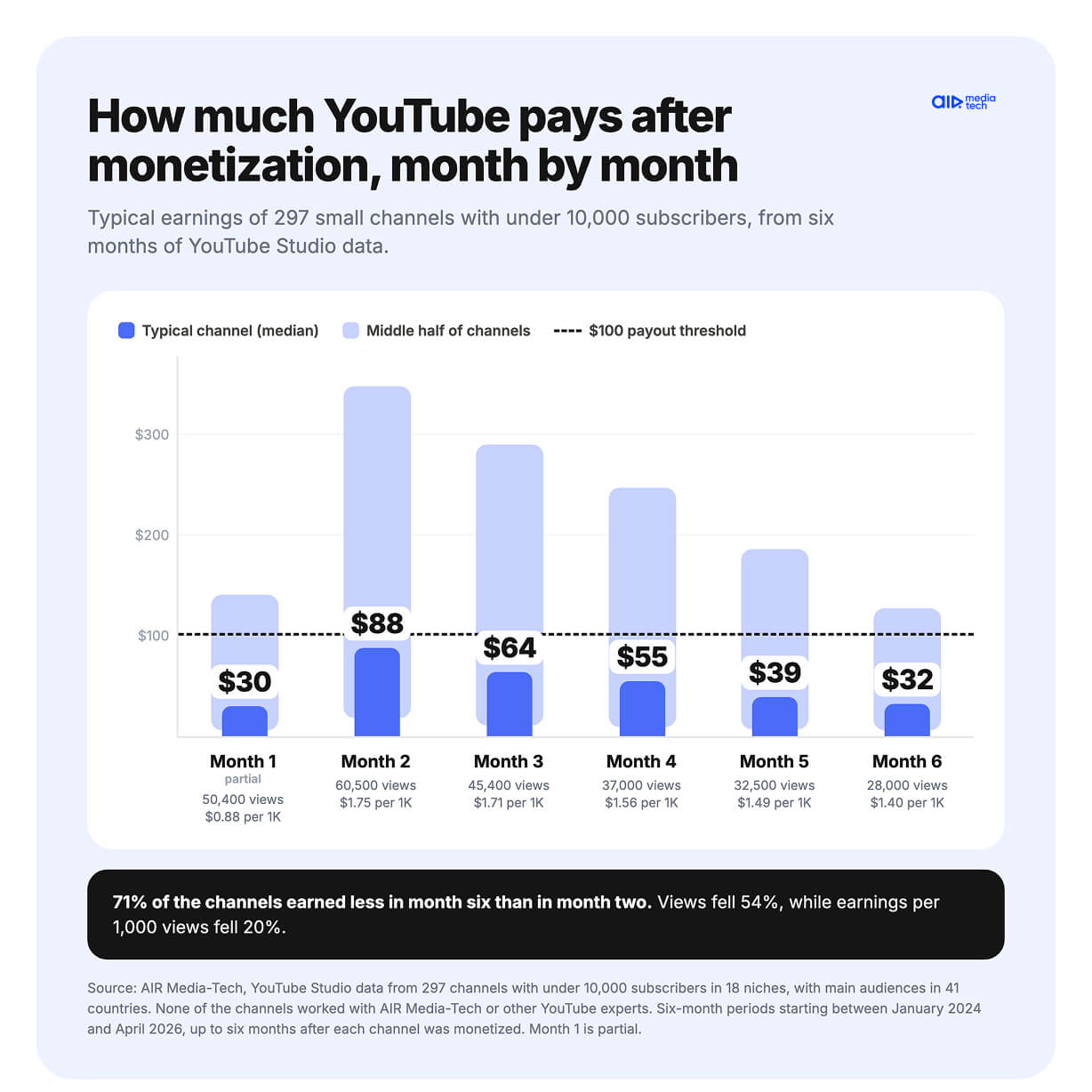
For a third of small channels in the data, month two was the best of the six, more often than any other month. In YouTube Studio data AIR Media-Tech reviewed for 297 small channels, a typical channel earned $88 in its first full month and $32 in its sixth. Views fell from about 61,000 to 28,000 a month over the same stretch.
Here's what a typical channel earned in each of the six months.
| Month | Typical earnings (median) | Middle half of channels | Typical views | Earnings per 1,000 views | Channels under $100 that month |
|---|---|---|---|---|---|
| Month 1 (partial) | $30 | $6–$141 | 50,400 | $0.88 | 69% |
| Month 2 | $88 | $18–$348 | 60,500 | $1.75 | 53% |
| Month 3 | $64 | $11–$290 | 45,400 | $1.71 | 56% |
| Month 4 | $55 | $9–$247 | 37,000 | $1.56 | 62% |
| Month 5 | $39 | $7–$186 | 32,500 | $1.49 | 67% |
| Month 6 | $32 | $6–$127 | 28,000 | $1.40 | 72% |
Source: AIR Media-Tech, YouTube Studio data from 297 channels with under 10,000 subscribers in 18 niches, with main audiences in 41 countries. None of the channels worked with AIR Media-Tech or other YouTube experts. Six-month periods starting between January 2024 and April 2026, up to six months after each channel was monetized. Medians for each month. Month 1 is partial.
The middle half shows how wide this gets. In month two, a quarter of small channels earned under $18 and a quarter earned over $348, so $88 is the middle of a wide range.
Month one is short for nearly everyone. A channel starts earning partway through a month, so month one brought about a third of month two's earnings. The month you're approved works the same way, because the monetization review can end on any day. That's why the first full month tells you more than the first one.
These are whole-channel earnings for channels with a few thousand subscribers. What a view pays in each niche, across bigger channels too, is in our study of 300 channels.
How Long Small Channels Take to Reach $100
YouTube pays through AdSense once your balance passes $100, so the first payout depends on how fast a channel gets there. Almost a third of small channels in the data (31%) crossed $100 in month one. By month two, 55% had. By month six, 76% had, and about one in four (24%) still hadn't earned $100 in total.
31%
crossed $100 in month one
55%
had crossed it by month two
76%
had crossed it by month six
24%
still hadn't earned $100 in six months
Reaching $100 in Studio doesn't put the money in your account that day. Earnings are finalized on the 7th–12th of the next month and paid on the 21st–26th, and our guide to AdSense Step 2, the PIN and your first payment walks through the dates.
Earning under $100 a month since you got monetized? Check your channel for free
In 15 minutes or less, the Free Channel Check reads your YouTube Studio data, compares it with a channel you choose, and shows what to fix first.
Check my channel for free →Why Views Drop After Monetization: 71% of Small Channels Earned Less by Month Six
Three weeks after getting monetized, a creator on r/youtube saw views fall and asked whether YouTube was pushing the channel less because it had just demonetized videos from months earlier. The same post mentions going down to one upload a week over winter break.
That drop is common. In YouTube Studio data AIR Media-Tech reviewed for 297 small channels, 71% earned less in month six than in month two. For a typical channel, earnings roughly halved.
Most of the drop came from views. Typical views fell 54%, from about 60,500 to 28,000 a month, while earnings per 1,000 views fell 20%, from $1.75 to $1.40.
−54%
typical views, month two to month six
−20%
typical earnings per 1,000 views over the same months
It isn't the January slump either. The six-month periods in our data start in every month of the year, and the drop shows up in all 12 starting months.
YouTube says the ads themselves aren't the cause. Its performance FAQ says the search and recommendation system doesn't know which videos are monetized. A video can still get fewer recommendations because of what's in it, the same content that can limit its ads.
AIR Media-Tech's team sees the same pattern when it reviews small channels. A channel usually gets into the Partner Program after one video takes off and brings in the watch hours it needs. The next videos rarely take off the same way, so in most cases the drop is the channel going back to its usual level of views after one strong video.
To see which part fell on your own channel, compare two full months in YouTube Studio, views in the Overview tab and RPM, your earnings per 1,000 views, in the Revenue tab. If views fell much more than RPM, as on most small channels in the data, look at the traffic sources of the videos that lost the most views before you touch your ad settings.
How to Find the Video That Carried Your First Full Month
A drop in views usually starts with a few videos, not the whole channel. Here's how to find them in YouTube Studio.
- Open Analytics and click Advanced mode, or click See more under any report.
- Set the dates to your best full month, then use Add comparison to put a later month next to it.
- Break the report down by content. The videos at the top of your best month are the ones to look at. Add impressions and impressions click-through rate next to views. Fewer impressions mean YouTube showed the video less, and a lower click-through rate on similar impressions points to the title and thumbnail.
- Switch the breakdown to traffic source for those videos. Browse features cover Home and the subscriptions feed, and Suggested videos cover what YouTube shows next to or after other videos, as YouTube Help describes. If those faded, YouTube showed the videos to fewer viewers. If YouTube search faded, fewer people were looking for the topic.
- Switch the breakdown to geography. If the share of views from the US or other high-paying countries went down, RPM goes down with it.
YouTube started rolling out an updated Studio in July 2026, so some buttons may look a little different on your channel. Whatever carried your best month is the best brief for your next video.
How Much Small YouTubers Make by Niche, Viewer Country and Size
Channels watched mostly from the US had fewer views than the rest and still earned nearly three times as much. In YouTube Studio data AIR Media-Tech reviewed for 297 small channels, the 70 with the US as their top audience earned a typical $106 a month on about 27,000 views. The other 227 earned $38 on about 39,000 views.
The gap comes from what each view pays, $3.46 per 1,000 views for the US group against $1.14 for the rest. Advertisers choose which countries their ads run in, so ad prices vary by geography, as YouTube Help explains.
Here's what a typical channel earned by its top audience country.
| Top audience country | Channels | Typical earnings a month | Earnings per 1,000 views | Typical views a month |
|---|---|---|---|---|
| United States | 70 | $106 | $3.46 | 27,300 |
| Mexico | 15 | $41 | $1.14 | 40,000 |
| Ukraine | 28 | $34 | $1.39 | 35,400 |
| Azerbaijan | 28 | $6 | $0.17 | 35,100 |
| India | 13 | $5 | $0.63 | 18,300 |
Source: AIR Media-Tech, YouTube Studio data from 297 channels with under 10,000 subscribers. Top audience country is the country with the most views over the six months. Medians of months 2–6. Countries with at least 10 channels.
Channels watched mostly from India earned the least in the table, about $5 a month at $0.63 per 1,000 views. Nine channels watched mostly from Germany earned $9.53 per 1,000 views, the highest rate in the data, though nine channels are too few to treat as a benchmark.
Setting Your Channel to the US Doesn't Raise Your RPM
89 of the 297 channels had the US set as their channel country. Only 37 of them were watched mostly from the US, and those earned $3.39 per 1,000 views. The other 52 were set to the US but watched mostly from other countries, and they earned $1.69.
AIR Media-Tech's team puts it simply. RPM follows the country of the person watching the video, not the country in your channel settings.
Entertainment $153 a Month, Gaming $29: What Niche Changes
By niche, typical monthly earnings ranged from $12 to $153.
| Niche | Channels | Typical earnings a month | Earnings per 1,000 views | Typical views a month |
|---|---|---|---|---|
| Entertainment | 42 | $153 | $2.81 | 54,900 |
| Education & Science* | 10 | $141 | $3.99 | 32,800 |
| Kids & Teens | 73 | $75 | $1.41 | 56,300 |
| Music | 94 | $40 | $1.49 | 33,100 |
| Gaming | 29 | $29 | $0.88 | 19,900 |
| Lifestyle* | 11 | $12 | $0.69 | 26,100 |
Source: AIR Media-Tech, YouTube Studio data from 297 channels with under 10,000 subscribers. Medians of months 2–6. *Fewer than 15 channels, so treat as directional.
Kids & Teens shows how views and rate pull against each other. These channels earned $1.41 per 1,000 views, half of Entertainment's rate, but got the most views, about 56,300 a month, so they still made $75. Videos made for kids can't show personalized ads, which keeps their rate low. Education & Science went the other way, with $141 a month on about 32,800 views, because each view paid $3.99.
For bigger channels, our ranking of YouTube niches by RPM has the rates for all 13 niches.
6,000 Subscribers Earned Eight Times More Than 2,000
Inside the under-10,000 group, size still made a big difference, mostly through views. Channels that started with 6,000–10,000 subscribers earned a typical $135 a month on about 93,000 views. Those that started with 1,000–3,000 earned $16 on about 12,000 views, and the 3,000–6,000 group sat in between at $58 on about 44,000. Per 1,000 views, the smallest group even earned a little more, $1.77 against $1.51.
Bigger channels show the same pattern at a larger scale. Our breakdown of why some channels earn 10x more with the same subscriber count traces it to library depth, video length, and the countries the audience comes from.
What to Change in the First Six Months After Monetization
Dr Roto, a fantasy sports channel, published more than 500 videos in four years and earned $0. An AIR audit found that 19 of its last 20 long-form videos had a click-through rate under 1.2%, while the leading channels in its niche had 4–6%. After three months of fixes with an AIR channel manager, the channel got its first payout, and it now earns $500 a month.
Dr Roto at a glance
Niche
Fantasy sports
Before
4 years, 500+ videos, $0
What the audit found
19 of 20 recent long-form videos under 1.2% CTR, against 4–6% for niche leaders. Shorts brought about 91% of views and 6% of watch hours.
What changed
8–12 minute videos, new titles and thumbnails, polls in the Community tab, three months with an AIR channel manager
Result
First payout about three months in. Now $500 a month and growing.
Dr Roto now earns about 15 times what a typical small channel in our data made in its sixth month. Most of what helped it works for any small channel in its first months of monetization. Here's what to change, starting with what takes the least effort.
Turn On Ads for Your Old Videos, and Mid-Rolls Past 8 Minutes
Check that ads are on for the videos you uploaded before approval. You can turn on ads for videos you've already uploaded, one by one or several at once from the Content page in YouTube Studio, and each video goes through a review before ads show.
On videos that are 8 minutes or longer, YouTube also lets you add mid-roll ads. You can place them by hand or let YouTube find natural breaks in the video.
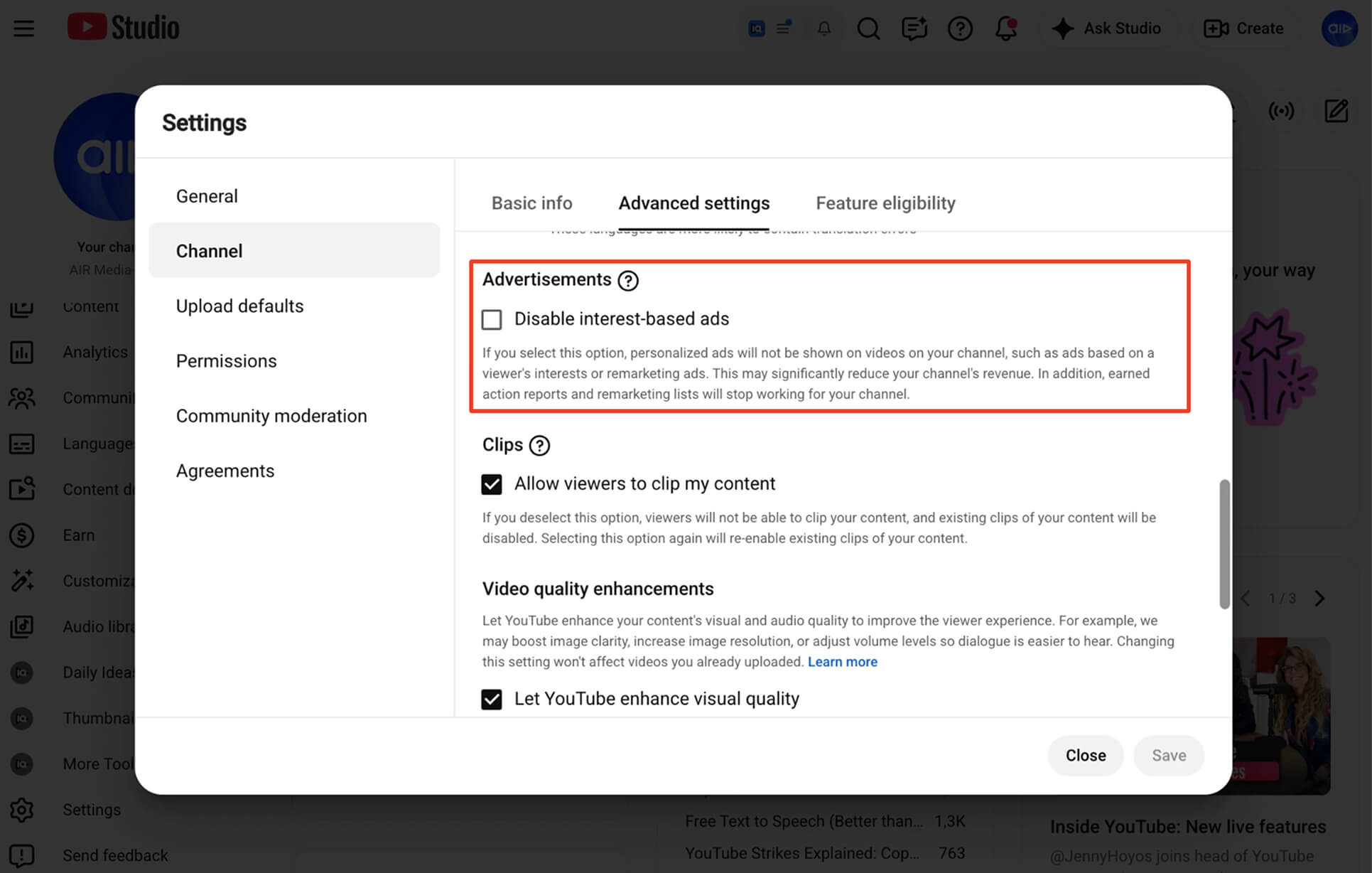
Two settings can cut what a monetized channel earns, and AIR Media-Tech's team finds both on channels it checks.
- Monetization can be off on single videos even when it's on for the channel, so check each video's monetization status on the Content page.
- In Settings, under Channel and then Advanced settings, the Disable interest-based ads box should stay unchecked, because YouTube warns that turning it on may significantly reduce your channel's revenue.
Make the Next Video From the One That Worked
Start from the video you found in the Studio steps above, and keep its topic and format. Then work on the click. Dr Roto moved to 8–12 minute videos and rebuilt its titles and thumbnails around what people in its niche searched for, after the audit showed most of its long-form videos losing the click. Our guide to what counts as a good CTR on YouTube shows how to read the number for your own channel.
Keep a Rhythm You Can Hold
Going quiet gives YouTube fewer new videos to recommend, which is how the creator in the Reddit post above ended up asking about falling views. More isn't always better either. In AIR Media-Tech's study of posting frequency across 282 channels, a Gaming channel's RPM dropped 73% once it went past five videos a month. Pick a number you can keep for six months and hold it.
“
Work out why your best video worked and try to repeat it. Post on a regular schedule, cover trending topics in your niche to reach new viewers, and build a core of loyal viewers who wait for your next video, because they set your channel's baseline views.
Vlad Khvorostianyi, AIR Media-Tech
Reach Viewers in Higher-Paying Countries
In our data, small channels watched mostly from the US earned nearly three times as much on fewer views. You can't move your audience, but you can make your videos easier to watch in more countries. Translated titles, descriptions, and subtitles help, and so does a multi-language audio track. Start with a language your geography report already shows, and try it on a few of your best videos first.
Use Shorts to Bring People to Long-Form
Dr Roto's Shorts brought about 91% of its views and about 6% of its watch hours. In AIR Media-Tech's data from 274 channels, Shorts earned 3–14% of long-form RPM in almost every niche and less than 2% of total revenue for most channels. Shorts still help new viewers find you, so link each Short to a related long video and give those viewers somewhere to go.
Add Income That Doesn't Depend on Views
Ads pay for views, so they fall when views fall. Inside the YouTube Partner Program, memberships, Super Thanks, and Super Chat let viewers who already like the channel pay you directly, and our breakdown of how much channel memberships can earn shows what drives that number. Brand deals are open to small channels too. Smaller channels usually get $50 to $2,000 per deal, depending on the niche and how engaged the audience is.
Earnings sliding since month two?
The Full Channel Audit, the same one Dr Roto started with, reads your Studio data and gives you a plan to grow from here.
- Your Studio numbers next to 3 channels you choose
- All 10 blocks, from packaging to revenue
- A full plan of 15 actions in 3 waves
- Read-only Studio access you can revoke anytime, no network contract