


Online, the question about how much YouTube Shorts pays comes up constantly. We pulled data directly from the YouTube Analytics API across 274 channels that mix in Shorts and saw that YouTube Shorts RPM is 3–14% of long-form RPM in almost every niche, meaning most channels need between 11,000 and 34,000 Shorts views to earn what 1,000 long-form views generate.
Direct Shorts revenue is negligible for most channels, accounting for less than 2% of total revenue while consuming a meaningful share of total production time. But the direct revenue calculation is the wrong frame. The right question is not "how much do Shorts pay?" but "what does Shorts traffic do to my channel?" Our cases answer that question more precisely than any RPM table.
- Shorts bring viewers to the channel.
- Long-form captures the revenue.
That flywheel works, and it works because short-form and long-form content occupy different positions in YouTube's discovery ecosystem.
It's also how the channels growing fastest right now got there: six of the ten biggest subscriber gainers in September 2026 grew on Shorts, as our list of the fastest-growing YouTube channels shows.
The strategic conclusion the data supports: a mixed strategy at 0.28–0.40 Short ratio (roughly 1 Short per 2–3 long-form uploads) is where most niches show the best subscriber and revenue outcomes. Heavy Shorts pivots show consistent performance decline.
What are the Shorts PRM by English-Speaking Countries?
From AIR's verified partner data, Shorts RPM by audience geography:
|
Country |
Shorts RPM |
|
United States |
$0.328 |
|
Australia |
$0.193 |
|
United Kingdom |
$0.166 |
|
Canada |
$0.165 |
|
Germany |
$0.163 |
1 million Shorts views from a US-heavy audience generate approximately $300 in direct revenue. 1 million Shorts views from a mixed global audience typically generate $150–$250. These are real ceilings. They explain why direct Shorts monetization cannot substitute for long-form revenue for most channels.
Shorts RPM vs Long-Form at a Glance
Here's what the data from 274 channels and 13 niches shows about YouTube Shorts monetization:
- Shorts RPM is 3–14% of long-form RPM in almost every niche. Music is the only exception where Content ID closes the gap to 41–60%. For every other niche, Shorts pay a fraction of what a long-form view generates, which has nothing to do with algorithmic penalties but everything to do with the monetization model being structurally different.
- It takes 11,000–34,000 Shorts views to match 1,000 long-form views in revenue. Music channels need only ~1,100 (roughly 1:1). Kids & Teens large channels need ~2,156. Everyone else is in the 11,000–26,000 range, with Crafting at the far end at ~34,000. The calculation is simple: long-form RPM ÷ Shorts RPM × 1,000.
- Entertainment channels show the sharpest RPM compression when Shorts are added. The within-channel comparison shows the same channels earning $4.58 RPM in months without Shorts and $1.84 in months with Shorts, a 60% drop. The dose-response goes further: $4.99 at 0 Shorts per month falls to $1.15 at 21+, a 77% decline. The causality is unproven, but the signal is too consistent to ignore.
- Gaming is the stable exception. Across 10 channels in the within-channel sample, RPM barely shifts between Shorts months and non-Shorts months ($3.42 vs $3.29). Gaming audiences are habitual because they don't substitute Shorts for long-form content the way Entertainment audiences do.
- For most channels, Shorts account for less than 2% of total revenue while consuming 1–35% of total views. The Entertainment medium cross-sectional gap is stark: irregular Shorts channels earn $559/month versus $2,979 for pure long-form channels in the same niche. Shorts are generating 26% of their traffic and 1.5% of their income.
- Education has the highest RPM in the dataset ($14.97–$18.23) and zero Shorts channels in the sample. The opportunity cost of shifting Education views to Shorts is the largest of any niche. The strategy data shows Education channels pivoting to Shorts face the sharpest subscriber decline of any niche, a 3.3× gap between mono-long and transitional channels.
- Kids & Teens Shorts have a 45.7% monetized playback rate versus 12.1% for long-form, which is related to a COPPA effect. This makes Shorts proportionally more monetizable in Kids than their RPM suggests. At the large tier with 21+ Shorts per month, Shorts revenue share reaches 41%.
- The sweet spot is 1–5 Shorts per month. This is where dose-response data shows minimal long-form RPM impact across most niches, and where strategy data shows mixed-strategy channels outperforming both mono-long and transitional in subscriber growth.
From February 1, 2027, Shorts also need 10 million qualified views in 90 days to earn ad revenue. How that fits with the rest of the numbers is in the State of YouTube Monetization 2026.
One thing remains consistent throughout the data: Shorts are better used as a discovery tool. Our Arts & Crafts channel case (+64% revenue in 30 days) is the clearest proof: none of that revenue came from Shorts RPM. It came from the long-form views that Shorts viewers went on to watch. The economic value of Shorts lies in that conversion, not in the $0.07–$0.20 per 1,000 views they generate directly, and if you want to know exactly how many long-form views one Short drives, we measured that across 18,000 channels.
If you're short on time, save this answer table with the important answers! The “views to match” column shows how many Shorts views it takes to earn the same revenue as 1,000 long-form views.
How We Ran This Study
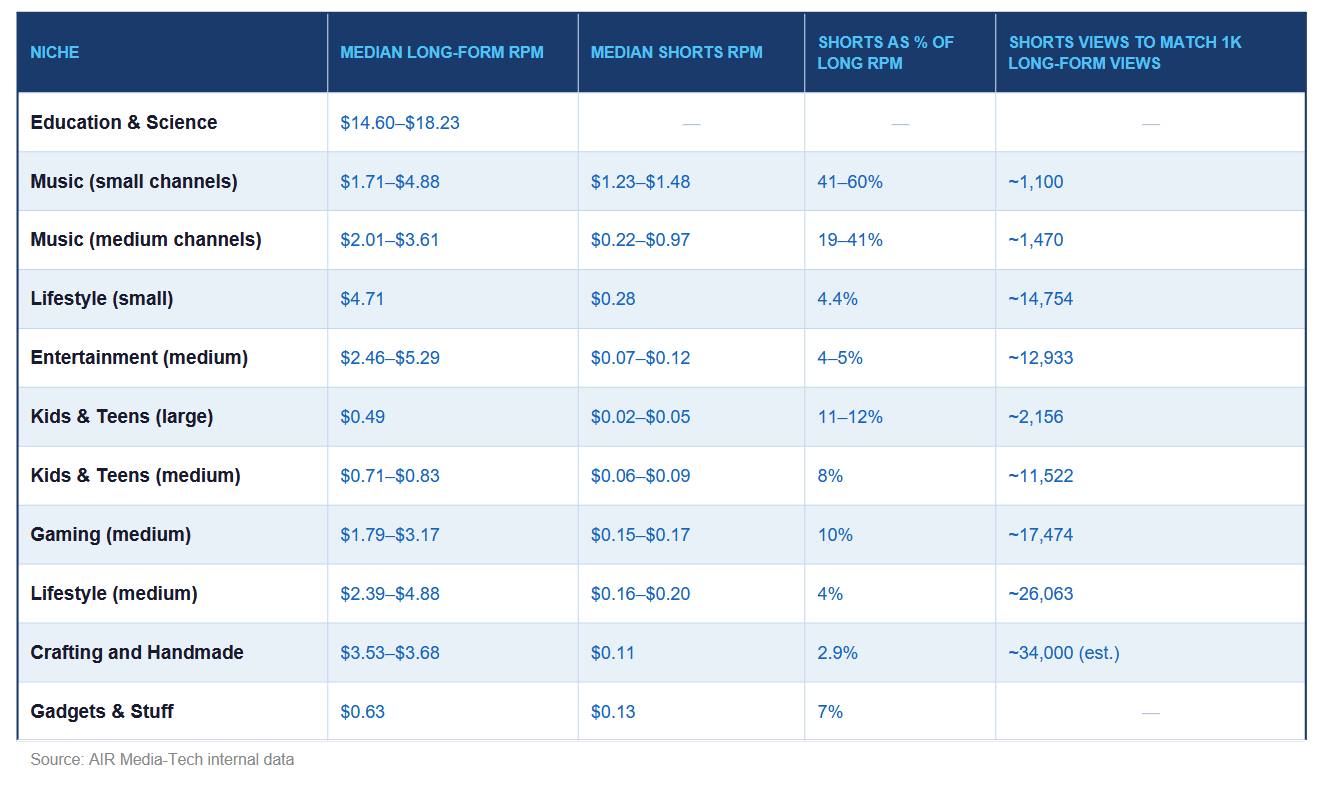
The data in this research comes from 274 channels across 13 niches with YouTube Analytics API access. All figures are verified and pulled directly from YouTube Studio.
Sample breakdown:
- Channel level: 274 channels, 3,044 channel-month observations
- Video level: 17 channels only (indicative; all video-level findings marked accordingly)
- Niches: News & Politics, Crafting and Handmade, Entertainment, Business & Finance, Gaming, Kids & Teens, Music, Education & Science, Lifestyle, Food & Cooking, Transport, Gadgets & Stuff, Health and Sport
- Size tiers: small (10K–100K monthly views), medium (100K–10M), large (10M–50M)
The most technically important element of this study is the methodology used to answer whether Shorts hurt long-form RPM. The standard approach is comparing channels that post Shorts against channels that don't, which has a fundamental problem: those are different channels with different audiences, content quality, and monetization setups. Therefore, any difference found could reflect those underlying differences, not Shorts.
Instead, this study uses a within-channel design. We identified 149 "irregular" channels, aka channels that posted Shorts in some months but not others. Then we compared the same channels in their Shorts months versus their non-Shorts months. This isolates the Shorts variable more cleanly than any cross-channel comparison can.
Metrics used:
- Primary: RPM (Revenue Per Mille) from YouTube Studio, revenue per 1,000 views after YouTube's share
- Secondary: total monthly channel revenue, Shorts revenue share as a percentage, views split between long-form and Shorts
Why Do Our RPMs Differ From What You See Online?
CPM figures circulating online come from three sources: creator self-reporting, third-party estimation tools like Social Blade, and advertiser-side industry reports from marketing agencies. That data reflects what advertisers pay to place ads, peak seasonal figures, and algorithm-generated estimates based on public view counts. None of these reflect what creators receive in their YouTube Studio.
Eight structural reasons account for this:
- One monetized playback can generate 1-3 ad impressions. A channel's CPM, as seen in YouTube Studio, is per 1,000 monetized playbacks, not per 1,000 ad impressions, so it is structurally lower than the "CPM" advertisers quote
- Shorts in the same channel lower blended CPM, so they add views without equivalent ad revenue
- Audience geography matters enormously. Channels with large audiences in Nigeria, Pakistan, or the Philippines (all publishing in English) receive $0.20–$1.50 CPM, which is significantly less than they would receive from European, American, or Australian audiences, with $8–$20
- Q4 advertising peaks in October–December. CPM in December can be 40–60% higher than in January. Creators publish their best months; we report the full-year median
- Nobody posts their February numbers. Our data is a median across 12 months of real operation
- Ad format mix: skippable TrueView, 6-second bumpers, and display overlays all have different CPMs. Blended channel RPM is the weighted average
- Adblock and YouTube Premium users generate no standard ad revenue
- Large channels negotiate floor CPMs with advertisers directly. Smaller channels receive open auction rates
What you're reading here is a median across 274 channels. It is the closest thing to a verified source of truth available on this topic.
Why are other channels outgrowing you?
It's not luck. There's a specific reason — and our specialists who've audited 3,000+ channels will find it in yours.
Show me what to fix
- Why Do Shorts Pay So Much Less Than Long-Form Videos?
- How Much Do Shorts Pay Compared to Long-Form, by Niche?
- How Many Shorts Views To Match 1,000 Long-Form Views?
- Do Shorts Hurt Your Long-Form RPM?
- Dose-Response: Does More Shorts Mean Lower RPM?
- What Share Of Revenue Comes From Shorts?
- Does Shorts Length Affect CPM?
- If Shorts RPM Is That Low, Why Do They Still Improve Revenue?
Want to see Shorts RPM in your niche?
We conducted additional research where we broke down different niches separately. → See the niche data here.
Why Do Shorts Pay So Much Less Than Long-Form Videos?
Most creators know Shorts RPM is low. Fewer people understand the reason why.
Long-form videos monetize through the standard CPM auction. Advertisers bid on ad slots in your videos; YouTube takes its cut, and you receive RPM (revenue per 1,000 views). The more competitive the advertiser market for your audience (Business, Finance, Education), the higher your RPM.
Shorts operate on a completely different model. YouTube created the Shorts Fund to monetize short-form content, and the mechanics result in structurally lower revenue per view because the ad-serving model itself is different.
A single long-form video can contain multiple pre-roll, mid-roll, and post-roll ad slots. A Short contains at most one brief ad break between Shorts in the feed, and that break is shared across multiple creators. The revenue per view is a fraction of what the same viewer generates while watching a long-form video.
Strong traffic but weak revenue?
A channel can have hundreds of thousands of views and still be significantly underpaid compared to channels at the same scale in the same niche. We'll find the revenue leaks and hand you a plan to fix them. → Find your revenue leaks
How Much Do Shorts Pay Compared to Long-Form, by Niche?
The central finding: for most niches, Shorts RPM is 3-14% of long-form RPM. Music is the exception, where Shorts RPM reaches 41–60% of long-form RPM in Music channels, driven by Content ID revenue that other niches cannot access.
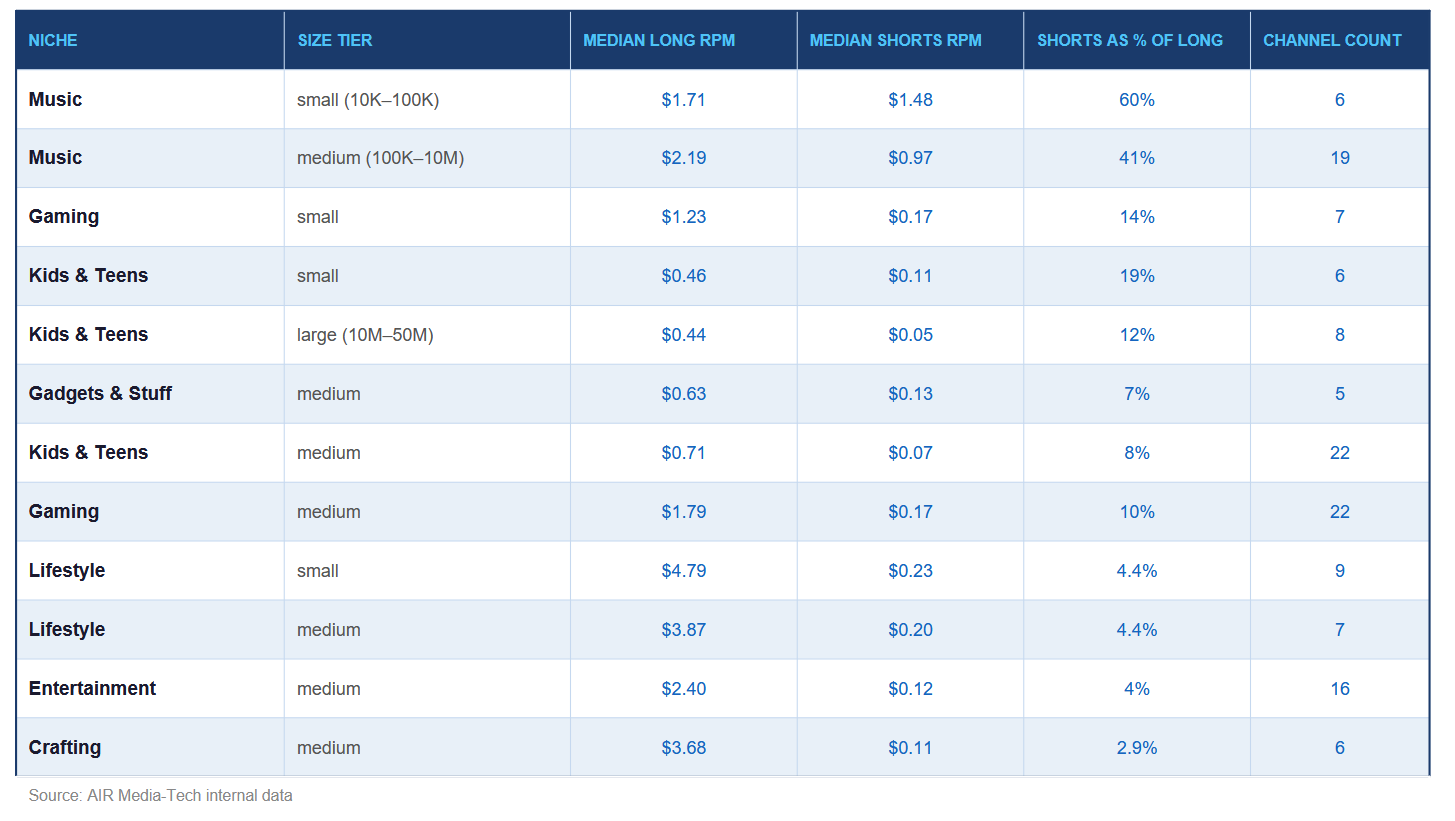
As you can see, Shorts RPM clusters between $0.07 and $0.20 per 1,000 views for most niches. The few exceptions are Music (Content ID), Lifestyle small (brand deal contamination in the sample), and Gaming small.
What does this mean in practice? If your Gaming channel earns $1.79 RPM on long-form and $0.17 on Shorts, every 1,000 Shorts views earns you about 9.5 cents, while every 1,000 long-form views earns $1.79. The Shorts view is worth roughly 9.5 cents. The long-form view is worth about 18× that.
How Many Shorts Views Does It Take To Match 1,000 Long-Form Views?
The calculation is pretty straightforward: divide long-form RPM by YouTube Shorts RPM and multiply by 1,000. The result tells you how many YouTube Shorts views you need to earn the same revenue as 1,000 long-form views.
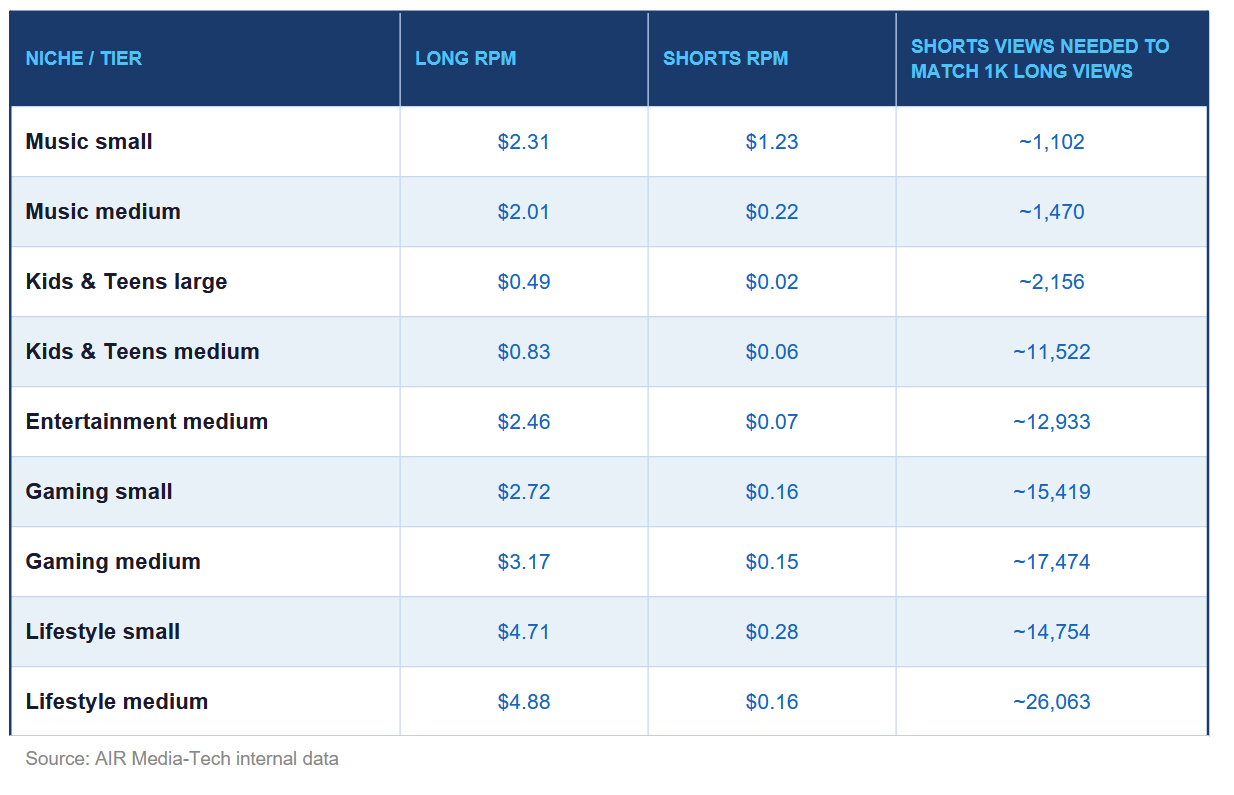
Music is the complete outlier. A Music small channel needs only about 1,100 Shorts views to match 1,000 long-form views, which is roughly a 1:1 exchange rate. This is because Music Shorts are frequently monetized via Content ID: when a Short uses copyrighted music, the rights holder receives a share of the revenue, and many Music channels are the rights holders. This mechanism is completely unavailable to non-Music niches.
For almost every other niche, the gap is 11,000-26,000 Shorts views per 1,000 long-form views. A Gaming channel generating 100,000 long-form views per month at $3.17 RPM earns $317. To match that from Shorts alone at $0.17 RPM, the channel would need 1,865,000 Shorts views per month.
At a million views, the gap gets hard to ignore: 1 million Shorts views from a U.S.-heavy audience earns about $300, while a million long-form views pays about $2,300 at the median.
See how much YouTube pays for 1 million views for long-form, Shorts, and live streams side by side.
Important: Shorts revenue on its own is not why you make Shorts. The reason you make Shorts is what those views do to your long-form performance. That is a different question, and one that the data also answers.
Do YouTube Shorts Hurt Your Long-Form RPM?
This is the most controversial question in the Shorts debate, and it is the one the within-channel design was built to answer. The finding is real but requires careful interpretation.
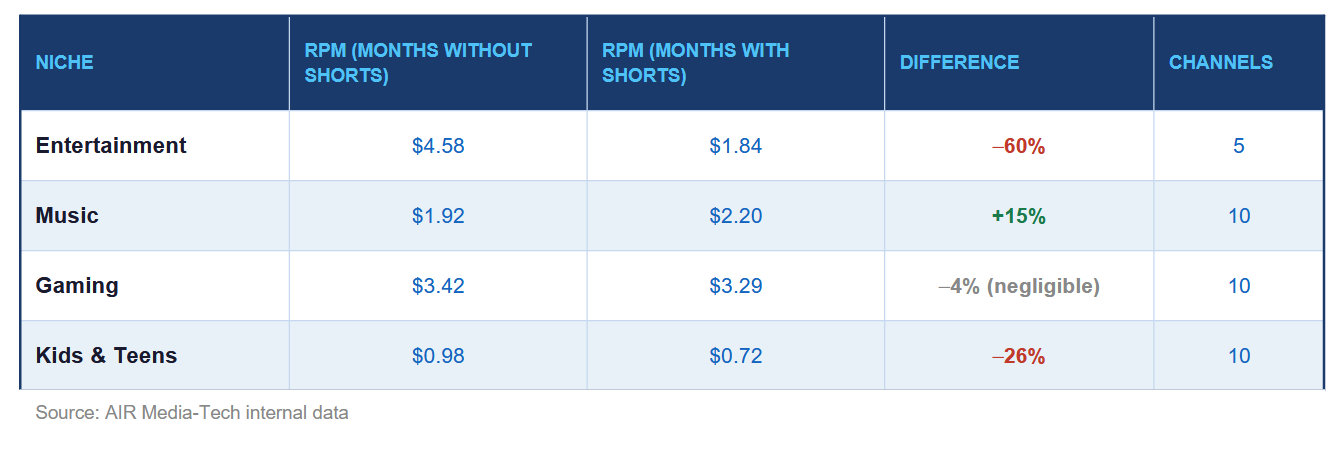
Entertainment shows the most dramatic compression: the same channels earn $4.58 RPM in months when they don't post Shorts and $1.84 when they do, which is a whopping 60% drop. Kids & Teens shows a 26% drop. Gaming shows almost no change. Music shows a modest increase in YouTube Shorts months.
However, it’s important to remember that this might be correlational. Channels may post Shorts in months when they are less active overall. The lower RPM in Shorts month may reflect overall lower channel activity rather than a direct Shorts-to-RPM suppression effect.
What can be said confidently: there is a consistent pattern in the data where months with Shorts activity show lower long-form RPM in Entertainment and Kids & Teens. Whether Shorts cause that RPM drop or merely correlate with it cannot be determined from this dataset. The most honest interpretation is: this is a signal worth monitoring in your own channel data.
Gaming's stability is notable. Across 10 Gaming channels in the within-channel sample, RPM is nearly identical in Shorts and non-Shorts months ($3.29 vs $3.42). This suggests that whatever the mechanism is behind RPM compression in Entertainment and Kids, it either does not apply to Gaming or applies much less. This may reflect Gaming's audience behavior, where Gaming viewers are habitual, subscribe-and-watch, and do not easily substitute Shorts for long-form content.
Dose-Response: Do More Shorts Mean Lower Long-Form RPM?
So, how often is too often when it comes to posting YouTube Shorts, niche-by-niche? The within-channel comparison shows a before/after effect. The dose-response data show whether the effect gets worse as Shorts volume increases, and in Entertainment, it does so dramatically.
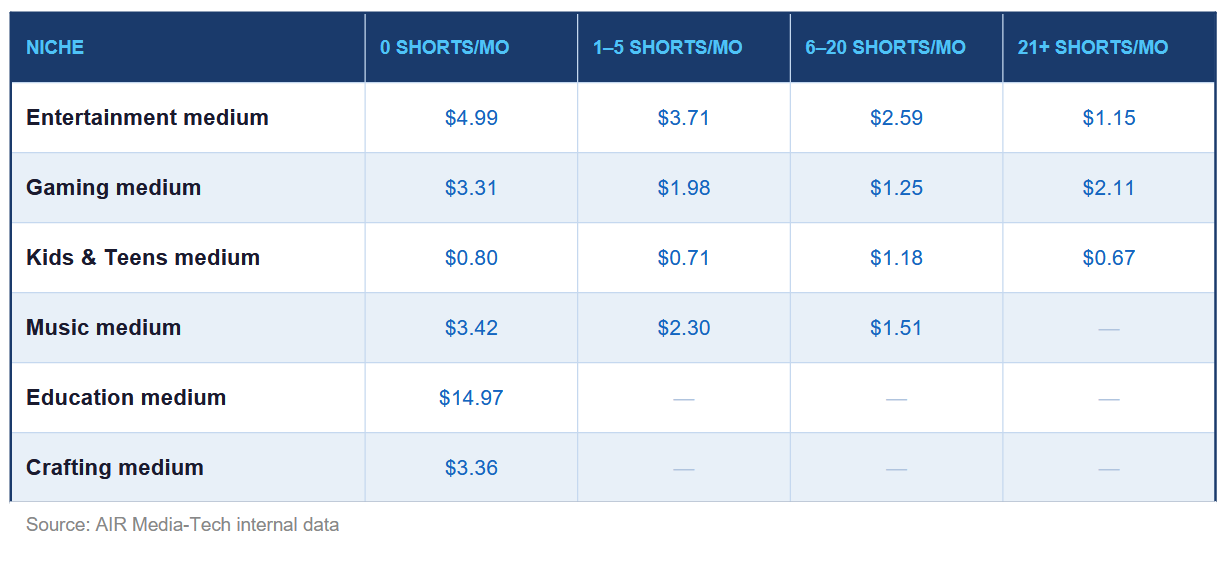
Entertainment shows a monotonic decline: $4.99 at 0 Shorts per month, falling to $1.15 at 21+ Shorts per month, a 77% drop. This is the strongest dose-response signal in the dataset.
Gaming breaks the monotonic pattern at 21+ Shorts per month ($2.11, a partial recovery from the $1.25 at 6–20). This likely reflects a cohort effect: Gaming channels posting 21+ Shorts per month are predominantly clip channels with a specific format and audience.
How many Shorts are too many?
If you're in Entertainment and considering a heavy Shorts strategy, the dose-response data suggests significant long-form RPM compression above 6-20 Shorts per month. If you're in Gaming, the RPM signal is noisier, and the channel-level data shows greater stability. The sweet spot across most niches where RPM damage is minimal appears to be 1–5 Shorts per month, which aligns with what the broader posting frequency data shows — the channels that over-posted even long videos had 55% fewer subscribers than those posting at the optimal rate.
What Share Of Revenue Comes From Shorts?
For most channels, Shorts contribute almost nothing to total revenue, despite generating a meaningful share of total views. This is the clearest illustration of the RPM gap in absolute dollar terms.
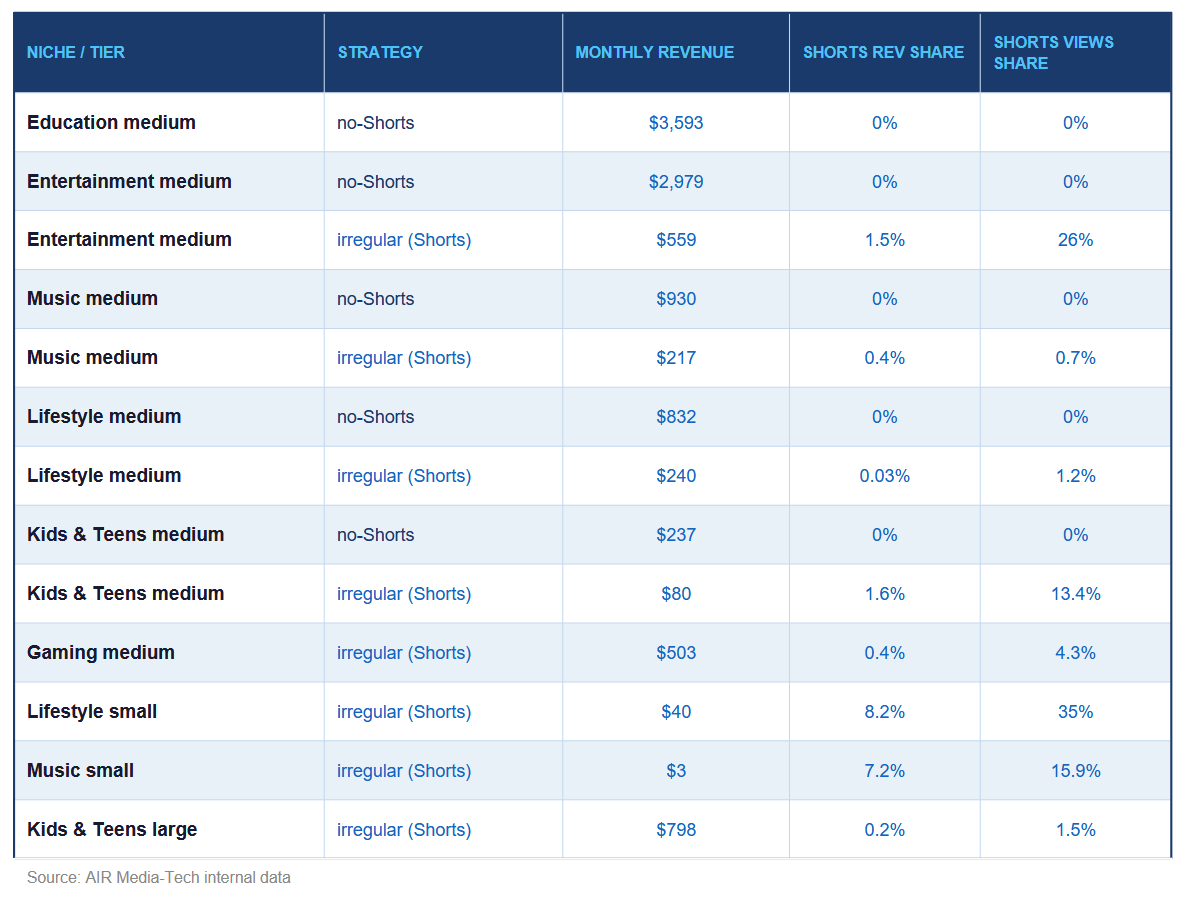
Once again, the Entertainment medium row deserves particular attention. Irregular channels (aka those that sometimes post Shorts) earn $559 per month versus $2,979 for pure long-form channels in the same niche. That is a 5.3× revenue premium for not posting Shorts. Meanwhile, those irregular channels' Shorts account for 26% of their total views but only 1.5% of their total revenue. They are generating a quarter of their traffic with a format that produces less than 2% of their income.
The critical context for interpreting these numbers: this is cross-sectional data. Channels that post Shorts and channels that don't are different kinds of channels: they differ in content quality, monetization setup, audience geography, and content strategy. The 5.3× revenue gap in Entertainment does not prove that posting Shorts costs these channels revenue. It shows that Short-active channels in this sample earn dramatically less, but the causality could run in either direction, or both ways could reflect underlying differences in channel quality.
The within-channel data (same channels in Shorts vs non-Shorts months) is the cleaner comparison, and it shows the gap is real but smaller than the cross-sectional comparison suggests.
Where Shorts revenue becomes meaningful:
The one context where Shorts revenue share climbs to significance is Kids & Teens at the large tier, posting 21+ Shorts per month: Shorts account for 41% of revenue at that combination. For large kids' channels, Shorts volume can shift the entire revenue mix. This is consistent with the Kids & Teens video-level finding that Shorts have a 45.7% monetized playback rate versus 12.1% for long-form, which is a structural effect of COPPA ad-serving restrictions that suppress ad serving on long-form kids content, making Shorts proportionally more monetizable in absolute terms.
From February 1, 2027, Shorts revenue gets a floor. YouTube has announced that channels will need 10 million qualified Shorts views over the trailing 90 days to share in Shorts ad revenue. At the 0.07–0.20 RPM most niches in this study earn, a channel with 1 million Shorts views a quarter makes 70–200 from Shorts today, and after that date it will make nothing from Shorts ads until it crosses 10 million again. Long-form monetization and YPP status stay in place. Large Kids & Teens channels, where Shorts bring in 41% of revenue at 21+ Shorts a month, have the most to lose if their qualified views dip below the line. Qualified views count only public Shorts watched past the first seconds, with loops excluded. We broke down the full update in YouTube's new monetization rules.
See channels half your size outperforming you?
It's not luck. They've solved a structural problem you haven't found yet. Our specialists who've audited 3,000+ channels will find it in yours.
Show me what to fix
Does Shorts Length Affect CPM?
Important! This section uses video-level data from 17 channels only. The findings are directional, so treat them as hypotheses (in this section). This part is about Kids & Teens specifically, comparing long-form videos (3–10 minutes) against Shorts (60–180 seconds):
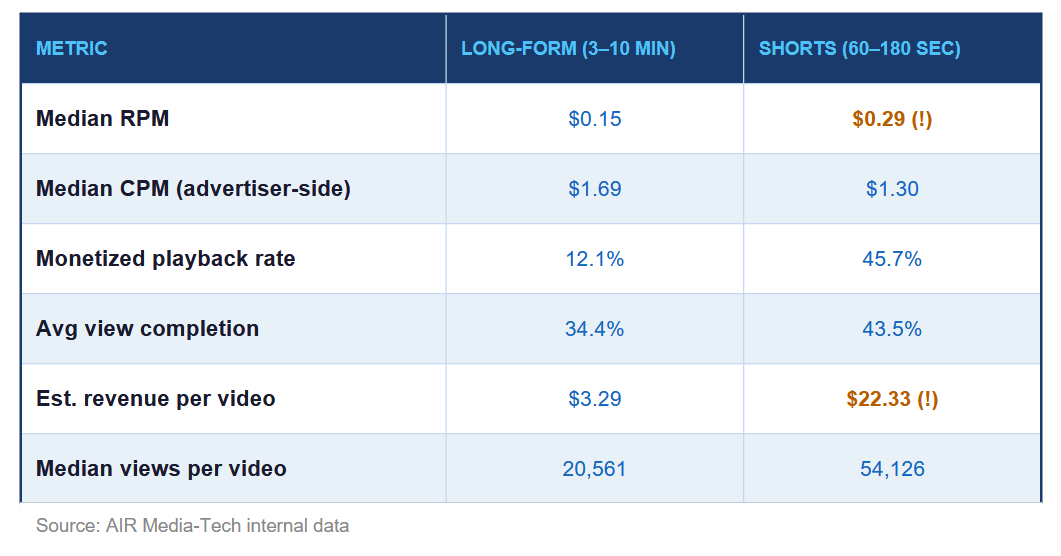
(!) Both rows are low-confidence (3 channels per format group). These figures should not be used as niche benchmarks.
The counterintuitive finding: Shorts show higher RPM ($0.29) than long-form ($0.15) at the video level, despite lower advertiser CPM ($1.30 vs $1.69). The explanation is the monetized playback rate: 45.7% of Shorts views carry a monetized ad versus only 12.1% of long-form views. Nearly 1 in 2 Shorts views is monetized. Only 1 in 8 long-form views carries an ad in Kids & Teens content.
This is a COPPA-specific effect: YouTube heavily restricts ad serving on content made for children under 13. Long-form kids' content faces stricter ad suppression than Shorts. The higher monetized playback rate for Shorts is not a general phenomenon; it reflects specific regulatory constraints that apply to this niche.
If Shorts RPM Is That Low, Why Do They Still Improve Revenue?
Everything above documents the direct revenue picture: Shorts pay 3-14% of what long-form pays per 1,000 views. Direct Shorts revenue is negligible for most channels, accounting for 0.03-8% of total revenue while consuming 1-35% of total views.
But we don’t use Shorts for direct revenue. Let’s see how it works on a real example.
How an Arts & Crafts Channel Got +64% Revenue in 30 Days
An arts and crafts channel (clay sculpting, resin art) hit a growth ceiling in August 2025. Long-form views slowed, recommendations cooled, revenue dipped. AIR recommended launching Shorts on August 22. The creator hesitated. Why? Exactly the concerns documented above: format mismatch, low RPMs, worry about cannibalization. On September 4, they started posting Shorts anyway.
Results in the 30 days following the Shorts launch:
- Views: +41.8%
- Revenue: +64.1%
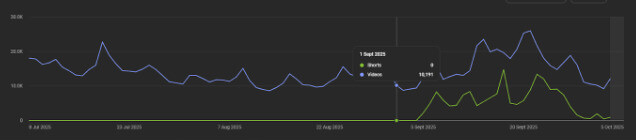
Revenue grew 1.5× faster than views, because the new views came partly from Shorts (low RPM) and mostly from the long-form content those Shorts viewers went on to watch (high RPM). Shorts didn't generate meaningful direct revenue. They reactivated the algorithm's recommendation behavior, which served the channel's existing long-form content to a larger audience. The monetary gain itself came from long-form.
+1M views with Shorts
PlayToys & Play Dolls includes two large kids channels (8.03M and 7.26M subscribers). They had been flatlining despite their subscriber bases. The reason: they weren't appearing in YouTube Kids, and they had never published a single Short. AIR escalated the YouTube Kids placement through YouTube's internal review team on May 20 and recommended launching Shorts simultaneously. The YouTube Kids approval came on June 18, four weeks later.
Results from zero Shorts activity before April 2025:
- Play Dolls: 877,000 total views, 503,000 engaged views, 3,900 hours watch time
- PlayToys: 301,000 total views, 161,000 engaged views, 1,400 hours of watch time
- Combined: 1.17M+ views from a standing start
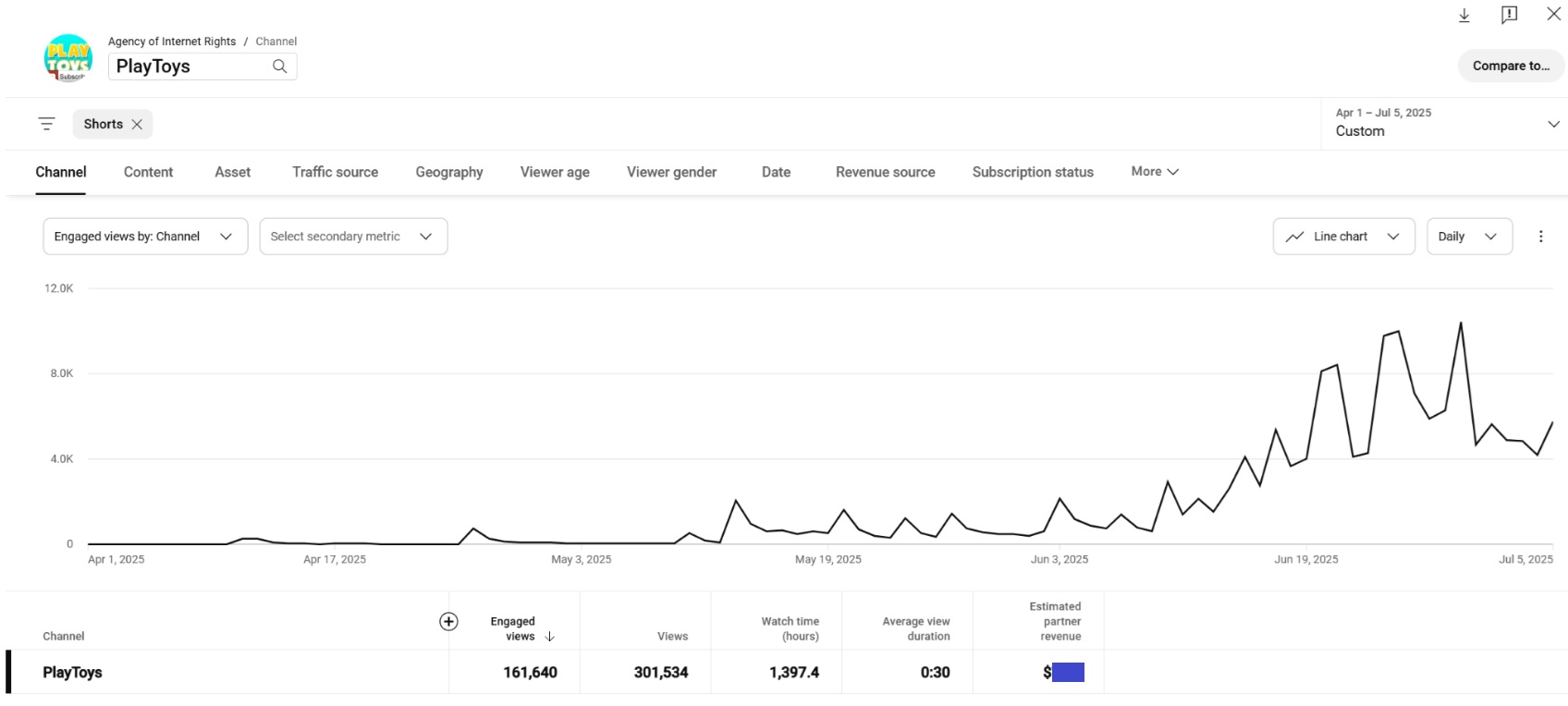
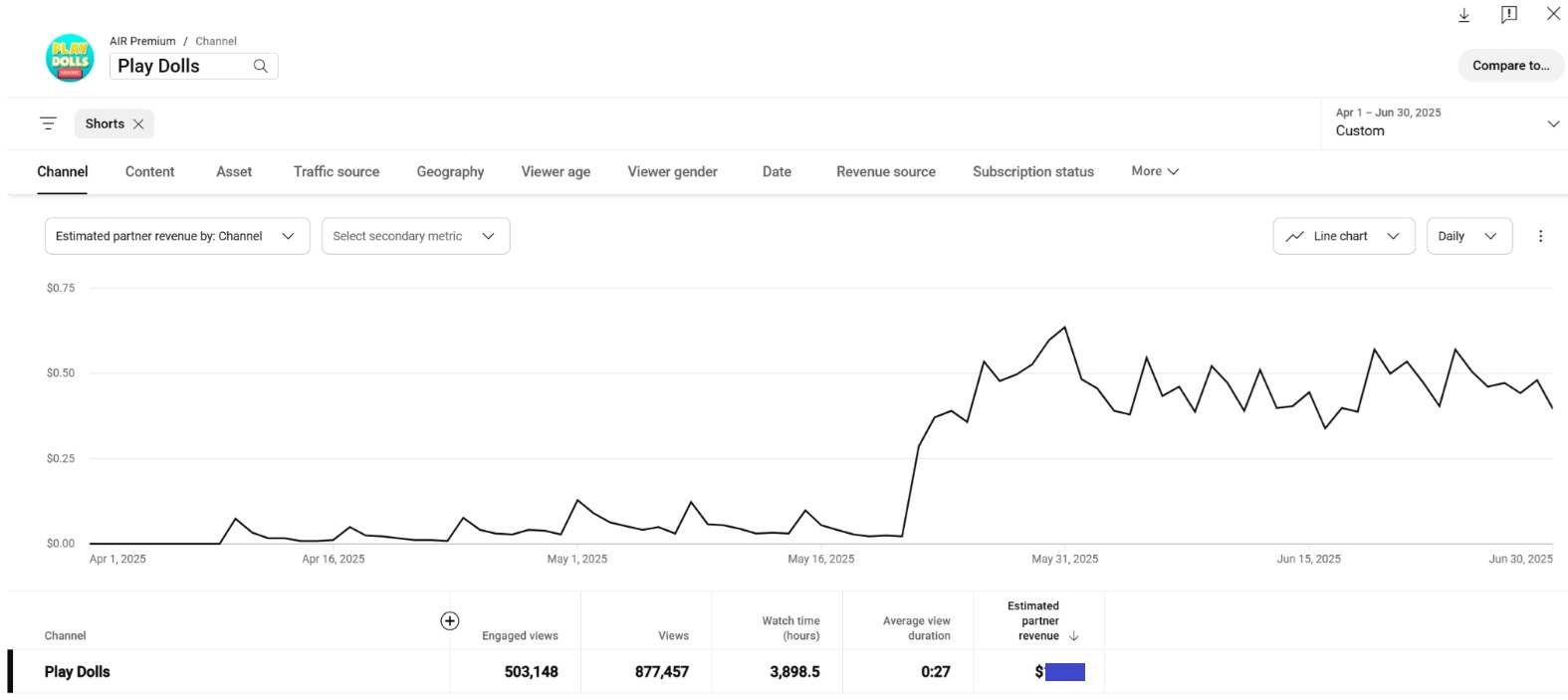
Both channels had the audience but were invisible to new viewers on two of YouTube's biggest discovery surfaces: the Shorts feed and the Kids app. The Shorts launch created the first mobile-native entry point for new viewers who had never encountered the channels before. The YouTube Kids placement created the cross-app signal that amplified recommendations on the main platform. Neither required a new content strategy nor higher publishing frequency.
This Kids’ Channel Got +153% Revenue with Shorts
A kids' channel with 5.68M subscribers had already been growing with AIR through localization, 400M+ views from translation work alone. The next goal was structural growth beyond translation. AIR applied a multi-lever intervention: packaging improvements, metadata optimization, seasonal timing, and a deliberate Shorts expansion. Shorts feed share grew from 6.2% to 15.7% of all channel traffic. Q3 vs Q4 2025:
- Views: +76% (27.7M → 48.9M)
- Revenue: +153%
- Long-form uploads: −35% (82 → 53 videos)
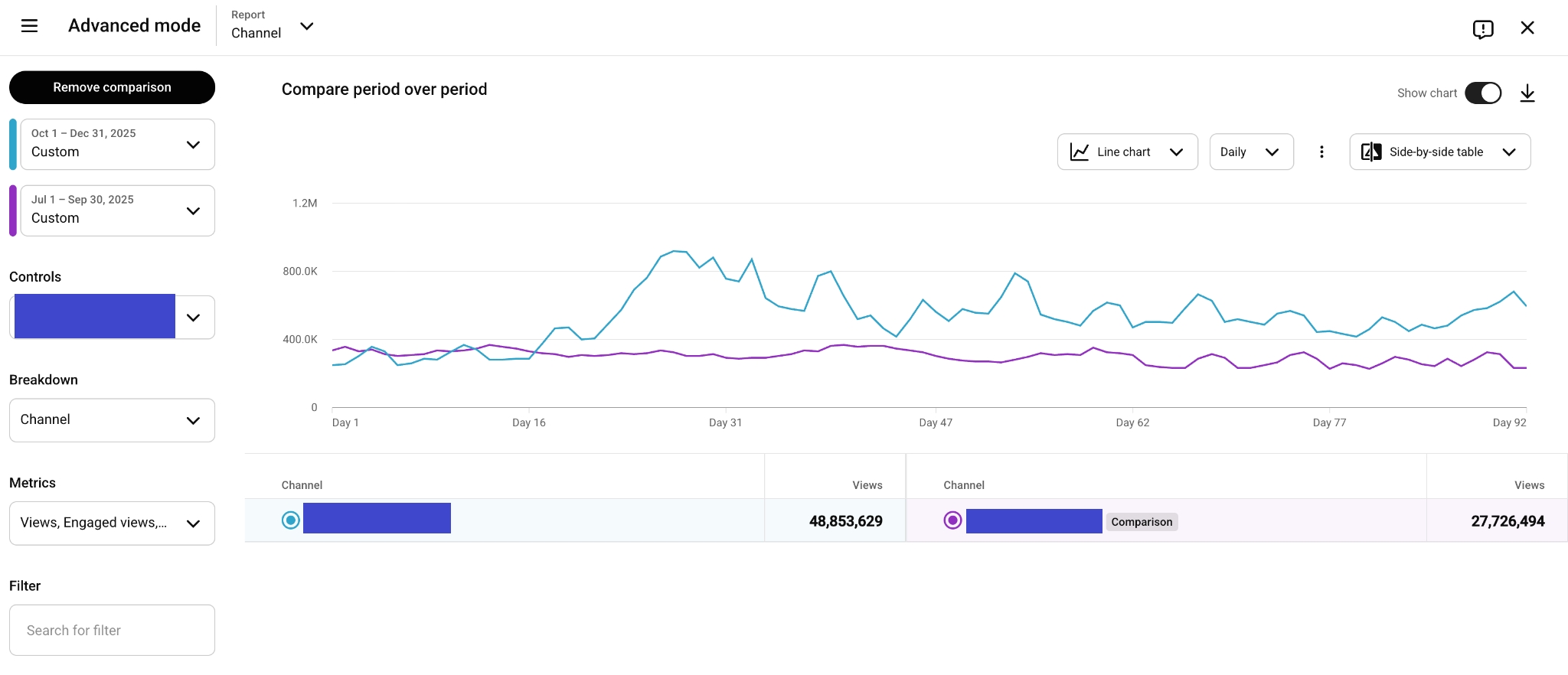
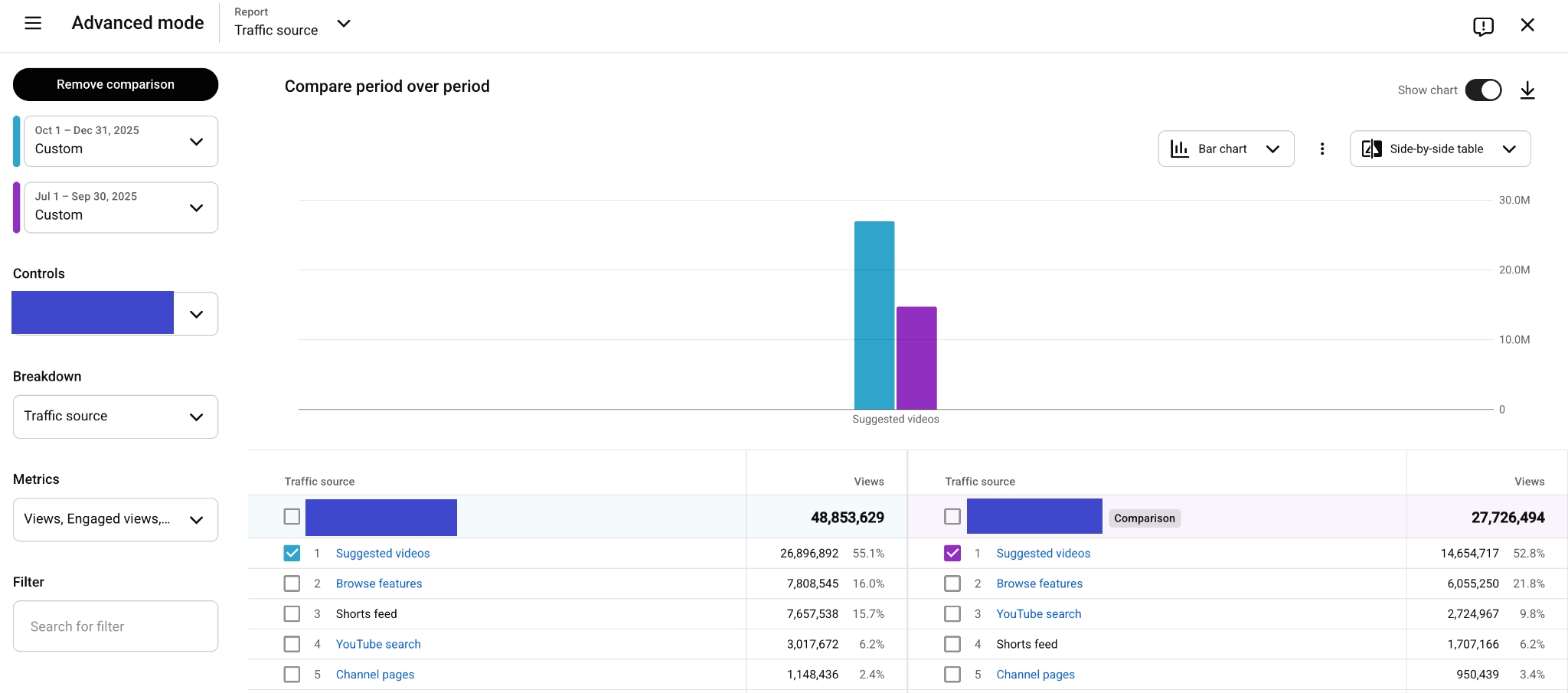
Revenue grew 2× faster than views, which is the same mechanism as the Arts & Crafts case, running at a larger scale. Shorts added 6 million net-new views to the channel. Those views seeded Suggested traffic, which grew 84% (14.65M → 26.90M). The fewer, better long-form videos that received that traffic had higher watch time and stronger CTR from improved packaging, which meant more monetized impressions per view. The Shorts themselves contributed minimally to direct revenue. The 153% revenue gain came from the long-form sessions Shorts viewers went on to watch, not from the Shorts feed itself. The most counterintuitive number in this case: 35% fewer videos published, 153% more revenue earned.
This Channel Got +33.4% Revenue with Shorts
A kids' channel with 7.5M subscribers had already built what most creators spend years chasing: a format kids enjoy, a recognizable content identity, and a loyal audience. The question AIR was asked to answer was "What can still move the numbers at this scale?"
The intervention had three components:
- 4K publishing to align with the shift toward TV viewership.
- A kids' content quality workshop. Grab the PDF with 34-rules here.
- And a deliberate format rebalancing.
- Long-form uploads dropped from 21 to 11 videos in the quarter, which is a 47.6% decrease.
- Shorts went from 10 to 23, so a 130% increase, built primarily by repurposing the strongest moments from existing long-form content into a vertical format.
Results for the quarter:
- Views: +5.5%
- Revenue: +33.6%
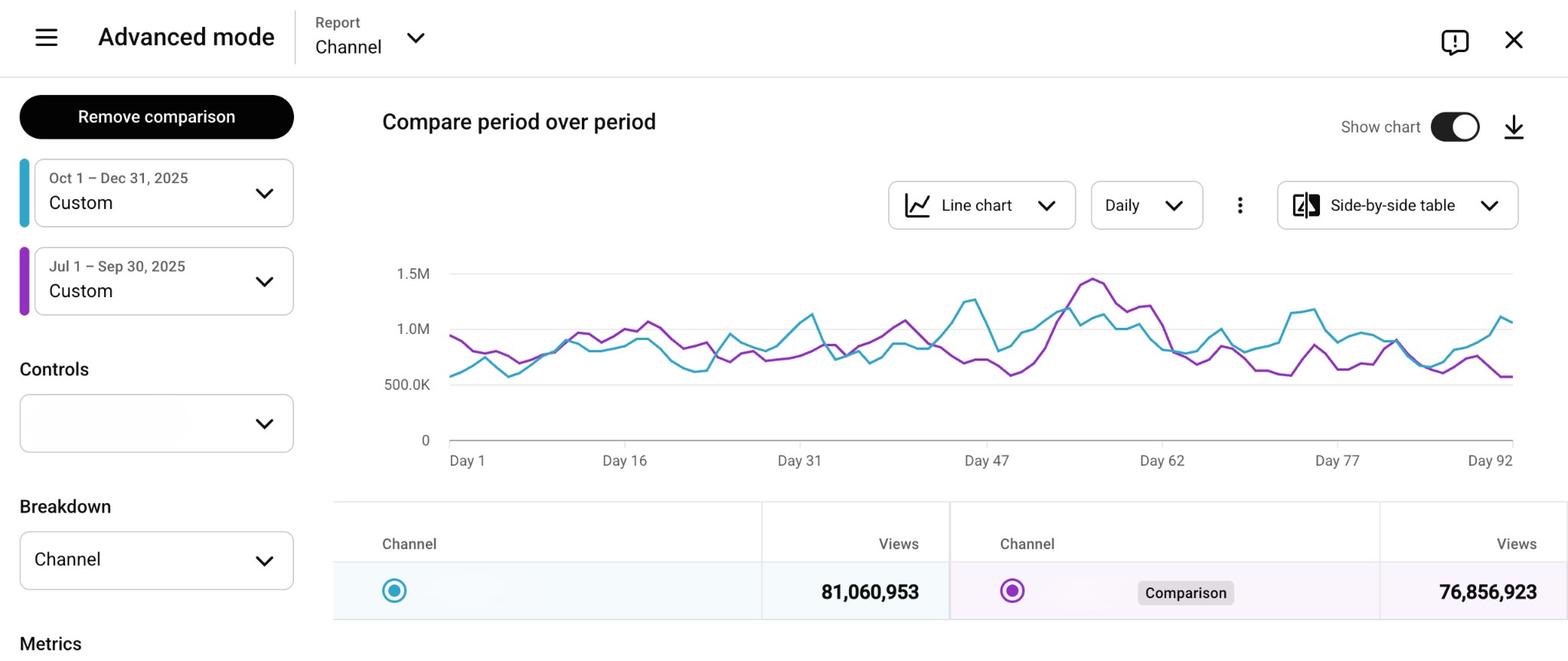
Revenue grew 6× faster than views. The mechanism is as follows: Shorts expanded the discovery surface, routing a better-matched audience into the channel's long-form library, where monetized watch time lives. In this case, the views had barely moved because the channel was already large and well-distributed, but even then, the 5.5% gain, at that scale, is huge. That way, fewer videos meant better traffic and more revenue.
What Can You Do With This Data?
- In almost every niche, Shorts are a discovery mechanism, not a monetization one.
Direct revenue from Shorts doesn't add up outside of Music. The path that works is indirect: Shorts put your channel in front of viewers who wouldn't have found it otherwise, and a portion of those viewers go on to watch your long-form content at full RPM. That downstream effect is where the economic value lives; design your Shorts strategy around it.
- Music operates under a different set of rules entirely.
Content ID fundamentally changes the Shorts equation for channels that own their rights. Small Music channels in this dataset reach 60% of their long-form RPM on Shorts, a ratio no other niche approaches. The revenue mechanism (rights holder share from Content ID) is structurally unavailable outside of Music. If you're a Music creator who controls your catalog, Shorts as a direct revenue stream is a real conversation worth having.
- If you're in Entertainment, the RPM compression data deserves your attention.
The within-channel comparison shows Entertainment channels earning $4.58 RPM in months without Shorts and $1.84 in months with Shorts. The dose-response extends that finding further: long-form RPM at zero Shorts per month ($4.99) falls to $1.15 at 21+. Causality isn't established, but a consistent 60% RPM drop across multiple channels is a signal that warrants tracking in your own Studio data before you scale Shorts volume up.
- Volume is where the risk concentrates.
Low Shorts cadence shows minimal RPM impact in the dose-response data across most niches. The damage appears at the high end: 21+ Shorts per month is where the RPM and revenue gaps between Shorts-active and non-Shorts channels are widest. The 0.28–0.40 Shorts ratio (one Short per two to three long-form uploads) is the range where mixed-strategy channels show the strongest combined subscriber and revenue performance.
- Kids & Teens is the one niche where the Shorts revenue math is genuinely different — in both directions.
COPPA's ad-serving restrictions suppress long-form monetization significantly: only 1 in 8 long-form views in Kids & Teens carries a monetized ad. Shorts, by contrast, show a 45.7% monetized playback rate in this niche. That structural difference makes Shorts proportionally more monetizable here than their per-view RPM suggests. At the large tier with 21+ Shorts per month, Shorts revenue share reaches 41% of total channel revenue.
What Can't This Data Tell You About Your Specific Channel?
The findings above describe patterns across 274 channels.
Your channel is one channel, with its own niche positioning, audience geography, monetization setup, content quality, and traffic source mix. So, the question of “is it worth starting post YouTube Shorts” on your channel might have multiple answers.
Show us your channel, and we will tell you more! After working with over 3,000 channels, we know what works and what doesn’t, and we will show you what results YouTube Shorts can bring to your channel specifically.
That is also what an AIR channel audit does, but with 10 performance dimensions, competitive benchmarking against the right channels in your niche, and 21 AI diagnostic tools trained on a 450K-channel dataset. If you want to know whether your channel's Shorts strategy is helping or hurting, and exactly what to adjust, the audit is where that answer comes from.
What you get:
- A structured report across packaging, retention, traffic sources, format mix, revenue structure, and audience behavior.
- A 30-day action plan ranked by impact.
- A 45–60-minute live walkthrough with a senior AIR strategist.