

The channels growing fastest on YouTube in 2026 look different from the outside. From the inside, in their YouTube Studio, the pattern is the same: retention holds, hooks deliver what the thumbnail promised, every video routes to the next one, Shorts feed long-form instead of sitting in isolation, at least three revenue streams run in parallel, and the channel stays active in the algorithm even when uploads slow down.
We work inside YouTube Studio for 3,000+ channels. The problems that cap growth are almost always the same. This playbook covers what they are, what the data shows by niche, and what to fix first.
7 Things That Matter Most on YouTube in 2026
- YouTube's algorithm is AI-first: it watches and listens to your video, not just reads your tags.
- Shorts and long-form run on separate algorithms. Weak Shorts no longer drag down your main channel.
- Long-form is your primary revenue engine. Personal Finance CPM averages $15–$40; Shorts RPM tops out at $0.33 in the US.
- Viewer satisfaction (not raw watch time) is the dominant ranking signal.
- The new YPP Early-Access Tier lowers the bar: 500 subscribers and 3,000 watch hours, or 3M Shorts views in 90 days.
- Revenue diversification matters more than ever: ads + memberships + Super Thanks + brand deals + livestream gifts.
- From May 2026, YouTube auto-labels AI content even without disclosure. Disclose yourself first.
Design Videos for Viewer Satisfaction
For years, the playbook was to make videos longer and keep people watching. That still matters, but YouTube's AI-first system now evaluates value per second, not just duration — a 5-minute video where 80% finish beats a 15-minute video where 60% drop off at the three-minute mark.
YouTube states directly that recommendations respond to four signals: whether viewers click when shown the video, how long they stay and whether they rewatch, whether the video starts a new viewing session, and post-watch signals like likes, shares, and satisfaction surveys.
The algorithm also cross-references your title and thumbnail against your actual content — if you promised something and didn't deliver it in the first 90 seconds, retention drops and distribution shrinks. What's new for 2025–2026: evaluation happens faster. The first 30–60 seconds now decide whether a video gets pushed further or cooled in Browse and Suggested.
Design Hooks That Earn Satisfaction Signals
The retention failure modes our audit team documents most often:
- A slow burn start (value delayed past 30 seconds)
- A missing payoff (no clear arc or resolution)
- Pacing drag (monotonous sections without a state change)
- Hook-content disconnect (thumbnail or title promises something the video doesn't deliver fast enough)
Every hook that works is the inverse of one of these:
- Lead with the result, then the tension. State the outcome first, then why it's harder than it looks.
- Lead with a specific number. "Most channels get 0.04% Shorts-to-long-form conversion. The target is 0.5%" is harder to skip than "most channels get this wrong."
- Lead with the direct answer. Answer the title's question in the first sentence, then prove it — YouTube and AI Overviews both reward front-loaded answers.
- In Shorts, it starts with the first frame. At VidSummit 2026, Jon Youshaei showed how a series that opens on an instant visual comparison reached 40 million views.
Audit your last 10 uploads: find every retention drop steeper than 5 points, write one sentence on the cause for each. The same cause will show up 3–4 times — fix that one structural issue on your next upload before anything else.
Why are other channels outgrowing you?
It's not luck. There's a specific reason — and our specialists who've audited 3,000+ channels will find it in yours.
Show me what to fixDesign Content in Pairs
YouTube's recommendation system is a session machine — it rewards channels that route one video into the next over channels that publish standalone pieces, with more Browse and Suggested placements.
Across AIR's audits, the same three gaps keep showing up:
- End screens go unscripted. A political news channel (4.82M subscribers) had an end-screen CTR of ~0.08% against a benchmark closer to 5 per 1,000 views. A B2B education channel had near-zero end-screen clicks on most long-form videos.
- Playlists are underpopulated. A kids channel (BabyTV, 2.55M subscribers) had playlist coverage of 167% versus its closest competitor's 299% — and versus Super Simple Songs' 891%. The audit flagged it as the biggest structural gap and the cheapest unlock on the channel.
- Cross-video routing is broken between related uploads that should be pointing to each other.
A content pair is two videos on related angles of one topic — "why your thumbnails stop working after 6 months" into "how to redesign a stale thumbnail without losing your CTR" — with Video 1's end screen pointing specifically to Video 2, and both grouped under a consistent playlist name ("YouTube Packaging | Episode 1/2," not "Tutorial #4"). The algorithm starts recommending Video 2 to everyone who watched Video 1, with no extra promotion needed.
What to do now:
- Check your end-screen CTR in YouTube Analytics. Below 5 per 1,000 views almost always means the last 30 seconds aren't scripted as a deliberate handoff — say the name of the next video aloud, then link it specifically.
- Add every video to 3–4+ playlists. Each placement is a separate discovery surface.
- Name your series consistently — "Episode 1/2" clusters algorithmically; "Tutorial #4" then "How I do X" doesn't.
AIR's promotion guide covers playlist architecture that drives binge sessions in full.
Treat Shorts and Long-Form as Two Separate Engines
AIR's analysis of 18,000 channels found the split by niche:
- Fitness, food, business, education: mix in Shorts. Fitness channels that post Shorts have 41% more subscribers than long-form-only fitness channels; business channels show 39% more.
- Gaming, entertainment at scale, science: stay long-form-only. Gaming channels that skip Shorts have 85% more subscribers than mixed ones — the widest gap in the dataset.
- Safe range: 25–40% Shorts by upload count. Above 55%, long-form performance thins. Below 10%, you're effectively long-form-only. Don't shift the ratio more than 30 points in one quarter — abrupt pivots underperform both a steady mix and a steady long-form-only approach.
The systems don't cross-contaminate. YouTube confirms — and Todd Beaupré, YouTube's Senior Director of Growth & Discovery, has said the same — Shorts and long-form run on separate signals. A weak Short won't suppress your next long-form upload.
What to do with Shorts:
- Configure Related Video on every Short (Video Details → Related Video → link to the parent long-form). It's the only routing mechanism Shorts support — no end screens.
- Structure the Short as an incomplete answer. Show the result, withhold the method, add a verbal CTA in the final 3 seconds: "Full breakdown in the linked video."
- Target 0.5–1% Shorts-to-long-form conversion, not the 0.04% most channels run at. It's a routing problem, not a content problem.
One AIR-managed arts and crafts channel proved it: solid long-form, recommendations had cooled, and they launched Shorts with proper routing on September 4. Thirty days later: +41.8% views, +64.1% revenue. Routing did that, not new content.
Long-form carries the mid-roll ad inventory; Shorts don't — CPMs run $2–$40 depending on niche (Personal Finance tops out at $15–$40) versus a Shorts RPM ceiling of $0.33 in the US.
|
Shorts |
Long-form |
|
|
Primary goal |
Discovery, reach, top-of-funnel |
Revenue, loyalty, search |
|
Algorithm |
Separate Shorts feed |
Browse, Search, Suggested |
|
Avg RPM (top markets) |
$0.14–$0.33 (US, AU, CH) |
$2–$40 depending on niche |
|
Best for |
New audiences, top-of-funnel |
Retention, monetization |
|
Optimal ratio |
25–40% of uploads |
60–75% of uploads |
Full niche-by-niche recommendations: Do YouTube Shorts Help Your Long-Form Videos Grow? — Data From 18,000 Channels.
Build Revenue Streams Beyond AdSense in 2026
AdSense is the floor, not the ceiling. Channels in AIR's network that earn 10x more than channels with the same subscriber count run 3–5 revenue streams simultaneously.
Memberships, Super Thanks, Super Chat
Memberships compound. A channel with 200 members at $4.99/month earns $1,000/month. Unlike ad revenue, it doesn't drop when CPM dips in January or when a video underperforms. Rally Point, an entertainment channel AIR worked with, built memberships to 60% of total channel revenue in six months.
Super Thanks works best with a specific call to action: not "support the channel," but "if this saves you time, the Super Thanks button is right below." Specificity converts.
YouTube's 2026 update adds ad-free windows for viewers who activate Super Chat during a stream, which is a meaningful incentive for activation. Channels that acknowledge Super Chats live, by name, show 30%+ higher Super Chat revenue than channels that treat it as background noise.
Brand Deals: How to Land Them in 2026
Two things now remove the friction that used to block most brand deals:
- Passive: You can use the Creator Partnerships Hub. Built into YouTube Studio, brands search 3M+ YPP channels by niche and audience data instead of subscriber count. Set up your profile under Studio → Earn → Creator Partnerships, or you're invisible to advertisers already searching.
- Active: your own storefront. pin.top gives you a public page with API-verified stats pulled directly from the platform, your own rates, and terms — brands apply and pay upfront.
Package UGC as a separate service on your pin.top page too — 97% of brands order creator UGC for ads and product pages, often without ever publishing it on the creator's own channel.
Both work without you pitching.
Use Live Streaming as a Revenue Engine
Over 30% of daily logged-in viewers now watch live content, and live keeps your channel active in the algorithm between uploads.
- If you can go live yourself, one consistent 60-minute stream a week, same day and time, compounds into meaningful Super Chat and gift revenue within 3–4 months.
- If you can't run live yourself, 24/7 live streaming turns your back catalog into a continuous live channel with no new filming. A boxing and entertainment channel (269K subscribers) ran four simultaneous streams and saw +65% revenue and +183% watch time, with 55% of total revenue eventually coming from the streams. A DIY crafting channel (731K subscribers) tripled average view duration running the same model.
Feel like you should be earning more?
You're probably right. And you'll keep not knowing why until someone who's seen 3,000+ channels looks at your data and tells you how to fix it.
Find my revenue leaksLocalize Where the Numbers Work in Your Favor
Check YouTube Analytics → Geography before picking a language. If viewers outside your primary market already show up, that audience is forming without you — that's your starting point.
Competition, CPM, and audience size rarely point to the same language:
- Spanish — 600M+ speakers, growing CPM, but also the most competition. Still the safest first move for most channels: only 15% of YouTube content is in Spanish; it reaches Spain, Mexico, and the whole Latin American and US Hispanic market (Latin America alone has more YouTube users than the entire US), and AI dubbing quality for Spanish is among the strongest available. In AIR's MLA dataset, Spanish viewers averaged 8:55 per session on one entertainment channel — nearly two minutes longer than the English-language audience on the same content.
- German — $9.79 CPM, one of the highest on YouTube, with lower competition in most niches. Small absolute audience, best conversion ratios in AIR's dataset.
- French reaches France ($6.76 CPM), Canada ($9.93 CPM), and 21 fast-growing African countries in one language.
- Arabic reaches 22 MENA countries plus the diaspora in Germany, France, and the US — takes longer to build loyalty, but scale compensates.
- Indonesian, Bulgarian, and other smaller markets convert at scale despite low CPM. One AIR-managed channel hit 6.8 billion views and ranks #6 in Indonesia for Kids Entertainment, at a $0.84 CPM.
Large, obvious markets work too, when the content fits and the execution is right. Brave Wilderness launched nine translated channels across Spanish, German, French, Portuguese, and five others — in six months: 27.2M views, 134K new subscribers, and regional sponsorship deals, because wildlife content travels well and the professional dubbing held retention.
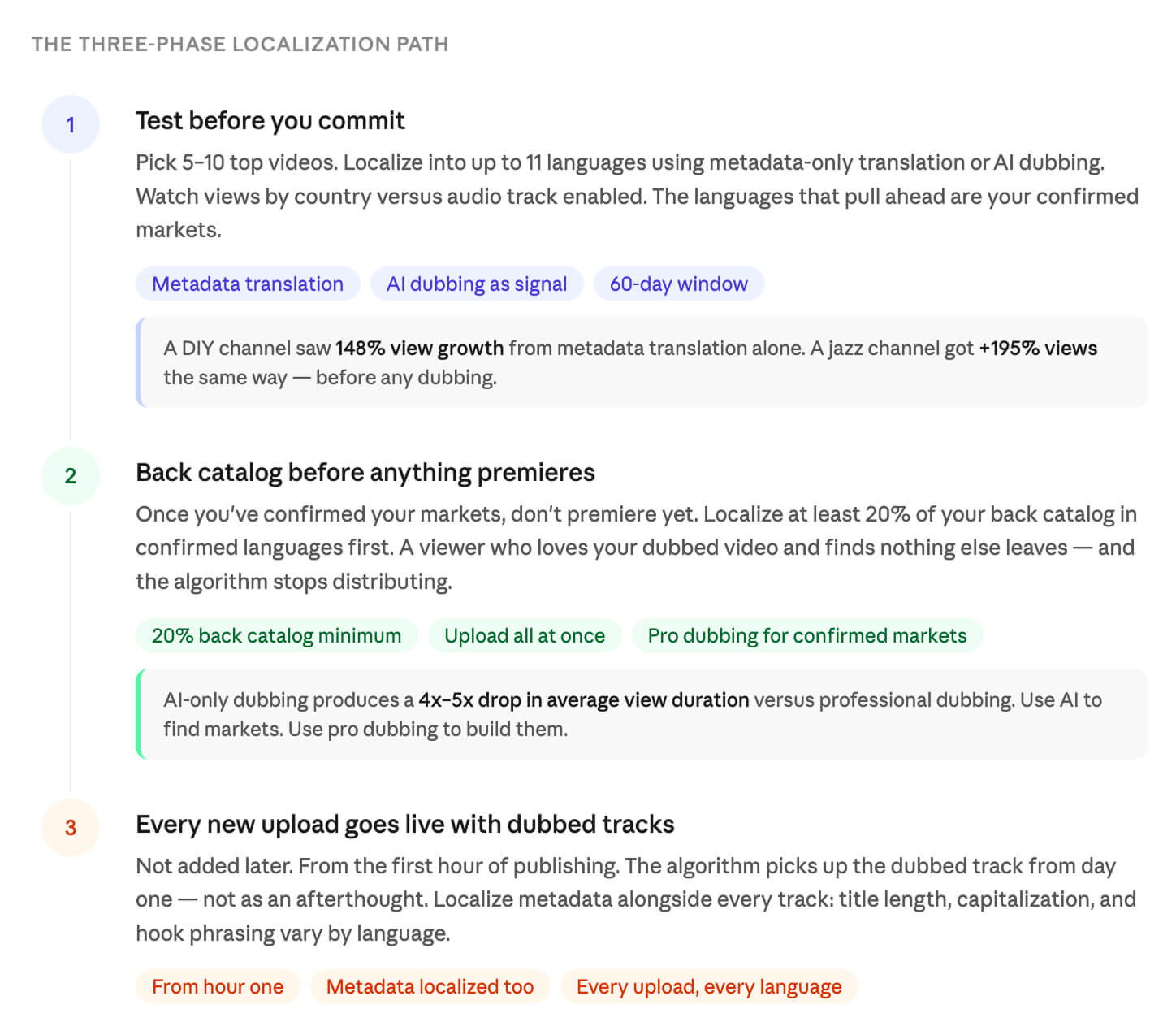
Test with metadata before you pay for dubbing: AIR's AI Metadata Translation tool tests demand across 200+ languages in minutes — a DIY channel saw 148% view growth this way; a jazz channel got +195%. Watch which languages pull views by audio track over 60 days before committing to voice work.
AI-only dubbing quality varies by language: it produces a 4x–5x drop in average view duration compared to professional dubbing in most cases — on Brave Wilderness's Spanish channel, pro dubbing held 5:19; an AI-only track on the same content dropped it to 1:22. Portuguese and Spanish AI quality is strong; French and Italian audiences feel the gap more.
How to roll out localization without wasting budget:
- Test first on your existing top videos. Localize your 5–10 best performers into 8–10 languages via AI dubbing or metadata-only translation. Watch views by country vs. audio track — languages that pull ahead are your confirmed markets; the rest stay as subtitles.
- Back catalog before premieres. Localize at least 20% of your back catalog in confirmed languages before you dub a new upload — a dubbed premiere with nothing else to watch loses the viewer, and the algorithm stops distributing it.
- Every new upload ships dubbed from hour one, not added later.
- Localize metadata with every dubbed track — title length, capitalization, and hook phrasing vary by language, and a perfectly dubbed video can still get suppressed by a title that doesn't fit the market.
If you're not sure which languages to start with, AIR's Translation Labs team analyzes your channel data, maps the right markets, and shows you where the demand already exists.
Distribute YouTube Videos Natively Across Other Platforms
Your existing catalog can earn a second income on platforms most creators haven't touched — as long as the promotion is native to each platform, not a YouTube link pasted into every feed.
- MSN pays from day one, no re-editing. This baseball commentary channel (575K subscribers) pulled $9,557 in a single month, $23,916 over the quarter on MSN, entirely from its existing library — on top of a YouTube AdSense income that swings $2,000–$10,000 a month with the news cycle. Access is invite-only through official publishers; the best fit is 7,000+ subscribers and 100+ videos.
- Facebook paid creators close to $3 billion in 2025, up 35% year over year, on a 55/45 creator split. Videos under 3 minutes only get pre-roll ads — 5–10-minute videos earn substantially more. 100K+ followers on any platform qualify for Meta's Creator Fast Track: $1,000–$3,000/month guaranteed for 3 months.
- Connected TV (Tubi, Roku, Pluto, Samsung TV Plus) pays the highest RPM — full-attention TV audience, no phone in hand — but the entry bar is higher: catalog depth and rights matter more than niche. We place creators on Tubi too, and the first channel was Amelka Karamelka Dark Stories.
- Snapchat fits an under-25 audience. 946M monthly active users, Creator Subscriptions launched in February 2026 as a paid tier on top of ad revenue.
|
Platform |
Best niche fit |
Audience |
Entry bar |
|
MSN |
Food, DIY, travel, health, science |
All ages, strong Gen Z growth |
7,000+ subs, 100+ videos |
|
|
Any — geography drives earnings more than niche |
25–55 |
5,000 followers or 100K Fast Track |
|
Connected TV |
Entertainment, kids, lifestyle, documentary |
TV viewers, 35+ |
Higher — catalog depth and rights required |
|
Snapchat |
Entertainment, lifestyle, beauty |
Under 25 |
50K+ followers, 25M+ Snap views |
The full platform-by-platform breakdown — entry requirements, RPM data by niche, and which niches perform where — is in AIR's 2026 video distribution study.
Use YouTube's New Discovery Tools From 2025–2026
The platform added several visibility levers in 2025–2026 that most creators haven't deployed yet.
Hype and Category Leaderboards
YouTube's Hype feature added Category Leaderboards in 2026: viewers get three free Hypes a week (resetting Monday) to push videos from 500–500,000-subscriber channels onto a category leaderboard visible to non-subscribers. The mechanics favor small channels — a 500-subscriber channel earns 7,500 points per Hype versus 50 for a 500,000-subscriber one.
- Publish your strongest video Monday or Tuesday, when Hype allotments refresh.
- Ask directly — "hit the Hype button; it resets Monday" converts better than "support the channel."
To see which channels are climbing fastest right now, and in which niches, check who's growing fastest on YouTube in 2026.
Shorts in Search and Home Feed (January 2026)
Shorts now appear in search results and the Home feed, not just the swipe feed — so they need long-form's metadata discipline: primary keyword in the first 5 words of the title, keyword plus direct outcome in the first 150 characters of the description. Strong metadata gets a Short into search and onto Home for people who've never seen your channel.
Reimagine for Shorts (March 2026)
YouTube's Reimagine feature, powered by Veo, lets viewers turn a frame from your Short into an 8-second AI continuation that links back to the original. Visually distinctive Shorts — strong composition, a recognizable style — pick up secondary distribution when viewers remix them.
Adapt for Conversational Search
YouTube's Gemini-powered Ask YouTube (testing with US Premium users since April 2026) assembles answers from multiple videos for natural-language queries. Titles written as direct answers to real questions beat keyword-stuffed ones; structure descriptions the same way — question first, then answer, then detail.
What Metrics Matter for YouTube Growth in 2026?
The creators who grow fastest aren't the ones who post most — they're the ones who read their data most accurately and act on the right signals.
Satisfaction Signals You Can See in YouTube Studio
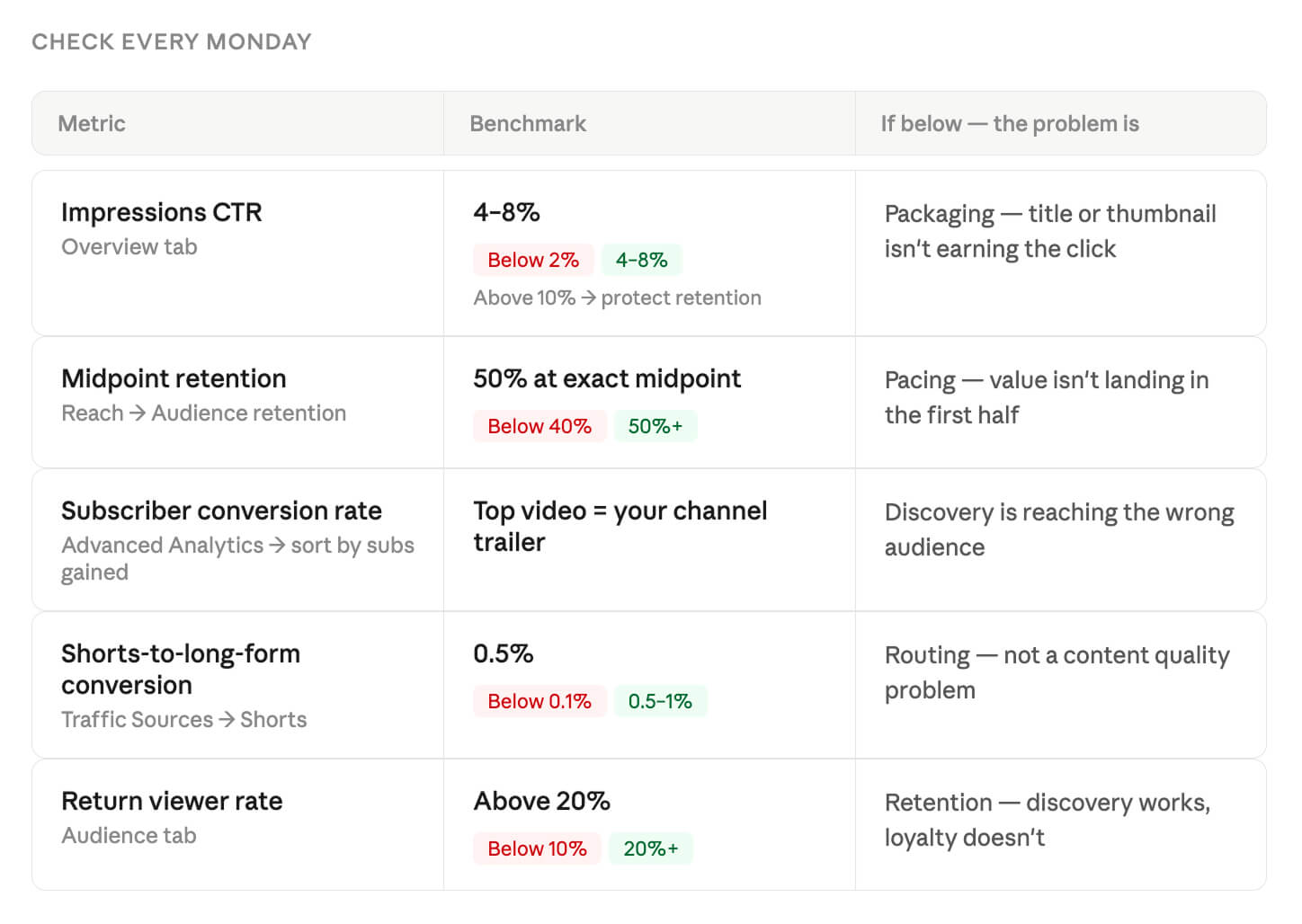
Five metrics worth checking every Monday:
- Impressions CTR: below 2% means your packaging is failing. Between 4 8% is healthy. Above 10%, protect retention — CTR can't outpace delivery.
- Average percentage viewed at the midpoint: the universal benchmark is 50% of viewers still watching at the exact midpoint. Below 40% means a structural pacing problem in the first half of your video.
- Subscriber conversion rate per video: found in Advanced Analytics → sort by subscribers gained. Your highest-converting video is your Magnet Video. Set it as your channel trailer for non-subscribers today.
- Shorts-to-long-form conversion rate: found in Traffic Sources → Shorts. Target is 0.5%. Below 0.1% means a routing problem, not a content problem.
- Return viewer rate (from the Audience tab): above 20% means you're building genuine loyalty. Below 10% means discovery is working but retention isn't.
What to Do Tomorrow
Some of these you do once. Some become your Monday routine.
Do once:
- Configure Related Video on every Short you've ever published. Video Details → Related Video → link to the parent long-form. Then add a verbal CTA note to your script template so every future Short routes automatically. One-time setup, indefinite compounding.
- Set your Magnet Video as your channel trailer. Sort by subscriber conversion rate in Advanced Analytics. The top video goes on the channel trailer for non-subscribers today. If you don't know which video converts best, you're leaving your most powerful acquisition tool undeployed.
- Set up one membership tier. If you're YPP-eligible, $4.99 with one benefit that costs you nothing to maintain — a members-only post per month, early access, or a loyalty badge.
- Run a metadata translation test. Take your top 5 performing videos and translate titles and descriptions tags into your strongest non-English market. Track for 60 days. If views appear and watch time holds, you've confirmed a market worth dubbing into — before spending a dollar on voice work.
- Build your playlist architecture. Every video should sit in at least 3–4 playlists. Go through your last 30 uploads and add each to at least two additional playlists minimum. Name series consistently — "YouTube Packaging | Episode 1" clusters algorithmically. "Tutorial #4" then "How I do X" doesn't.
- Script your end screens. For every upcoming video, write the last 30 seconds as a deliberate handoff. Say the name of the next video aloud. Link it specifically. End-screen CTR below 5 per 1,000 views almost always traces back to unscripted closings.
- Send your back catalog to MSN. 100+ videos and 7,000+ subscribers and not on MSN yet? Your existing library is earning nothing on a platform that pays from day one, with no subscriber or watch-hour threshold. Reach out to AIR for a fit check.
- Check your 24/7 streaming eligibility. If you have a back catalog of rewatchable content, your existing videos can run as a continuous live channel, earning extra revenue without any additional filming. Kids, music, DIY, entertainment, news, and education are the strongest fits. Check if your channel qualifies.
- Audit your brand deal visibility. Set up a pin.top page with your verified stats, services, and rates. Brands can book directly — budget locked upfront, brief and deadline in one place. If you're YPP-eligible and haven't done this, you're invisible to the 74% of brands actively looking for micro-creators right now.
Do every Monday:
- Run your retention curve audit. Open your 10 most recent videos. Find every timestamp where retention drops by more than 5%. Write one sentence explaining the cause. You'll see the same cause 3–4 times across all 10 videos. That's the structural issue to fix on your next upload — before anything else.
- Check your five Studio metrics. Impressions CTR (target: 4–8%), midpoint retention (target: 50%), subscriber conversion rate (top video = your trailer), Shorts-to-long-form conversion (target: 0.5%), return viewer rate (target: 20%+). Any metric below the benchmark has a named cause. Fix one per week.
- Check your end-screen CTR. Found in Reach → End screens. Below 5 per 1,000 views means your last 30 seconds aren't scripted as a handoff. Name the next video aloud. Link it specifically.
- Review your playlist coverage. Every video should sit in at least 3–4 playlists. Each placement is a separate discovery surface. Add two playlists to your five least-covered videos.
- Check your Shorts-to-long-form routing. Traffic Sources → Shorts. If you're below 0.1%, you have a routing problem — not a content quality problem. Go back to Related Video on your most recent Shorts and tighten the verbal CTA.
- Check your MLA signals. Open Analytics → Audience → Audio track breakdown. Find which language markets are building Casual + Regular viewers. The 40%+ threshold is your signal to invest in professional dubbing. Under 20% after four months means that the market isn't converting — move resources elsewhere.
- Run one thumbnail A/B test. YouTube's native Test & Compare runs up to three variants simultaneously and picks the winner by watch-time share, not just CTR. Test one variable at a time — image, text, or color palette, never all three at once. If you haven't tested your last five videos, start today.
- Check your revenue mix. Open Analytics → Revenue. If AdSense is above 80% of your total, you're one CPM dip away from a bad month. Memberships, Super Thanks, brand deals, MSN distribution, and 24/7 streaming revenue should all be visible lines, not blank rows.
What Should You Do Next?
We don't know until we see your channel.
The strategies above show patterns across 3,000+ channels. Your channel is one channel — with its own niche, audience behavior, traffic source split, and specific growth ceiling. A pattern that holds for 70% of channels in your niche doesn't tell you which 30% you're in.
Our team dissects channels across 10 angles: packaging, retention, traffic sources, competitor gaps, format mix, revenue structure, audience behavior, risk signals, growth projection, and a ranked action plan. You get exact steps on what to do, why to do it, and what to expect.
We've done this for 3,000+ channels, using a 450K-channel training dataset and 21 proprietary AI diagnostic tools that process your Studio data against niche benchmarks in days.
What you get:
- A structured report covering all 10 pillars of channel performance
- A 30-day action plan ranked by impact
- A 45–60-minute live walkthrough with a senior AIR strategist