

A baseball recap earns most of what it will ever earn in the first day or two. That is the arrangement a daily sports channel lives with, and it makes predicting income hard from one week to the next. Made The Cut publishes on exactly that rhythm: 575,000 YouTube subscribers, weekly deep dives, a daily reaction to whatever happened in Major League Baseball. In April 2026 that same library earned the channel $9,557.51 on MSN.
Across the trailing three months it came to $23,916.29, on more than 3.5 million views, none of it from new footage. And unlike the YouTube side, it didn't rise and fall with whether anything interesting happened that week.
What a News Cycle Does to a Month's Income
The channel is built on staying current. New records, standout plays, ejections, trade news: whatever happened in the league that day gets a reaction, and the bigger stories get a full breakdown later in the week.
That works for engagement and it complicates the accounting. A no-hitter or a suspension can double a week's ad revenue; a quiet stretch with nothing newsworthy can halve it. Over a full month, that showed up in the AdSense figure as a range rather than a number: $2,000 to $10,000, on a channel with more than half a million subscribers.
Nobody wanted to replace YouTube or slow the publishing schedule down. What the team wanted was a second line of income drawn from content they were already producing, one that didn't move in step with the first.
What April Paid, and the Two Months Before It
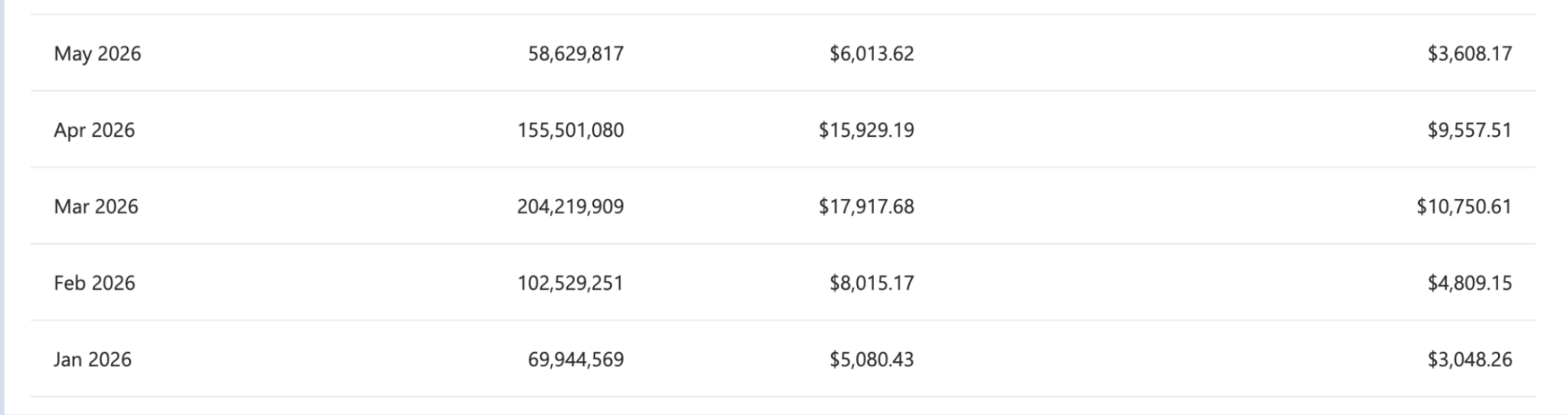
April 2026 is the most recent full month on the books, at $9,557.51. The two months before it added $14,358.78 between them, which brings the quarter to $23,916.29.
- Before MSN: $2,000–$10,000 a month from YouTube AdSense. A range rather than a figure, driven by what was happening in the league that week.
- April 2026: $9,557.51. The most recent full month, and the strongest of the three.
- Trailing three months: $23,916.29. What reached the channel once AIR's share came out.
- Views across the quarter: more than 3.5 million. All of it from videos that had already been published.
- Effect on YouTube revenue: none. AdSense carried on as before. The two audiences barely meet.
Two Revenue Lines That Don't Move Together
Evergreen tutorials are the obvious fit for a recommendation feed, because they stay correct for years. Daily sports content is the opposite shape, and it works here for a different reason.
On YouTube, a channel's reach runs through its subscribers. People who already follow Made The Cut come back when something happens, so the revenue rises and falls with how much is happening.
MSN doesn't work through that relationship at all. It serves baseball content to people who read about baseball, whether or not they have heard of this channel, so the money it generates responds to a different set of conditions. Two income lines that move on different triggers are steadier together than either one is alone.
How the Channel Got Onto MSN
The channel's own involvement in this was small. One application, contract, and no change to the publishing schedule at any point.
- Applied through air.io. A short form on channel details, content type and publishing cadence.
- Signed one non-exclusive contract — May 2025. Joining costs nothing and the YouTube side is left alone entirely. The revenue share applies to MSN money and nothing else.
- Microsoft review. Their team checks the content against quality and rights standards before anything goes live.
- Distribution began. Rather than pushing the whole library out at once, our team picked what went where and when: onto Bing, onto msn.com, into the Start feed on Windows desktops. On a catalogue this size that sequencing matters more than it does on a small archive.
- First payout — July 31, 2025. Payments have run monthly since.
Where a Baseball Recap Ends Up
Open a new tab in Edge, glance at the feed on a Windows desktop, or search for anything in Bing, and you are inside Microsoft's content network. It runs msn.com too. Together those places see 1.29 billion unique users in a month, and a large share of what people are there for is news.
Microsoft Start is a news product, and sport is one of the things people open a news product to read. A recap of last night's game is the kind of thing the reader came for, which is not something you can say about most video a feed might serve them.
There is no open door into MSN, though. Microsoft hands that job to a short list of accredited partners who handle the agreement, the onboarding and the payments. AIR Media-Tech holds one of four such slots worldwide.
Which Channels This Suits
From what we see across the creator network, a few things matter more than the rest:
- High-frequency, news-driven channels. Sports recaps, entertainment coverage, tech news, daily commentary. Any format where income tracks what happened this week rather than sitting flat.
- A monetized channel from around 10,000 subscribers upward. Below that, Microsoft's review is hard to clear. There is no ceiling: MSN is simply a smaller slice of what a very large channel already earns.
- A library that already exists, and enough of it. MSN distributes what has been made, and the more there is, the more angles the feed has to work with. It asks nothing of the publishing pace or the format.
- An English, Spanish or Portuguese-speaking audience. The strongest markets at the moment are the US and UK, Canada and Australia, then Brazil, Spain and the wider Latin American region.
- Original material only. Commentary and analysis built on your own footage or your own take. Clip compilations with nothing added don't clear moderation.
If Your Income Moves With the News
Made The Cut changed nothing to earn this. The schedule stayed, the format stayed, and the videos MSN distributed were ones the channel had already published.
What is worth taking from the case is less the size of the number than its shape. A channel whose income depends on how eventful the week was now has a second line answering to something else. That doesn't smooth out the YouTube side, but it does mean fewer months where both halves move the same way at once.
Send us a high-frequency channel, and we'll tell you whether MSN will take the library. Nothing to pay, and the form is about fifteen minutes.