
The creator economy has reached an inflection point. For the past decade, the dominant strategy was singular – build a library on YouTube, optimize for its algorithm, and rely on its AdSense payouts. But 2026 looks different – audiences are fragmented, platform dynamics keep changing, and where you publish has become a real strategic variable.
AIR’s video distribution team conducted this study to show you what syndication ways are available for creators in 2026, so you can decide which path to take based on data.
Starting With the Video Distribution Market in 2026
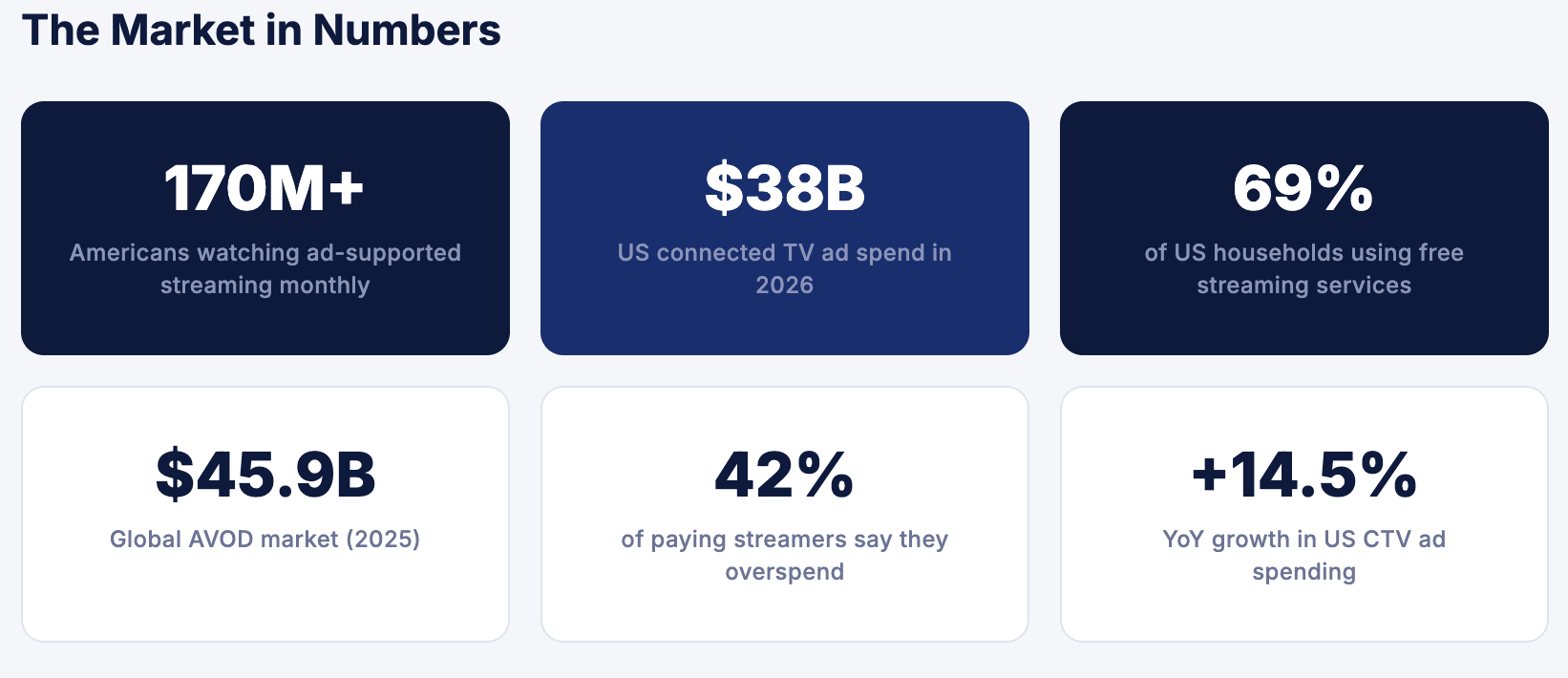
In 2025, ad-supported streaming platforms generated $45.9 billion in revenue globally. By 2031, that number is expected to reach $72.9 billion. Just in the US, over 170 million people now watch at least one ad-supported streaming service every month. Connected TV ad spending in the US alone is on track to hit $38 billion this year.
These are big, abstract numbers. What they mean in practice is more specific – the audiences exist, and the advertising dollars are waiting, yet creator content remains largely absent.
The creators and agencies generating the most revenue execute aggressive syndication strategies. They syndicate existing catalogs to untapped environments.
This study covers every major distribution channel where creator videos earn money outside YouTube in 2026, breaking down the exact platforms, requirements, and economics needed to scale your catalog’s revenue.
Repurpose What You Already Have
For creators who just start expanding beyond YouTube, the best way to start is by repurposing already existing content with little to no reformatting.
The strategy here completely removes the need for net-new production. By routing current assets to these specific channels, you capture distinct audience segments operating entirely outside the YouTube ecosystem.
Video Distribution to MSN
MSN is easy to underestimate because, for some, it looks like a legacy news portal.
In practice, it is a distribution layer that runs across Microsoft’s entire consumer stack – Windows News feeds, Bing results, Edge new tabs, the MSN app, and Copilot Discover.
When a video gets published to MSN through an authorized partner, it appears across all of those surfaces at once. The combined reach is 700 million+ monthly active users.
The discovery model is different from anything on social media. Instead of seeking out new content, users encounter it inside tools they already use for work and browsing. That passive, ambient exposure is what makes MSN additive to YouTube rather than competitive with it – you are reaching people in a completely different context.
Video consumption on MSN grew +40% in 2025. Gen Z engagement was up +80% year over year, which challenges the assumption that younger viewers only exist on TikTok and Shorts. A significant chunk of Gen Z interacts with creator video inside Copilot Discover and Edge – college students, early-career professionals browsing during their day.
The Economics & Entry
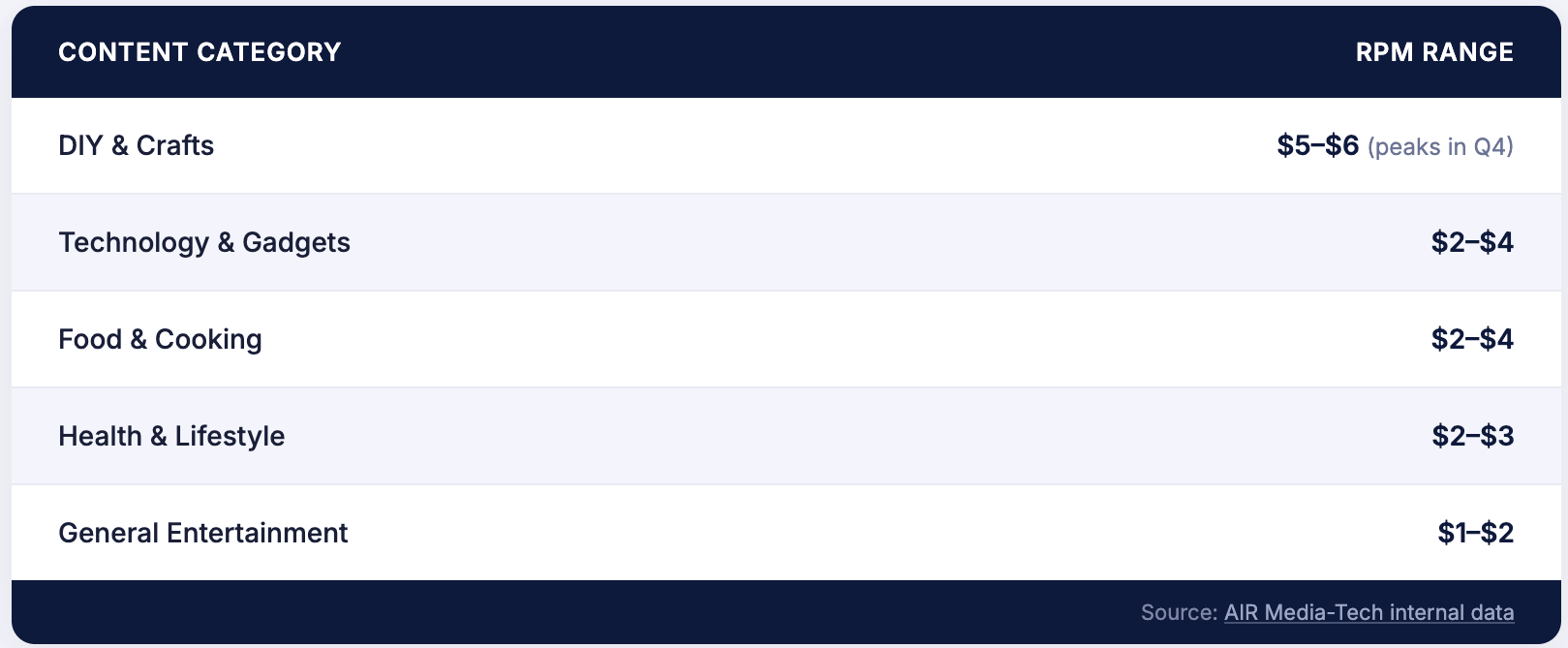
MSN pays from day one via an ad-supported model, with RPMs heavily dependent on niche:
Access is invite-only through authorized publishers.
The approval baseline as of early 2026:
- 10,000+ subscribers (sometimes 7,000 with strong metrics)
- a library of 100+ videos
- uploads at a pace of 1–4 per week
- clean rights on every piece of content
Accepted categories include food, travel, DIY, science, tech, health, fashion, infotainment, and much more. The acceptance criteria have been tightening quarter over quarter, and the categories open today may not stay open indefinitely.
We published a full MSN data report with creator case studies and detailed RPM analysis – you can read it here.
AIR Media-Tech is an official MSN publishing partner. Show us your content, and we’ll tell you if it has a chance to pass MSN's moderation criteria.
Video Distribution to Facebook
Facebook’s creator monetization looks completely different from what it did a year ago. On August 31, 2025, Meta shut down every legacy program – Reels Play Bonus, In-Stream Ads, Ads on Reels, the Performance Bonus – and replaced them all with a single system, the Content Monetization Program (CMP).
The CMP rolls in-stream ads, Reels ads, Stars (tips), subscriptions, and bonuses into one payout. Revenue is split roughly 55% to the creator, 45% to Meta. The company paid creators close to $3 billion in 2025, a 35% year-over-year increase. These are the numbers that signal that Meta is spending aggressively to pull video content onto its platform. Meta brought that push to VidSummit 2026, where it ran hands-on Facebook monetization workshops for YouTube creators.
Facebook Video Distribution Eligibility
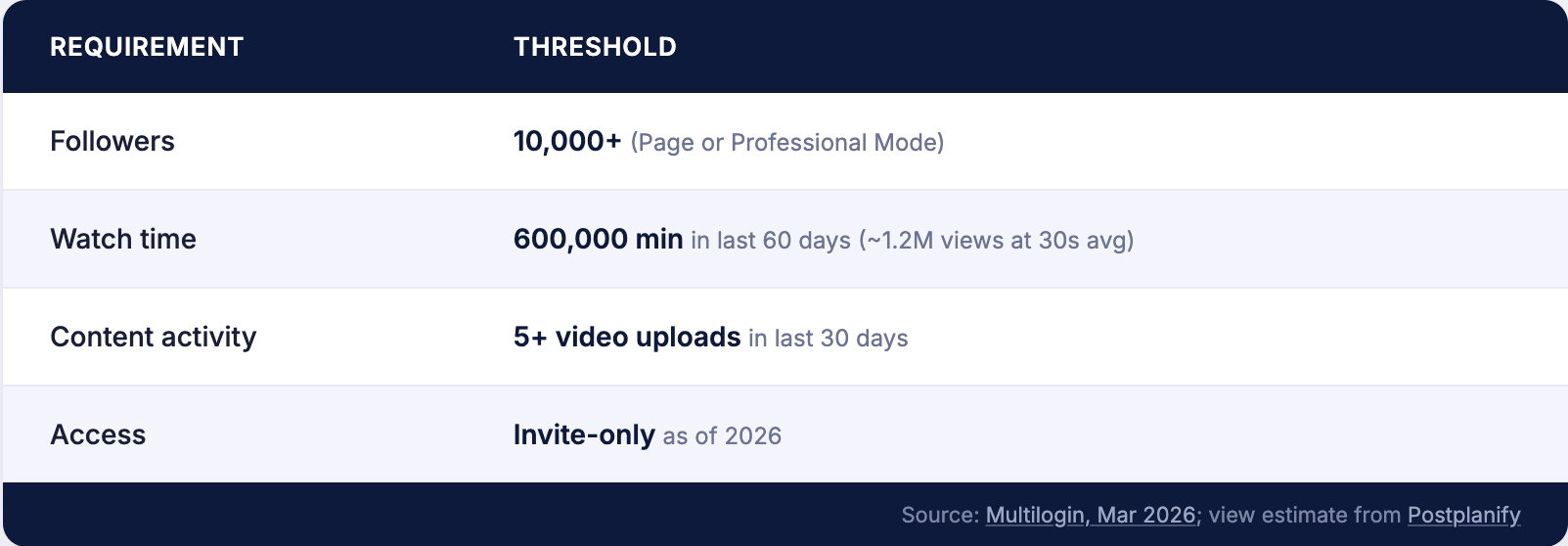
Two mechanics shape what you earn on Facebook more than anything else.
First – video length.
In-stream ads only run on content that is 3 minutes or longer. Below that, you get pre-roll only, which pays far less. This is why the creators earning real money on Facebook consistently publish in the 5–10 minute range.
Second – where your audience lives.
Geography drives a wider earnings gap on Facebook than on almost any other platform.
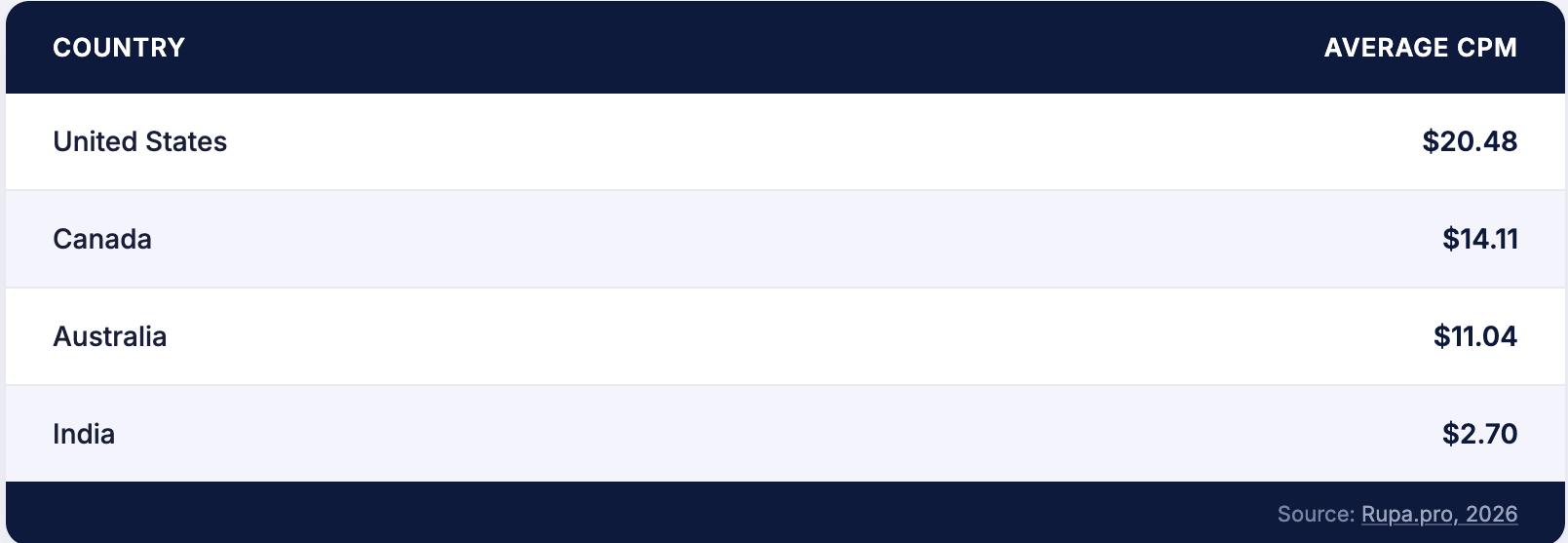
A finance creator with a US-heavy audience can earn dramatically more per view than an entertainment creator with a global audience. Overall RPMs on Facebook range from $0.15 to $4, depending on the combination of niche, length, and geography.
Additionally, Meta launched Creator Fast Track on March 18, 2026.
If you already have 100K+ followers on Instagram, TikTok, or YouTube, you skip the standard CMP eligibility requirements and receive a guaranteed $1,000–$3,000/month for three months. Meta is paying creators upfront to bring their content over.
Video Distribution to Snapchat
Snapchat often gets overlooked, but it is actually a worthy platform for creators whose audience skews young. The platform hit 946 million monthly active users in Q4 2025. US Spotlight posting grew 47% year over year.
Snap consolidated its creator payouts into the Unified Monetization Program in February 2025, with the following requirements:
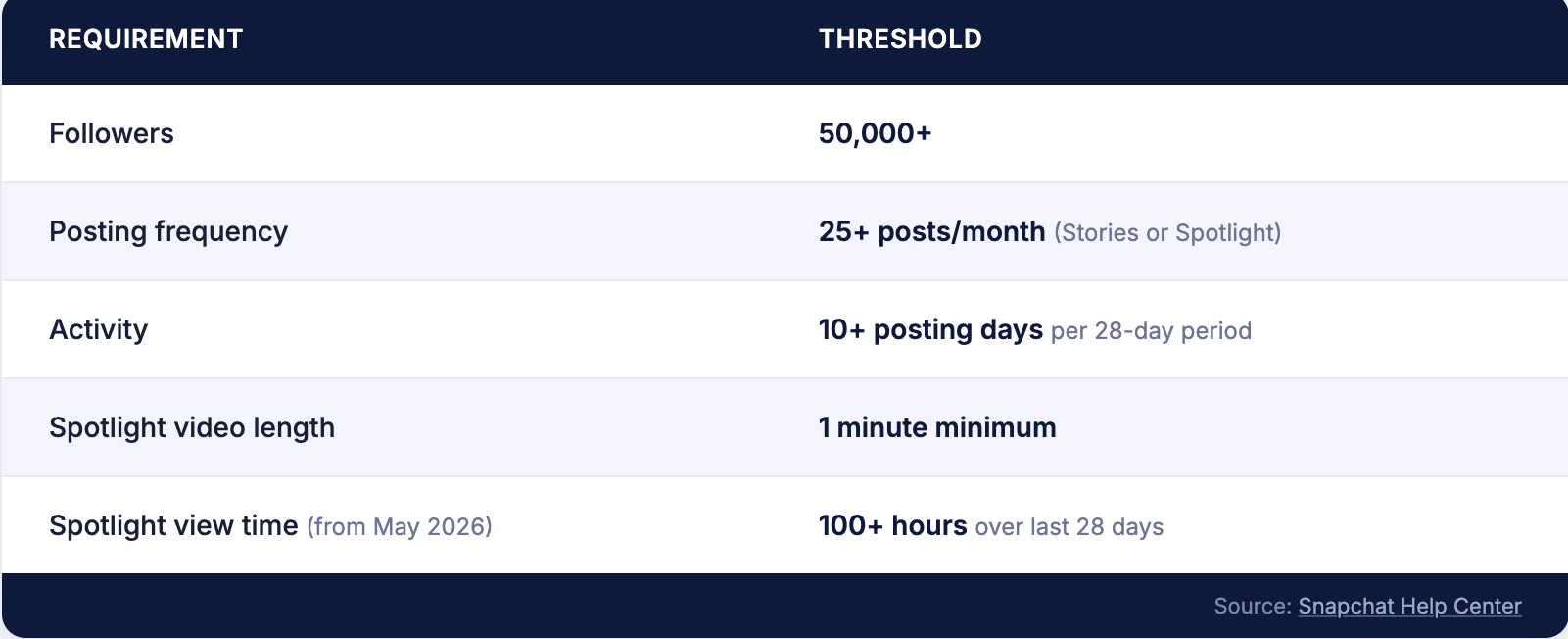
Snapchat also launched Creator Subscriptions in February 2026 – a paid tier where fans get exclusive content, subscriber-only Snaps and Stories, and priority replies. It adds a recurring revenue layer on top of the ad-based program.
If your audience is predominantly under 25, Snapchat belongs in your distribution mix. For older demographics, MSN and Facebook offer a better effort-to-return ratio.
The Connected TV Opportunity
This is where the biggest gap sits between the size of the opportunity and how many creators are aware it exists.
What FAST Means and Why It Grew So Fast
FAST stands for Free Ad-Supported Streaming TV. In plain terms, free streaming services that run on smart TVs, funded entirely by ads, deliver linear-style content you can just turn on and watch. Tubi, Roku Channel, Pluto TV, and Samsung TV Plus are the major ones.
The growth over the past two years has been striking.
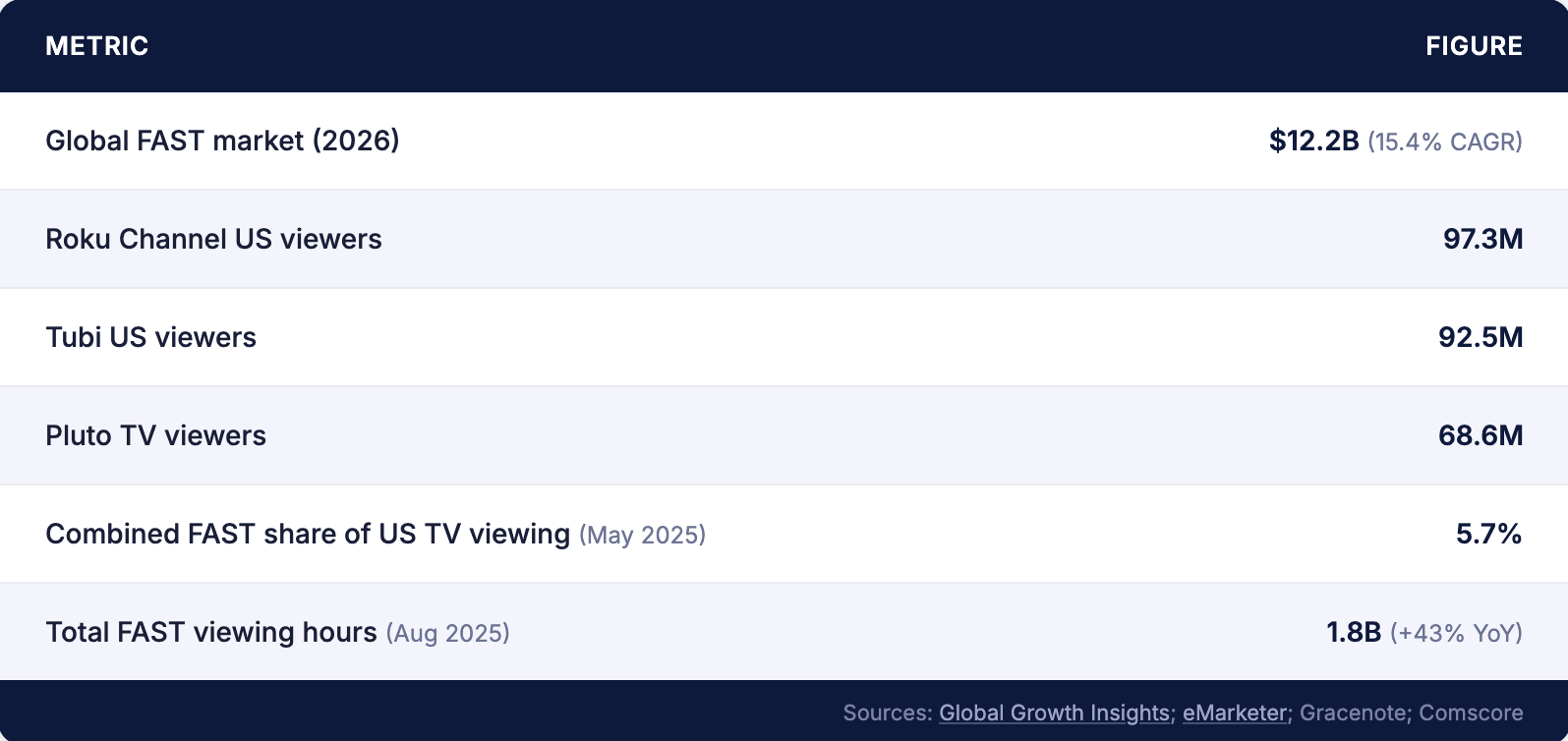
What makes FAST relevant for creators is a supply problem. These platforms are adding viewers faster than they can fill their content libraries.
They need hours of brand-safe, high-quality video in categories that attract advertiser spending – food, DIY, tech reviews, comedy, lifestyle, science explainers. Creator content with deep back catalogs is a natural fit for that gap.
Video Distribution to Tubi
Most creators have heard of Tubi as a place to watch free movies. What few realize is that Tubi has been building one of the most aggressive creator content pipelines in streaming.
The platform reached 110 million monthly active users, up from the 100 million it hit in May 2025, and crossed 1 billion viewing hours in a single month. Revenue grew 35% year over year, and the company reached profitability in 2025, which means the creator investment is coming from a sustainable business
The audience is young – over half of Tubi viewers are Gen Z or Millennials. 67% are cord-cutters or people who never had cable.
These viewers watch free content on their connected TVs, and their numbers keep growing. Tubi held 2.3% of total US TV viewing time by April 2026 – a small-sounding number that represents an enormous audience in absolute terms.
Tubi & Сreators
Tubi now carries more than 25,000 episodes from over 400 creators.
The platform has licensing deals with MrBeast (YouTube seasons 6–8), our partner Alan’s Universe, Jomboy Media, CelinaSpookyBoo, and Steven He. Kevin Hart’s production company, Hartbeat, signed on for four creator-led films. And the hire of Kudzi Chikumbu, who came directly from TikTok, as VP of Creator Partnerships, tells you where Tubi sees its growth coming from.
The biggest development landed in March 2026.
Tubi and TikTok announced the Creatorverse Incubator – a joint program where TikTok identifies creators ready for longer formats, Tubi helps them develop original series (scripted and unscripted), and the shows premiere exclusively on Tubi. TikTok promotes the content through its Spotlight feature.
Coverage from TechCrunch, Deadline, and The Hollywood Reporter all noted this as part of a larger trend: streaming services are now actively building bridges to creator talent, not waiting for it to come to them.
And there is already solid proof. Kelon Campbell’s “Terri Joe: Missionary in Miami,” based on his TikTok Live characters, debuted at No. 8 on Variety's Streaming Original Movies Chart.
The audience data backing this strategy is clear. A Tubi-commissioned Harris Poll found that 67% of respondents consider creators more original than traditional TV and film content. 76% said they want more programming from independent and smaller-scale creators.
What This Means in Practice
Tubi operates differently from MSN or Facebook. Here, you can’t just upload an existing YouTube video and start earning. Tubi works through licensing deals and creator programs. We've started doing this ourselves. Amelka Karamelka Dark Stories became the first channel AIR placed on Tubi, and our announcement explains how AIR places creators on Tubi and what the platform looks for in a catalog.
The content needs to fit the streaming format – longer episodes, series-style packaging, material designed for a TV screen – all show that the bar is higher. But the platform is spending real money to bring creators in, and the runway from a profitability and audience standpoint is long.
Other FAST Platforms
Tubi is the most visible player in the creator-content space, but the FAST ecosystem is broader.
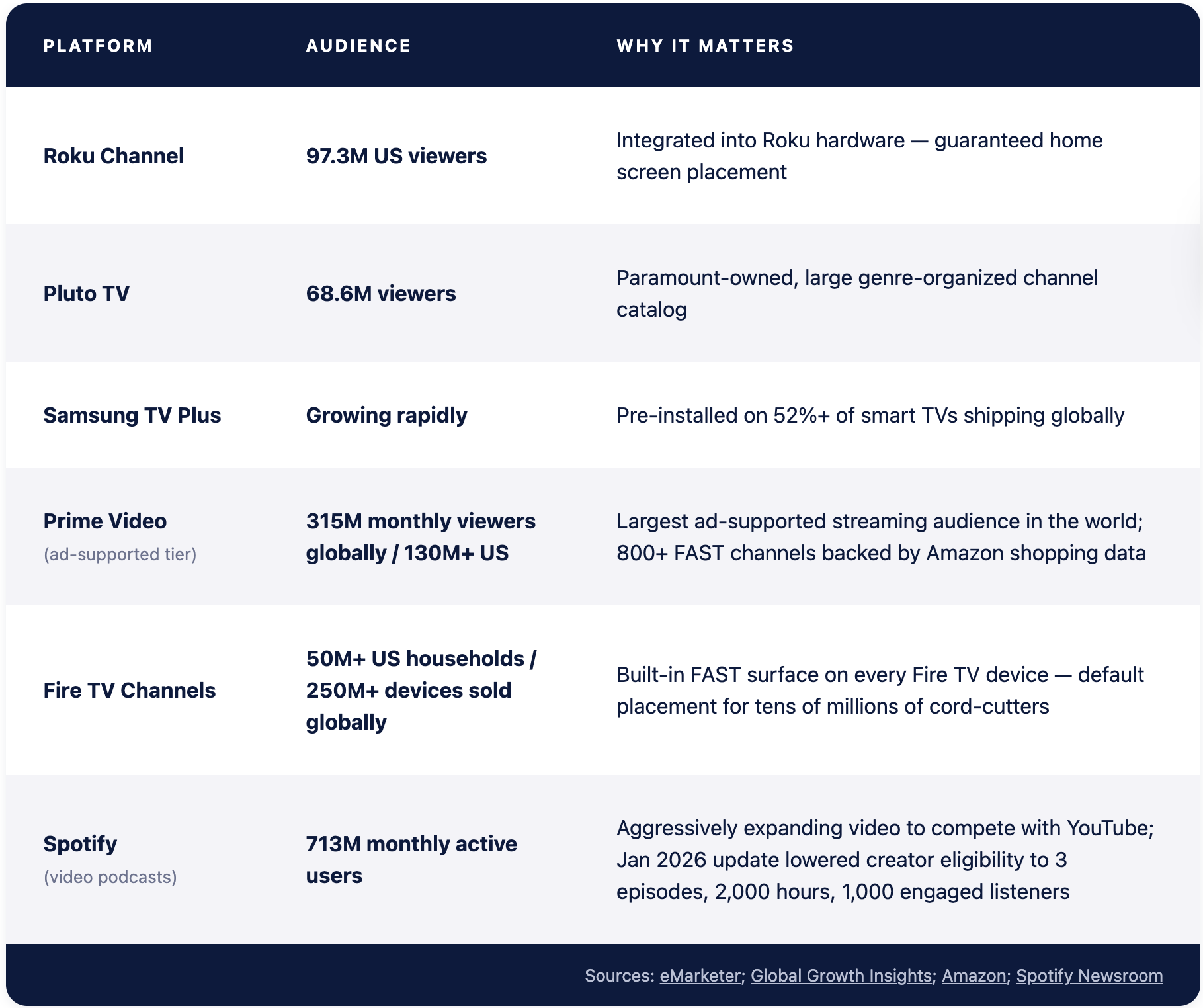
FAST platforms reward deep catalogs of evergreen, brand-safe video.
If you have 200+ videos in categories like food, tech, DIY, or lifestyle, and your content holds up visually without depending on YouTube-specific context (community tab references, shorts funnels, card links), there is a real distribution opportunity here. If your videos are highly YouTube-native in format and references, the translation to a TV screen will require a bit more effort.
Premium Distribution Deals
Everything above operates on a logic of syndication – you take existing content and route it to new surfaces. Premium distribution works differently. This is where creator content gets packaged, licensed, or produced specifically for a major streaming platform like Amazon Prime Video or Apple TV+.
The economics change at this level – but so do the requirements.
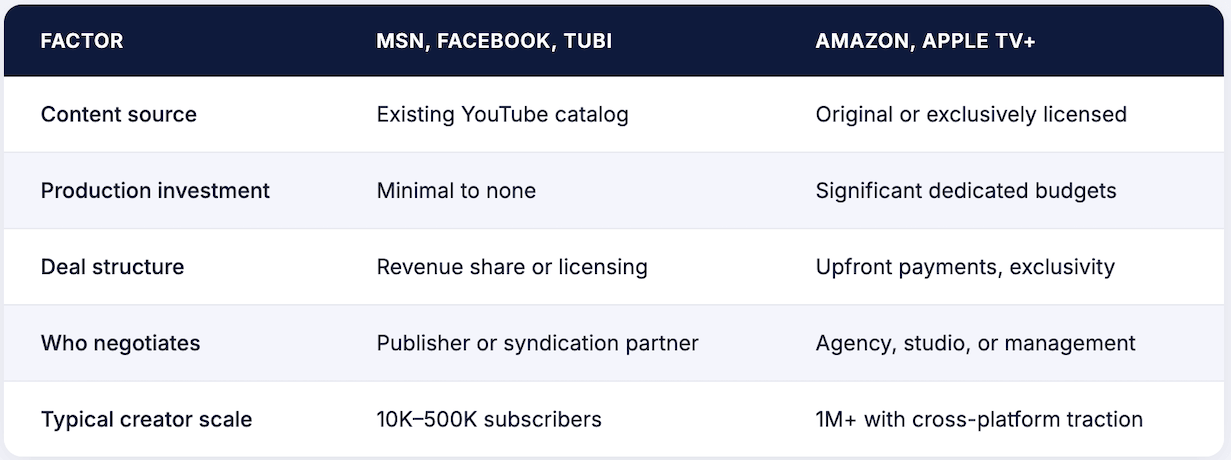
The most prominent example is the $100 million deal between MrBeast and Amazon MGM Studios for Beast Games. Season 1 became Prime Video’s most-watched unscripted series, drawing 50 million viewers in 25 days. Amazon renewed it for two more seasons. The platform outbid at least one competing streamer and granted full creative control to MrBeast.
It is a significant market signal.
A top-tier streaming platform paying premium prices for content that originated in the creator ecosystem validates the entire distribution chain described in this study. But the scale required to get there – hundreds of millions of subscribers, a production operation, a negotiation team– is years away for most working creators.
For the 10K–500K subscriber range, these platforms are the long-term destination. The practical path runs through the platforms we’ve mentioned earlier – build a multi-platform track record, accumulate performance data on different surfaces, and develop content that works outside the YouTube format.
How to Sequence a Distribution Strategy
After learning what the market has to offer comes choosing where to start with – and the answer to that relies solely on what you already have.
If you have a deep catalog of evergreen content
MSN and Facebook are the fastest to activate. Both accept existing videos with minimal reformatting. MSN works through an authorized publisher. Facebook requires meeting the CMP eligibility. Run both for 60–90 days, study the per-platform performance data, and use those numbers to decide what comes next.
If your content works on a TV screen (longer format, visually self-contained, series potential)
Tubi and the broader FAST ecosystem are worth evaluating. The operational complexity is higher – formatting, metadata, rights clearance across platforms – and this is where working with a syndication partner starts making practical sense.
If you’re building toward premium
Every platform you distribute through now generates performance data. That data – view-through rates, audience retention, geographic performance, category benchmarks – becomes your proof of concept when a premium licensing conversation happens. Nobody walks into an Amazon meeting without numbers.
And don’t forget – the timing component is real.
MSN’s approval criteria are tightening quarter over quarter. Tubi now carries more than 25,000 episodes from over 400 creators and is formalizing its pipeline through programs like the Creatorverse Incubator. Facebook’s CMP stays invite-only. Creators and agencies who move early accumulate platform-specific performance history that late entrants won’t have – and that history compounds into better content placement and revenue optimization over time.
The distribution window is open, but it is getting narrower. So make sure to keep up with your video distribution decisions.
About AIR Media-Tech
AIR Media-Tech is a global leader in the creator economy, providing an ecosystem of growth solutions for creators and talent agencies. Supporting 3,000+ partners across 70+ countries, AIR's network generates over 125 billion annual views. AIR is one of the first official MSN publishing partners, handling end-to-end distribution, rights verification, metadata optimization, and creator payouts.