
Until February 1, 2027, a new channel needs 1,000 subscribers and 4,000 qualified watch hours in the last 12 months to apply for ad revenue in the YouTube Partner Program. From that date, new applicants need 8,000 hours, and channels already in the program keep their place. So a channel under the bar has until January 31 to apply against the lower number.
More videos don't always mean more hours. Dr Roto, a fantasy sports channel we worked with, published more than 500 videos in four years and never reached the threshold. Next to its long-form videos, its Shorts brought in about 91% of the views and only about 6% of the watch hours. A few months after it switched to 8–12 minute videos, it was in.
So we went through YouTube's rules on qualified watch hours, cases from channels we work with, and the questions creators ask most about the threshold. Here's what a channel under the bar needs: how many views 4,000 hours take, what counts toward them, which watch time fixes add hours fastest, how to plan the months before February, and what to do when the hours are there but the subscribers aren't.
In this guide:
- How many views 4,000 hours take
- Your hours-a-day math before February 1
- Why 500 videos weren't enough
- Where your watch time leaks
- Fixes that add hours fastest
- Why old videos should stay public
- Hours without 1,000 subscribers
2 Minutes a View or 20: How Many Views 4,000 Watch Hours Take
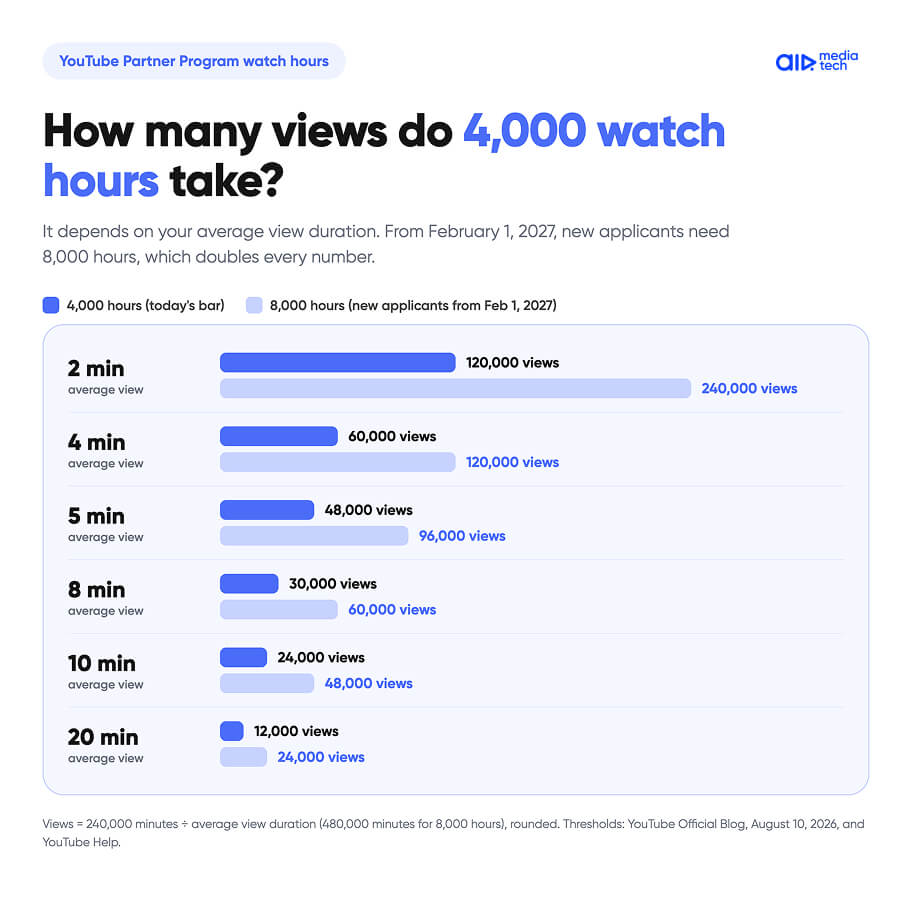
4,000 watch hours is 240,000 minutes. From February 1, 2027, new applicants need 8,000 hours, or 480,000 minutes. How many views that takes depends on one number: your average view duration, the time a typical view lasts.
Here's what both bars take in views, rounded:
| Average view duration | Views for 4,000 watch hours | Views for 8,000 watch hours (new applicants from Feb 1, 2027) |
|---|---|---|
| 2 minutes | 120,000 | 240,000 |
| 4 minutes | 60,000 | 120,000 |
| 5 minutes | 48,000 | 96,000 |
| 8 minutes | 30,000 | 60,000 |
| 10 minutes | 24,000 | 48,000 |
| 20 minutes | 12,000 | 24,000 |
At a 5-minute average view, 4,000 hours takes about 48,000 views, and 8,000 hours takes about 96,000. To find your own number, open Analytics in YouTube Studio and go to the Content tab. Average view duration for your long-form videos is there. Take the last 90 days, not your best video. Then divide the views you need by what a typical video of yours gets. At a 5-minute average and 2,000 views a video, 4,000 hours takes about 24 videos.
Only qualified hours count
YouTube counts only qualified watch hours toward the threshold. Rene Ritchie, YouTube's Creator Liaison, spelled them out in August 2026: hours from public long-form videos, podcasts included, and from live streams that stay archived on the channel. These don't count:
- private, unlisted, or deleted videos
- videos watched as an ad
- Shorts
- live streams that aren't archived
Two of these catch channels close to the bar: a stream that never got saved as a video, and an old video deleted to tidy up the channel. For the full rules, including the Shorts route, see our YouTube Partner Program requirements guide.
Embeds are the overlooked source. When a public video of yours plays on another website through YouTube's standard embedded player, that watch time counts, says Olga Soshynskaya, Head of Customer Service on the Network Support & Safety team at AIR Media-Tech, an official YouTube partner. Views from paid Google Ads campaigns and bots don't. So your own blog, a newsletter, or a partner's article with your video in it adds to the 4,000.
Count Back From February 1: How Many Watch Hours a Day You Need
Your starting point is the Earn tab in YouTube Studio. It shows your subscribers and qualified watch hours from the last 12 months. Turn on Get notified on the same screen, and you'll get an email once you're eligible. Go by that number, not the views under your videos. Since August 24, 2026, a view counts the moment playback starts, so the view count can grow while your watch hours stay flat.
The 12-month window also works against you. Every day, the hours from the same day a year ago drop out of your total. A channel that had a strong November last year loses those hours this November and has to earn them again.
So count the hours you need like this:
- Take 4,000 and subtract the hours the Earn tab shows.
- Add what your public videos and live streams earned in the same weeks last year, from today to your apply date. In Analytics, switch to Advanced mode, set those dates, and filter by content type to Videos and Live.
- Divide by the days left until you apply. That's your hours a day.
- Multiply by 60 and divide by your average view duration in minutes. That's your views a day.
Say a channel has 2,600 hours on October 15 and wants to apply on December 20, 66 days later. The same weeks last year brought it 300 hours, and they drop out as the window moves. It needs 1,700 more hours, about 26 a day. At a 6-minute average view, that's about 260 views a day.
Example: 2,600 hours on October 15, applying on December 20
1,700
hours to gain: 1,400 missing + 300 dropping out of the window
~26
watch hours a day
6-min view
~260
views a day to apply on time
Why December 20?
It leaves a buffer before the real cutoff, since the monetization review alone can take a month. An application that reaches YouTube by 23:59 UTC on January 31, 2027, is reviewed against 4,000 hours even if the decision comes later, Olga Soshynskaya of AIR Media-Tech says. It counts as sent once the Get Reviewed step in the Earn tab shows In Progress, after you accept the base terms and link AdSense. A rejection is the bigger risk: a reapplication on or after February 1 faces 8,000 hours, and so does an appeal decided after that date. If you want time for a second try, apply by early December. Every case is in our breakdown of the 2027 YPP changes.
If your views a day look out of reach, more uploads rarely close the gap. On Dr Roto's channel, 500 videos didn't.
Not sure what's holding your hours back? Check your channel for free
The Free Channel Check compares your channel with one channel in your niche that you pick and shows what to fix first on the way to 4,000 hours. It takes about 5 minutes.
Run my free channel check →500 Videos, Still Under 4,000 Hours: What Dr Roto's Audit Found
Dr Roto, a fantasy sports channel we worked with, published more than 500 videos in four years and earned $0 from them. It never got into the YouTube Partner Program. An AIR audit set the channel next to four leading channels in its niche.
Four findings explained why the videos didn't add up to watch hours:
- Few people clicked. 19 of the 20 latest long-form videos had a click-through rate between 0% and 1.14%. The four niche leaders got 4–6%.
- Shorts took the effort, not the hours. 35 of the channel's 168 videos were Shorts, 21% of its output, against 1–3% for the leaders. Next to its long-form videos from Browse, Shorts brought about 91% of the views and about 6% of the watch hours.
- Titles spoke to regulars. Names like "The Fight Club of Pain Presents" mean something to fans of the show. A new viewer types "NFL Week 8 DraftKings picks", and that's what the leaders' titles were built to catch.
- Nothing brought viewers back between uploads. The channel had no Community posts and no pinned comments, even on streams with an active chat.
What changed: over three months, the creator and Kate, their AIR channel manager, moved to 8–12 minute videos, rebuilt titles and thumbnails around the terms fans search for, reworked sound, visuals and intros, and started Community polls. The audit's projection for the new format alone was 2–3x less time to reach eligibility. Shorts stayed, on purpose, to reach new viewers before the football season.
Dr Roto on the way to 4,000 hours
Niche
Fantasy sports on YouTube
Before
4 years, 500+ videos, $0. Not in the YouTube Partner Program.
What held hours back
CTR of 0–1.14% on 19 of 20 long-form videos. Shorts: about 91% of views, about 6% of watch hours.
What changed
8–12 minute videos, new titles and thumbnails, reworked intros, Community polls. Three months with an AIR channel manager.
Result
In YPP, earning from ads. First payout about three months after the changes. Now $500 a month and growing.
The channel got into the YouTube Partner Program and now earns from ads. The first payout came about three months after the changes, and today it makes $500 a month. The audit found the fixes. Three months of work with a specialist turned them into watch hours.
What to take from it: if Shorts bring most of your views, or your long-form click-through rate sits far below your niche leaders, fix that before you add more uploads.
Clicks, the First 30 Seconds, or the Middle: Find Where Your Watch Time Leaks
A kids toy-play channel we work with was uploading compilations of 28 minutes or more, and viewers watched only 8–12% of each one. Its channel manager suggested shorter compilations. The share watched rose to 16.4–22%, recommendations brought in more of its views, and revenue grew 17.8% the next quarter.
Long videos add hours only if people stay. Before you change anything, find where yours leave. There are three places, and YouTube Studio shows each one:
| Where viewers leave | Where to check in YouTube Studio | What it looks like | What to fix |
|---|---|---|---|
| Before the click | Analytics > Reach: impressions, click-through rate, views | Plenty of impressions, a low click-through rate | The title and thumbnail |
| In the first 30 seconds | A video's Analytics > Engagement: audience retention | A sharp drop right at the start | The opening: show in the first frame what the thumbnail promised, then say what the video gives |
| Across the middle | The same retention graph | A slow, steady slide, or one big drop at a dull stretch | Pacing and sound: cut slow parts, change the shot every 30–60 seconds, and check the audio if people leave with nothing changing on screen |
A spike on the retention graph means the opposite: people rewound to that moment. Note what happened there and do more of it.
To judge the share watched, compare a video with others of the same length. In AIR Media-Tech's YouTube Studio data on 21,755 long videos that 302 channels we work with published in 2025, the best quarter of videos held at least 46% of their length at 3–5 minutes, 41% at 5–15 minutes, 33% at 15–60 minutes, and 25% past an hour. That's the healthy mark to aim for.
Healthy share watched, by video length
46%+
3–5 minute videos · typical: 38%
41%+
5–15 minute videos · typical: 30%
33%+
15–60 minute videos · typical: 26%
25%+
Videos over an hour · typical: 17%
Best quarter and median of 21,755 long videos from 302 channels AIR Media-Tech works with, published in 2025, YouTube Studio data.
A video at the typical level isn't broken. In the same data, the median video held 38%, 30%, 26%, and 17%, so it's a decent start, and the gap to the healthy mark is what to work on next.
What to try: fix the stage with the biggest drop first, then compare your next three videos with your last three.
Fixes That Add Hours Fastest: How to Increase Watch Time on YouTube
These five fixes move watch hours the most for a channel under the bar. Start with the one that matches your biggest leak.
A title written for strangers, not regulars
New viewers find a small channel through search and suggestions, so a title has to make sense to someone who has never seen the channel. My Untold Story, a storytelling channel we work with, dropped its exaggerated "horror-bait" thumbnails and clickbait phrasing and fixed its tags. Its click-through rate went from 5.6% to 6.4%, and watch time from 90,631 to 272,869 hours.
Our study of YouTube titles across 11 niches shows what tends to get the click. Beyond the title, four things help a video reach people who don't know you yet:
Words people search
The Research tab in YouTube Studio Analytics shows what your viewers and YouTube users overall search for, with a rough search volume.
Other languages
Titles and descriptions you translate in Studio under Languages show up for people searching in their own language.
Sound off
Captions let viewers turn on auto-translated subtitles and follow your opening even with the sound off.
Hype from fans
Fans can hype a new long video, and smaller channels get more points per hype, which helps it reach the leaderboard in Explore.
A music channel we work with went from about 21,000 to 64,500 daily views after translating its metadata with AIR's AI tool. Hype works for channels in the YouTube Partner Program with 500 to 500,000 subscribers, the 500-subscriber tier included, and fans can hype long videos in their first 7 days, so ask for it right after a release.
Give each video 8–12 minutes to work
Hours grow with both length and the share watched, so a format has to be long enough to collect hours and tight enough that people finish it. Dr Roto's audit put 8–12 minutes on top for its niche. The kids' toy-play channel we work with found the same from the other side: its 28-minute compilations lost viewers, and shorter ones held them.
Longer formats work when the topic fills them. Podcasts count as long-form toward qualified hours, and so do full tutorials. TV screens favor long sessions too: a European creator we work with moved every upload to native 4K, and views from TVs grew 107%.
End every video with the next one
One view adds a few minutes. A session of three videos adds three times that. These tools keep a viewer on your channel:
| Session tool | Where to set it | How to use it |
|---|---|---|
| Chapters | Timestamps in the description | Start at 0:00 and add at least three, each 10 seconds or longer (YouTube Help) |
| Cards | Video details in YouTube Studio | One card at a natural pause, pointing to a related video (YouTube Help) |
| End screens | Video details in YouTube Studio | Point to one specific next video, or let YouTube pick with "best for viewer" (YouTube Help) |
| Playlists | Playlists in YouTube Studio | Order videos the way a new viewer should watch them (our playlist guide) |
| Your own words | The last 20 seconds of the video | Skip the goodbye. Name the next video and the reason to watch it |
Googling YouTube-related questions from time to time?
200+ AIR specialists check 3,000+ channels and every platform update daily. Add AIR to preferred sources, and Google surfaces our precise answer first. → Add AIR to preferred sources.
Live, archived, under 12 hours
Live streams count toward the 4,000 hours only if they stay on the channel as public archived videos. YouTube archives streams shorter than 12 hours, and a longer one may not be captured at all. A 24/7 stream can bring a channel already in YPP huge watch time, but for a channel under the bar, hours from a stream that isn't archived don't count.
INRI Motivation, a faith channel we work with that was already in YPP, got 4.4 million hours from streams in five months, 11 times more than from its regular uploads. Viewers stayed about 32 minutes on its streams against 17 on its videos.
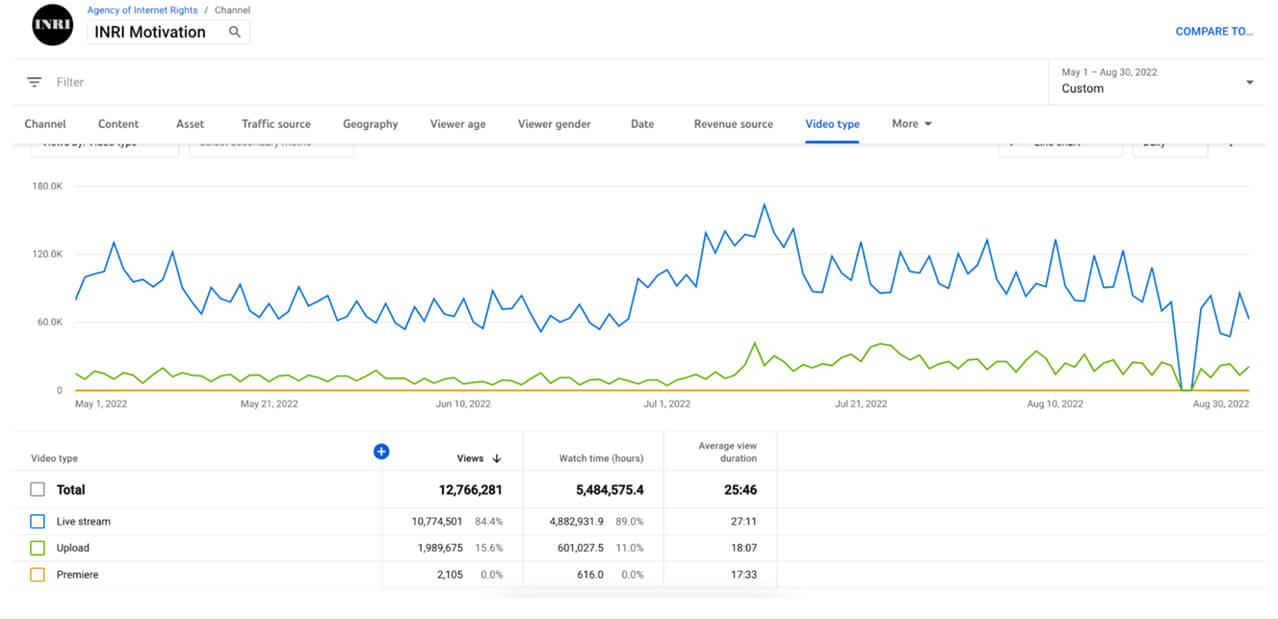
What to try: keep each stream under 12 hours, leave it public after it ends, and link it from related videos. Premieres work too. A premiere runs with live chat and then stays as a regular public video, so its hours count like any upload.
Point every Short at a long video
Shorts don't add to the 4,000 hours, but they can send viewers to videos that do. With advanced features turned on, you can set a related video on each Short, and it shows as a link in the Shorts player. Pick the long video each Short fits best. Dr Roto kept its Shorts on purpose, to reach new viewers before the football season.
A Deleted Video Takes Its Hours With It: Habits That Keep Watch Time Growing
Hours from deleted, private, and unlisted videos don't count toward the threshold. A video you hide to tidy up the channel takes its hours out of your total, and it can't pick up new ones. Even a video with a few hundred views can get found months later through search or a related trend, so leave old uploads public.
The exception is a video that breaks YouTube’s rules. AIR Media-Tech’s Safety team advises removing those about 30 days before you apply, and our guide shows what to delete before you apply for YPP.
Three more habits keep hours coming in between new videos:
- Keep a schedule you can hold. In AIR Media-Tech's study of 18,000 channels, channels that posted on a predictable schedule got more views per subscriber than channels posting the same number of videos on random days, in every niche. Posting above a niche's usual pace hurt more often than it helped.
- Pin a comment that sends viewers back into the video. A timestamp challenge like "Spot the mistake at 6:42" makes people rewind, and the rewatched minutes count as watch time. In our guide to pinned comment formats, a gaming creator we work with got 37% more replies from challenges than from open questions. Keep links that lead off YouTube out of the pin: they get clicks but end the session.
- Let viewers vote on your next video. Offer two or three topics you're already planning and say when the winner comes out, so people who voted come back to watch their pick. Post the poll a day or two before release and keep to about one a week, as our breakdown of YouTube poll strategies recommends. Polls don't need a subscriber count, only advanced features, and in Dr Roto's niche almost none of the leading channels used them.
What to try: before you delete or hide a video, check its watch time in Analytics. If it still earns hours, leave it public and fix its title or thumbnail instead.
Plenty of Watch Hours, Not Enough Subscribers: How to Reach 1,000
"I got watch hours long before subs," reads the top answer in a r/youtubers thread about the 4,000 hours, from a creator whose videos ran about two hours each. Long videos often work that way: a few hundred loyal viewers fill the hours well before 1,000 of them subscribe. Shorts channels usually hit the opposite wall.
You need both at once: 1,000 subscribers and 4,000 qualified watch hours from the last 12 months. Subscribers have no time window, so YouTube looks at your count when you apply. Hours keep expiring, so while you work on subscribers, keep publishing long videos at the same pace.
Which wall a channel hits first
Long videos, a smaller loyal audience
Hours first
Each viewer adds many minutes, but few of them subscribe. The fix is asking for the subscription and sending viewers to the next video.
Shorts, a wide audience
Subscribers first
Shorts reach many people fast, but their hours don't count toward 4,000. The fix is pointing each Short to a long video.
YouTube counts hours from public long-form videos and archived streams, not from Shorts (YouTube Official Blog, August 2026).
To turn viewers into subscribers:
- Ask once, right after the video has given people something useful, not in the first seconds.
- Add a subscribe element to your end screen next to the next video.
- Find the videos that already convert. In Analytics, switch to Advanced mode and sort your videos by subscribers gained, then make more like the top ones.
- Set a channel trailer for visitors who haven't subscribed yet, so they see your best pitch first.
- Run a series. People subscribe when they want the next episode.
On the way to 1,000, a lower YPP tier opens at 500 subscribers in countries where it's available. With 3 public uploads in the last 90 days and either 3,000 qualified watch hours in the last 12 months or 3 million qualified Shorts views in 90 days, a channel can turn on memberships, Super Chat, and Super Thanks, though not ad revenue. For ads, this tier doesn't count as being in YPP: a channel that reaches the ad bar after February 1, 2027, needs 8,000 qualified hours or 20 million Shorts views and goes through a full review again, Olga Soshynskaya of AIR Media-Tech says. So if you're in this tier, apply for ads as soon as you have 1,000 subscribers and 4,000 hours, and before February 1. Our breakdown of the 2027 changes covers the rest.
Hours stuck under 4,000 no matter how much you post?
Dr Roto posted 500+ videos before a Full Channel Audit showed why they didn't add up to watch hours. The audit compares your Studio data with 3 channels you choose and ends with a ranked plan of what to fix first.
- All 10 analytical blocks, from packaging and retention to monetization
- Your numbers next to 3 channels you choose
- Every fix ranked by effort and expected impact
- Read-only Studio access, no revenue share, no network contract