


Not Sure Which Languages to Choose?
Views and watch time are not the only metrics to see if your dubbed MLA is doing well.
Views going up tells you the algorithm found new people. It tells you nothing about whether those people care about your channel or whether they'll come back. What you need to track is audience behavior, and today, we'll explain how to do it.
Meet Three Channels This MLA Analysis is Built On
This article is built on data from channels we work with at AIR Translation Labs. All three have MLA running.
- Channel A is a long-form entertainment channel. Average view duration sits close to 7 minutes. Its original language is English, which has been running for years. Spanish was added as an MLA track and now has 1.5 years of development — long enough to show what a healthy translated language looks like at scale.
- Channel B is a kids' channel. It has three MLA languages running simultaneously on the same content: Arabic, French, and German. Because it's the same videos and the same upload schedule across all three, this channel gives us the cleanest comparison in the dataset — the only variable between the three is the market.
- Channel C is a personal brand edutainment channel. MLA launched mid-period, and you can see the exact moment in the data: flat lines, then sudden activity. It has three languages: Turkish and Polish, which launched 6–8 weeks before the data was captured, and Spanish, which has been running longer and is already maturing.
What to Measure on Dubbed Tracks
Before we get into the channel data, you need to understand the tool we're using in YouTube Analytics. Most creators never see this data because it takes four clicks to reach, and the default view doesn't show it.
Here's the path:
Analytics → Audience tab → Breakdown dropdown → "Audience by watch behavior" → Filter: Audio Track → select your language.
What you get is a time-series graph with three colored lines and a table beneath it. The table is useful. The graph is where the real story is. You need both.
The three tiers you'll see are:
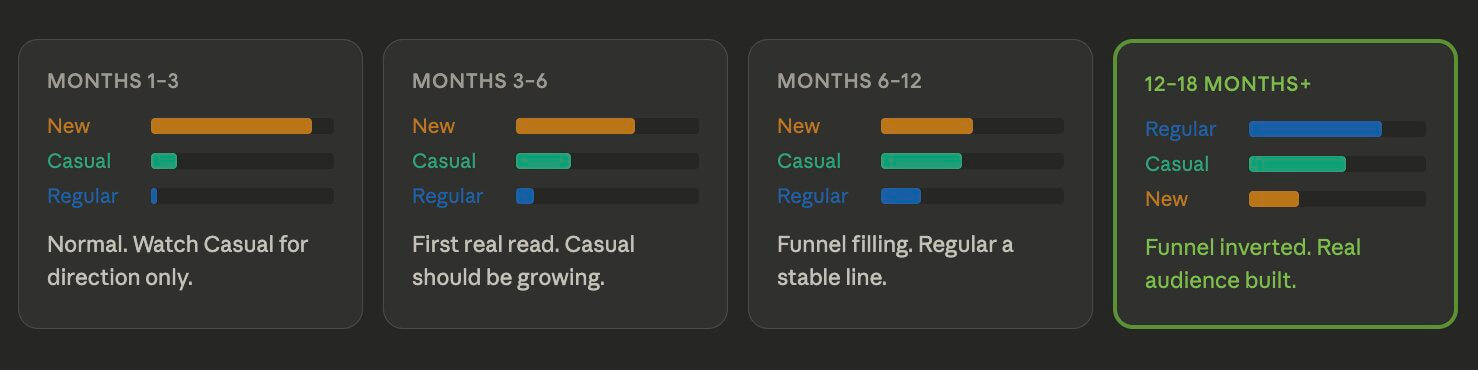
- New viewers are people seeing your channel for the first or near-first time. No habit formed, no loyalty established. Every MLA language starts here, and this tier will always dominate in the first months because the algorithm is distributing your audio track to cold audiences. A high New % in month one is expected.
- Casual viewers are people who came back 2 to 5 times. They moved past first contact but haven't built a real habit. One person can be counted as New on their first visit and as Casual across the next three or four, so within a reporting period, the same human shows up in both buckets. Casual is your conversion signal: the tier that tells you whether discovery is turning into interest.
- Regular viewers are the ones who are genuinely hooked. They return for new uploads, they subscribe, they engage. The critical context: in any established language, roughly 90% of Regular viewers were watching before MLA launched. This means growing the Regular tier in a translated language takes time. Don't judge a language by its Regular % in the first 90 days.
These three tiers form a conversion funnel. The single number to pull from all of this: Casual + Regular as a percentage of total views, checked monthly per language.
That is your conversion rate. Under 20% after 4+ months is a problem. 40%+ means it's working. 60%+ is a strong market.
Now let's look at each channel.
Case 1: When Dubbed MLA Beat the Original
Channel A gives us two views in one: what a fully mature language looks like (English), and what 1.5 years of healthy MLA development produces (Spanish).
English MLA: The Baseline
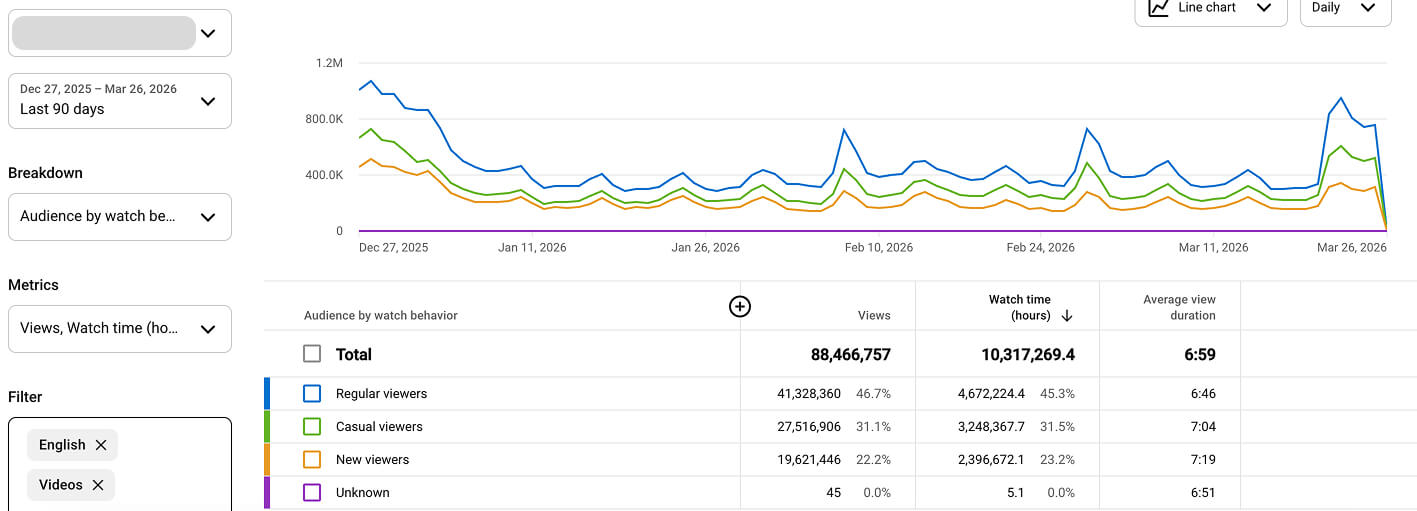
88.5 million views over 90 days. Average view duration: 6:59. This is what years of compounding look like.
|
Tier |
Views |
Share |
Watch time share |
Avg duration |
|
Regular |
41.3M |
46.7% |
45.3% |
6:46 |
|
Casual |
27.5M |
31.1% |
31.5% |
7:04 |
|
New |
19.6M |
22.2% |
23.2% |
7:19 |
The funnel is fully inverted. Regular leads, New is the smallest.
Several things are worth noting beyond the headline numbers:
- All three tiers watch for nearly identical durations. Only 33 seconds separate Regular (6:46) from New (7:19). That tight clustering means the content performs consistently regardless of who is watching: first-timers, returners, and loyal regulars all find value across the full catalog.
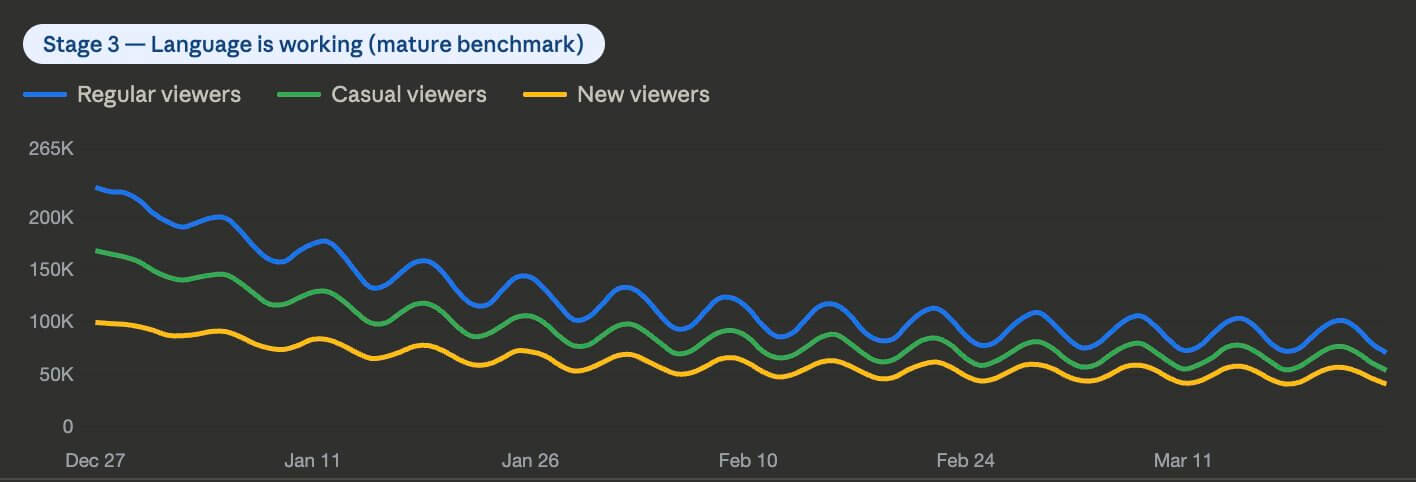
- On the graph, all three lines move together in sync with every upload. When new content drops, the whole audience responds, and no tier is decoupled. That synchronized rhythm is the visual signature of a mature, deeply habitual audience.
- New viewers average slightly longer (7:19) than Regulars (6:46). This is normal: Regular viewers know the catalog and browse more selectively. New viewers binge whatever gets recommended to them.
Spanish MLA: 1.5 years builds
19.7 million views. Same channel, same content, built from zero 18 months ago.
|
Tier |
Views |
Share |
Watch time share |
Avg duration |
|
Regular |
7.9M |
40.2% |
40.2% |
8:56 |
|
Casual |
6.7M |
33.8% |
34.1% |
9:00 |
|
New |
5.1M |
26.0% |
25.7% |
8:48 |
Nearly inverted already. But the number that stands out most is watch time: Spanish viewers average 8 minutes 55 seconds per session, nearly two full minutes longer than the English audience. Every tier watches more: Regular 8:56, Casual 9:00, New 8:48.
It means the Spanish-speaking market has fewer competing channels offering this type of content. When an audience finds something that works in an underserved space, they consume it harder. The Spanish audience is hungrier for this content than the native-language audience, and MLA is the only reason they found it.
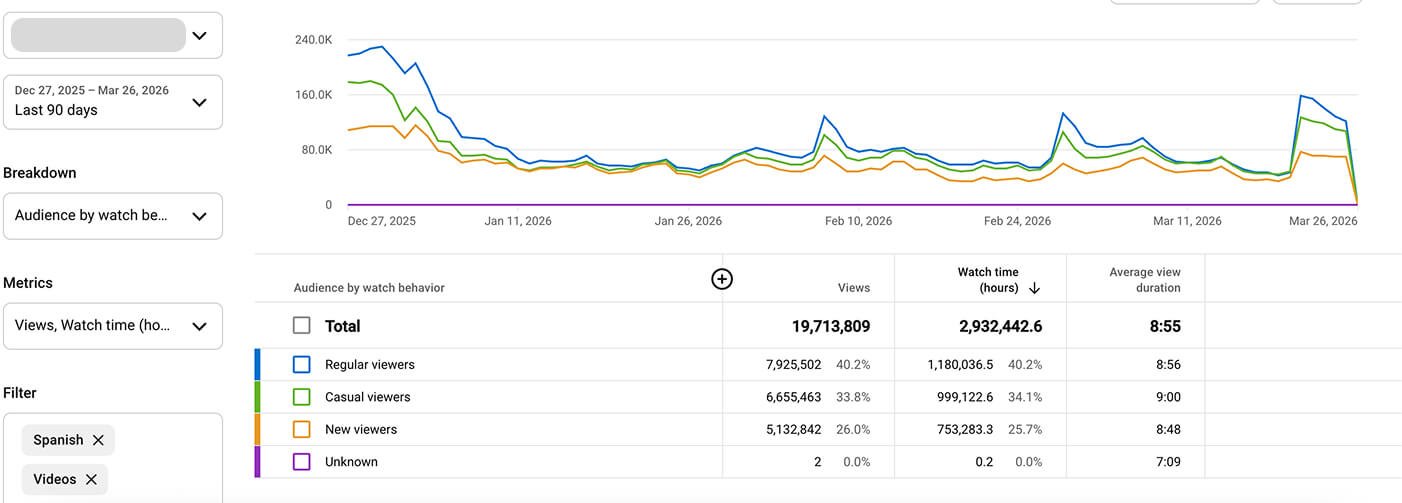
On the graph, note how the period starts with high activity in December, then gradually settles into a stable rhythm. By mid-January, all three lines are moving together with consistent spikes. That settling and synchronizing is the conversion process happening in real time.
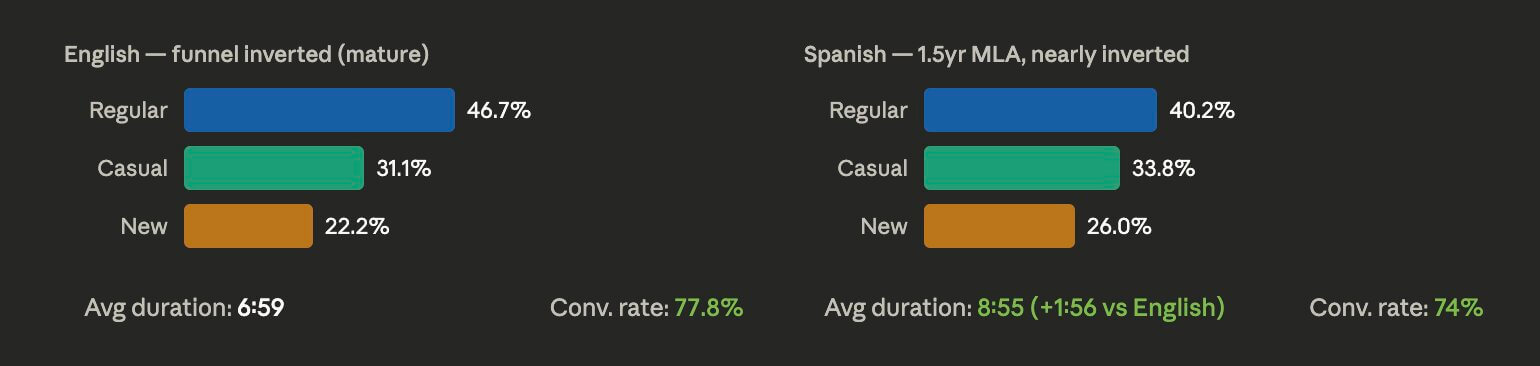
What Channel A's data tells you:
- A nearly inverted funnel is achievable in 18 months on a long-form channel, but only if content holds attention consistently across the catalog.
- When a translated language's average watch time exceeds that of the original language, treat it as a priority market. It means you're underserved there.
- The Spanish graph settling into synchronized spikes after a few months is what healthy MLA development looks like in motion. Not a straight line up, but a gradual stabilization of audience behavior.
Want your dubbed track to outperform the original?
We can’t guarantee that, but we’ve driven billions of views for 400+ dubbed channels. Let AIR Translation Labs build your dubbed tracks that deliver results. Get high-performing dubbed tracks
Case 2: Why Small Markets Win
Channel B is the analytically cleanest case because it eliminates variables. Same videos, same thumbnails, same upload cadence. Whatever you see between Arabic, French, and German is purely about market behavior — not content quality, not publishing frequency, not anything you control.
Arabic MLA
The Arabic audio track has 3.4 million views over the tracked period (Feb 16 – Mar 24, 2026).
|
Tier |
Views |
Share |
Watch time share |
Avg duration |
|
New |
1,799,913 |
53.1% |
53.4% |
2:49 |
|
Casual |
1,344,927 |
39.7% |
39.8% |
2:49 |
|
Regular |
247,549 |
7.3% |
6.9% |
2:38 |
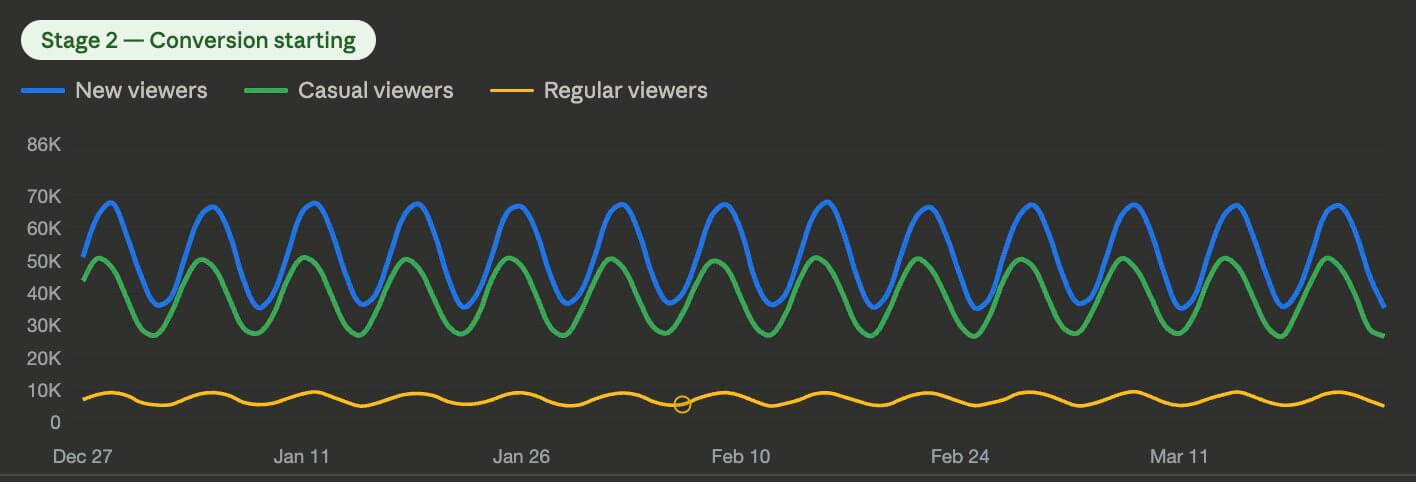
New and Casual are separated by just 13 percentage points, and on the graph, both lines move together. When a new upload drops, both spike in parallel. That synchronization is the conversion signal: people are discovering the channel and coming back within days. Regular at 7.3% is a real, stable line. This language is working.
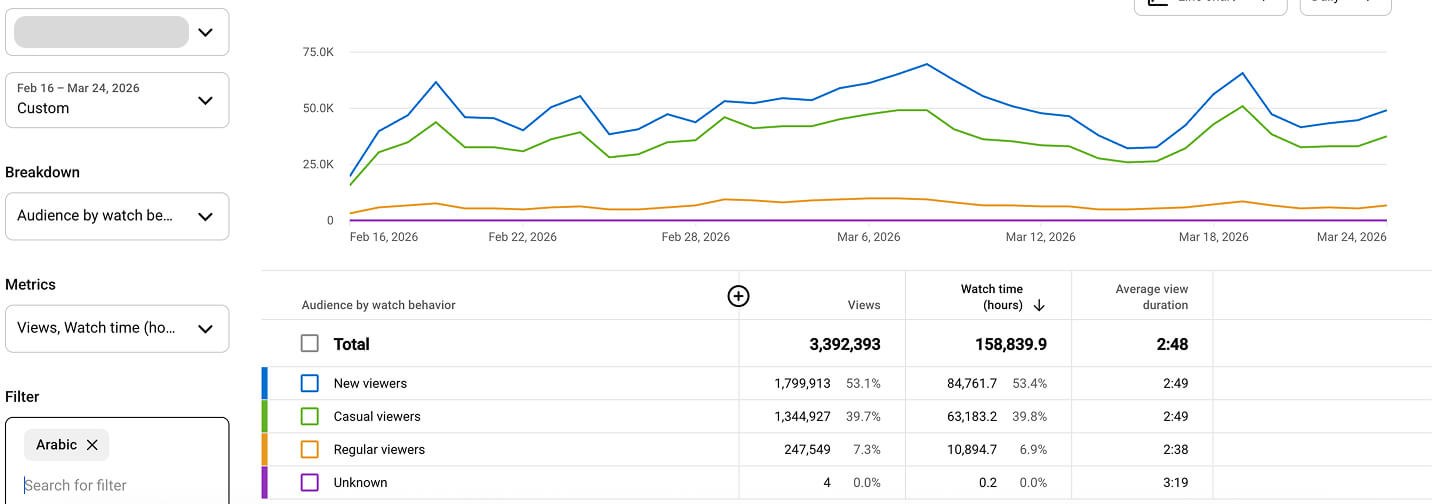
One detail in the table: New and Casual average the same watch time (2:49). That alignment means returning viewers engage as deeply on their second and third visit as first-timers do. The content holds consistently.
French MLA
The French audio track gained 745K views over the same period.
|
Tier |
Views |
Share |
Watch time share |
Avg duration |
|
New |
436,385 |
58.6% |
58.2% |
3:09 |
|
Casual |
262,276 |
35.2% |
36.1% |
3:15 |
|
Regular |
46,668 |
6.3% |
5.7% |
2:54 |
![A YouTube analytics screenshot of the Kids channel, showcasing the progress of the French audio track on YouTube MLA]](/storage/n3mJdPt0ZNFIPYFii2uXHH19GIJuUR0Bcevh0qjW.jpg)
New-Casual gap is wider here (23 points vs Arabic's 13), but the direction is healthy. One notable detail: Casual viewers average 3:15 versus New at 3:09. People who came back watched slightly longer than first-timers. That is a deepening engagement signal: the second and third visits are more valuable than the first, not less. It tells you the content is rewarding repeat viewing.
German MLA
134K views over the same period — 25 times smaller than Arabic.
|
Tier |
Views |
Share |
Watch time share |
Avg duration |
|
New |
64,795 |
48.1% |
52.1% |
4:30 |
|
Casual |
55,699 |
41.3% |
39.8% |
4:00 |
|
Regular |
14,256 |
10.6% |
8.1% |
3:10 |
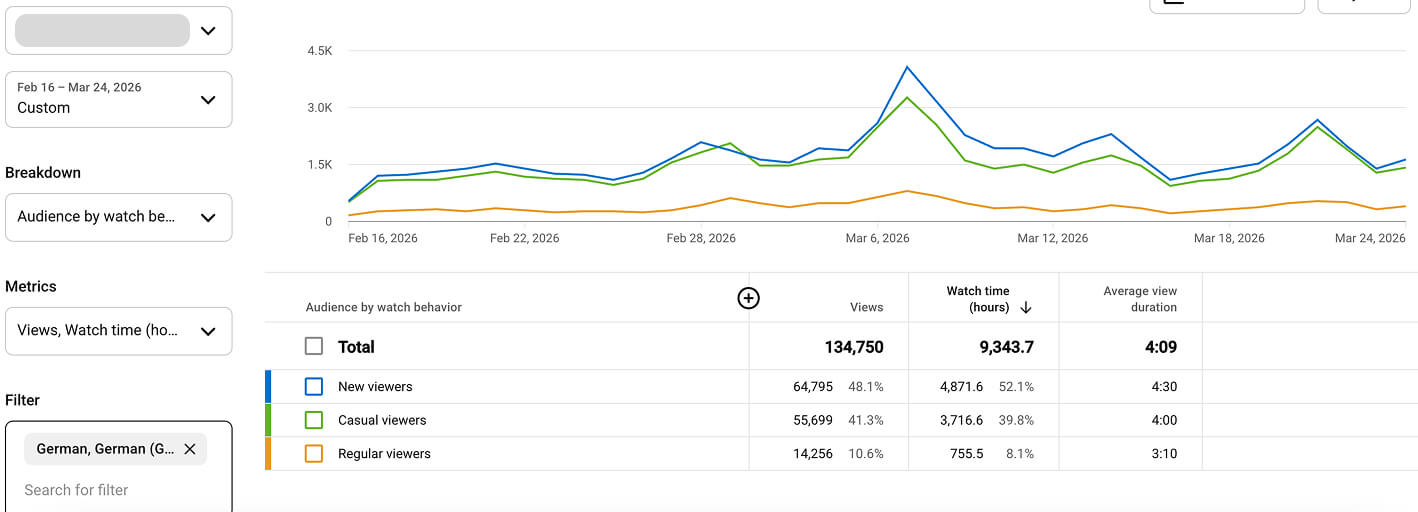
German has the smallest audience and the best ratios on every metric that matters.
- The New-Casual gap is just 7 points.
- Regular at 10.6% is the highest Regular share of any translated language in this entire dataset.
- Average view duration for German New viewers is 4:30: 95 seconds, longer than Arabic's 2:49 and over a minute longer than French's 3:09.
- On the graph, New and Casual lines track almost in parallel, with barely any gap between them.
German is 25 times smaller than Arabic in terms of views and outperforms it on every quality metric.
That’s not a coincidence. German-language kids' content is a thinner market than Arabic or French. Fewer competing channels means the audience that finds you has fewer alternatives, they stick harder, watch longer, and return more often. A creator who sorts MLA languages by view count and deprioritizes German based on that list is making a direct strategy error.
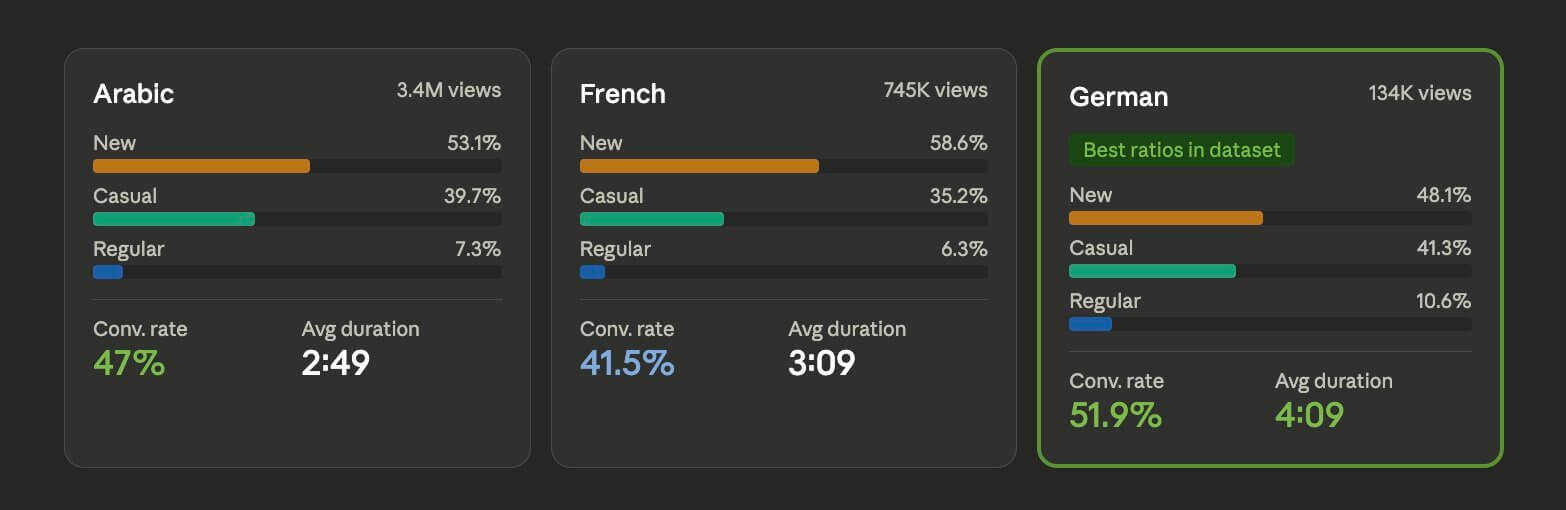
What Channel B's data tells you:
- Always rank your MLA languages by conversion rate, not by views. The smallest audience can be your strongest market.
- The New-Casual gap closing over time is the key trend to watch. Arabic (13pts) is closer to parity than French (23pts). German (7pts) is almost at parity already. Track this gap monthly.
- Watch time per language varies significantly even on the same channel's content: 2:49 (Arabic) vs 4:30 (German). This reflects market competition, not content quality. Higher watch time = less competition in that language.
Which languages will pay off for you?
Show us your content, and we’ll map out a high-conversion language strategy. YouTube recommends AIR, and so do the world's biggest creators.
Case 3: Seeing Through the Launch Spike
Channel C gives the most complete lifecycle view in this dataset. Turkish and Polish are at week 6–8. Spanish, on the same channel, shows what happens when a language has had more time to develop.
Turkish MLA: week 6–8
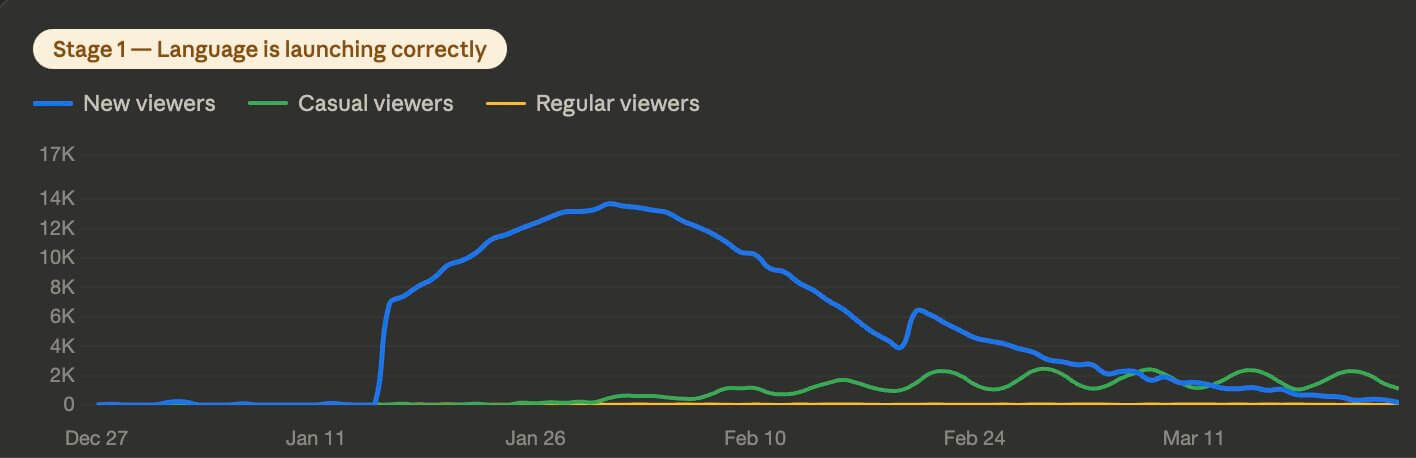
489K views. The MLA launched around late January 2026. The graph shows flat lines until late January, then a sharp spike in New, which has been declining since.
|
Tier |
Views |
Share |
Watch time share |
Avg duration |
|
New |
414,555 |
84.7% |
84.7% |
4:23 |
|
Casual |
71,939 |
14.7% |
14.8% |
4:25 |
|
Regular |
3,076 |
0.6% |
0.4% |
3:00 |
This is exactly what week 6 should look like.
The spike-and-decline in New is the algorithm doing its job — distributing the new audio track to cold audiences, reading engagement, adjusting. Casual has appeared and is forming its own line on the graph, still small but visible.
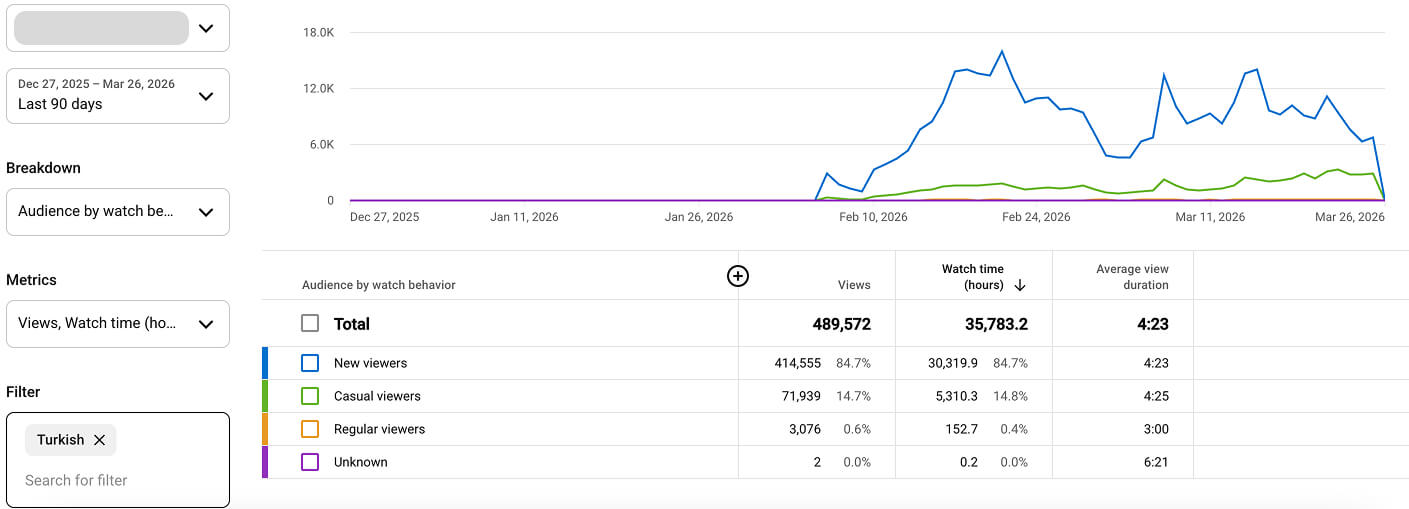
One important thing not to misread: Regular averaging 3:00 versus New at 4:23 looks backwards. It isn't. At 0.6% of total views — around 3,000 people — the Regular cohort is too small to produce a meaningful average. Ignore tier-level duration comparisons until Regular reaches at least 8–10% of total views.
Polish MLA: week 6–8
326K views. Same launch window as Turkish, slightly fewer total views.
|
Tier |
Views |
Share |
Watch time share |
Avg duration |
|
New |
259,538 |
79.4% |
78.5% |
4:22 |
|
Casual |
64,876 |
19.9% |
20.9% |
4:40 |
|
Regular |
2,431 |
0.7% |
0.6% |
3:26 |
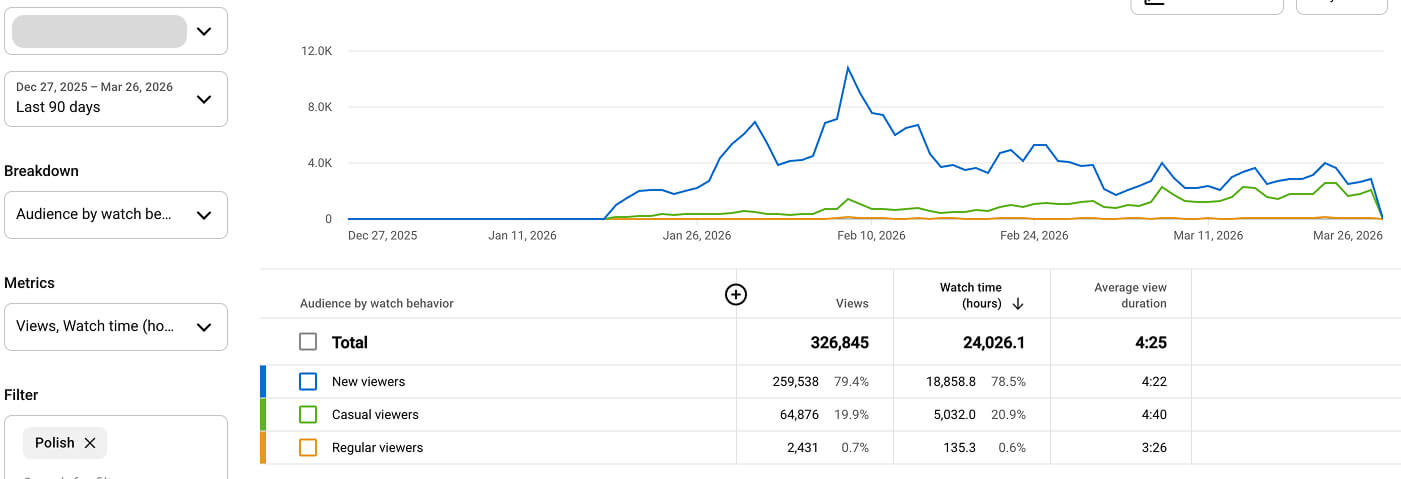
Same structure as Turkish, but Casual is already 5 percentage points ahead at the same stage.
Two things make this notable:
- First, Polish has fewer total views, so the higher Casual % isn't inflated by volume.
- Second, Casual viewers in Polish average 4:40 — 18 seconds longer than New at 4:22.
People who came back watched more than first-timers. That's an early deepening signal you don't always see this soon after launch.
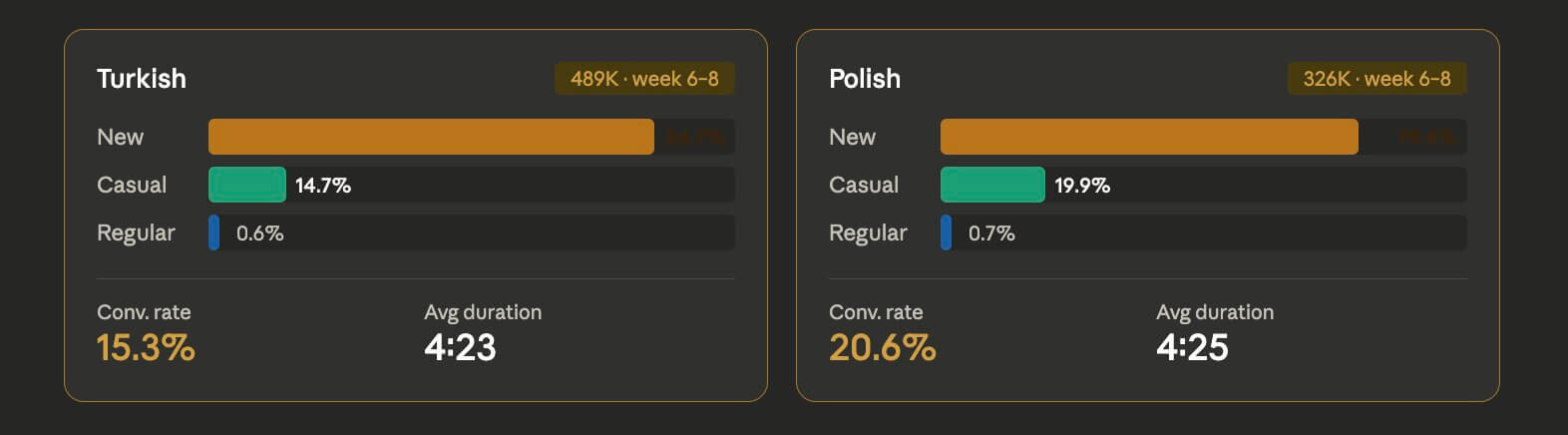
Both too early to evaluate. The only question to answer in 60 days: is Casual's percentage growing? Watch direction, not the absolute number.
Spanish MLA: original channel language
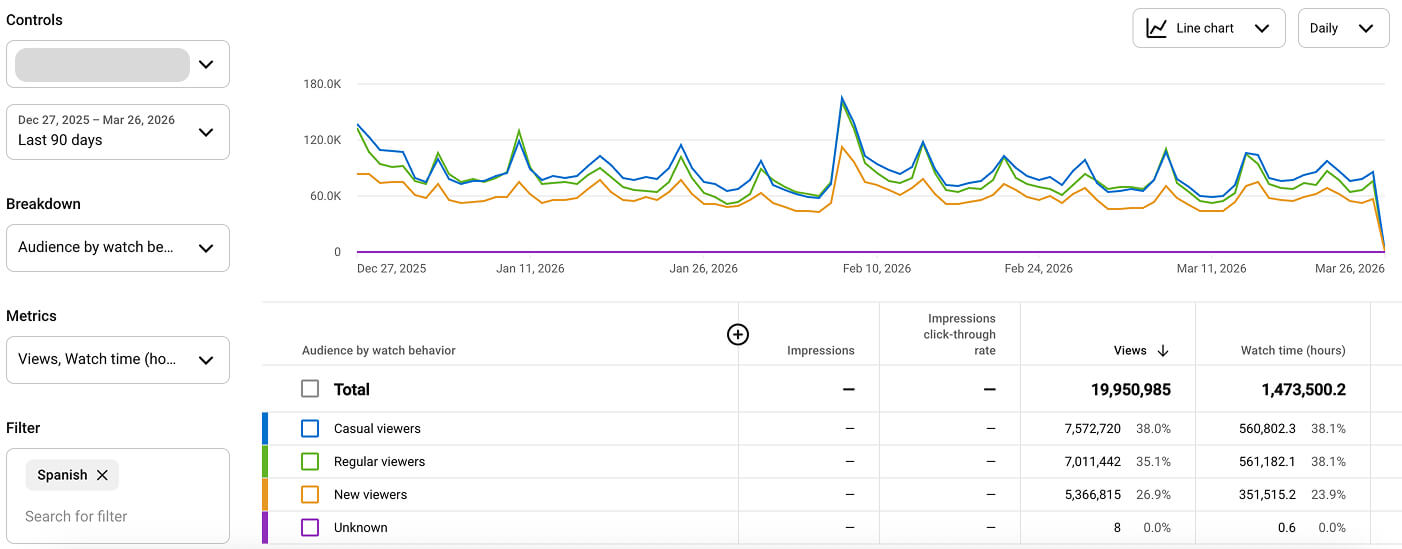
This is Channel C's Spanish track after more development time. ~20 million views, 1.47 million watch hours.
|
Tier |
Views |
Share |
Watch time share |
|
Casual |
7,572,720 |
38.0% |
38.1% |
|
Regular |
7,011,442 |
35.1% |
38.1% |
|
New |
5,366,815 |
26.9% |
23.9% |
All three lines move together on the graph with a consistent rhythmic pattern, synchronized with upload cadence. That's the same signature as Channel A's mature English track.
The one analytically interesting detail: Casual still leads Regular by 3 points. In a fully mature language, Regular would be on top.
What this gap means is that the conversion process is still actively running. New Casual viewers keep rolling into Regular, but the incoming Casual volume stays high enough to remain marginally ahead. This is not a problem. It means the language is still compounding. Give it 3–6 more months, and Regular will likely overtake Casual.
One more thing: Regular and Casual have identical watch time shares (38.1% each) despite Casual having a slightly higher view share. Regular viewers watch slightly longer per session. They're more committed per visit, even if Casual still leads in raw numbers.
What Channel C's progression tells you:
- Turkish and Polish at week 6–8 are not failing. They are exactly where a healthy early-stage language should be.
- Comparing Turkish and Polish side by side at the same stage already reveals a signal: Polish is converting 5 points better. If that gap widens over the next 3 months, it tells you something real about the relative market fit between those two languages for this content.
- The Spanish data on the same channel is the destination. It shows what consistent publishing and quality translation produce over time.
Don't know how to reach strong MLA results?
We’ll analyze your data and show you how to scale to millions with YouTube dubbing. Join the roster: AIR is the team behind Alan's Universe, Brave Wilderness, and Mat Armstrong. Analyze my channel
What a Healthy YouTube MLA Looks Like
Based on the data across all three channels, a healthy MLA language has a consistent set of characteristics. Here's what you're aiming for, and how to read each one in practice.
- The funnel is moving in the right direction. Casual + Regular % grows month over month in the first 6–12 months. It doesn't have to be fast — 3–5 percentage points per month is healthy. What matters is that it's not flat.
- The graph shows synchronization. When a new upload drops, New and Casual spike together. They don't have to be the same size — but they should move in the same direction at the same time. That lag between discovery and return is getting shorter as the habit forms.
- Watch time per tier is stable or deepening. Casual viewers watch at least as long as New viewers. If Casual duration is lower than New, the second visit isn't delivering on the promise of the first — either the content varies too much in quality, or the translation doesn't hold up across the catalog.
- Regular is a visible line, not noise. By month 6, Regular should be a stable, distinct line on the graph — small, but there and consistent. If Regular is still flatlined at month 6, the audience is not habituating.
- Conversion rate is above 40% and growing. This is the composite signal. Below 20% after 4 months: investigate. 20–40%: building, watch closely. Above 40%: working. Above 60%: strong market, prioritize it.
The data from these three channels gives a clear picture of what each milestone looks like in practice:
Phase 1: Language is launching correctly
New dominates, Casual is forming, the graph shows a launch spike
Phase 2: Conversion starting. Language is working
Casual % growing month on month, New-Casual gap narrowing → Casual + Regular above 40%, lines tracking together on graph
Phase 3: Language is maturing
Regular approaching or exceeding Casual, all lines synced → Regular leads, all three lines move together, avg duration converges across tiers
A Shortcut to Strong MLA Results - AIR Translation Labs
We aren't a dubbing agency. We are a YouTube growth team that uses localization as our primary lever.
Most services stop at "file delivered." For us, the delivery is just the start of the experiment. We manage the translation, the launch, and the ongoing optimization for 400+ channels because we know that a dubbed track is a living product, not a static asset.
- We are YouTube recommended. We don't just follow the platform's best practices. We help define them.
- Our goal isn't just to make your video speak Spanish or Arabic. It’s to make the Spanish and Arabic algorithms love your video.
- We dub, launch, track, and optimize. If a language is underperforming, we don't just keep uploading; we pivot the strategy.
We’ve already generated billions of views for creators like Alan's Universe, Brave Wilderness, Futcrunch, Mat Armstrong, Lady Diana, and Jason Vlogs. We know exactly what a "healthy" 6-month-old language looks like, and how to fix one that’s flatlining.
Show us your content, and we’ll show you which markets are hungry for it, create dubbed tracks, and deliver them to the tables where they’re already waiting to feast.