
Not Sure Which Languages to Choose?
If your channel is eligible, YouTube has probably already dubbed some of your videos. Automatic dubbing is on by default for eligible creators, so AI voice tracks can show up on a channel without the creator doing anything. YouTube built the feature, so it won't penalize you for using it. The real choice is between YouTube's free AI dub and a professionally dubbed track: which one keeps viewers watching, and what a weak AI track does to the rest of your channel.
Our team tested it on channels that already had professionally dubbed tracks. On one wildlife channel, the auto-dubbed English track held viewers for 1:22 on average. The pro-dubbed tracks on the same videos held them for 3:40 to 5:19. This article covers what we've seen across 400+ localized channels at AIR Media-Tech: where AI dubbing works, where it costs you, and how to tell the difference on your own channel before it shows up in your revenue.
Key takeaways
- AI dubbing breaks no YouTube rule, and dubbing with your own cloned voice doesn't need an AI label. The real risk is retention.
- In AIR's tests on channels that already had pro dubbing, AI-only tracks with no human involved kept viewers watching 4 to 10 times less. On Brave Wilderness, that meant 1:22 on the English auto-dub versus up to 5:19 on pro-dubbed tracks.
- Results depend on the language. On DenLion, a Spanish-language channel, the AI-dubbed Arabic track kept viewers longer than the Spanish original, while AI-dubbed French and Italian fell well below the English track.
- Testing many languages at once is faster than testing one at a time. AIR localized 5 of Alan Chikin Chow's videos into 11 languages and found 6 worth dubbing. Once a language proves itself, move it to hybrid or pro dubbing.
- YouTube's auto-dubbing doesn't translate titles and descriptions, so viewers in a new market have a harder time finding the video without localized metadata.
"Allowed" Isn't the Same as Safe: The Retention Cost
YouTube's message to creators is that auto-dubbing won't hurt and can only add views. What we see on real channels is more mixed.
We added auto-dubbed tracks to a set of channels that already had human-dubbed audio and compared the two. AI-only tracks kept viewers watching 4 to 10 times less than the same videos with pro-dubbed audio.
3:40–5:19
Average view duration on Brave Wilderness pro-dubbed tracks
1:22
Average view duration on the same videos' English auto-dub
|
Channel |
Pro-dubbed track |
AI-dubbed track |
|
Brave Wilderness (wildlife, 21.8M subscribers) |
3:40–5:19 average view duration |
1:22 on the English auto-dub |
|
Italian-speaking kids' channel (5M+ views) |
5–6 min average view duration |
54 sec on the English AI track |
|
Serbian channel with 10+ localized versions |
5:51 on the German track (7:13 on the Serbian original) |
43 sec on the English AI track |
All three cases, track by track, are in our AI dubbing retention case studies.
Why viewers leave an AI dub
Viewers rarely say they dislike an AI voice. They hear one of these and close the video:
- flat delivery in scenes built on emotion, jokes, or tension;
- lips that don't match the words (YouTube's lip sync is still an experimental feature for select channels);
- background audio that sounds hollow or distorted after the voice is replaced;
- a voice that doesn't match the speaker, such as a female voice over a male host;
- the same voice for every person on screen, or a voice that changes mid-video;
Low retention on one audio track doesn't stay on that track. When AI-dubbed tracks drag down average view duration, that signal feeds into how the algorithm reads your whole channel. The algorithm doesn't separate "this video is weak in Italian" from "this video is weak." Kids' content takes the hardest hit, because YouTube weighs retention heavily for videos watched in family settings.
AI dubbing is improving. In May 2026, YouTube said millions of channels already use auto-dubbing. The latest viewer figure it has shared is more than 6 million people a day watching at least 10 minutes of auto-dubbed content.
YouTube has also added Expressive Speech (an auto-dubbing mode that keeps the speaker's pitch, intonation, and energy instead of reading the text in a flat voice) in 8 languages: English, French, German, Hindi, Indonesian, Italian, Portuguese, and Spanish. Expressive Speech is a real step up, but it still isn't a voice actor.
One weak dub can drag down your whole channel
AIR has dubbed 400+ channels with voice actors and a hybrid human + AI workflow, built to hold retention in every language.
Hear how good dubs sound
Why Some Languages Hold on AI Voice and Others Don't
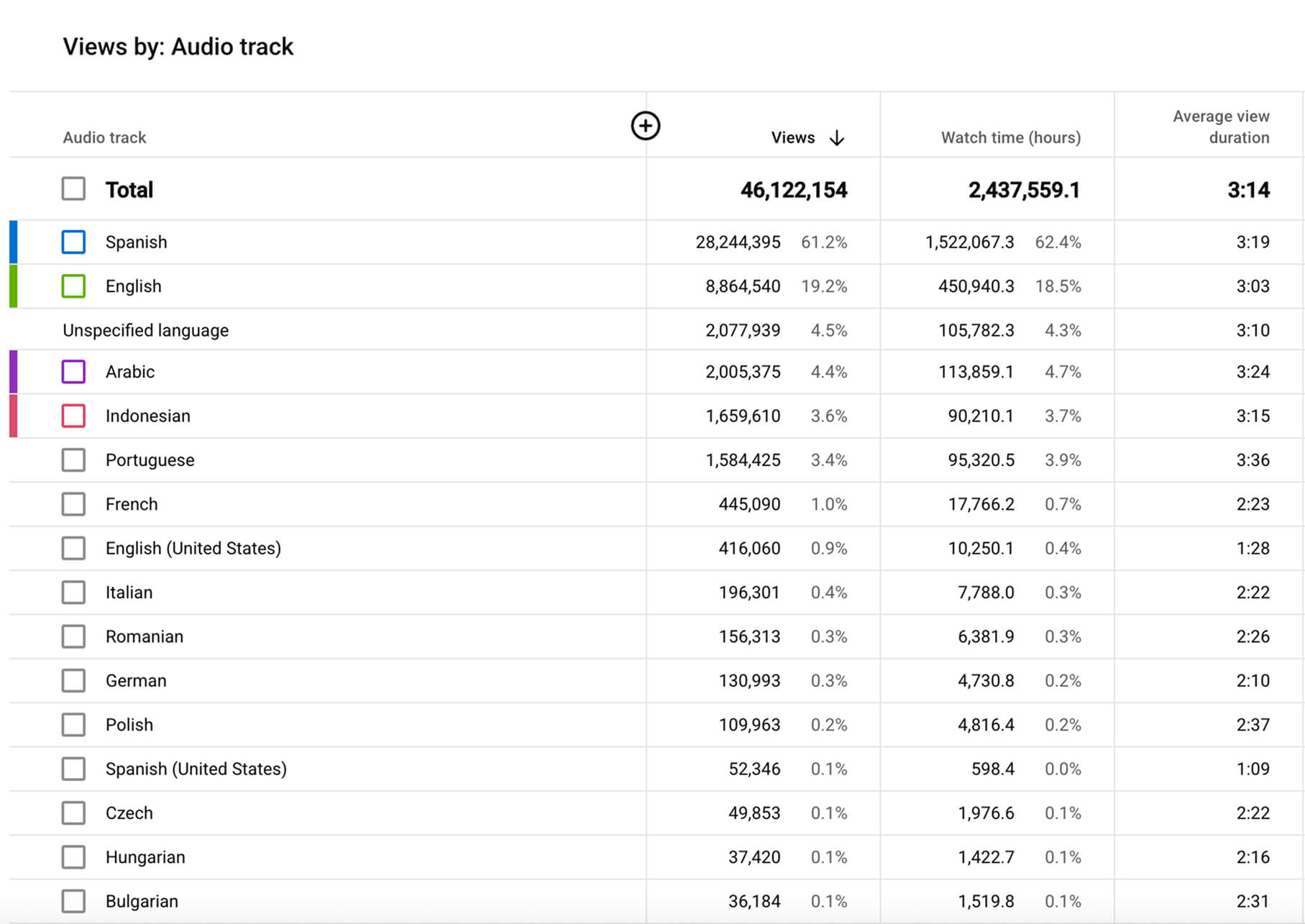
On the same channel, with the same videos and the same AI tool, some languages perform better than the original while others fall apart.
Take DenLion, a Spanish-language channel where we use AI dubbing for Arabic, English, French, Italian, Greek, and Dutch, and pro dubbing for the rest.
|
Audio track on DenLion |
Dubbing |
Share of views |
Average view duration |
|
Spanish (original) |
— |
61.2% |
3:19 |
|
Arabic |
AI |
4.4% |
3:24, above the original |
|
Portuguese |
Pro |
3.4% |
3:36, above the original |
|
Indonesian |
Pro |
3.6% |
3:15, close to the original |
|
English |
AI |
19.2% |
3:03 |
|
French |
AI |
1.0% |
2:23, well below the English track |
|
Italian |
AI |
0.4% |
2:22, well below the English track |
"Some languages hold. Others don't. It's not random."
Anton Yanovskyi, Growth Expert, AIR Translation Operations team
Anton breaks it down to five things that decide whether a language holds on an AI voice:
- How well AI tools are trained on that language. Spanish and Portuguese AI voices are among the strongest available.
- How culturally close the markets are. The closer the market, the less the voice has to carry.
- How much dialogue the content has. Visual, low-dialogue formats travel on AI voice more easily than talk-heavy ones.
- Whether the channel already had traffic from that country. Existing demand gives the track a head start.
- How forgiving the audience is of an imperfect voice. Portuguese-speaking audiences grew up on dubbed content and accept localized audio easily. French and Italian audiences expect more from a voice and notice the gap.
AI-dubbed traffic also behaves differently over time. On a Spanish-language channel with 80M total views, where the original drives 85% of traffic, we added AI dubs in English, French, German, and Italian, plus smaller Indonesian and Dutch tracks. The traffic line came out jagged: spikes, then drops. Unstable, spiky traffic is the typical pattern of AI-dubbed tracks the algorithm hasn't learned to distribute yet. Uploading tracks to as many videos as possible at once helps them settle faster.
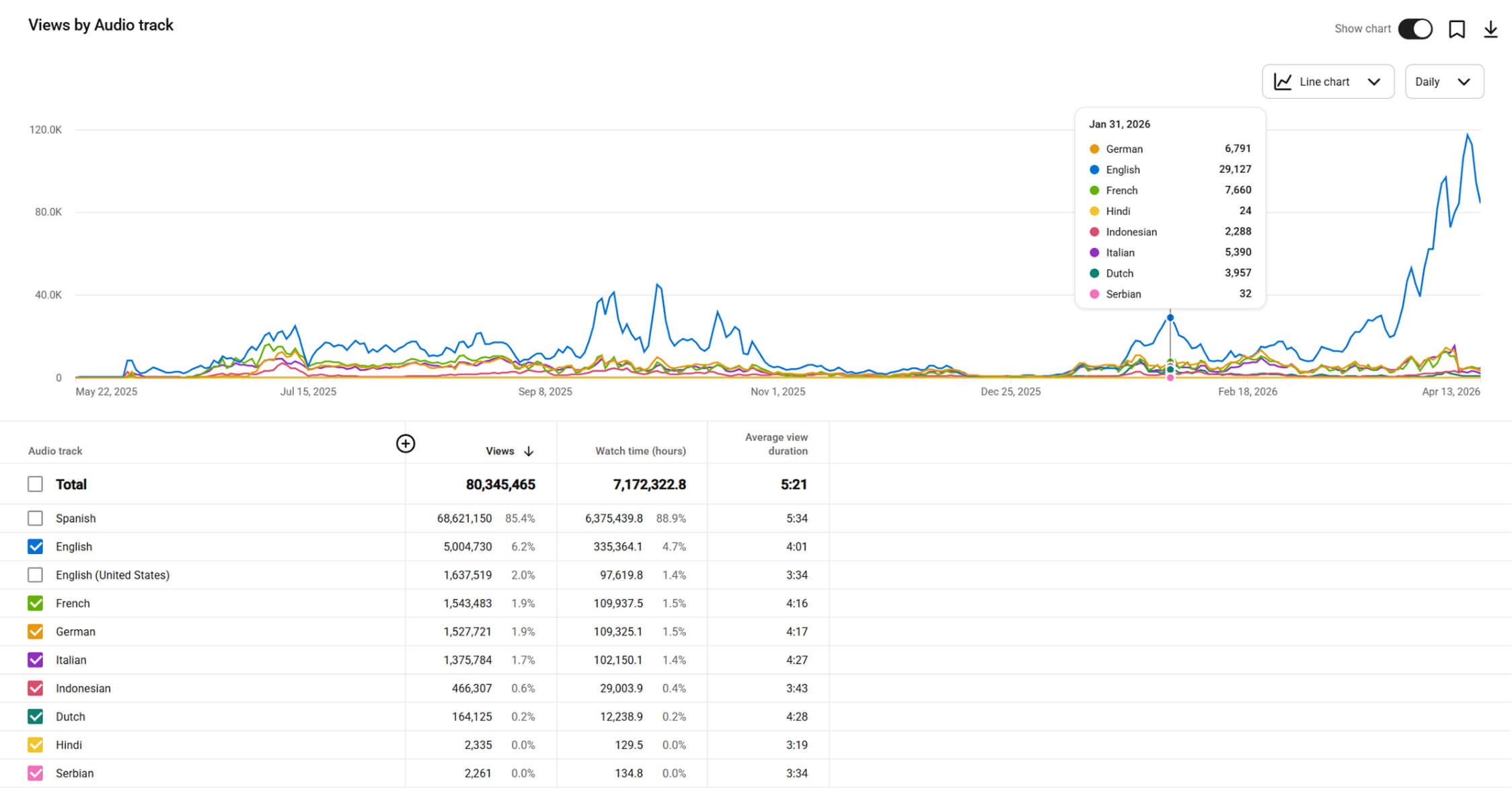
On that 80M-view Spanish-language channel, we also learned when to drop a language. We localized its top 20 videos into all target languages, including Hindi and Serbian. Hindi and Serbian both got low retention and little traffic, so we dropped them. Knowing when to drop a language saves as much money as knowing which ones to add.
AI, Hybrid, or Pro Dubbing: Matching It to Your Channel
Each dubbing option costs a different amount and holds viewers differently, and the right one can change from language to language on the same channel. Here's how the four options compare:
|
Dubbing type |
Best for |
Trade-off
|
|---|---|---|
|
YouTube auto-dubbing |
Testing whether a market exists |
Free, but no control over voice or wording |
|
Third-party AI dubbing |
Secondary languages, low-dialogue content |
Cheap and fast; quality varies by language |
|
Hybrid (voice actors + AI) |
Confirmed markets where cost matters |
Human voices for leads, AI for secondary characters and timing |
|
Full pro dubbing |
Kids' content, music, humor, games, emotional formats, big channels |
Highest cost, strongest long-term retention |
AIR's own hybrid workflow is roughly 80% human and 20% AI, with AI handling voice matching, cloning, and timing sync.
Test many languages at once, not one
Most advice, including what ChatGPT and Claude say when you ask them, tells you to test one language first. Our data points the other way.
When we started working with Alan Chikin Chow, his channel had 57M subscribers. It has since passed 100M. We localized 5 videos into 11 languages at once: Arabic, Chinese, Spanish, Portuguese, Turkish, Filipino, Japanese, Korean, Vietnamese, Hindi, and Indonesian. Then we compared views by country against views with each audio track enabled.
Four languages pulled ahead fast: Spanish, Arabic, Indonesian, and Portuguese. Japanese and Korean followed. The final dubbing lineup was 6 languages. The rest stayed as subtitles.
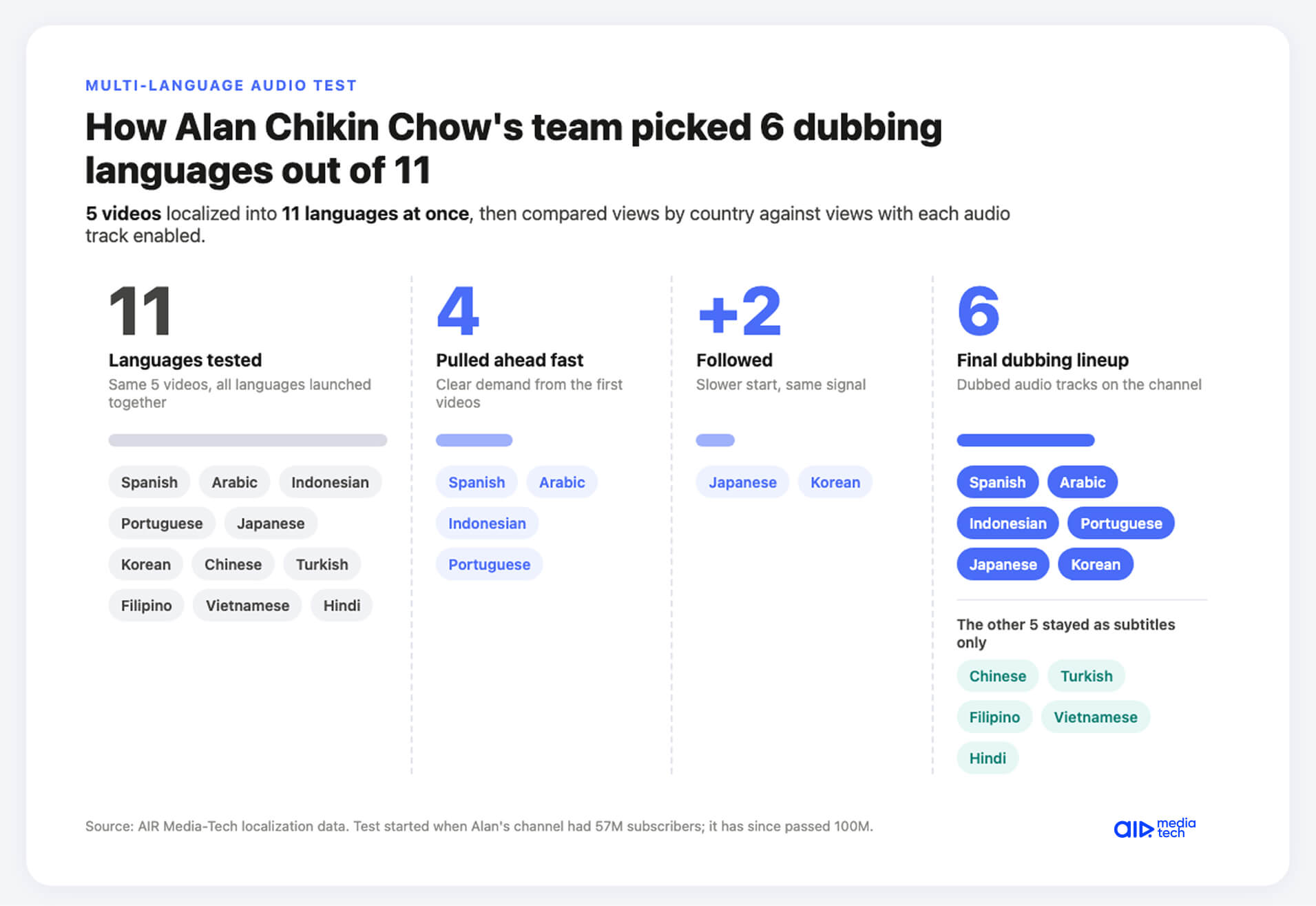
Testing one language at a time would have taken months to find those four. It could also have started with a language that didn't make the cut.
YouTube's auto-dub vs a third-party AI track
YouTube's built-in auto-dubbing and an AI track from a third-party tool are two different routes, and they show up differently on your channel:
|
YouTube auto-dubbing |
AI track from a third-party tool |
|
|
Voice control |
You can review, unpublish, or delete a dub, but you can't edit it |
You pick or clone the voice |
|
Label |
Marked "auto-dubbed" in the video description |
Not marked "auto-dubbed"; YouTube may still add an AI label if the file carries C2PA metadata |
|
Languages |
30 original languages as of September 2026. English videos can be dubbed into 20 languages; most other languages dub into English only. Expressive Speech in 8 |
Depends on the tool |
|
Eligibility limits |
Skips videos over 120 minutes, videos with little or no speech, very fast speech, unsupported languages, and copyrighted content |
Needs access to YouTube's Advanced features; an existing auto-dub in that language must be deleted first |
Sources: YouTube Help: automatic dubbing, YouTube Help: multi-language audio.
If your channel isn't in English
YouTube's auto-dubbing mostly gives you one new language: English. A Spanish channel also gets Arabic and Portuguese, but a Serbian channel gets no auto-dubs at all, because Serbian isn't a supported original language. For other markets, you need a third-party AI track or translated metadata.
Review every AI dub before it goes live
YouTube lets you switch auto-dubbing to manual publishing, so you can check each dub before viewers hear it. Turn it on. The errors that hurt most are the ones AI makes most often:
- names of people, places, and brands;
- numbers and statistics;
- jokes, slang, and idioms;
- technical terms;
- the voice's gender and age against the speaker on screen.
A mistranslated punchline or wrong number can make a good video feel cheap. Five minutes of review costs less than the retention you lose.
Where pro dubbing pays for itself
Two channels on pro dubbing show what a well-made track can do:
|
Channel |
Original language |
Dubbed tracks
|
|---|---|---|
|
HZD (kids, 165M views) |
Indonesian: 54% of traffic, 2:00 AVD |
Spanish holds 2:11, beating the original; Turkish, Italian, and German stay close |
|
Amelka (teen, 22M views) |
Serbian: 79% of traffic, 8+ min AVD |
Georgian holds ~8 min, Croatian ~7 min; Bulgarian, Hungarian, Czech, and Greek hold strong |
The lowest-risk path is to start on AI, let the data confirm a market, then move that language to hybrid or pro. You pay for quality only where an audience has already shown up.
What YouTube Flags in AI Audio
YouTube's position on AI is simpler than the forums make it sound. As Anastasiia Vovk, Localization Expert at AIR, put it during our webinar on AI content: "YouTube is not against AI tools. It's against the absence of a human touch."
The cleanup began in July 2025, when YouTube renamed its "repetitious content" policy to "inauthentic content" and widened it (here's how YouTube treats AI in 2026). It peaked in January 2026: YouTube terminated 16 channels with a combined 35 million subscribers and 4.7 billion views, together earning an estimated $10 million a year. All of them were channels with nobody behind the content.
From what our team sees, YouTube reads AI content on three levels:
- File origin. AI voice tools can sign or watermark the audio they generate, and YouTube says it may add an AI label on its own to content that carries this kind of C2PA metadata.
- Audio and video signals. Deepfake patterns, robotic rhythm, and sounds no human voice makes. Flat, evenly paced AI voices are the easiest to spot.
- Channel behavior. Twelve uploads a day with zero variation reads as a bot, whether the videos are dubbed or not.
A channel that dubs its own original videos passes all three. What gets flagged is AI standing in for the creator, and dubbing doesn't do that.
Four Risks the Auto-Dubbing Docs Don't Mention
YouTube's help pages explain how to turn auto-dubbing on and off. They say less about what can go wrong once dubbed tracks are live. Four risks of AI dubbing that AIR's localization team plans around:
- Music claims on dubbed tracks. Content ID applies to multi-language audio. If a dubbed track carries music you haven't licensed, expect claims on it. YouTube also skips auto-dubbing for videos with copyright claims (YouTube Help).
- The wrong voice on kids' content. On a kids' channel, the voice is part of the product. An AI voice that sounds too adult, too flat, or emotionally off from what's on screen can trigger platform flags for misleading content. Kids' content is where we're most careful about AI-only dubbing.
- Brand deals tied to one market. Multi-language audio brings in viewers from new countries. Reaching new countries is the point of dubbing. But if a sponsor paid for a specific audience, a sudden shift in your geography can catch them off guard. Talk to brand partners before you scale dubbing.
- Voice cloning without clear rights. Third-party tools can clone your voice into other languages. YouTube treats that as routine: cloning your own voice for voice-overs or dubs doesn't need the "altered or synthetic content" label, and neither does a stock synthetic voice that doesn't imitate a specific person. A voice that sounds like another real person does, even for a few seconds, because it makes that person appear to say something they didn't. So does AI-generated music. Our guide to AI disclosure lists every case that does and doesn't need the label. Clone only your own voice or voices you have written consent for, and check the tool's commercial license. For how YouTube protects creators' faces and voices from misuse, see our guide to likeness detection.
None of these four risks is a reason to avoid AI dubbing. They're reasons to go in knowing where the edges are.
What to Check Before You Scale
Dubbing is only half of localization. Before you commit budget to more languages, check these four things.
- Your metadata is translated. YouTube's auto-dubbing does not translate titles and descriptions. YouTube itself says translated titles and descriptions help viewers find your videos in their own language. A strong Spanish track under an English title still has to reach Spanish-speaking viewers somehow. Metadata can open a market even before a dub does. After AIR translated every title and description on KrasOlka, a Ukrainian DIY channel, into 9 languages, its views grew 148% in six months, mostly from countries that speak those languages.
- Your AI track's AVD sits in a healthy range. In our data, an AI-dubbed track whose average view duration sits 25–45% below the original language is in the normal range. Compare markets carefully. India watches mostly on mobile, so its AVD runs lower than TV-heavy markets. Here's how device split changes AVD on dubbed tracks.
- The track is building returning viewers. In YouTube Studio, go to Analytics → Audience → Breakdown → Audience by watch behavior, and filter by audio track. Track the Casual + Regular share per language every month:
|
Casual + Regular share |
What it means
|
|---|---|
|
Under 20% after 4 months |
Something is broken: voice, metadata, or market fit |
|
40%+ |
The language is working |
|
60%+ |
Strong market, worth pushing harder |
- Suggested traffic is growing. If the original lives on Suggested Videos but the dubbed track is stuck on Search and Browse, the algorithm hasn't mapped the track to an audience yet. Keep improving the local metadata until Suggested starts to grow.
The full method, with benchmarks from our dataset, is in how to know if your dubbed MLA is working. If you're weighing dubbed tracks against a separate channel per language, see our breakdown of that decision.
What's New in YouTube's Translation Tools
YouTube keeps adding localization features, and each one changes what you can do without paying for dubbing. Here's where things stand as of September 2026:
|
Date |
Update |
Status |
What it means for your channel
|
|---|---|---|---|
|
September 2025 |
Multi-language audio opened to millions more monetized creators (YouTube Blog) |
Live |
Most monetized channels can now upload their own dubbed tracks |
|
February 2026 |
Auto-dubbing opened to everyone, Expressive Speech in 8 languages (YouTube Blog) |
Live |
Free AI dubs with more natural intonation in the main languages |
|
February 2026 |
Lip sync for auto-dubbed videos |
Experimental, select channels (YouTube Help) |
Not something to plan around yet |
|
August 2026 |
Multi-language thumbnails: a separate thumbnail for each language version (AIR's August 2026 update roundup) |
Rolling out to creators with Advanced features |
Text on thumbnails no longer has to stay in your original language |
|
September 2026 |
Live auto-dubbing announced (YouTube Blog) |
Pilot starts in early 2027 |
Streams could reach viewers in other languages in real time |
Multi-language thumbnails matter more than they look. A dubbed Spanish track under a thumbnail with English text still tells a Spanish-speaking viewer the video isn't for them. If you have the feature, upload a translated thumbnail for each language. If you don't have it yet, use thumbnails without text. Even FutCrunch, whose channel runs in 19 languages, still uses one thumbnail per video. At VidSummit 2026, he explained that testing 20 thumbnails in 20 language versions is too much for a small team for now.
Live auto-dubbing is the biggest shift on the list. YouTube's reason for it: more than 40% of live watch time comes from viewers outside the creator's home country. Translating unscripted speech on the fly is harder than dubbing an edited video, so expect the same retention questions as with uploaded dubs, only in real time.
Find out which languages your channel should be in
- A language plan built on where your channel already has demand
- Scripts adapted for each market and voice actors cast to match your speakers
- A hybrid workflow, roughly 80% human and 20% AI, for tone, timing, and sync
- Upload-ready dubbed tracks through AIR's multi-language audio service
Sources: YouTube Help — Use automatic dubbing; YouTube Blog — How YouTube auto dubbing helps creators reach global audiences (May 2026); YouTube Blog — Unlocking a global audience with auto dubbing (Feb 2026); YouTube Blog — Made on YouTube 2026; YouTube Help — Disclosing altered or synthetic content; YouTube Help — Channel monetization policies; The Next Web — YouTube's AI slop purge (June 2026).