
YouTube confirmed more monetization changes in the past eighteen months than in the previous five years combined. The biggest change coming is a full Partner Program rewrite, the first one since 2018, announced August 10, 2026, effective February 1, 2027. Between that and eleven separate, dated brand-safety rule changes since March 2025, here’s what had already been implemented and what’s coming on YouTube.
All Confirmed YouTube Monetization Policy Changes at a Glance
|
Change |
Date |
Who it affects |
Status |
|
Human review added to ad suitability checks |
March 10, 2025 |
All monetized creators |
Active |
|
"Repetitious content" renamed "Inauthentic content" |
July 15, 2025 |
AI-assisted, faceless, mass-upload channels |
Active |
|
First major inauthentic-content enforcement wave |
January 2026 |
Mass-produced / AI-slop channels |
Enforcement ongoing |
|
AI disclosure required for realistic synthetic content |
Standing rule; enforcement rising |
Creators using generative AI |
Active |
|
11 dated advertiser-friendly / brand-safety rule changes |
March 2025 – August 2026 |
Creators in news, politics, gaming, firearms, and gambling niches |
Active (see table below) |
|
6-month inactivity rule can remove monetization |
Standing rule |
Channels that stop uploading or posting |
Active |
|
Shorts Creator Pool mechanics + "early access" fan-funding tier |
Standing structure |
All Shorts-monetizing and pre-monetization creators |
Active |
|
Partner Program overhaul: doubled entry thresholds, new Shorts revenue floor, Premium Lite expansion, activity grace window |
Announced Aug 10, 2026 → effective Feb 1, 2027 |
New applicants; all current Partners |
Upcoming (confirmed) |
|
Deadline to review or customize automatic Channel Memberships pricing |
August 17, 2026 |
Creators with international members |
Upcoming (confirmed) |
Why Is YouTube Tightening Its Monetization Rules in 2026?
There are three main reasons for the changes on the horizon:
- Mass-produced AI ‘slop’, which flooded the platform through 2025, caused the inauthentic content policy to now have a channel-level detection system instead of a video-by-video one.
- Advertisers grew wary of appearing next to AI-generated slop content, pressuring YouTube toward the eleven-item run of dated ad-sustainability changes described below.
- The scale of YouTube’s growth. Neal Mohan stated that YouTube sees more than 200 billion daily Shorts views and over a billion hours watched on TV screens. Simply put, YouTube had grown over the threshold where 2018’s rules were still applicable.
Individually, each of these wouldn’t be grounds enough for overhauling the entire ruleset, but all three together? And something needs to shift.
How Do You Check Your Channel's Monetization Status in YouTube Studio?
Four steps, about two minutes:
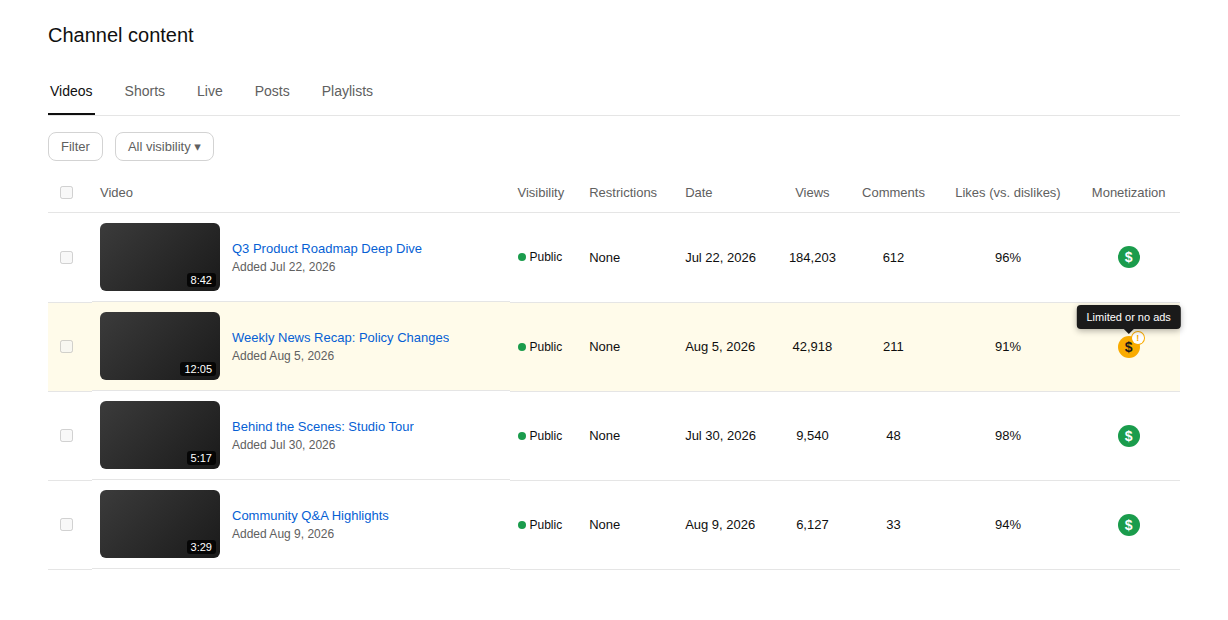
- Open YouTube Studio and go to the Content tab.
- Look at the dollar-sign icon next to each video: green means fully monetized, yellow means limited ads, and red or grey means no ads.
- Click any flagged video to see YouTube's stated reason for the decision.
- If the reason looks wrong, use the appeal option on that same screen. Appeals run through the same human-review process introduced in March 2025, and a successful appeal typically restores ad revenue on that video going forward.
While you're there, confirm under Monetization that you've accepted the Watch Page Monetization Module, the Shorts Monetization Module, and the Commerce Product Module if it applies to you. More on that below.
Which Channels Are Most at Risk of Demonetization in 2026?
Six channel types carry the most exposure right now, based on the pattern YouTube's enforcement has followed since January 2026:
|
Channel type |
Why is it flagged |
|
AI voiceover, no-face channels |
Synthetic narration over stock footage with zero original commentary or on-screen human input |
|
Compilation channels |
Reused clips with no meaningful transformation, analysis, or added commentary |
|
News-reader channels |
Articles read aloud verbatim instead of being analyzed or reported firsthand |
|
Faceless Shorts farms |
10+ near-identical uploads a day at a pace no editorial process could support |
|
Kids/family channels |
Content that skirts updated child-safety and misleading-content rules |
|
Channels with sudden topic pivots |
A format change that reads as chasing the algorithm rather than a creator's actual interest |
Eleven Dated Changes to Advertiser-Friendly and Brand-Safety Rules (March 2025 – August 2026)
YouTube’s advertiser-friendly content guidelines and its general policy changelog show eleven separate, dated adjustments to what content qualifies for full ads, more specific and more frequent than most creators realize:
|
Date |
Change |
|
Shorts view-counting updated to include plays with no minimum watch time |
|
|
Minimum livestreaming age raised to 16 |
|
|
"Bare Skin (Image Only)" removed from ad-sensitive categories |
|
|
EU political promotions require disclosure and become region-restricted |
|
|
New policy removes content falsely claiming tobacco or nicotine aren't addictive or harmful |
|
|
Gambling policy expanded to cover digital goods; enforcement on graphic gaming content strengthened |
|
|
Controversial issues (e.g., dramatized, non-graphic treatments) gained monetization eligibility |
|
|
Firearm content showing 30-round magazines became monetizable |
|
|
Content showing young subjects in distress with shocking imagery lost ad eligibility |
|
|
Channel descriptions became directly enforceable against the Community Guidelines |
|
|
Educational, documentary, or news content depicting death may now be monetized |
These changes go to show that the definition of brand safety is always evolving and changing on YouTube.
Standing Rule: The 6-Month Inactivity Clause Can Remove Your Monetization
Okay, now let’s review the policy that sounds the most terrifying (and which a lot of YouTubers got wrong). No, you don’t need to post a video every 5 months to keep your channel.
Per YouTube’s monetization FAQ: “YouTube does reserve the right, at its discretion, to remove monetization from channels if a channel is inactive and not uploading or making posts for 6 months or more.”
This policy is completely separate from Google’s general 2-year dormant-account policy, and YouTube creators with uploaded videos are exempt from that broader account-deletion rule. What you might lose if your channel is inactive for longer than 6 months is your monetization, specifically.
Community posts counted as activity, so you didn’t need to stress out if you couldn’t make a video “before the mone-timer runs out”. If you were stepping away from a channel for an extended period of time, you could schedule a couple of Community posts every few months to keep the clock from resetting your monetization.
YouTube Monetization Policy Changes in 2026: Timeline
Let’s review the nine entries in the order YouTube made them.
Human Review Joins the Ad Suitability Process (March 10, 2025)
YouTube added a manual layer to automated ad suitability checks, including on private videos. Per YouTube’s own monetization policy page, “videos undergoing checks (including private videos) may receive an additional review that may be completed by a human. In some cases, video monetization decisions may take up to 24 hours.” The stated goal is to “improve the accuracy of monetization decisions and increase your channel’s overall monetization potential.”
For creators, it meant that a monetization decision that used to resolve instantly would now take up to a day (and sometimes even longer), especially around edge cases that automated systems handled badly. Human review was a positive change in monetization rules, which helped a lot of creators whose works were wrongfully flagged.
"Repetitious content" becomes "Inauthentic content" (July 15, 2025)
Here, YouTube decided to change the way they approach low-effort and mass-produced content, which put a lot of AI videos on the chopping block:
- Template videos with tiny changes
- Slideshow videos with identical voice-over or none at all
- AI-generated videos with zero creative input
- Copied content across your whole channel
Why has YouTube renamed and clarified the policy that used to be called “repetitious content”? The official update reads: “We’re making a minor update to our ‘repetitious content’ policy to better clarify that this includes content that is repetitive or mass-produced. We are also renaming this policy from ‘repetitious content’ to ‘inauthentic content’.”
To put it simply, the July 2025 update clarified the existing rules. YouTube explicitly stated there was "no change to our reused content policy, which reviews content like commentary, clips, compilations, and reaction videos," so legitimate reaction and clip-compilation channels weren’t the intended target.
The First Major Inauthentic-Content Enforcement Wave (January 2026)
This is when things got more serious. In January of 2026, some creators woke up to their channels being completely erased from the Partner Program in one coordinated sweep. Combined, those channels held roughly 35 million subscribers and 4.7 billion lifetime views, and had been generating an estimated $10 million a year in ad revenue.
The wave fell under the inauthentic content policy. We have already covered that wave in detail, including the specific format patterns that triggered it, in how YouTube treats AI in 2026.
The removed channels shared a fingerprint: synthetic narration, templated thumbnails, stock-footage loops, and an upload pace no human editorial process could sustain.
Why are other channels outgrowing you?
It's not luck. There's a specific reason — and our specialists who've audited 3,000+ channels will find it in yours.
Show me what to fixAI Disclosure Enforcement Gets Sharper Teeth (Throughout 2026)
Throughout 2026, since the January ‘purge’, YouTube was enforcing those AI-generated content policy rules more and more.
Per the AI-generated content policy, “we require creators to disclose when they use AI to meaningfully alter or generate photorealistic content,” aka content that makes real people appear to say or do things they didn’t, alters real footage, or generates realistic scenes that never happened.
Disclosure happens through the "AI use" toggle in Studio at upload. Non-compliance risk: "manual application of a label, or penalties from YouTube, including removal of content or suspension from the YouTube Partner Program."
Disclosing AI use didn’t reduce a video’s reach or monetization eligibility in theory, and there wasn’t an upside to skipping the toggle, or sometimes the toggle was enforced for you.
Since May 27, 2026, YouTube also applies the label itself when its systems detect undisclosed photorealistic AI. Which videos need the label, and which auto-applied labels you can still remove, is covered in AIR's guide to YouTube AI disclosure rules.
How Does YouTube Shorts Monetization Work, and What's the "Early Access" Tier?
First, YouTube runs a two-tier path into monetization: an early-access, fan-funding-only tier at 500 subscribers plus 3 public uploads in 90 days and either 3,000 watch hours in a year or 3 million Shorts views in 90 days, which unlocks memberships, Super Chat, and Super Thanks, but not ad revenue.
Full monetization requires the familiar 1,000-subscriber bar plus 4,000 watch hours or 10 million Shorts views.
Second, Shorts ad revenue runs through a monthly Creator Pool: Shorts with no music send their full ad revenue into the pool; Shorts using music split that revenue with music licensing based on track count (one track means roughly a 50/50 split). Creators keep 45% of their allocated share of the pool either way. Shorts views only count toward payment after a channel accepts the Shorts Monetization Module.
YouTube Doubles Partner Program Thresholds, Effective February 1, 2027 (August 10, 2026)
On August 10, 2026, YouTube announced the first major change to the Partner Program since 2018. From February 1, 2027:
- New channels applying for ad and Premium revenue need 1,000 subscribers plus 8,000 qualified watch hours in 365 days or 20 million qualified Shorts views in 90 days. Until then, the bar is 4,000 hours or 10 million Shorts views.
- Applications submitted by 23:59 UTC on January 31, 2027, are still reviewed against the old bar, according to AIR Media-Tech's partner support team.
- Channels already in YPP keep their status but must accept updated terms in YouTube Studio by January 31, 2027.
- Earning from the Shorts Creator Pool needs 10 million qualified Shorts views over the last 90 days.
- Every partner has to stay active: 1,000 qualified watch hours in 365 days, 1 million qualified Shorts views in 90 days, or 2 long-form videos or 5 Shorts every 90 days.
- Premium Lite expands to every country with YouTube Premium, and 60% of its net revenue goes into the creator pool.
The 500-subscriber fan-funding tier doesn't change. For what each change means for your channel, and what to do if you're close to 4,000 hours, read our full breakdown of the 2027 YPP changes. For what channels earned before these rules take effect, by niche and format, see our YouTube monetization benchmarks for 2026.
Important: The new terms need to be accepted by January 31, 2027!
These new terms can look intimidating, but they aren’t. How do you accept the terms?
- Open YouTube Studio → Monetization
- Review the modules that apply to your channel: the Watch Page Monetization Module, the Shorts Monetization Module, and, where relevant, the Commerce Product Module
- Accept the new terms
Missing the deadline does not cancel your Partner Program; the affected monetization tools simply stop paying out until you accept.
Fan funding, separately
If you turned on memberships, Super Chat, or other fan-funding features before 2023, check the Commerce Product Module in Studio. Creators still on the old Commerce Product Addendum move to the current Commerce Product Module automatically; the terms and payout mechanics don't change.
Four more changes, each landing on a different type of channel first:
1. Premium Lite: A New Revenue Source With No Setup
Premium Lite expands to every country that offers regular Premium. It excludes YouTube Music and keeps ads on music content, Shorts, and search. Sixty percent of net Premium Lite revenue funds a separate creator pool (versus 30% for standard Premium). Nothing to configure; watch YouTube Analytics for the new line item.
2. Shorts: A Payout Floor Appears
A channel needs at least 10 million Shorts views in the trailing 90 days to draw a monthly Shorts Creator Pool payout. Falling short doesn't automatically mean that your Partner Program status was revoked, but the Shorts payout for that month will stop, long-form monetization keeps working the entire time, and payouts resume automatically once views cross back above 10 million, with no additional reapplications.
YouTube is also adding a targeted-ad option: when an advertiser picks five channels or fewer, the Shorts creator gets a direct 45% revenue share of that placement, on top of standard pool payouts. If Shorts drive real revenue for you, the practical target is roughly 111,000 views a day to hold 10 million across a 90-day quarter.
3. Channel Activity Becomes Its Own Requirement
Starting February 1, 2027, every channel needs at least one of the following:
- 1,000 watch hours in the last 365 days
- 1 million Shorts views in the last 90 days
- 2 long videos / 5 Shorts every 90 days
Miss all three, and YouTube opens a 90-day grace window. Keep in mind that uploading during that window wouldn’t be enough on its own. To regain active status, you will need to reach 1,000 watch hours or 1 million Shorts views again.
If you miss the grace window, your channel will be at risk of losing its Partner Program status.
4. New Channels Face a Higher Bar
For ad monetization, a new channel will need:
- 1,000 subscribers plus 8,000 watch hours in 365 days
- OR 1,000 subscribers plus 20 million Shorts views in 90 days, which is double today's 4,000 hours or 10 million views
Important! This change applies only to new applicants! Current Partners are not affected by the higher entry thresholds.
Fan-funding requirements stay unchanged at 500 subscribers plus 3,000 watch hours, or 3 million Shorts views in 90 days. If you're not yet in the Partner Program and close to today's bar, apply before February 1, 2027, to qualify under the lower thresholds still in effect.
Have questions about the new YPP rules?
We see that Premium Lite's payout pools, the Shorts grace period, and the new activity thresholds raise more questions than the headlines answer. Get clear answers for your channel. → Ask a specialist.
What you need to do:
- By January 31, 2027, accept all required updated terms in Studio; check the Commerce Product Module if you turned on fan funding before 2023.
- If you're already in YPP, no need to reapply because of the new thresholds; keep an eye on channel activity; if Shorts drive meaningful revenue, track your trailing-90-day view count now.
- If you're not in YPP yet, check how close you are to today's requirements; if you qualify, don't delay your application past February 1, 2027, since entry requirements double after that date.
What stays the same: the revenue split (creators keep 55% of ad revenue on long-form, 45% on Shorts); status for existing Partners; fan-funding, Shopping, and Creator Partnerships thresholds (500 subscribers + 3,000 watch hours or 3 million Shorts views); and the 1,000-subscriber requirement for ads and Premium eligibility.
Deadline to Review or Customize Automatic Channel Memberships Pricing (August 17, 2026)
This date is frequently misread as a universal price increase. In truth, YouTube is adjusting international Channel Memberships pricing for new members to reflect current foreign-exchange rates.
Creators get AI-recommended price adjustments in Studio and will have until August 17, 2026, to review the recommended changes or set up their own custom prices before automatic updates go into effect. Pricing updates are limited to once every 12 months per membership tier.
Can You Navigate These Changes Alone?
Maybe, but a policy change rarely hits a channel in isolation, and sometimes keeping afloat with these changes can become challenging.
AIR Media-Tech is a YouTube Certified Partner with direct escalation routes into YouTube's Creator Support that solo creators don't have access to. We can help you stay ahead and stay above the minimum YPP requirements. How? By looking into your channel fully!
We audit channels across 10 pillars: packaging, retention, traffic, niche, portfolio, revenue, audience, forecast, risks, and roadmap, and hand you a fix for all of them, including the policy-risk signals covered in this article.
What you get:
- A structured report covering all 10 pillars of channel performance
- A 30-day action plan ranked by impact
- A 45–60-minute live walkthrough with your strategist