
YouTube has widened access to its deepfake detection tool four times in eighteen months, which is a fair measure of how quickly the problem is moving. Since May 17, 2026, it has been open to everyone: any creator aged 18 or over who owns or manages a channel can switch on Likeness Detection and have the platform scan new uploads for their face.
Detection is where the tool stops. Matches land in a queue inside YouTube Studio, the removal request is yours to file, YouTube's reviewers decide the outcome, and anything posted outside YouTube stays outside its reach.
The law meant to close that distance would make removal a right rather than a request. The NO FAKES Act cleared the Senate Judiciary Committee on June 18, 2026, and has not moved since. The rules around it have moved instead: several US states now let you sue over a cloned voice, platforms face a 48-hour deadline on intimate fakes, and creators with European audiences picked up a labelling duty of their own on August 2, 2026.
What Changed in YouTube's AI Policy in 2026?
The rules touching what other people can do with your face now sit at different stages. Some are live platform policies you can use this afternoon, some are enforceable only in certain states, and one is still a bill. Here is where each of them stands.
|
Protection |
Status as of September 2026 |
What it covers |
Where you act |
|
YouTube Likeness Detection |
Live, experimental. Open to all creators 18+ since May 17, 2026 |
AI-generated video showing your face |
YouTube Studio → Content detection → Likeness |
|
YouTube privacy complaint |
Live. No enrollment needed |
Realistic AI depictions of you, voice included |
YouTube privacy complaint form |
|
YouTube impersonation policy |
Live |
Channels and fake AI endorsements pretending to be you |
Impersonation report |
|
YouTube Content ID |
Live, for rights holders with a catalogue |
Your copyrighted footage and audio, reused |
Certified partner or direct application |
|
TAKE IT DOWN Act |
In force since May 19, 2026 |
Intimate images shared without consent, AI-made included |
Platform removal request, or the FTC portal |
|
State right-of-publicity laws |
In force, scope differs by state |
Your name, face, and voice, AI copies included |
Civil claim, with a lawyer |
|
EU AI Act, Article 50 |
Applies from August 2, 2026 |
Your duty to label AI content for EU viewers |
Disclose at upload |
|
NO FAKES Act |
Not law. Approved by the Senate Judiciary June 18, 2026 |
Would give you a national right over your face and voice |
Nothing to file yet |
|
YouTube automatic AI labels |
Live since May 27, 2026 |
Undisclosed photorealistic AI content in your uploads |
Nothing to file; correct a mistaken label in YouTube Studio |
Sources: YouTube Help, YouTube Blog, FTC, European Commission, Congress.gov S. 4591. Verified September 2026.
The pilot began in December 2024 with actors and NBA and NFL athletes represented by Creative Artists Agency, reached six creators including MrBeast and Marques Brownlee in April 2025, and opened to the Partner Program that October.
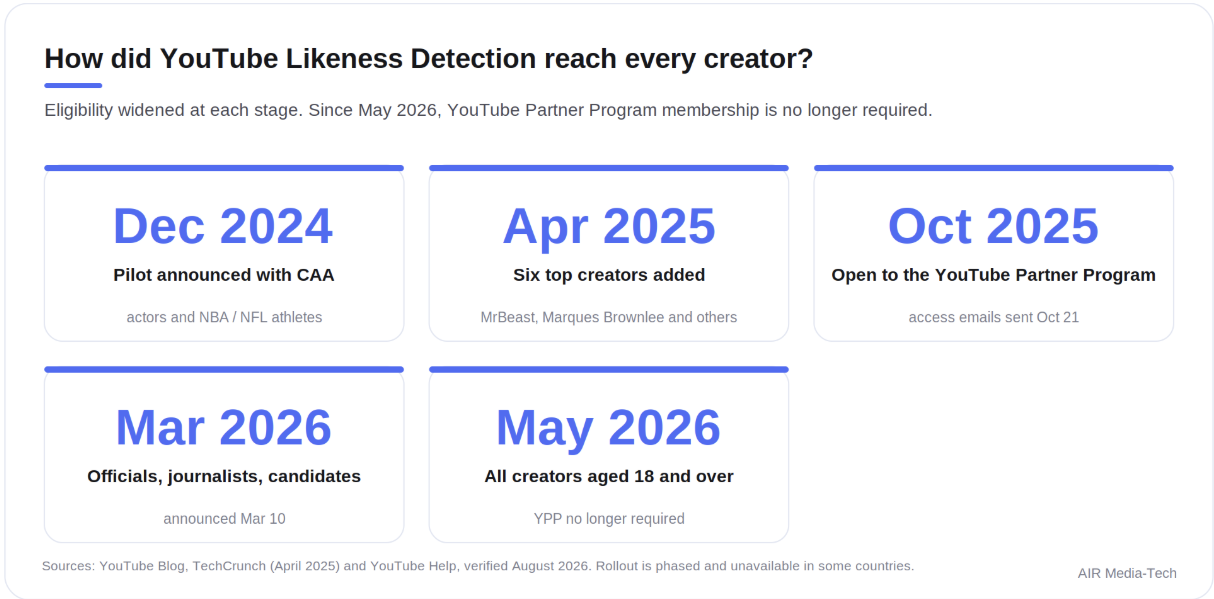
YouTube Likeness Detection rollout, December 2024 to May 2026. Source: YouTube Blog and YouTube Help, verified August 2026.
What Is YouTube Likeness Detection and How Does It Work?
Likeness Detection scans videos uploaded to YouTube for your face and puts every match into a review queue inside YouTube Studio. It works the way Content ID works for copyrighted material, except the reference asset is your face rather than a song or a film.
You enroll once by verifying your identity with Google, which builds a biometric reference from that check. The system then searches new uploads against it. Matches land in your Likeness tab, where you decide what happens next.
YouTube does not delete matched videos for you, and creators consistently expect that it will. From the queue, you can:
- submit a likeness removal request under the privacy guidelines;
- submit a copyright removal request if the video reuses footage you own;
- archive the match to clear it from your list while the video stays up.
The judgment call on removal stays with YouTube's reviewers.
Handing a government ID to Google makes people uneasy, reasonably. YouTube states that verification data collected for Likeness Detection is not used to train Google's generative AI models, and that it is retained for up to three years from your last login.
Who Can Enroll in Likeness Detection in 2026?
Any YouTube user aged 18 or over with a Channel Owner or Manager role can enroll, as of the May 17, 2026 expansion. The earlier gate, membership in the YouTube Partner Program, no longer applies.
The rollout is phased, so the Likeness tab arrives in Studio in waves rather than for everyone at once, and the feature has not launched in every country. If the tab is missing, the account is not broken; it is queued.
Enrollment is also per person, not per channel. A channel with three on-camera hosts needs all three to verify separately for all three faces to be scanned.
What Can Likeness Detection Not Do?
It does not detect voices. YouTube's current documentation states that the feature is used to find matches of an enrolled creator's face, with audio detection planned but not shipped. A cloned voice over stock footage will not appear in your queue, and reporting it means filing a privacy complaint by hand.
Some other gaps are also worth remembering:
- It only watches YouTube. A deepfake circulating on TikTok, Instagram, or X is outside its reach. Each platform runs its own process.
- It is experimental, and it produces false positives. During this phase the queue can surface real footage of you, not only altered or AI-made video.
- It does not decide fair use. Parody, criticism, and commentary that use your face can be flagged and still stay up after review.
- It is not retroactive protection. Matches surface from the point of enrollment onward, so the sooner you verify, the more the queue is worth.
Enrolled creators find fakes within days of upload. Unenrolled creators find them when a viewer sends a link, which can be weeks later and several thousand views in.
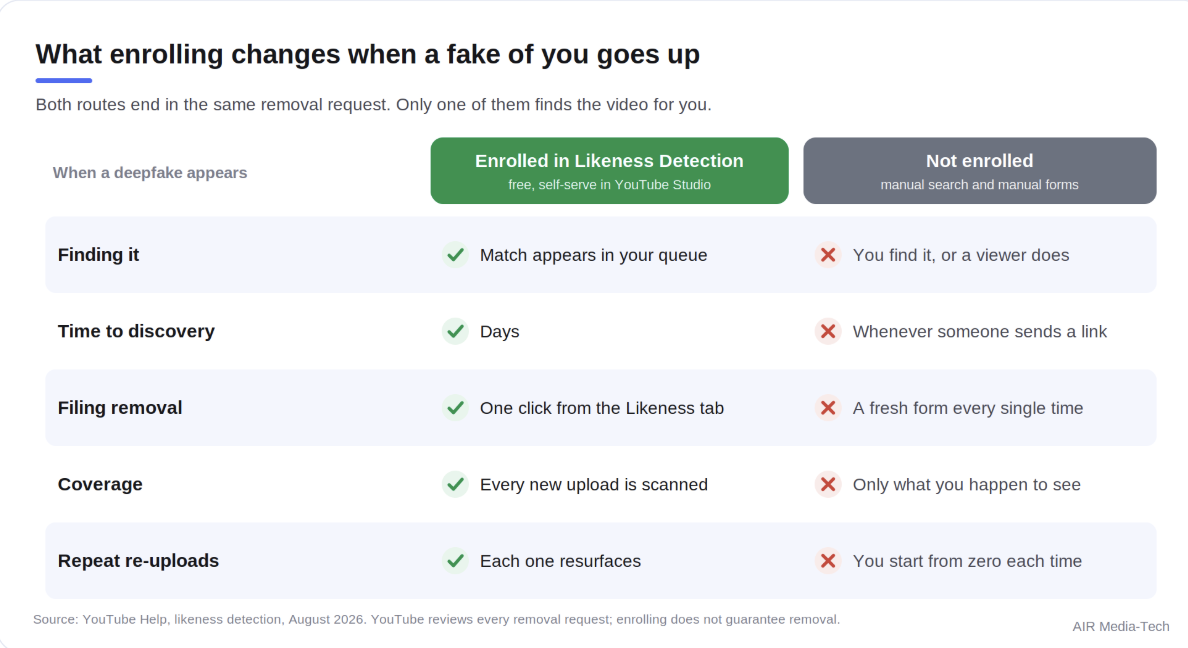
What changes when you enroll in Likeness Detection? Source: YouTube Help, likeness detection, August 2026.
Most creators enroll after the first fake turns up, and enrollment is not retroactive, so everything already posted stays invisible to the queue. AIR is a certified YouTube partner and covers what Studio's queue leaves out.
How Do You Enroll in YouTube Likeness Detection, Step by Step?
Enrollment takes about ten minutes of your time and up to five days of Google's. You need a phone, a government-issued ID, and the account that owns or manages the channel.
- Open YouTube Studio on desktop and sign in with the account holding the Owner or Manager role.
- Go to Content detection in the left menu, then open the Likeness tab. If you do not see it, your account is in a later rollout wave or in a country where the feature has not launched.
- Select Start now and read the consent screen.
- Agree to the use of biometric technology for facial search. Enrollment cannot proceed without this.
- Scan the QR code with your phone to move the identity check to a mobile device.
- Photograph your government-issued ID and follow the prompts.
- Record a short selfie video so Google can match the live capture to the ID.
- Wait for confirmation by email. Verification takes up to five days. Matches begin appearing in the Likeness tab once your enrollment is approved.
Repeat steps 3 to 8 for every person who appears on camera.
Turning it off is faster than turning it on.
Content detection → Likeness → Stop finding matches ends the scanning, and YouTube stops within 24 hours.
How Is Likeness Detection Different from Content ID?
Content ID protects what you made. Likeness Detection protects who you are. They run on related matching technology and answer different questions, and most creators who take protection seriously end up using both.
|
YouTube Likeness Detection |
YouTube Content ID |
|
|
Reference asset |
Your verified face |
Your video and audio files |
|
Who can use it |
Any creator 18+, Owner or Manager role |
Rights holders with a catalogue, vetted by YouTube |
|
How to get access |
Self-serve in YouTube Studio |
Application, or through a certified partner |
|
Automatic action |
None. You review and request |
Yes. Block, track, or monetize by policy |
|
Covers cloned voice |
No, as of August 2026 |
Covers your recorded audio only |
|
Outcome you can get |
Removal under privacy or copyright rules |
Removal, or the revenue from the upload |
Source: YouTube Help — Likeness detection and YouTube Help — Content ID. Current August 2026.
Content ID can claim revenue from a re-upload without you lifting a finger, while Likeness Detection hands you a list and waits for you to act on it. Access runs through a different door too: YouTube vets Content ID applicants on exclusive rights and catalogue size, which is why most creators reach it through a certified partner rather than directly.
Every day a re-upload of your video stays up, it earns revenue for whoever posted it. Content ID finds those uploads on its own and lets you block them or take the revenue instead.
What Should You Do If You Find a Deepfake of Yourself on YouTube?
Pick the route that matches what the video is. These run as separate processes at YouTube, not one form with different labels, and filing under the wrong one wastes the review.
A realistic AI video of you saying or doing something you did not…
…goes through the privacy complaint process. YouTube's privacy guidelines cover synthetic or altered content that depicts a realistic version of you, so you do not need to argue copyright. You must be uniquely identifiable in the video, and the request has to come from you or your legal representative.
Your own footage, re-uploaded or clipped into an AI edit…
…is a copyright removal request. This is stronger ground, and the review is faster, because ownership is easier to prove than harm.
Intimate images shared without your consent, real or AI-made…
…have a legal deadline behind them. Platforms must take them down, and any copies they know about, within 48 hours of a proper request. That became enforceable on May 19, 2026, and the FTC runs a complaint site at TakeItDown.ftc.gov if a platform ignores you.
A channel pretending to be you…
…is an impersonation report, filed separately from all of the above. It targets the account rather than a single upload.
If you are enrolled in Likeness Detection, the privacy and copyright routes both start from the Likeness tab instead of a blank form, with the video already attached.
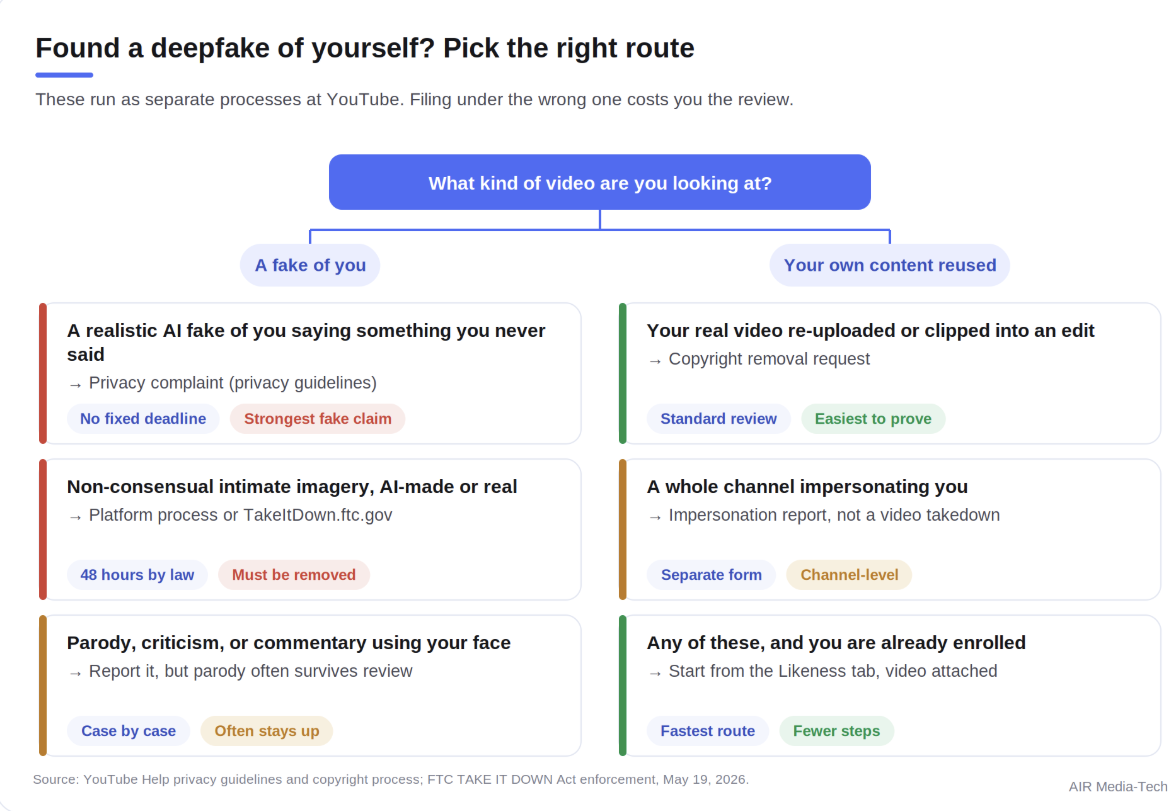
Which removal route fits which kind of video. Source: YouTube Help; FTC TAKE IT DOWN Act enforcement, May 19, 2026.
What Happens After You File a Removal Request?
YouTube contacts the uploader first and gives them 48 hours to remove or edit the video. Creators read the silence in that window as a rejection and give up on the request, when the clock is simply running.
If the uploader does nothing, YouTube's team reviews the video independently. It can remove the video outright, blur your face and other identifying details, or strip identifying information out of the title, description, and metadata while the video stays up.
YouTube has published what its reviewers weigh.
Parody and satire cut against removal. So does a video where you are not uniquely identifiable. Public-official or well-known-figure status raises the bar rather than lowering it, and that one catches creators off guard — an audience puts you nearer the public-figure end than a private individual, so a request that only says "this is fake" tends to lose.
Specificity is what moves a request.
Give timestamps for every point where you appear, describe what the video claims you said or endorsed, and name the guideline it breaks rather than describing how it feels to watch. Requests that read like evidence get treated like evidence.
What Can You Do About a Cloned Voice?
File a privacy complaint. YouTube's synthetic-likeness request has covered voice as well as face since November 2023, and that route still works even though Likeness Detection cannot find these videos for you. You will have to find the video yourself, and once you have it the complaint is the same one you would file over a face.
Musicians get a route of their own.
Labels and distributors representing artists in YouTube's AI music programme can request removal of tracks that mimic an artist's singing or rapping voice, judged case by case and weighed against news reporting or critique of the synthetic vocals.
State law reaches further on voice than most creators expect, and the section on state protections below covers what is already enforceable.
What About Scam Ads and Fake Endorsements Using Your Face?
This is the version most creators meet first: an AI clip of you promoting a crypto scheme, a giveaway, or a product you have never touched. YouTube's impersonation policy names it directly, banning AI-generated content that shows a real person willfully participating in a video or endorsing a product when they did not.
Report it as impersonation rather than as a privacy violation.
Impersonation targets the channel, so a successful report can take down the whole operation instead of one upload out of forty. YouTube states that a channel it determines exists to impersonate others can be removed entirely.
Do both if the same clip is running as a paid ad. The ad and the channel go through different reporting flows, and taking down the channel does not automatically stop the ad spend behind it.
Is the NO FAKES Act Law Yet?
No. As of August 2026, the NO FAKES Act has not been signed into law and has not received a floor vote in either chamber.
The Senate Judiciary Committee approved it unanimously on June 18, 2026, which is the furthest any version of this bill has travelled. It still needs a floor vote in the Senate, passage in the House, and a presidential signature before it binds anyone. The Senate version is S. 4591 and the House companion is H.R. 8915, both introduced in May 2026. YouTube, TikTok, OpenAI and Disney are among the companies backing it publicly.
YouTube has supported it publicly since April 2025, which is context worth carrying into its policy announcements. The platform wants this law to exist.
What Would the NO FAKES Act Do for Creators?
It would make your face and voice something you own nationally, the way you already own the videos you make. That protection currently exists state by state, and what it covers changes every time you cross a border.
What it would mean in practice:
- You could not sign it away. The right stays yours for life and cannot be transferred, whatever a brand deal, production contract, or platform's terms of service might say. After death, it becomes licensable by your estate for up to 70 years.
- Platforms would have to act on your report, under a takedown process modelled on the one that already exists for copyright. A service that removes flagged content promptly is shielded from liability, and none would be obliged to go hunting for fakes on its own.
- The uploader could contest it. If they dispute your report and you do not sue within 14 days, the video can be restored. A dispute filed in bad faith carries a $25,000 penalty.
- The penalties are heavy. A service that ignores valid reports faces up to $750,000 for a single video, falling to $25,000 where it can show a good-faith effort to comply.
- Parody, news reporting, criticism, documentaries, and incidental appearances stay protected. Nobody would lose the right to make a video about you.
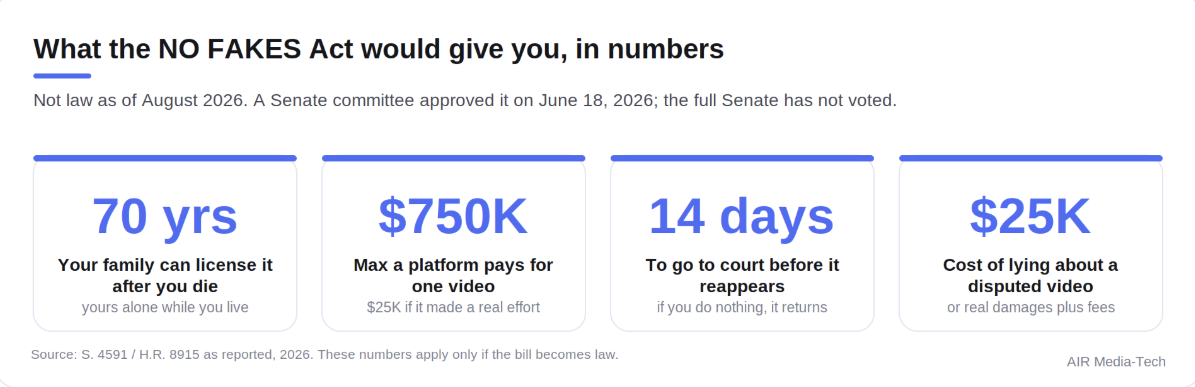
What the NO FAKES Act would give creators. It is not law as of August 2026. Source: S. 4591 / H.R. 8915 as reported.
Not everyone wants it passed as drafted.
The Electronic Frontier Foundation, a digital rights group, warned in June 2026 that with penalties that size, platforms will remove first and ask questions later rather than risk misjudging whether a video is parody. If you make reaction, review, or comedy content, that is your video getting removed.
Which Laws Protect Your Likeness Right Now?
Your state probably does, and creators overlook this while watching Congress.
Most US states have long had right-of-publicity laws, which stop other people earning money from your name, face, or voice without permission. Several have now been rewritten to say explicitly that an AI copy counts.
- Tennessee's ELVIS Act is the strongest of them for a cloned voice. It has been law since July 1, 2024, and despite the name, it protects every individual rather than only recording artists. Its important move is definitional: a sound the public recognises as you counts as your voice whether or not you ever made it, which puts AI imitations inside the statute rather than in a grey area beside it. Liability extends to whoever distributed the cloning tool. Damages triple where the defendant knew the clone was unauthorised.
- California went after the paperwork. Since January 1, 2025, a contract clause handing over rights to a digital replica of you is void there unless the agreement specifies how the replica will be used and you were represented by a lawyer or a union when you signed it. That is worth checking against any likeness clause a brand or production company has sent you. A companion law from the same date bars AI recreations of deceased performers without estate consent, at $10,000 per violation or actual losses, whichever is greater.
Whether any of it reaches your case depends on where you live, where the uploader lives, and where the harm landed. Establishing that takes a lawyer and several months. A takedown request to YouTube takes an afternoon, which is why it is almost always the first move.
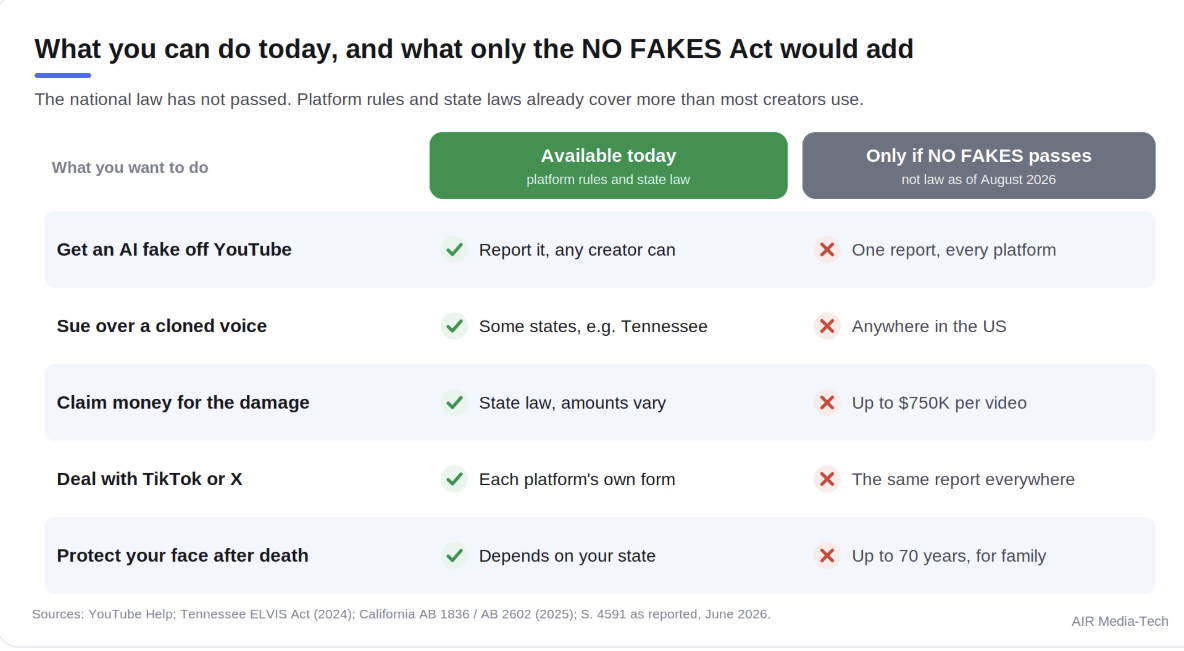
What you can already do, and what would change if the NO FAKES Act passed. Sources: YouTube Help; Tennessee ELVIS Act; California AB 1836 / AB 2602; S. 4591 as reported.
How Does the TAKE IT DOWN Act Already Protect You?
This covers far less ground than NO FAKES and has the advantage of being law today. It applies to intimate images shared without consent, including material generated by AI from scratch, and gives platforms 48 hours from a valid request to remove them along with any copies they know about. Enforcement began on May 19, 2026, and the FTC runs a complaint portal at TakeItDown.ftc.gov for platforms that do not comply.
Most creators will never need it, but anyone who does gets a hard 48-hour deadline that no platform policy matches, and one that does not depend on what the Senate does next.
What Do You Have to Label as AI-Generated on YouTube?
You must disclose altered or synthetic content when it makes a real person appear to say or do something they did not, alters footage of a real event or place, generates a realistic scene that did not occur, or uses AI-generated music.
The disclosure is made at upload, under the AI use question in Studio. Since May 27, 2026, YouTube also applies the label itself when its systems detect heavy photorealistic AI that a creator did not declare. A label applied by mistake can be corrected in Studio; labels on content made with Veo or Dream Screen, or on files carrying C2PA "fully generative" metadata, are permanent.
Plenty of AI use needs no label at all. Beauty filters and colour grading, script drafting, thumbnail generation, captions, upscaling and repair, clearly fantastical scenes, and cloning your own voice all fall outside the requirement.
Where the label appears depends on how realistic the content is.
- Photorealistic content carries it directly below the player on long-form videos, and as an overlay on Shorts.
- Lightly altered or animated content carries it in the expanded description.
Disclosing does not reduce your reach or your monetization eligibility. Repeatedly failing to disclose can bring a manually applied label, content removal, or suspension from the YouTube Partner Program.
The penalty lands on hiding it rather than on doing it — the same pattern in YouTube's wider crackdown on low-effort synthetic uploads, covered in AIR's breakdown of how YouTube treats AI in 2026.
What Changes If You Have Viewers in the EU?
Article 50 of the EU AI Act started applying on August 2, 2026, and unlike YouTube's checkbox, the obligation sits with you rather than with the platform.
It covers anyone using an AI system as part of a commercial activity whose output reaches the EU. A monetized channel publishing AI content to European viewers is inside that definition. Posting AI clips personally, with no money involved, is not.
The standard is higher than ticking a box. Viewers have to be able to tell the content is AI at first exposure, without special tools and without hunting for a label. Work that is evidently artistic, satirical, or fictional carries a lighter version of the duty, disclosed in a way that does not spoil it.
Technical marking requirements carry a grace period until December 2, 2026. The fines behind the rest are not decorative, reaching €15 million or 3% of worldwide turnover, scaled down for smaller operators.
Ticking YouTube's synthetic-content box is a sensible start on both rules at once. Saying it in the video, or putting it on screen, meets the EU standard more convincingly.
What If Filing the Form Isn't Enough?
Sometimes the process works cleanly. You file, YouTube reviews, the video comes down, and the whole thing costs you an afternoon.
The other version is the one creators write to us about. The request sits in a queue while the fake keeps running, copies appear faster than anyone can report them, a sponsor asks whether the endorsement clip is really yours, and no one at YouTube is answering a form submission from an individual account.
Escalation through a partner with direct YouTube contacts changes that timeline. AIR pushes stalled removals and strike disputes through those channels, recovers hacked accounts, restores monetization after a wrongful suspension, and sets up Content ID from 50K subscribers so re-uploads of your real footage earn for you rather than for whoever posted them. Daily moderation catches the compliance problems that get channels demonetized before the automated systems find them.