

Not Sure Which Languages to Choose?
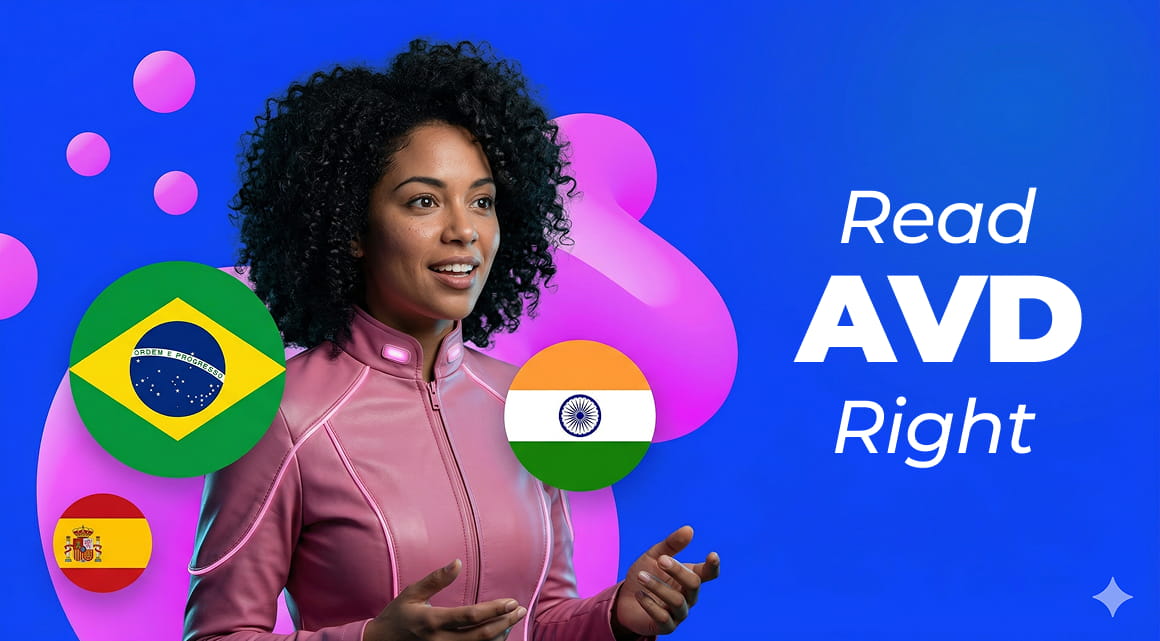
We manage localization for 400+ YouTube channels: dubbing, metadata, channel launches, and growth strategy across languages. One thing we see consistently: Average View Duration on dubbed tracks is one of the most misread metrics creators encounter when they go multilingual.
Here's a case that changed how our team reads regional retention data.
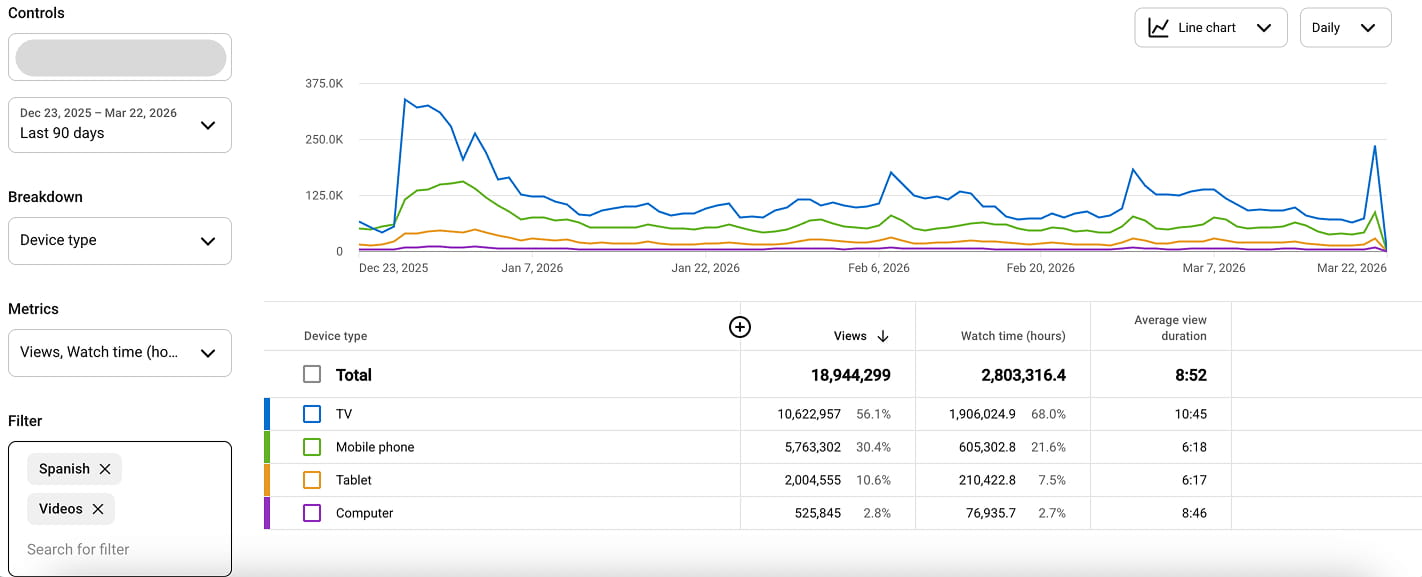
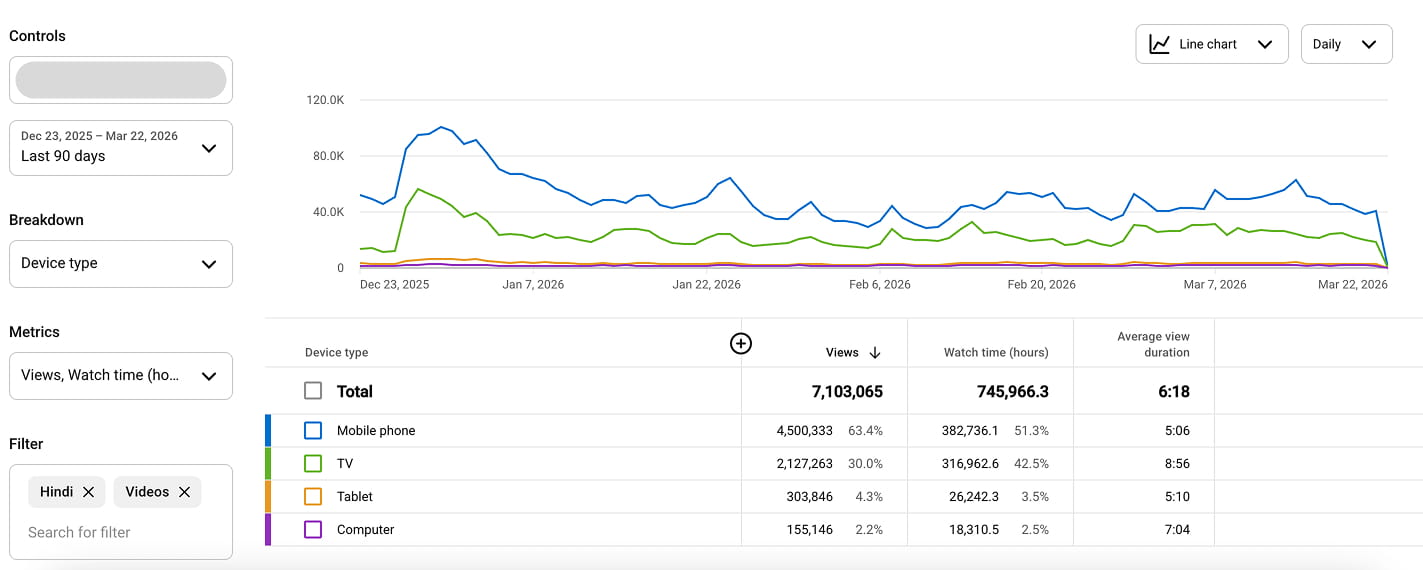
We were ready to replace a voice actor. An entertainment channel we work with had strong view numbers across multiple language tracks, but Hindi AVD was sitting at 6:18 while Spanish was held at 8:52. The gap looked like a dubbing problem. Wrong tone, wrong delivery, wrong actor.
Then we pulled the device breakdown.
|
Language |
Mobile |
TV |
AVD |
|
Spanish |
30.4% |
56.1% |
8:52 |
|
English |
43.9% |
30.4% |
6:54 |
|
Hindi |
63.4% |
30.0% |
6:18 |
Over 56% of Spanish views come from TV, where sessions run long: TV AVD on this channel hits 10:45. Over 63% of Hindi views come from mobile, where AVD sits at 5:06. Nearly the entire gap between Spanish and Hindi AVD disappears once you account for screen size. The voice actor had nothing to do with it.
AVD on Spanish Audio-Tracks by Device
AVD on Hindi Audio-Tracks by Device
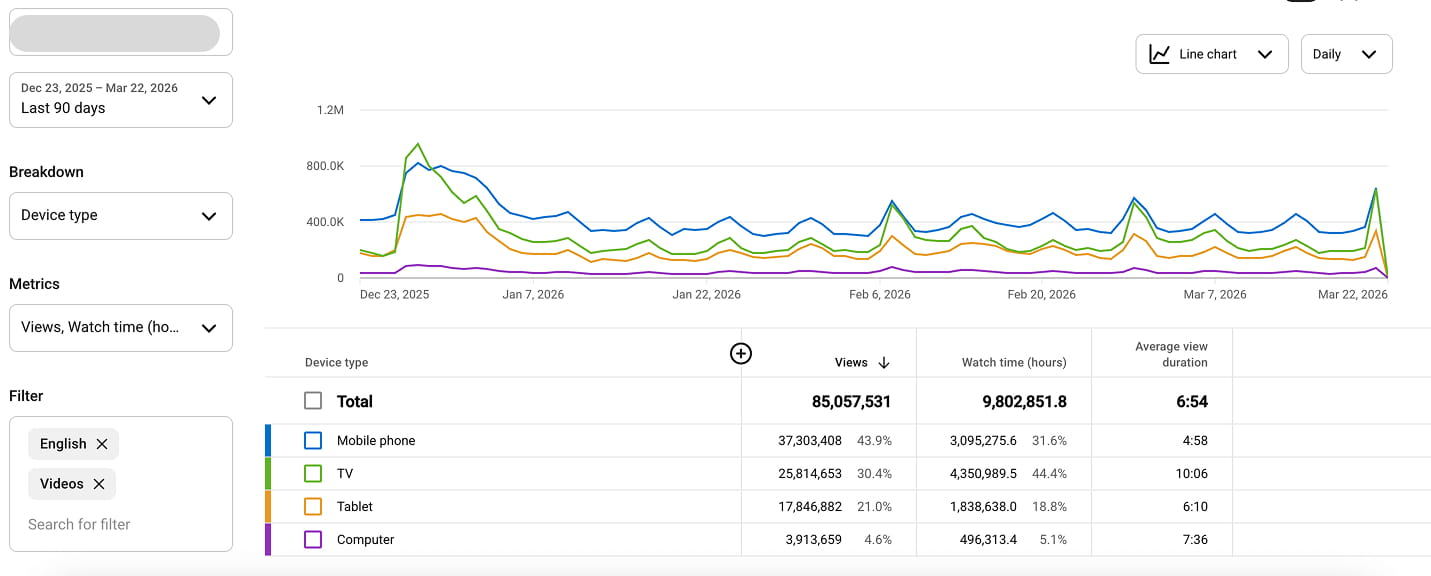
AVD on English Audio-Tracks by Device
But the Device Split Doesn't Explain Everything
Look closer at English vs. Hindi. A pretty close device splits: both around 30% TV, a big chunk on mobile traffic. Yet English AVD still edges out Hindi by 36 seconds.
Our read is that the remaining gap comes down to regional internet infrastructure. Hindi-speaking audiences are predominantly in India, where mobile connection stability is more variable. Buffering interrupts sessions in ways that have nothing to do with content quality or dubbing.
"In markets with unstable mobile connections, AVD drops for a reason that has nothing to do with your dubbing. The video buffers. The viewer leaves." — Vlad Tarasenko, AIR Translation Labs
So there are two layers.
- The first is device type: TV vs. mobile, which explains most of the variation between language markets.
- The second is infrastructure: even within the same device category, connection stability in the viewer's region shapes how long a session actually runs.
Both are invisible if you only look at the headline AVD number.
What Else Moves AVD on Dubbed Tracks
The device and infrastructure story explains a large portion of AVD variation across languages. But there are other variables we see consistently across our 400+ channels.
Dubbing Type Is the Most Dramatic One
Across our tests, AI-only dubbed tracks produce a 4x–5x drop in average view duration compared to professional human dubbing.
On Brave Wilderness's Spanish channel, pro dubbing held 5:19. An AI track on the same channel dropped it to 1:22. On a kids channel we work with that had 5M+ Italian-speaking views, pro dubbing held 5–6 minutes. AI dropped to 0:54, and low AVD from an AI track can drag down recommendation performance across the whole channel, not just the underperforming language.
The Flip Side is Equally Real
On one of our entertainment channels, the Spanish pro-dubbed track outperformed it. 8:24 vs. 6:26. A well-matched voice actor in a market hungry for content that doesn't yet exist in their language can produce stronger engagement than the source material in its native language. Novelty, quality dubbing, and precise algorithmic matching compound into something the original channel often can't replicate.
Algorithmic Matching Maturity Adds Another Layer
A newly launched dubbed track gets served to a broad test audience while the algorithm learns who actually responds. AVD in the first 4–8 weeks is typically lower than it will be at month 3–4, once the recommendation engine has enough signal to place the content more precisely. What looks like underperformance early is often the algorithm still finding its footing.
Device Split per Language
TV audiences watch longer than mobile audiences, consistently and significantly. Spanish markets skew heavily toward TV. South and Southeast Asian markets skew heavily toward mobile. That device reality shapes AVD before a single frame of content plays.
The Honest Read
There's no universal benchmark for what good AVD looks like on a dubbed track.
A 6:18 Hindi AVD on a channel where TV-dominant Spanish pulls 8:52 isn't a failure. It's a different audience, on different devices, in a different infrastructure environment, being found by an algorithm that's still calibrating.
The number that matters is whether AVD is growing over time as we find better-matched viewers, and whether per-device AVD is comparable across languages. If Hindi TV AVD and Spanish TV AVD are close, the dubbing is working. If they're far apart on the same device type, that's worth a closer look.
Most of the variation we see in the first 3–6 months of a new dubbed track has nothing to do with the voice actor. The data usually tells a more interesting story than the headline number suggests.
What Your AVD is Telling You?
AVD on dubbed tracks is a useful signal, but only when read in context. The questions to ask before making any decision about a localized track:
- Is this AI or pro dubbing?
- What does the device breakdown look like for this language?
- How does per-device AVD compare across languages?
- Is AVD trending up, flat, or down over the last 60–90 days?
- What's the internet infrastructure reality in this market?
If you're running dubbed tracks and are not sure whether what you're seeing is a signal or noise, we can take a look. We'll tell you what's actually going on and whether you need to adjust now or just wait.
We work with channels like Kids Diana Show, Brave Wilderness, and Jason Vlogs, and across 400+ localized channels, we've seen every AVD pattern there is.
Reach out to AIR Translation Labs, and we'll dig into your data.
Sources:
AIR Translation Labs Case Studies:
- AI vs Pro Dubbing — 3 YouTube Cases That Show the Gap
- 272M Reasons to Localize — Brave Wilderness Global Growth
- +125M Views With AIR's Dubbed Audio Tracks — Kids Channel Case
- Inside Jason Vlogs — Interview With the Creator of a 46M Kids Channel
- How Lady Diana Reached 7.6B Views With 52 Dubbed Channels
Internal Data:
- AIR Translation Labs analytics, entertainment channel case, Dec 2025 – Mar 2026 (device breakdown by language track)