



The annoying answer that everyone has heard countless times: it depends. And while technically correct, we did our best to research the question and get to the bottom of it. This is what we found out: YouTubers with 1M subscribers typically make between $9,000 and $50,000+ a month once ad revenue, sponsorships, memberships, and merch are combined. Let’s look at those numbers in more detail and figure out all the variables!
First things first, remember that YouTube pays for monetized views and not subscribers, and two channels with the same 1M subscribers can earn 10x apart depending on niche, video length, and audience geography. Yup, even the small stuff counts! Secondly, below is what 1M-subscriber channels earn in 2026, based on AIR Media-Tech’s internal data from 300 monetized channels and 3,595 channel-months of YouTube Analytics.
If you want to know more about the view-based version (how much a single 1M view pays), read our companion breakdown here.
Monthly Income at 1M Subscribers, by Source
|
Income source |
Typical monthly range |
Key variable |
|
Ad revenue (AdSense) |
$2,000 – $50,000+ |
Niche RPM × monthly views |
|
Sponsorships/brand deals |
$5,000 – $100,000+ |
Views, engagement, niche CPM |
|
Channel Memberships |
$500 – $15,000+ |
Subscriber-to-member conversion × tier price |
|
Super Chat / Super Thanks |
$200 – $10,000 |
Livestream frequency and audience |
|
Merch/affiliate revenue |
$500 – $20,000+ |
Niche-product fit |
|
Total (all streams, typical channel) |
~$9,000 – $195,000+ |
Diversification across streams |
Ad revenue figures are anchored to AIR's median RPM of $2.30 across 300 partner channels (May 2025–May 2026). Every benchmark behind them is in how much YouTube paid creators in 2025–2026
Why 1 Million Subscribers Doesn't Tell You How Much You Earn
YouTube’s Partner Program pays out from the ad pool based on monetized views and watch time; subscriber count matters much less than watch time. There could be subscribers who never watch your new uploads and therefore generate $0, and there could be non-subscribers who watch a full 15-minute video from a high-CPM country.
This specific gap shows up in AIR’s audit data.
- Two Kids channels with 2.1M and 2.3M subscribers each (so, nearly identical audience size) landed 13x apart in monthly revenue: one earned around $40,000 by dubbing into 14 languages with a 25-minute average video length; the other earned around $3,000 with 40-minute videos and a heavier Shorts mix.
- Two news channels with 2.2M subscribers each landed within 20% of each other in revenue despite one publishing 47 videos a week and the other just 2 (because the smaller-output channel had better metadata localization and higher average view duration). And there are many more examples like these.
- Our full breakdown of these cases is here.
The determinants that explain the spread, in order of impact: video length (videos under 8 minutes get zero mid-roll ads), library depth (a large back-catalog keeps earning after upload day), audience geography (the same view from Switzerland pays roughly 10x what it pays from a low-CPM market), how many monetization layers are stacked on top of ads and how much of the output is Shorts vs long-form.
Why are other channels outgrowing you?
It's not luck. There's a specific reason — and our specialists who've audited 3,000+ channels will find it in yours.
Show me what to fixAd Revenue With 1 Million Subscribers
A 1M-subscriber channel typically earns between $2,000 and $50,000+ a month from AdSense alone, driven almost entirely by niche RPM and how many monthly views the channel generates. But what’s the difference between CPM and RPM? How many views are the right number of views for a 1M-subscriber channel? What is the real RPM by niche in 2026? Let’s find out!
Why Do YouTubers With 1M Subscribers Earn Less Than CPM Suggests? CPM vs. RPM
RPM (Revenue Per Mille) is what lands in a creator's account per 1,000 views, after YouTube's cut. CPM (Cost Per Mille) is what an advertiser pays per 1,000 ad impressions. They are not the same number, and confusing them is the single biggest reason creators overestimate their income.
YouTube pays creators 55% of net ad revenue on watch-page ads and 45% of the Shorts Feed ad pool allocated to their views; memberships, Super Chat, Super Stickers, and Super Thanks combine for a 70% creator share (official YouTube revenue-share terms). But even before that split, RPM is structurally lower than the CPM figures third-party estimators like Social Blade quote, for reasons that show up clearly in AIR's dataset of 300 partner channels:
- Shorts dilute blended CPM. Shorts run on a separate, much lower-RPM model. A channel mixing Shorts into its upload schedule will show a lower blended CPM than its long-form CPM alone.
- Audience geography does most of the work. An English-language channel isn't the same as a US-audience channel. CPM in the US sits around $14.67 versus $0.48-0.60 in markets like Yemen, Bangladesh, or Pakistan, which is a 25-30x spread on the exact same video.
- Ad blockers and YouTube Premium viewers pay differently. Premium revenue flows from a separate subscription pool, generally at lower per-view rates than a served ad; ad-blocked views generate nothing.
- Self-reported numbers are always the highlight reel. Nobody publishes their worst month. AIR's figures are 12-month medians across 300 real partner channels.
Worked example: a 1M-subscriber channel in a $5 RPM niche generating 3 million monthly views earns roughly 3,000 × $5 = $15,000 that month from ads. The same channel in a $1 RPM niche at the same 3 million views earns $3,000. Subscriber count doesn't appear anywhere in that math.
How Many Views Do 1M-Subscriber YouTube Channels Get?
First, the ratio varies by niche and engagement: kids’ content and highly loyal fan communities trend toward the higher end (broader industry benchmarks put "actively watching" subscribers at roughly 5-14%), while broad entertainment and lifestyle channels trend lower.
Usually, a 1-million-subscriber channel typically gets 30,000 to 100,000 views per video from its own subscriber base, because only about 3-10% of subscribers watch any given upload.
Two things push total monthly views well past what the subscriber math suggests.
- First, most of a healthy channel’s views come from the recommendation algorithm and search, so a channel with a deep, well-optimized back-catalog keeps earning from suggested and browse traffic long after upload day.
- Second, upload frequency compounds: a channel publishing 5 long-form videos a month at 20,000 views each nets roughly 100,000 monthly views before any catalog or search traffic is counted, while a channel publishing 2 videos a month at the same per-video average nets only 40,000. This is why two 1M-subscriber channels can land 5-10x apart on total monthly views alone, before RPM is even factored in.
There’s another thing to consider: not every view gets an ad. Across AIR’s 300 partner channels, the median share of views that show an ad (aka the monetized playback rate) is 53%. Monetization rate itself varies by niche: Education & Science channels monetize around 77% of views, Lifestyle around 61%, Gaming around 55%, down to roughly 32- 34% for Kids & Teens and Gadgets & Tech.
So the ad-revenue math comes down to:
Total views x monetized-playback rate x RPM ÷ 1,000.
YouTube RPM by Niche in 2026, AIR Data From 300 Real Channels
|
Niche |
Median RPM |
|
Education & Science |
$10.22 |
|
Transport |
$5.69 |
|
Lifestyle |
$2.98 |
|
News & Politics |
$2.60 |
|
Entertainment |
$2.43 |
|
Crafting & Handmade |
$2.39 |
|
Gadgets & Tech |
$2.33 |
|
Music |
$2.28 |
|
Food & Cooking |
$2.25 |
|
Gaming |
$2.05 |
|
Business & Finance |
$2.01 |
|
Health & Sport |
$1.23 |
|
Kids & Teens |
$0.33 |
Source: AIR Media-Tech internal data, 300 monetized channels, 3,595 channel-months, May 2025–May 2026, measured via YouTube Analytics API. Median RPM across all niches: $2.30.
The one finding that contradicts almost every other YouTube-earnings article: Education & Science tops AIR’s RPM ranking. That doesn’t mean finance creators earn less overall; it just means their edge shows up in sponsorship and affiliate deals (more on that later).
Feel like your channel is underperforming?
It probably is. We've run audit across 3,000+ channels, and it almost always finds something. Packaging, retention, traffic, monetization — the fix is usually smaller than the problem feels. → Get the answers.
YouTube Sponsorship Rates at 1 Million Subscribers
Sponsorships typically pay a 1M-subscriber channel anywhere between $5,000 and $100,000+ per deal, and for most creators past the 250K-subscriber mark, sponsorship income overtakes AdSense as the largest single revenue stream.
Brand deals are priced off expected views and an effective CPM, using roughly: average views × sponsor CPM ÷ 1,000 = deal value. Sponsor CPMs for dedicated integrations commonly run $15-$50, well above AdSense RPM, because the brand is buying a direct, trusted endorsement rather than a programmatic ad slot. A channel that averages 200,000 views per video at a $25 sponsor CPM is looking at roughly $5,000 per integration; the same channel at a $40 CPM in a premium niche is closer to $8,000.
Tier benchmarks compiled from current sponsorship-rate guides put deal sizes at roughly $100-$500 under 10K subscribers, $500-$2,500 at 10K–50K, $2,500-$10,000 at 50K–250K, $10,000-$40,000 at 250K–1M, and $40,000+ once a channel clears 1M subscribers, though the number for any single deal still comes down to average views and niche.
This is where the niche math flips from the AdSense section: finance, software, and B2B-adjacent channels command premium sponsor CPMs because each converted customer is worth far more to the advertiser than a typical entertainment-niche customer, even though, per AIR's RPM data above, finance's raw AdSense RPM isn't the category leader. A finance creator with modest AdSense income can still out-earn an Education & Science creator overall once sponsorships are counted.
Other factors that move the price: a 60-second mid-roll mention is priced differently from a dedicated review video; usage rights (letting the brand reuse the content in its own ads) add to the fee; and competitor-exclusivity clauses should be compensated separately, since they block other sponsorship income for the exclusivity period.
Channel Memberships, Super Chat, and YouTube Premium Income at 1M Subscribers
Channel Memberships typically add somewhere between $500 and $15,000+ a month at the 1M subscriber tier, which is mostly driven by the conversion rate (aka the share of subs who pay for membership), so the subscriber count matters very little.
Again, conversion rates (at least from AIR’s partner channels) vary sharply by niche: education, tutorial, and coaching channels convert 2-4% of subscribers into paying members, while lifestyle and vlog channels convert roughly 1-2%, entertainment and gaming convert only 0.5-1%, but often make up for it with sheer audience size.
Creators receive 70% of net Memberships, Super Chat, Super Stickers, and Super Thanks revenue under YouTube’s current partner revenue-share terms; tier pricing itself runs anywhere from $0.99 to $499.99, depending on perks and region.
The gap between "flipped the feature on" and "built it like a product" is enormous.
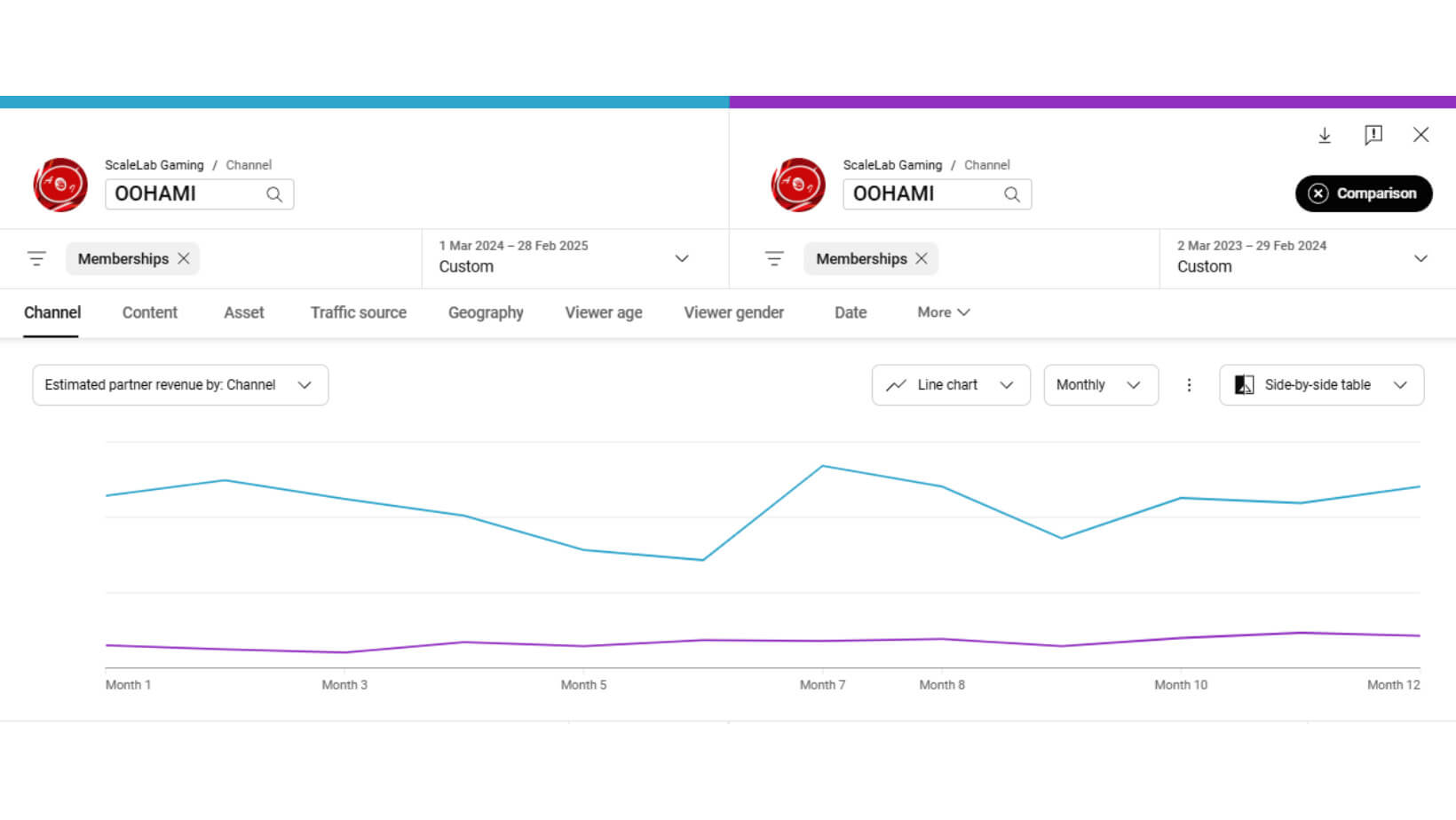
OOHAMI, a channel with 1M+ subscribers, had Memberships sitting dormant since 2020. After AIR rebuilt the offer (a short explainer video, perks viewers wanted, and constant visibility across the homepage, descriptions, and Community tab), membership income grew 6.5x in 60 days, and Memberships became 30% of total channel revenue.
Another real-case example is Rally Point, which took Memberships from zero to 46% of total channel revenue within six months by treating it as a designed product rather than a button.
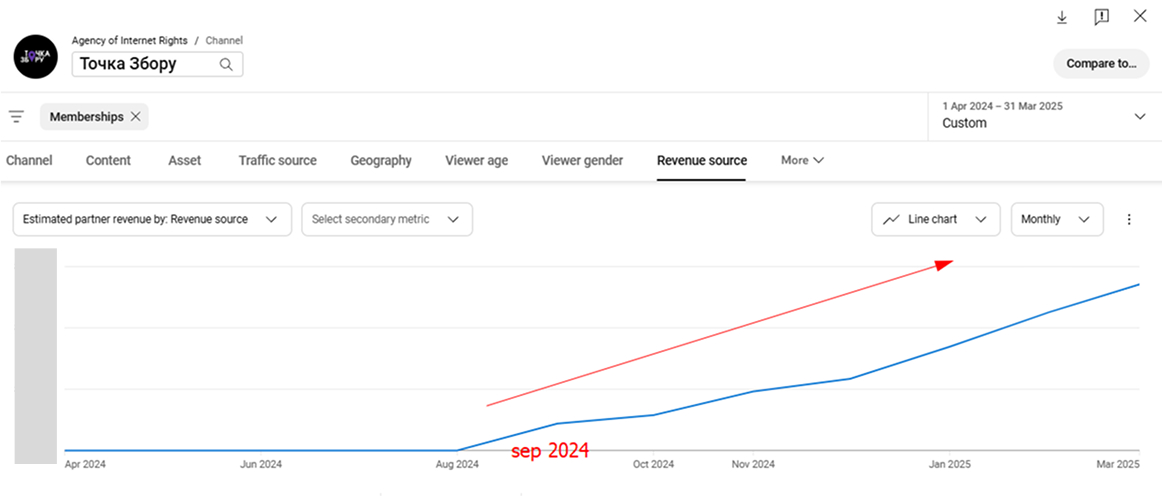
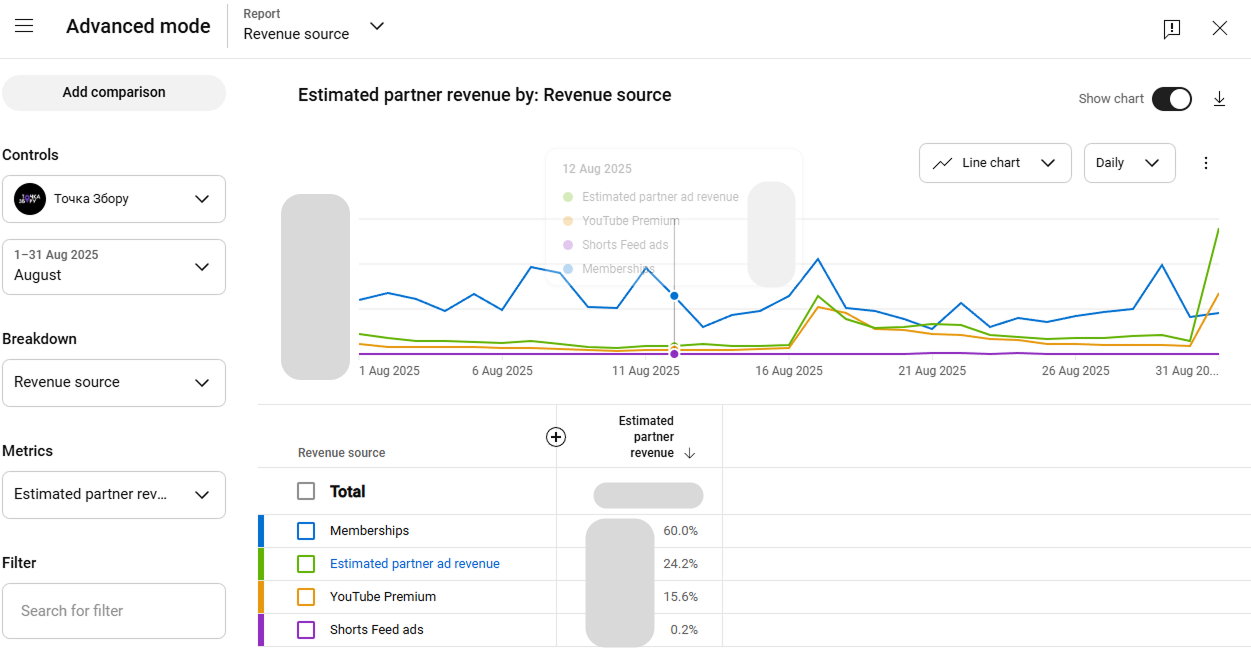
Super Chat and Super Thanks add a smaller, livestream-dependent layer (typically $200 to $10,000+ a month), scaling with how often a channel streams and how monetizable its live audience is. YouTube Premium revenue is folded into the same watch-page ad-revenue pool, paid out based on a viewer's Premium watch time share rather than as a separately reported line item.
Merchandise and Affiliate Revenue for 1M-Subscriber Channels
Merch and affiliate income typically contribute anything between $500 and $20,000 a month at 1M subscribers, which, again, varies depending on the niche more than raw audience size. A beauty or lifestyle channel with strong affiliate placements can potentially out-earn a gaming channel triple its size, because the products map directly onto what the audience already buys.
Unlike the ad revenue and niche RPM figures above, this range reflects broader industry benchmarks because merch and affiliate revenue rarely flows through YouTube Analytics, so it’s a bit harder to verify at scale the way AdSense RPM is.
What YouTubers With 1 Million Subscribers Realistically Make: Full Breakdown
Put the streams together and three realistic 1M-subscriber profiles emerge:
- Low end (~$9,000/month): a Kids & Teens or low-RPM niche channel, ads-only or close to it, minimal sponsorship activity, Memberships never set up. Low RPM ($0.33-$1.50) caps ad revenue regardless of view volume.
- Mid-range (~$47,000/month): a mid-RPM niche (Lifestyle, Gaming, Entertainment) running ads plus a steady sponsorship cadence and a functioning Memberships program converting 1-2% of subscribers.
- High-end ($195,000+/month): a high-RPM or high-sponsor-value niche (Education & Science on the AdSense side, or Finance/Tech on the sponsorship side) stacking ads, premium brand deals, Memberships, Super Chat, and merch, as well as full diversification across every stream in the table above.
The distance between the low and high profile is roughly 20x, at the identical 1 million subscribers. That gap is the honest answer to "how much do YouTubers with 1M subscribers make": a range that's determined by niche RPM, monthly view volume, geography, and how many of the five income streams above a channel has built out.
Want to Outearn Competitors?
The data above shows patterns across 300 monetized channels.
Your channel is unique, with its own niche positioning, audience geography, video length habits, and monetization setup. A pattern that holds for most channels in your niche doesn't tell you which side of it you're on.
We can tell you the exact steps to take to boost revenue with our channel audit. AIR has been a YouTube Certified Partner for 16 years, working across 70+ countries.
What you get with a channel audit:
- A structured report across all 10 performance pillars: packaging, retention, traffic sources, competitor gaps, format mix, revenue structure, audience behavior, risk signals, growth projection
- ranked roadmap plus a 30-day action plan ranked by impact
- nd a 45–60-minute live walkthrough with a senior AIR strategist.
AIR has deep Studio access to 3,000+ YouTube channels, a 450,000+ channel training dataset, 1 trillion views analyzed, and 21 in-house AI engines built to find exactly what's capping a channel's revenue: packaging, traffic routing, format mix, monetization setup, or a policy restriction invisible from inside your own analytics.
