
Not Sure Which Languages to Choose?
Growing this kids' YouTube channel didn’t go the way you'd expect. This is the uncensored version of a story about the localization bets that paid off, the platform bugs that ate revenue, the fixes that nobody talks about, and the real reason some channels in the same ecosystem tripled while others dropped 30% in views and still made 4x more money.
This is the story of our partner, Vania Mania Kids.
We've been working with them for a long time now. We watched them grow from a promising kids' channel into a 30M+ subscriber global operation, one of the most impressive in the space.
They were actually one of the first channels where we discovered the MLA localization lifehack: cross-seeding audio tracks. Meaning building separate localized channels, and cross-adding audio tracks between them. We added their dubbing from a Portuguese channel directly as an audio track onto their existing high-performing channels. Nearly 5 million additional views in six months.
Since then, the ecosystem has kept expanding. Today, the Vania Mania Kids ecosystem runs across dedicated localized channels in Spanish, German, Polish, French, Indonesian, Arabic, Turkish, and more. Plus, audio tracks are layered across the network, plus a live channel.

Our team has been deep in all of it: localization, moderation, packaging, rights, and technical ops.
In this case, we'll give a glimpse into the behind-the-scenes of four channels from that empire, the ones we worked most intensively on in Q4 2025:
- Vania Mania Kids - the main channel
- Vania Mania Kids Live - their live content channel
- Vania Mania Indonesian - localized channel
- Vania Mania French - localized channel
Here's what happened on each, what we did, and what other kids' channel creators can take from it.
The Numbers Up Front
One pattern worth naming before going into the details: across every channel, revenue grew faster than views. That gap is not an accident. It's what happens when you fix the infrastructure.

Started with Catching Troubles Before YouTube Does
Every upload across all four channels went through our daily moderation. Every video, every day: automated systems flagging potential issues, specialists turning those into same-day recommendations.
This matters more for kids' content than anywhere else. YouTube's content classifiers act on thumbnails, titles, and scenes before any human reviewer gets involved.
- A slightly off title
- A scene that reads as danger to a classifier
- A thumbnail with the wrong emotions
These things suppress the distribution before a creator realizes anything has changed. There are just fewer views all of a sudden.

The Vania Mania Kids main channel grew views 6% quarter over quarter, but revenue grew 23%. Some of that gap comes from rights work (more on that below), but moderation contributes too: clean signals on every upload means the algorithm keeps routing the content to the right audience consistently, which improves monetizable reach even when total view growth is modest.
Another important thing: the traffic growth came from the fact that the channel was appearing more in recommendations (aka algorithms trust and like the channel, which is why they push it higher). Why did the trust suddenly improve? Because we offered them insights and recommendations to improve that metric.
Download 34 Rules for Kids Content in 2026
We’ve put all 34 of our top kids’ content insights into one easy PDF. No gatekeeping here, download your free copy and start leveling up your channel today.
One Face Kills Distribution: Thumbnails on Kids' Content
Thumbnail work ran on all four channels. It's where the rules for kids' content diverge most sharply from everything else on YouTube, and where most creators are still applying the wrong playbook.
The assumption is that content that's genuinely safe will be treated as safe. That's not how it works. The algorithm reads thumbnails before it reads the video. An expression that looks playful to an adult (wide eyes, an open mouth, anything approaching shock or distress) reads as a different signal to a classifier trained on kids' safety standards.
A lot of creators borrow packaging styles from general entertainment:
- High-energy faces
- Dramatic compositions
- Bold all-caps text
And wonder why kids' videos stall.
The rules are genuinely different, and the consequences of getting it wrong are invisible until you check the numbers.
Thumbnails for YouTube Kids require utmost attention to detail. General things to avoid: exaggerated fear, panic, crying, or shocked faces, scary monsters, and dangerous or disturbing imagery. - Yuliia Doncheva, Kids Channel Expert at AIR Media-Tech
What to avoid:
- Exaggerated fear, panic, crying, or shocked expressions
- Anything that reads as danger (sharp objects, falls, physical confrontation)
- Overstimulating compositions with too many competing focal points
- All-caps text (amplifies energy in a way that triggers stricter review on kids' content)
What works:
- Warm, positive expressions (joy, curiosity, delight, rather than shock)
- One clear focal point: usually a face or a single obvious action
- Title text on the thumbnail that adds context, not duplicates it
- Bright but calm colors (high energy without high alarm)

We worked through thumbnails do's and don'ts with Vania Mania Kids across all channels. The improvements are visible in the sustained suggested traffic numbers, particularly on the French channel, where suggested traffic grew 42% alongside total views.
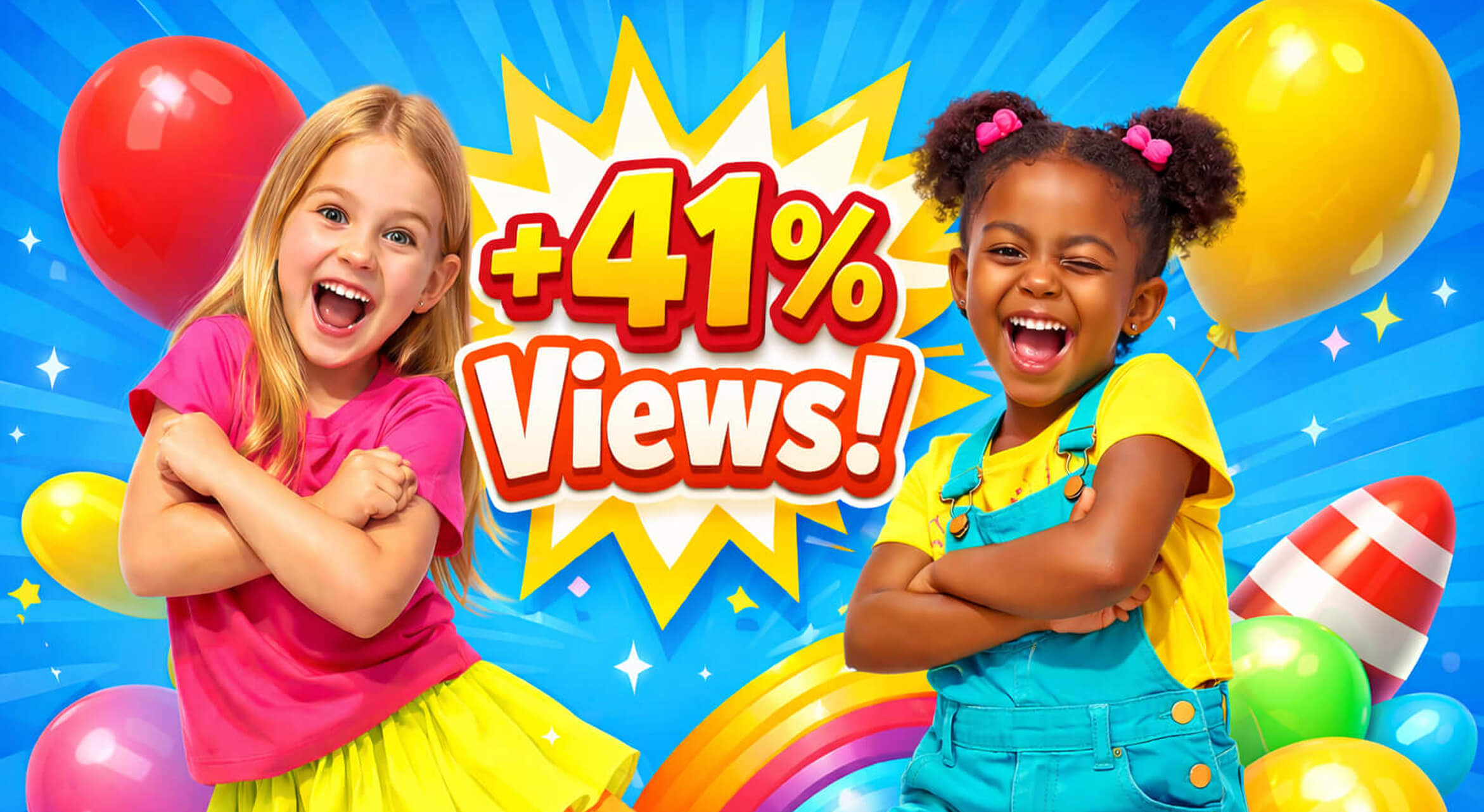
Here is what high-performing Vania Mania Kids thumbnails look like.

Tell YouTube Who It's For: Metadata Optimization
Metadata optimization was a meaningful driver of view growth: most visibly, the +6% on the main channel and +37% on the French channel. Titles, descriptions, and tags don't rescue weak content. But when the content already works, better metadata helps YouTube understand where a video belongs, who it's for, and when to surface it. That's the difference between the algorithm guessing and knowing.
After analyzing 3,000+ channels, here's the structure we use with partners:
- Interactive hook first. Lead with something that creates curiosity or emotion: "SUSIE'S EMBARRASSMENT! What happened at school?" Capitals and emojis help, but don't overload.
- Functional keyword second. Phrases like "cartoons for kids," "challenge with my brother," "fairy tales for children", whatever fits naturally without making the title feel mechanical.
- Be specific. "24-Hour Challenge - Extreme Adventure in the Desert" beats "Adventure Challenge" every time. Specificity helps YouTube match videos to actual search intent.
- Complement the thumbnail, don't copy it. If the thumbnail shows the "what," the title gives the "why" or "who." Repeating the same text in both wastes one of your two shots at the viewer's attention.
- Skip all-caps on kids' content. A calm, clear title like "Tatty and Misifu in the Magical Park? 🏆 Fairy Tales for Kids" performs better in this category and avoids triggering additional review.
- Re-optimize old videos carefully. Changing titles on videos with existing watch history can disrupt their performance. Test one change at a time, monitor CTR - it's the most direct signal. Also, watch which competitor videos your content appears alongside: if the keywords are pulling the wrong neighbors, that's wrong audience routing.
Upload Quality Is Worth the Storage
On the French channel, there was one more recommendation: upload in higher source quality - up to 256GB files. It sounds like a technical detail. It functions as a distribution one.
TV has become the primary screen for kids' content. Over 1 billion hours of YouTube are watched on TVs every day, and in the US, TV viewership has already overtaken mobile. For kids' channels specifically, the living room experience has shifted the audience from solo viewing on a tablet to family co-viewing on a 65-inch screen, with parents in the room. The content that gets recommended for that context is content that looks good on that screen.
YouTube's algorithm favors higher-quality video for TV placement. A 256GB source file gives YouTube's encoding pipeline something to work with:
- cleaner frame compression on fast-motion kids' content
- better motion handling
- and sharper auto-generated thumbnail frames.
The platform compresses everything on delivery, but what it compresses from sets the ceiling. On a channel doing 40M+ views a quarter, that ceiling matters.
We saw this work directly with another AIR partner, a 340K subscriber music channel that switched to 4K uploads and saw +52% revenue in the following quarter. YouTube started surfacing the videos more often in TV recommendations, engagement climbed, and revenue followed. One format change, no new content.
And the TV placement opportunity is only expanding. YouTube Shorts are now officially rolling out to TV screens. For kids' channels that produce Shorts alongside long-form content, TV is about to become an even more important distribution surface than it already is.
The French channel grew views 37% and revenue 60% that quarter. Some of that gap comes from audio track recovery and copyright removal, but encoding quality is part of it too. Higher-quality sources mean better TV placement, and TV viewers watch longer and monetize better.
The practical rule: upload the highest quality source file you can, always. And if you're not yet thinking about how your content looks at 65 inches, start now - your competitors are.

A Bug Eating Views
YouTube had a recurring bug that was deleting multilingual audio tracks from channels.
We caught it on the main Vania Mania Kids channel and on the French channel before either lost meaningful ground.
This is the kind of issue that our troubleshooting team exists for. We have a direct line with YouTube, which means we can identify platform-side bugs, escalate them formally, and get them resolved faster than any creator could independently. Most creators only discover something like this weeks later, through a slow performance slide they can't explain.
If you're running audio tracks:
- Monitor track availability regularly; they don't disappear with any notification.
- Check "Views by audio track" in YouTube Studio. A sudden drop in views from a specific country on a dubbed channel is often a tracking issue before it's anything else.
And if you're not sure where to start, our team can run the diagnostic for you.
Upload Frequency Is a Signal
On the Live channel, we recommended increasing upload frequency ahead of the holiday season. The partner acted on it:
- Uploads went from 32 to 42 videos in the quarter, a 31% increase.
- Views went from 3.1M to 11.4M.
- Suggested traffic grew 351%.

Frequency matters to the algorithm because consistency is a signal. A channel publishing 42 videos in a quarter (compared to the 32 videos in the previous quarter) tells the algorithm there's a reliable content stream to route viewers into. That's what tips a channel from occasional to habitual in how YouTube's recommendations treat it.
Suggested Traffic Exploded. Why?
Across the four Vania Mania channels this quarter, suggested traffic moved very differently on each one.
The Indonesian channel had the most dramatic shift: from 32,000 suggested views in Q3 to 3.75 million in Q4 (a 11,568% increase) while publishing fewer videos.

The cause there was copyright claims sitting on already-published content. Claims interfere with how YouTube classifies the channel overall, which can pull it out of recommendation flows entirely. Once cleared, the classifier could read the channel cleanly and start routing content to audiences it hadn't reached before.
The French channel grew suggested traffic 42% (from 21.2M to 30.1M), driven by a different combination: copyright removal, audio track recovery, and packaging work. No single fix, compounding effect.

The Live channel grew suggested traffic 351% (from 2.5M to 11.4M), with no copyright issues and no rights work at all. What moved it was packaging and upload frequency. More videos published consistently, with better thumbnails and titles on each one, gave the algorithm a reliable content stream to categorize and route.

Suggested traffic and total views moved almost identically on this channel, which tells you something: at the Live channel's stage of growth, suggested video is essentially all the traffic. The algorithm distributes the content, and subscribers aren't doing the work.
The main channel, at 543M suggested views per quarter, moved only 1%. That's expected; at that scale, the baseline is enormous, and even sustained operational work shows up as a small percentage. The absolute gain (9.8M additional suggested views) is real. The percentage just doesn't flatter it.

What Moved Suggested Traffic Across All Four
- Copyright claims on published content. Active claims suppress YouTube's ability to classify and route the video. The channel can have millions of subscribers, and the algorithm still won't recommend it to new audiences. Remove the claims and routing resumes. This was the dominant factor on the Indonesian channel.
- Packaging signals - thumbnails and titles. The algorithm recommends what it can categorize. Thumbnails that send clear, appropriate signals for kids' content, titles that carry the right keywords: these tell YouTube who the video is for. Wrong packaging, and the algorithm routes to the wrong audience or doesn't route at all. This ran on all four channels every week.
- Upload frequency and consistency. A channel publishing consistently gives the algorithm a reliable stream to feed viewers into. The Live channel's jump from 32 to 42 uploads per quarter coincided with its suggested traffic tripling. Consistency signals to YouTube that there's more content for a viewer who likes what they're watching, which is the whole premise of suggested video.
- Audio track availability. When tracks are missing, multilingual audience segments drop or bounce. Lower retention and higher bounce rates on those sessions degrade the quality signals YouTube uses to determine where to recommend a video next. Restoring tracks restores those sessions' quality, which feeds back into distribution. This was relevant for the main channel and the French channel.
- Content quality signals, source file resolution. YouTube's algorithm factors in quality signals for TV placement, which is the fastest-growing surface. Higher-quality source files produce better-encoded output, which gets favored in TV recommendations. We recommended 256GB uploads specifically for the French channel, and it contributed to both the suggested traffic gain and the revenue outpacing views.
The Indonesian channel's story is the clearest because the effect was most isolated: fewer videos published, one major fix applied, and suggested traffic went from near-zero to meaningful in one quarter. But it's not the only story here. Suggested traffic is the output of everything the algorithm can read about a channel: its rights status, its packaging quality, its publishing consistency, and its retention signals. Get all of those clean at once, and the algorithm has everything it needs to distribute the content for you.
Want to Double Your Kids' Channel Results?
Every channel leaks performance somewhere. Most creators can't find it because they're looking at the wrong numbers, or they're changing content when the problem is infrastructure.
There's no universal fix.
What suppresses one channel won't be what's suppressing yours. But there is a method for finding it.
Our audit experts go into your channel with our own tech and read your:
- Traffic sources
- Algorithms signals
- Rights status
- Audience behavior
- AVD
- CTR
- Encoding quality
- Packaging signal
- Monetization gaps across languages and devices.
- A precise map of what's holding your specific channel back: ranked by impact, with a clear action for each one.
And if you want it implemented, our team stays on.
We don't just tell you to fix your titles. We fix them with the structure that works for your niche, your audience, and your existing library. We don't just flag a copyright issue. We help to resolve it. We don't just say "optimize for TV." We change what needs changing and track whether it moved the numbers.
You've already made the content. The question is how much of its potential is actually reaching the audience it was made for.