
The advice for the perfect YouTube titles always comes down to this: use numbers, keep it short, ask a question, add a power word. The problem is that most of this advice comes from people who looked at a handful of viral videos and wrote down what they had in common. We did something a little different. We analyzed titles across 18,000 English-language YouTube channels and measured which title patterns correlate with higher engagement rates and views across 11 niches and four channel size tiers.
What YouTube Titles Work in 2026?
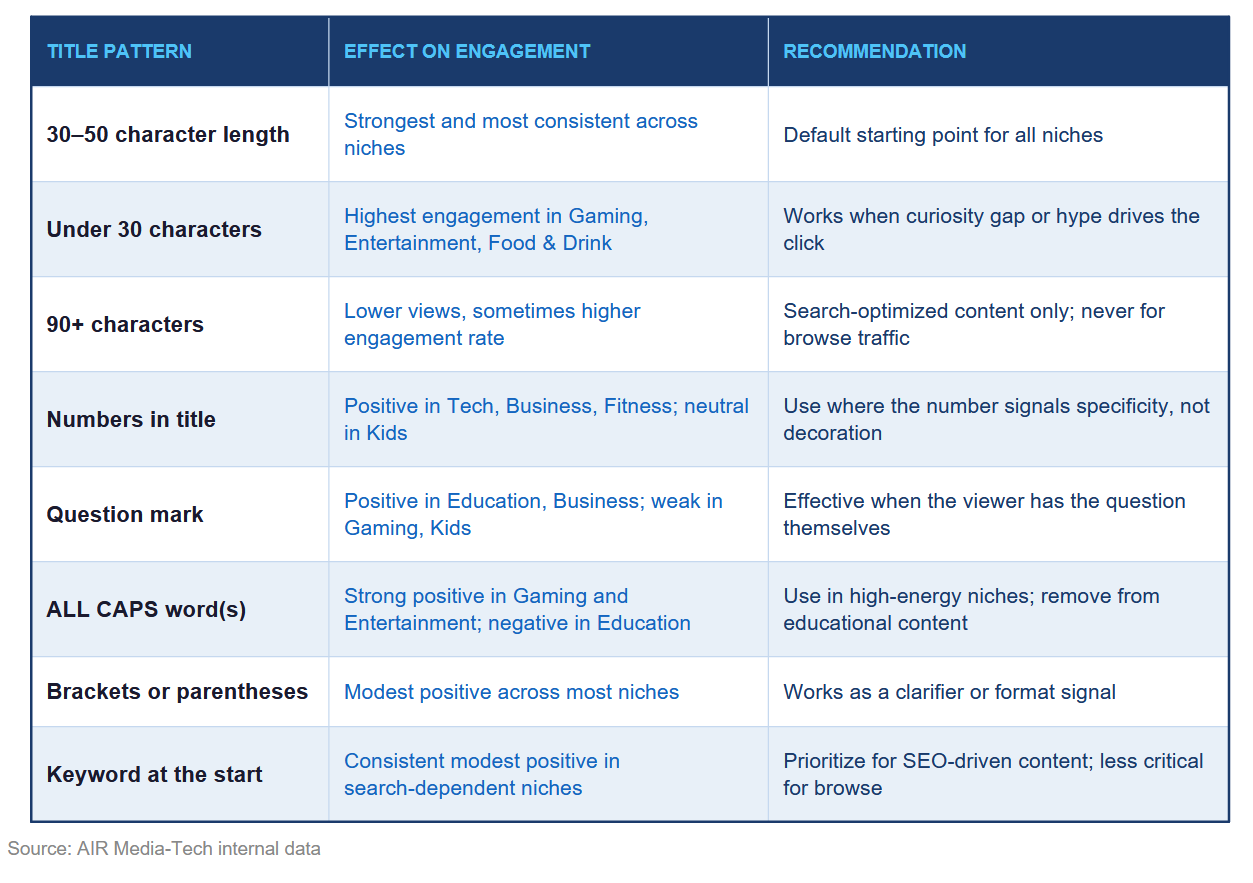
Here's what the data from 18,080 channels and 11 niches has to say:
- 30–50 characters is the universal sweet spot. This range outperforms every other length bucket across almost every niche and channel size tier. Long enough to communicate value, short enough to survive mobile truncation.
- Under 30 characters win in three specific niches: Gaming, Entertainment, and Food & Drink. In these niches, short titles either create a curiosity gap that forces the click or confirm a pre-existing intent so efficiently that the description gets in the way.
- 90+ character titles consistently underperform on views, truncation cuts them off before the viewer sees the point. The one exception: search-optimized content where a specific query match matters more than browse CTR.
- Numbers help in Tech, Business, Fitness, and Food, and do little elsewhere. A number that makes a specific promise ("30-day challenge," "$50K in 6 months," "3-ingredient pasta") converts. A number that decorates ("7 gaming tips") does not.
- Question marks work when the viewer already has the question. Strong positive in Education, Business, and Science & Tech. Weak or neutral in Gaming, Food & Drink, and Kids, niches where the viewer is not in seeking mode before they click.
- ALL CAPS is the most niche-dependent pattern in the dataset. Strong positive in Gaming and Entertainment, where it reads as energy and enthusiasm. Actively negative in Education, where it reads as sensationalism and drops perceived credibility.
- Brackets and parentheses produce a modest positive across most niches by functioning as format signals that reduce decision friction before the click. Least effective in Gaming and Entertainment, where bare titles outperform elaborated ones.
- Keyword position matters most in search-driven niches. Front-loading the primary keyword in the first 40% of the title improves search ranking and survives truncation. In browse-dominant niches like Gaming and Entertainment, hook strength outweighs keyword placement: put the most interesting element first, and the keyword lands naturally.
The consistent pattern across every niche: curiosity language ("what nobody tells you," "the real reason," "I finally found") is the only positive signal that transfers cleanly across all niches and channel sizes. If you change one thing about your titles, add something that signals the viewer doesn't already know what's inside.
If you're short on time, save this answer table!
Do YouTube Titles Have Influence on Engagement?
In short, yes. A YouTube title does two things simultaneously. It tells the algorithm what the video is about (aka feeding the recommendation and search systems), and it tells the viewer whether to click. Both matter, and they operate on different logic.
The algorithmic function is semantic. Titles that contain clear entity signals (a niche, a concept, a specific product name) help YouTube route a video to the right audience. The viewer function is emotional and informational; a title either triggers curiosity, answers a question the viewer already had, or signals that this video is relevant to something they care about.
Important: a title never works alone. Every click decision happens on a thumbnail-plus-title unit. A viewer processes the title and thumbnail simultaneously. This means every finding in this research is a signal. We measured which title patterns correlate with higher engagement and views; we did not isolate the title from the thumbnail. On channels where packaging was changed holistically (title and thumbnail together), the effects documented in our partner cases are significantly larger than what the isolated title data would predict.
What the data rules out is the idea that the title is a minor variable. Across 18,000 channels, the patterns are too consistent to dismiss. The title is doing more work than most creators realize, but it does so alongside the whole package the viewer sees before clicking.
Why are other channels outgrowing you?
It's not luck. There's a specific reason — and our specialists who've audited 3,000+ channels will find it in yours.
Show me what to fixHow We Ran This Study
The dataset for this research covers the same 18,000 English-language channels used in our earlier studies on video length and posting frequency. The starting pool was 22,294 channels meeting baseline criteria: English-language, generating between 100K and 100M monthly views, outside low-earning regions. After filtering out channels where 80% or more of uploads were YouTube Shorts, the final working sample was 18,080 channels.
What we analyzed:
Title characteristics measured for every video in the sample:
- Character count, broken into buckets: under 30, 30–50, 50–70, 70–90, 90+ characters
- Presence of numbers (any digit sequence)
- Presence of a question mark
- Presence of one or more ALL CAPS words
- Presence of brackets (square or round)
- Presence of emotionally charged words by category (curiosity, urgency, positive sentiment, negative sentiment)
- Keyword position (first third, middle third, last third of the title)
Niches covered: Entertainment, Gaming, Health & Fitness, Food & Drink (Cooking), Beauty, Travel, Home & DIY, Business, Kids & Animation, Science & Tech, Education
Channel size tiers:
- 100K–1M monthly views
- 1M–10M monthly views
- 10M–50M monthly views
- 50M–100M monthly views
Primary metric: Median engagement rate per video (likes + comments divided by views, expressed as a percentage). Median rather than mean to exclude viral outliers that would distort the averages.
Secondary metric: p75 views (the 75th percentile view count for each bucket), which captures typical performance without being skewed by breakout videos.
Methodology limitation (important): This is correlational data. We can say which title patterns appear on higher-performing videos; we cannot prove the title alone caused the result. Video quality, thumbnail design, topic selection, and publishing timing all contribute. The title patterns documented here are associated with better performance, but they aren’t a guarantee of success.
If you want to know a detailed answer to a certain question, click on it to go straight to the point.
- Optimal title length
- Numbers in YouTube titles
- Question marks in titles
- Brackets and parentheses
- ALL CAPS: red flag or no?
- Emotional words
- Working with keywords
What Is the Optimal YouTube Title Length?
The single most consistent finding in this dataset is the performance of the 30–50 character range. Across almost every niche and every channel size tier, this bucket produces the most reliable engagement and view figures. It is the closest thing to a universal answer that exists in this data.
Why does this range work? Thirty to fifty characters are long enough to communicate a specific value (aka who the video is for, what it delivers, why the viewer should click) without getting truncated on mobile. YouTube truncates titles in browse and home feed on mobile at approximately 60–70 characters, depending on the device. The 30–50 range lands well inside the safe zone and still has room to include the primary keyword and a hook.
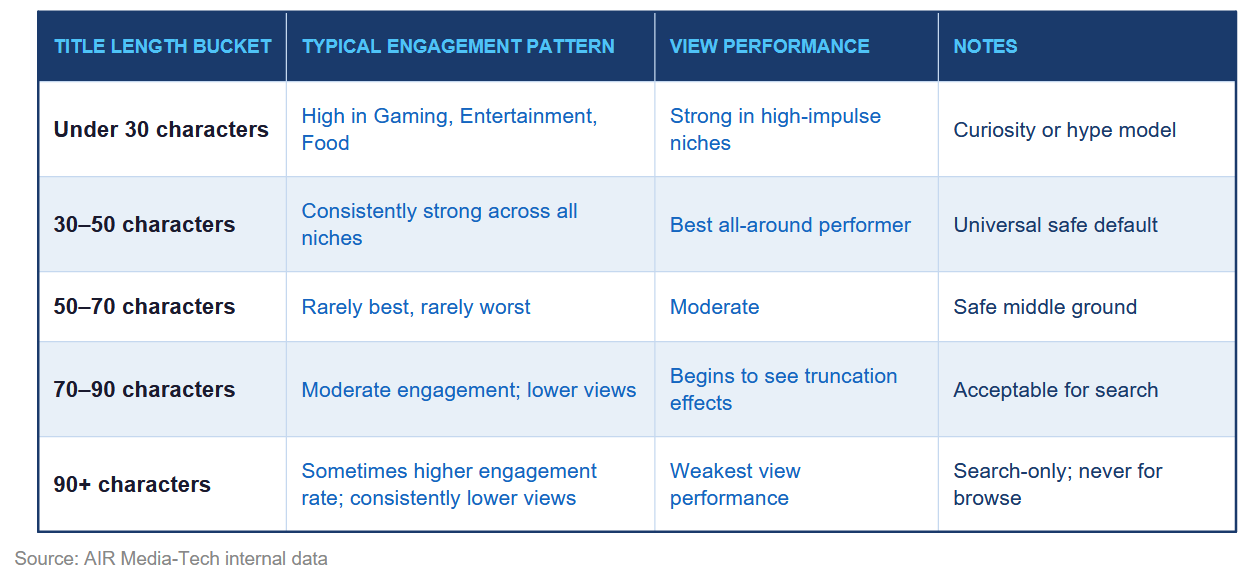
The under-30-character bucket deserves its own reading. In Gaming, Entertainment, and Food & Drink, very short titles outperform everything else.
Food & Drink channels in the 100K-1M tier show the highest engagement rate in the entire dataset at roughly 10% (driven primarily by short recipe-name titles: "Perfect Pasta," "5-Minute Breakfast," "Crispy Chicken Thighs"). These titles work because the viewer already knows exactly what they want, and the title confirms they found it. The search-to-click conversion is almost frictionless.
It’s a bit different for Gaming and Entertainment, where the under-30-character bucket works, but on a different mechanism: brevity creates mystery. A title like "I did this" or "they let me" withholds enough information to force the click. The curiosity gap is maximized when the title is short enough that the viewer cannot resolve it without watching.
The 90+ character penalty is the most consistent negative pattern in the dataset. Very long titles consistently show lower view counts. A title that gets cut to "The Complete Guide to Building Your YouTube..." in the mobile feed forces the viewer to mentally complete the sentence, which requires more effort than the average viewer is willing to do.
The counterintuitive finding: 90+ character titles sometimes show higher engagement rates among those who do click. This likely reflects a search-driven audience, aka someone who was looking for an answer to a specific question, found a detailed title that matched, and clicked. This viewer is more likely to watch, comment, and like. But the absolute number of such viewers is smaller. Long titles work for SEO-driven content. They do not work for browse or discovery traffic.
Do Numbers in YouTube Titles Help?
In short, yes, but the data also gives a slightly more nuanced answer: numbers help in specific niches and hurt (or do nothing) in others. So, the effect isn’t as universal as some advice claims it to be.
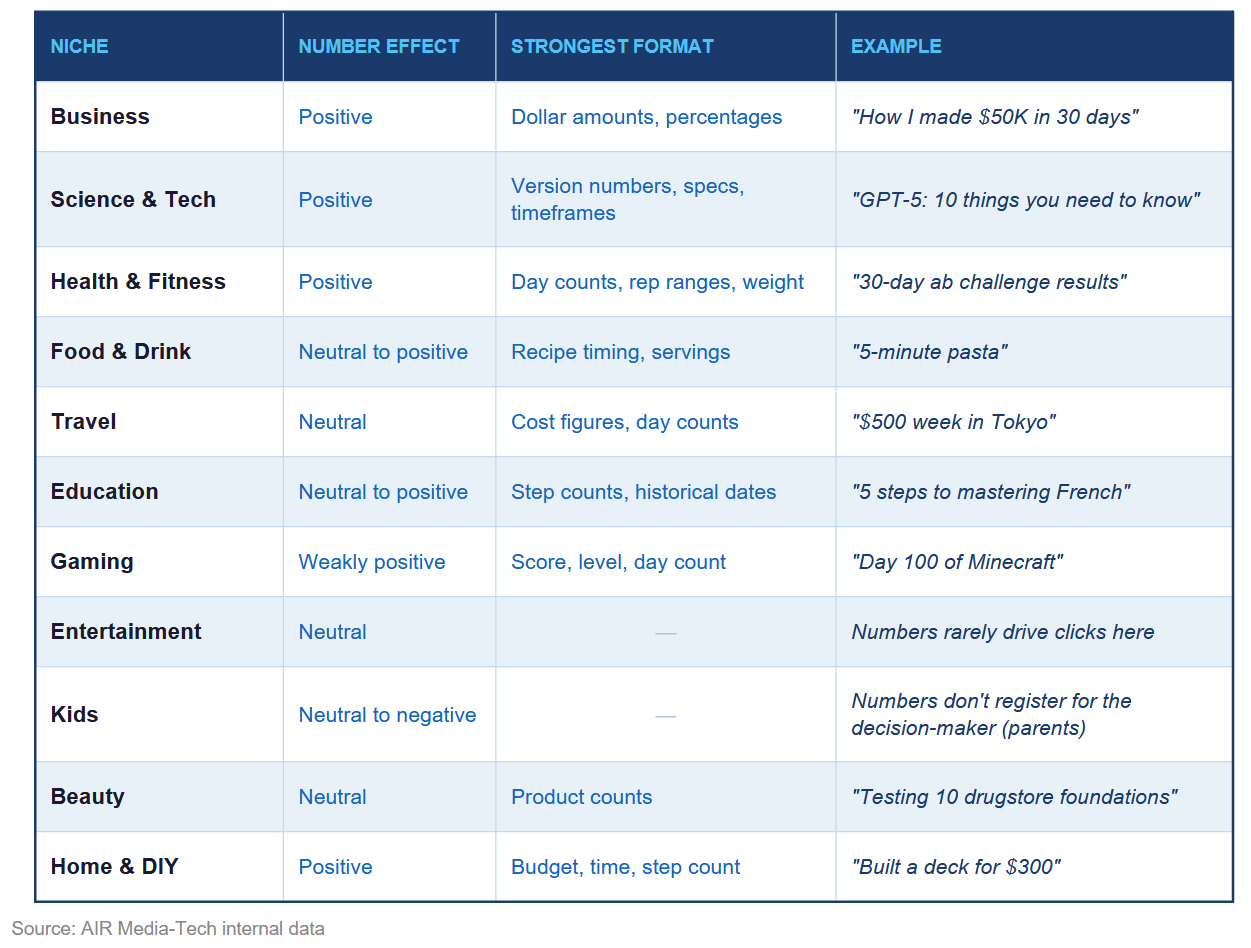
Don’t get us wrong, numbers do work when they offer more insight into your credibility or specify something. "5 ways to grow your channel" is more clickable than "ways to grow your channel" because the number makes the definitive promise, and the viewer knows exactly what they're getting. Numbers also work when they carry intrinsic interest: a dollar amount, a dramatic time frame, a surprising quantity.
Numbers do not work when they are decorative. "7 tips for your first bg3 run" does not outperform "tips for your first bg3 run" in a niche where the audience is driven by personality and entertainment value rather than instructional content.
The Food & Drink anomaly is worth examining. Short titles with embedded numbers, such as "5-minute breakfast," "3-ingredient pasta," show exceptionally high engagement at the 100K-1M tier. This happens more because of psychological reasons than anything else. Humans are driven by convenience, and when we see something that looks easy to replicate for dinner, we click. The number here is doing double duty: it signals simplicity (this is fast/easy) and specificity (I know exactly what I'm getting). This is the most efficient number use case in the dataset.
Business and Finance show the clearest positive number effect: titles with specific dollar figures, percentages, or timeframes consistently outperform generic variants. An audience seeking financial or business education has high prior intent and responds to precision.
Feel like your channel should be growing faster than it is?
Something in your mechanics can be capping the growth, and it's rarely obvious from inside your own Studio. We've diagnosed this across 3,000+ channels we can find it, and we can help you to fix it. → Find what's holding you back
Do Question Marks in Titles Work?
Question mark titles are among the most debated in YouTube strategy conversations, because some people regard them as nothing more than clickbait. The data shows that they do work, however, only in specific niches and when the viewer already has the question.
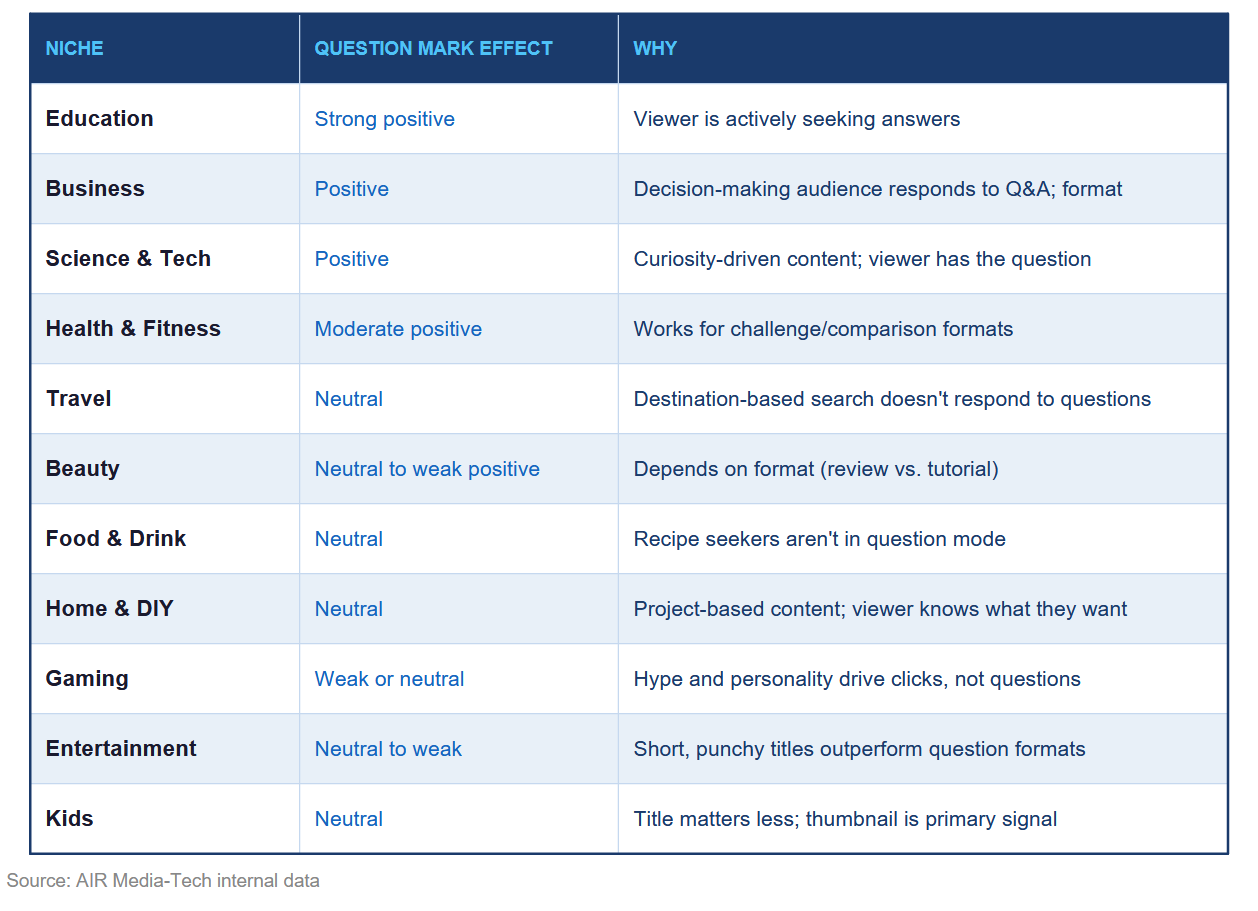
It’s a matter of the mechanism, truth be told. A question works when the viewer is already in “seeking” mode, aka they have a version of that question in their head, and the title confirms that this video has the answer. Similarly, the question title works whenever the viewer confirms their bias. “Is YouTube dying?” would work because the viewer already believes that it is. “Should you post YouTube Shorts?” works because creators are actively debating this. “What happens if you don’t sleep for 72 hours?” works because the viewer doesn’t know the answer, and it’s outlandish enough to spark curiosity.
Questions, however, fail when they don’t match the viewer’s intent. For example, people who are looking for quick recipes on YouTube type “quick recipes,” and they want just that, not philosophy.
Is the clickbait risk there?
In short, yes, but there’s nuance. YouTube's quality classifiers flag certain patterns as low-quality, but a genuine question that matches viewer intent won’t get flagged. What gets suppressed is the question that doesn’t have an answer in the video or cannot be answered by the video. “Is this the WORST video on YouTube?” with no resolution, or “Is he DEAD???” used on a video where said topic isn’t mentioned, and it’s just used for sensationalism. Authentic question titles that deliver on their promise are rewarded, while the manipulative ones are penalized.
Is It Worth Using Brackets and Parentheses?
Brackets, both square [like this] and round (like this), appear frequently in high-performing titles across most niches. The data shows a modest but consistent positive effect, particularly at the 100K-1M and 1M-10M tiers.
The mechanism is different from numbers or questions. Because brackets communicate additional context about what the video is without requiring it to be in the main title text. The common uses include:
- [2026] - shows the viewer that the information is fresh and recent
- (Full Tutorial) - shows that this is an in-depth, complete dive
- (Reaction) - categorizes the format
- [Data Study] - establishes credibility
- (Gone Wrong) - adds drama
For example, the bracket pattern, such as Video Title (What's Inside), would be particularly effective in niches where the viewer wants to know the exact format of the video before committing with a click. So, a business creator making a “How I built my capital to $1M [Step-by-Step]” video tells the viewer exactly what to expect, which is a structured walkthrough (a tutorial, if you will).
Brackets perform weakest in Gaming and Entertainment, where short, bare titles outperform elaborated ones. In these niches, the thumbnail is doing the format signaling that brackets do in text-heavy niches.
Important: titles with [year] perform better in Science & Tech, Business, and Education. The audience of these niches is trying to avoid outdated information. Even if the science of sound hasn’t changed since its discovery, a [2026] tag still increases click-through from viewers by sheer psychology. The information might be the same year-for-year, but the “freshness” is what triggers the click.
Are ALL CAPS an Amplifier or a Red Flag?
Let’s just say that this topic is quite controversial. The data shows it is one of the most niche-dependent patterns in the entire dataset, which is strongly positive in Gaming and Entertainment, neutral in most others, and actively negative in Education.
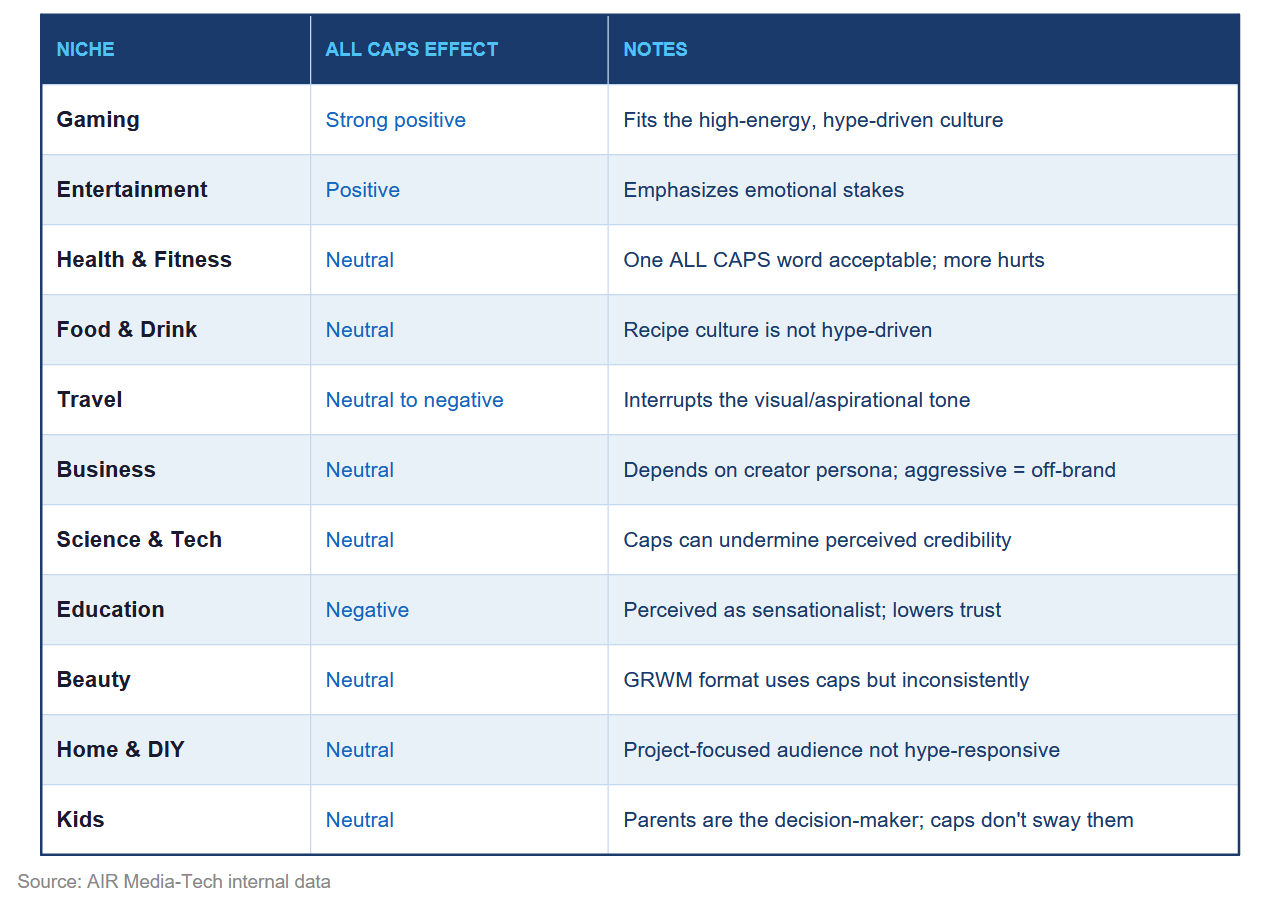
Why is gaming so receptive to ALL CAPS in titles? Mainly because gaming culture is built around hype, competitiveness, and high-energy. “I TRIED GOTHIC 1 REMAKE” or “IS IT POSSIBLE TO BEAT CUPHEAD ON EXPERT” are read as enthusiasm, which is the primary signal that gaming audiences seek before clicking.
The same all-caps title would read as low-quality or manipulative in an Education or Tech.
The negative effect of the education niche is direct and consistent across tiers. Educational content audiences are looking for credibility. A title like "5 THINGS EINSTEIN GOT WRONG" reads as clickbait to an audience that came to learn. Education creators who have been using ALL CAPS to stand out are, in most cases, actively suppressing their own CTR.
The rule is simple: match the energy level of your niche. Gaming is high-energy. Education is low-energy. Using high-energy signals in a low-energy niche creates a mismatch that viewers see, which is why they don’t click.
Feel like something's off but can't pinpoint it?
Most channels have two or three structural problems invisible from the inside: in packaging, traffic routing, or format mix. Our analysts have found them across 3,000+ channels. We'll find them in yours. → Find what's off.
Do Emotional Words Trigger the Click?
Not all emotional language performs equally. The data separates four categories of emotionally charged words and shows they have different effects depending on niche and channel size.
Curiosity words ("secret," "hidden," "what nobody tells you," "the truth about") show the strongest and most consistent positive effect across niches. Curiosity is the closest thing to a universal positive in title language. A viewer who doesn't already know the answer is predisposed to click when the title hints that the answer is surprising or withheld.
Urgency words ("now," "before it's too late," "immediately," "stop") show a positive effect at smaller channel sizes (100K-1M) and a weaker or neutral effect at larger sizes. At scale, urgency language is either ignored (too common) or read as manipulative. For smaller channels building an audience, urgency can create engagement from a loyal core. At 10M+ monthly views, it’s ineffective.
Positive sentiment words ("best," "perfect," "incredible," "amazing") are the most nuanced category. "Best" correlates positively with performance in niches where ranking is the primary viewer intent — "best gaming mouse 2026," "best budget travel destinations." It correlates negatively or neutrally when used as pure superlative amplification — "My AMAZING vacation" or "the BEST day ever" — where the claim is unverifiable and the viewer knows it.
Negative sentiment and controversial words ("worst," "failed," "exposed," "toxic") show mixed results. In Gaming and Entertainment, negative framing ("I failed the hardest challenge") can outperform positive framing because failure is interesting. In Business and Education, negative framing ("I lost $100K") works specifically when the viewer cares about avoiding the same mistake. In all niches, negative framing that reads as a personal attack or manufactured outrage underperforms clean, honest negative framing.
Curiosity language is the most reliable positive across all niches. If you only make one emotional language adjustment to your titles, add something that signals the viewer doesn't already know what's in the video.
Where to Put the Keyword in Your YouTube Title?
The SEO advice has been rather consistent about it: put your primary keyword at the beginning of the title. The data confirms this, but with nuance.
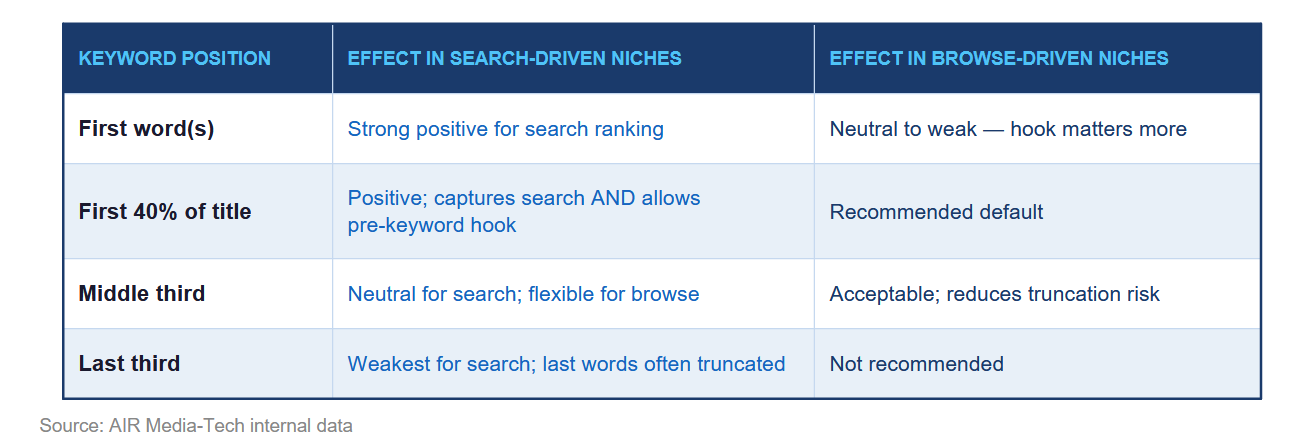
The reason keyword-first is very suitable for search is simple: YouTube’s search algorithm weights the beginning of titles more heavily, a pattern confirmed by consistent observations across high-ranking videos in search-dependent niches. More practically: when a title gets truncated in search results, the first 40-50 characters are what the viewer sees. If your keyword appears at character 65, a mobile search result doesn’t show it.
For browse and discovery traffic, keyword position matters less than hook strength. A viewer browsing their home feed is responding to visual and textual signals that trigger interest. "5 ways to grow your channel faster" outperforms "YouTube channel growth: 5 strategies" in browse because the hook (growth, faster) arrives before the category label. Both contain the same keyword; the first is a promise, the second is a label.
The practical framework: If you're optimizing for a search query, put the primary keyword in the first 40% of the title. If you're optimizing for browse discovery, put the hook first and let the keyword land naturally; it usually does, because hooks are often the same as keywords in YouTube niches. Only sacrifice hook placement for keyword placement when you have specific evidence that the video will be found primarily through search.
Want your channel to grow faster?
The answers are in your data. We have a team of 200+ analysts and 21 AI diagnostic tools to find them.
Find what's holding you backYouTube Title Patterns by Niche
The sections above cover universal patterns across the niches. This section will break down the differences niche-by-niche, the cases where the general rules don’t apply, and where creators in specific niches need to stay away from the default.
Click yours to go straight to the numbers.
- Gaming
- Science & tech
- Beauty
- Health & fitness
- Cooking
- Travel vlogs
- Home & DIY
- Business & finance
- Entertainment
- Kids & animation
- Education
What Works Best for Gaming Channels?
Gaming is the niche that strays from the general “best practices” the most. The 30-50 character recommendation gives way to under-30. ALL CAPS works. Questions don’t. Numbers are only weakly positive.
In fact, the gaming audience is overwhelmingly personality-driven. Viewers click because they either want to see a specific creator play a game or discuss the latest news in the industry. This means that the title’s primary job is to deliver the right energy and context. “I Finally Beat the Hardest Boss in Elden Ring” does more work in this niche than “How to beat Malenia, Blade of Miquella [Tutorial]”.
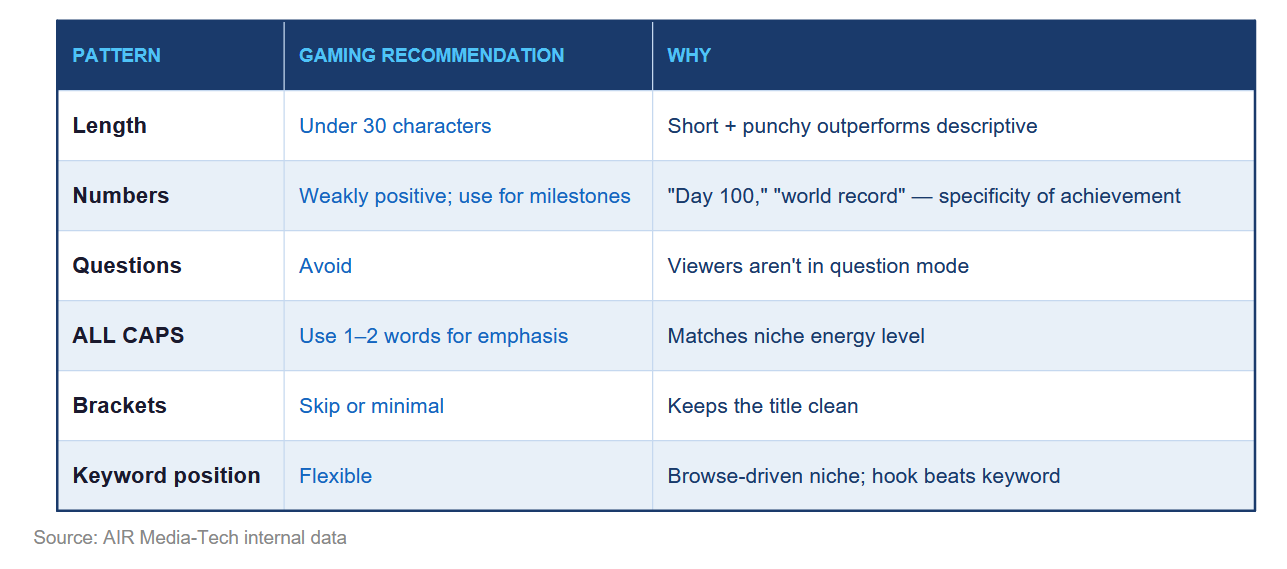
The highest-performing gaming titles in the dataset follow one of these three patterns: milestone ("Day 100 of surviving the NETHER"), challenge/impossibility ("The Hardest Mario Game Ever"), or event/reaction ("I finally tried Gothic.."). All three are short; none of them requires a question or an in-depth explanation; a hint of an outcome is enough.
The Importance of Credibility in Science & Tech Channels
Tech audiences are very intent-driven. They arrive with a question, and they click on the title that most convincingly promises a specific, credible answer.
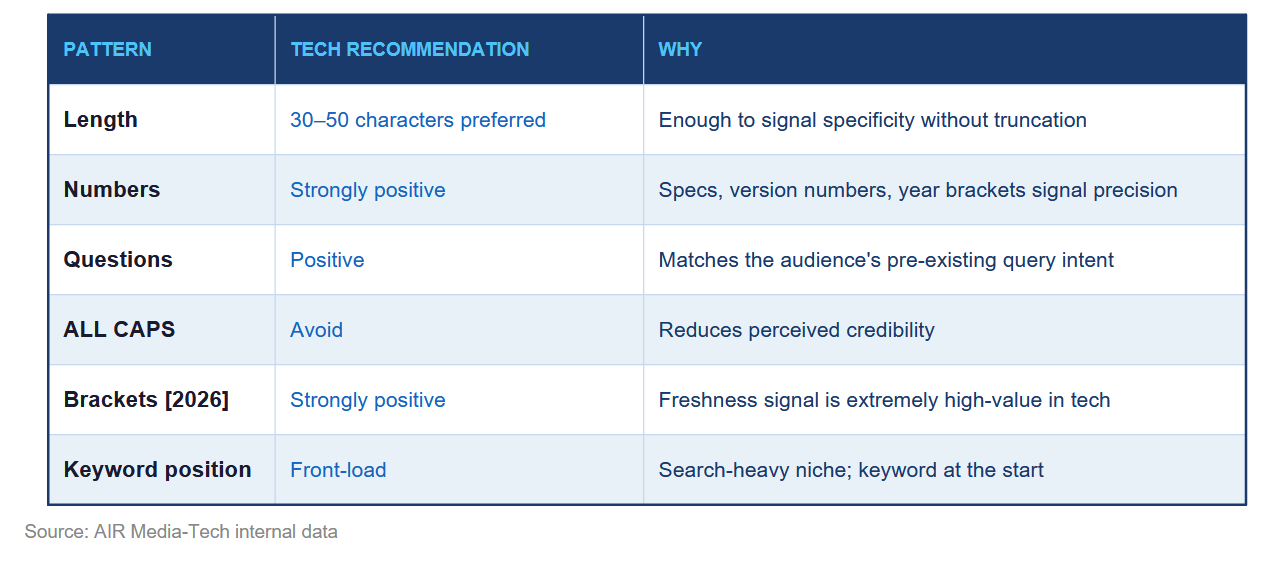
The [2026] bracket effect is most pronounced in tech. A viewer searching for "best budget phone" will click on "Best budget phones [2026]" over "Best budget phones" because tech information becomes irrelevant fast, and the viewer is explicitly trying to avoid outdated advice. Year-bracketing is low-effort and high-return in this niche.
The data shows consistent performance at the 10-20 and 20-30 character title length range only in the specific case of established creators with strong brand recognition, where the audience clicks on the creator's name before reading the full title. For most channels in this niche, 30-50 characters with a clear subject and year signal is the optimal default.
The Title Patterns of the Beauty Niche
Beauty diverges from gaming in almost every dimension as well. Longer titles outperform short ones. Questions work, but only in some formats. ALL CAPS doesn’t help. The niche is heavily split between two sub-formats (tutorials and reviews), and the title strategy is different for both.
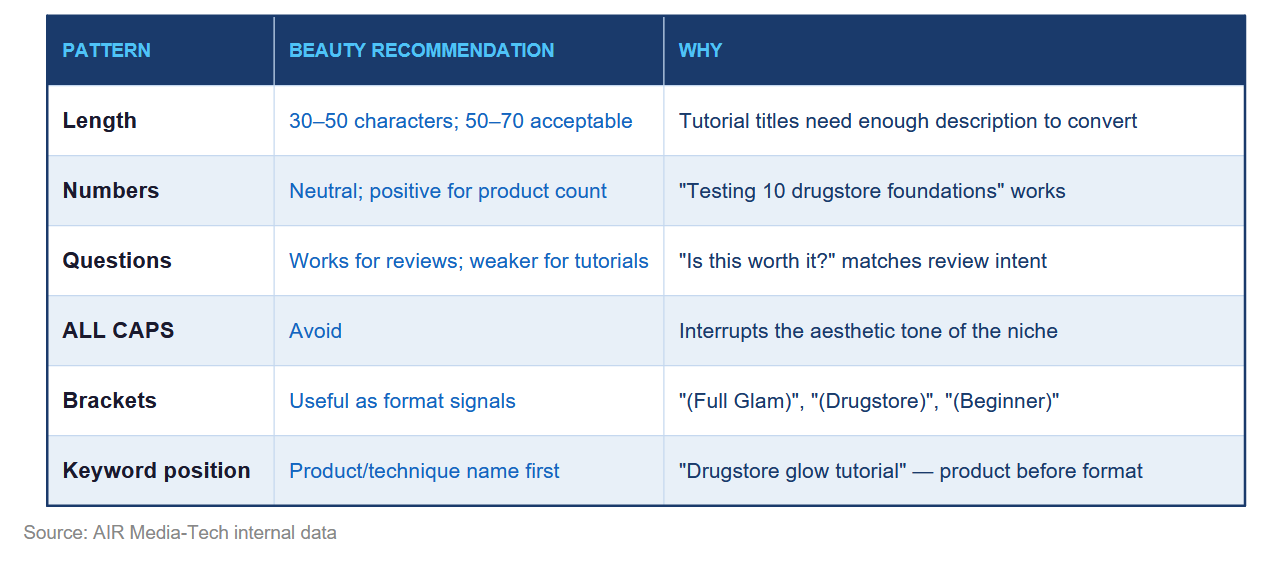
Tutorial titles work best when they name the technique and the target outcome: "soft glam tutorial for beginners," "no-makeup makeup routine," "drugstore dupe for Charlotte Tilbury." The viewer knows exactly what result they're trying to achieve; the title confirms this video gets them there.
Review titles work differently. "I tried 10 drugstore foundations" creates narrative tension (which one won?) that drives clicks. This is one of the clearest list-plus-result structures in the entire dataset, because the number creates a promise, and the viewer clicks to see the resolution.
At the 10M-50M tier, beauty title patterns compress toward shorter formats, reflecting a shift from tutorial-seeking to personality-following. At scale, the audience clicks because they know the creator, and the title does less heavy lifting. For most creators in this niche (100K-1M and 1M-10M tiers), descriptive titles outperform short ones.
What Works Best for Health & Fitness?
Fitness audiences are goal-driven, which isn’t really surprising. Every click is motivated by a desired outcome (lose weight, build muscle, run faster, sleep better, food advice, etc). Titles that name the benefit directly and specifically outperform titles that focus on the content.
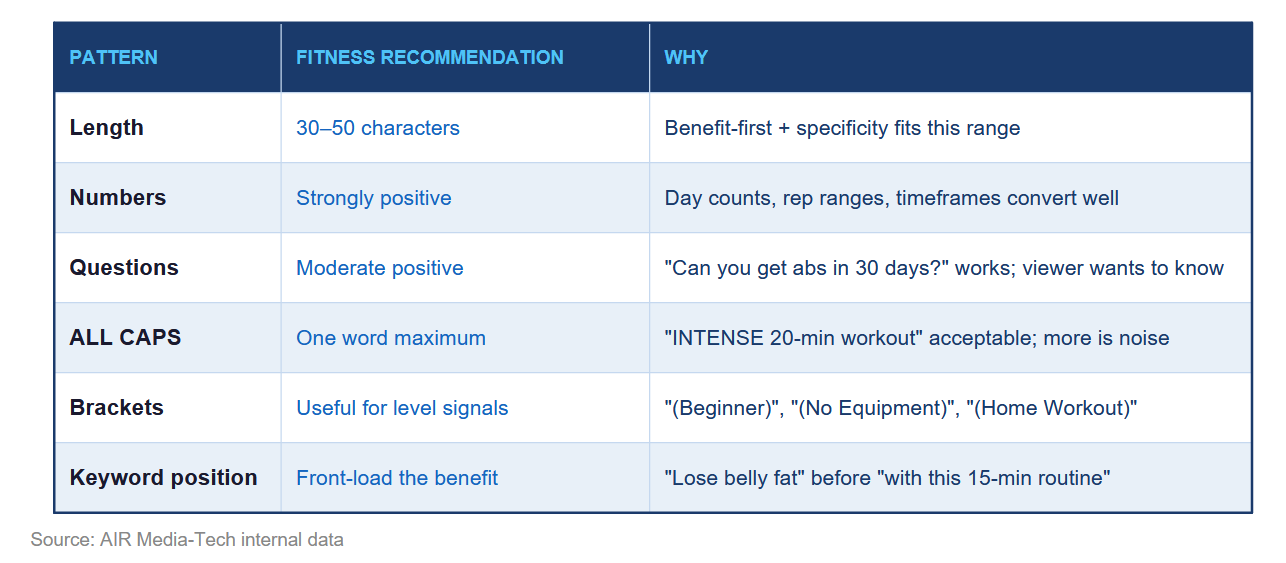
The strongest titles in this niche follow the formula: [specific outcome] + [time frame/constraint]. "Lose 10 pounds in 30 days," "6-pack abs in 6 weeks," "10-minute full body workout." This doesn’t count as clickbait because the video delivers on the exact promise to a precisely defined viewer.
The niche data shows that "challenge" titles significantly outperform format titles. "30-day squat challenge results" outperforms "30-day squat workout plan" because "results" signals resolution and accountability, which fitness audiences strongly value. They want to know the plan, but they also want to know if it worked.
The Power of Short Recipe Names for Cooking Channels
Food is the most distinctive niche. Short recipe names produce the highest engagement rate in the entire study at the 100K-1M tier, at approximately 10%. The mechanism is search-to-click efficiency: viewers searching for a recipe are already sold before they click. The title only needs to confirm they found the right video.
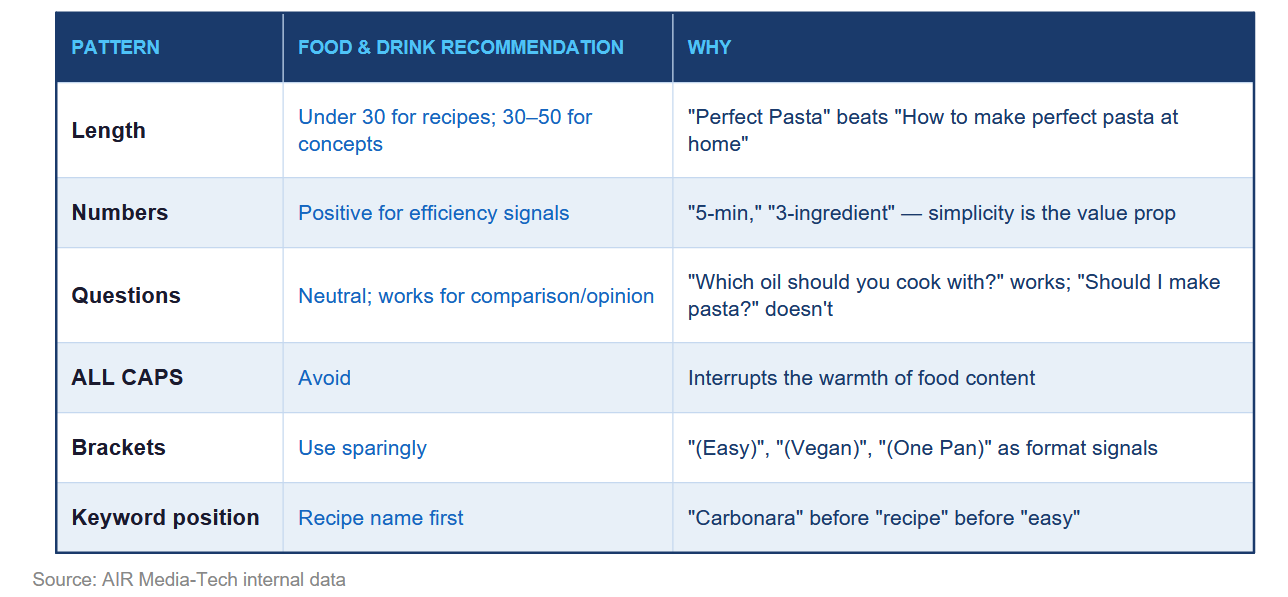
The recipe-name-as-title pattern is the clearest example in the dataset of a niche where the conventional advice ("be more descriptive") actively hurts performance. A cooking channel that titles videos "Crispy Roast Chicken" outperforms one that titles them "The Best Crispy Roast Chicken Recipe You'll Ever Make [2026]" because viewers already wanted crispy roast chicken before they saw the title, and the short version gets out of the way faster.
This does not mean description is always worse in Food. For food science, restaurant reviews, and food history, the 30–50 character range with a clear hook outperforms the bare recipe name. The rule is: if the viewer knows what they want, name it. If the viewer needs to be convinced they want it, pitch it.
Which Titles Drive Clicks in Travel Vlogs?
Travel titles are almost entirely work by destinations. The primary click trigger is the location, followed by a content type signal (budget, solo, etc.) Generic travel titles perform poorly, while specific destination titles perform especially well.
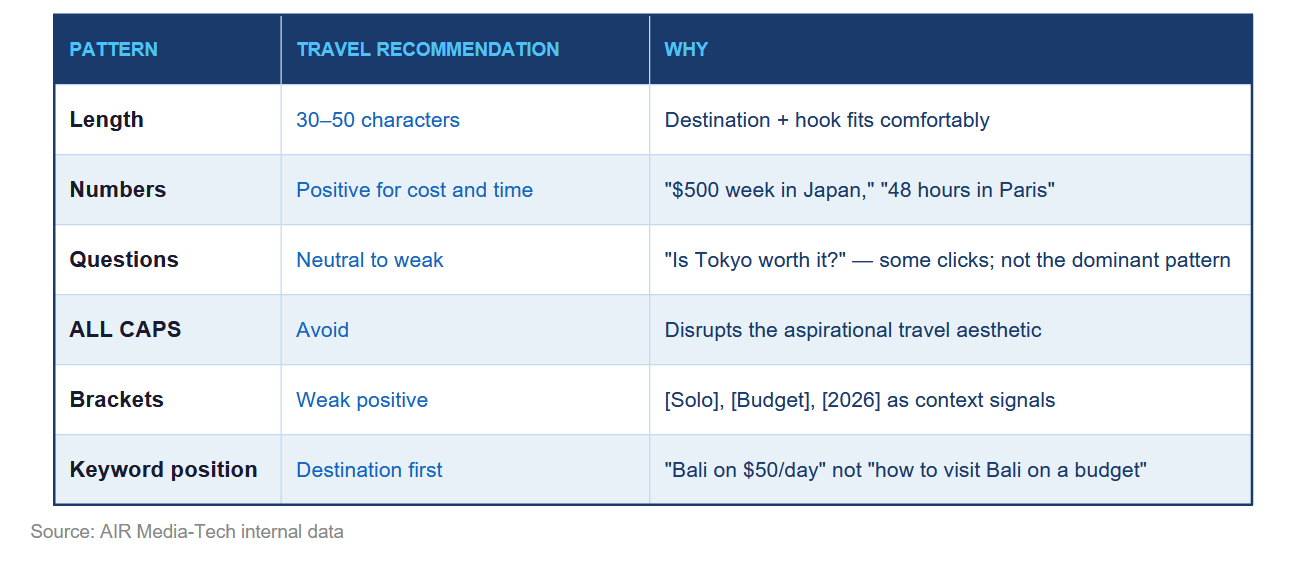
The destination-first rule is the clearest finding in travel title data. "Vietnam in 7 days" outperforms "How I spent 7 days in Vietnam" because a viewer searching or browsing for Vietnam content responds to the destination as the primary signal. Everything after the destination is secondary.
Budget and time constraints add strong specificity. "$50/day in Tokyo" is more clickable than "budget Tokyo vlog" because the dollar amount makes the title appear more interesting, and the viewer knows exactly what standard of experience to expect and whether it matches their budget.
Do the Project Titles Work Best in the Home & DIY Niche?
DIY viewers arrive with a project goal. That means that they might want to build a deck, fix a leaky faucet, paint their bedroom, or tile a bathroom. Titles that name the finished project do outperform titles that describe the process.
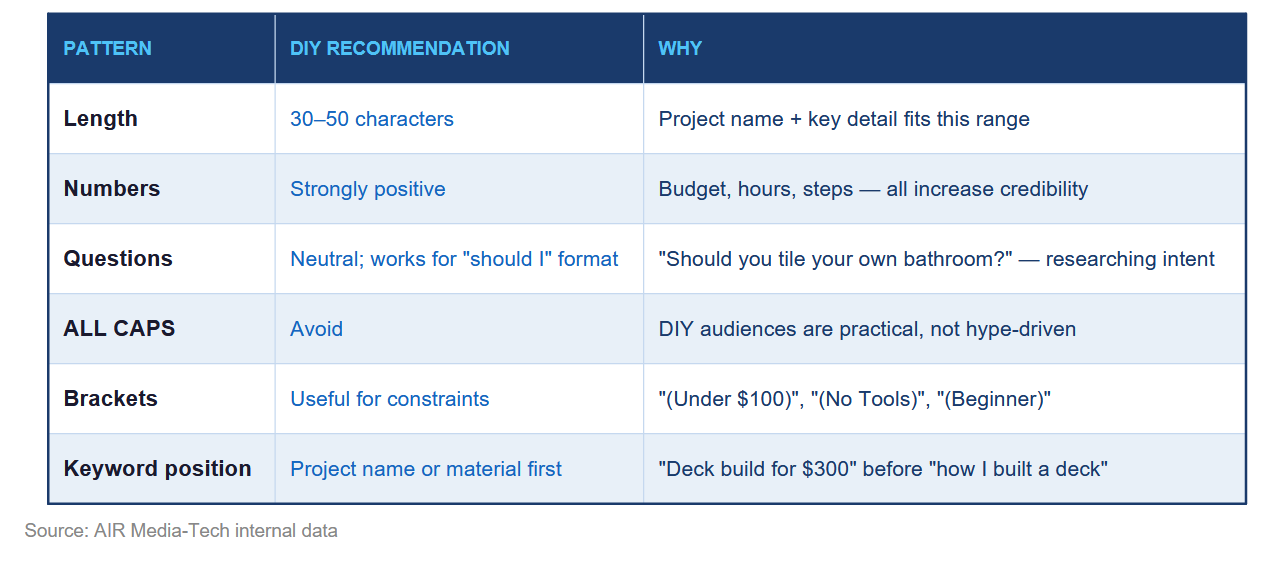
Budget titles are particularly effective in DIY. "I built a pergola for $500" does heavy lifting: it names the project (pergola), signals it's achievable (someone did it), and anchors the cost (credibility through specificity). A viewer planning a similar project clicks immediately. This pattern is the DIY equivalent of the food niche's "3-ingredient" structure, aka, to specify, because that reduces friction.
The data also shows a modest positive for step-count titles in DIY: "5-step tile installation" outperforms "how to install tile" at the 100K-1M tier. The step count makes the process feel bounded and achievable, which is exactly what a beginner viewer needs before they commit.
Precision is the Product in Business & Finance
Business and Finance audiences are among the most intent-driven in the dataset. They look for a specific answer or a case study. Generic business content titles perform poorly; specific ones perform very well. This is the niche where numbers, precision language, and keyword-front-loading have the strongest combined effect.
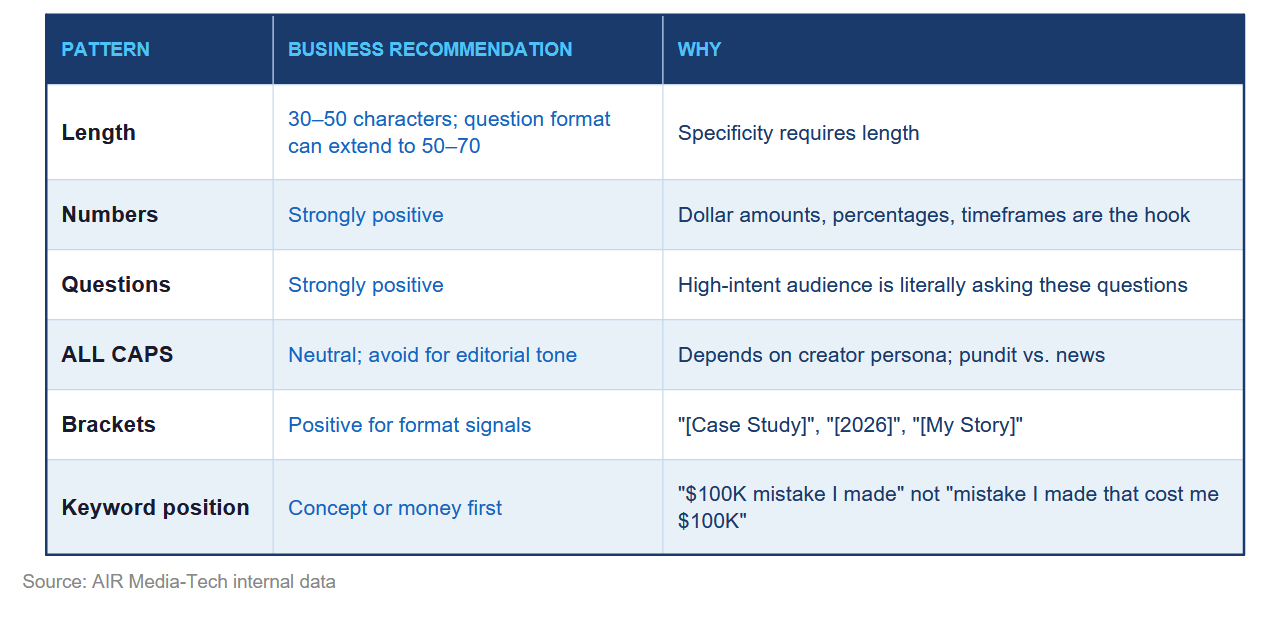
The highest-performing business title structure would be: [specific outcome or number] + [context or mechanism]. "How I went from $0 to $10K/month in 6 months." "The $50K mistake every new entrepreneur makes." "Why 90% of businesses fail in year one." All three are specific, all three make a claim the viewer wants to evaluate, and all three front-load the most interesting element.
Business audiences are sophisticated and skeptical of vague promises. "Make money online" performs poorly in this niche; "How I make $8,000/month from one YouTube channel" performs well, because the specificity signals that the creator has a real answer.
What Performs Well in Entertainment Channels?
Entertainment is the most internally varied niche in the dataset, which makes general recommendations harder. The category includes commentary channels, reaction channels, challenge channels, sketch comedy, and viral clip compilations, and all of them have different title mechanics. The aggregate finding is that short titles (<30–50 chars) outperform long ones, and the under-30 bucket is the strongest individual pattern.
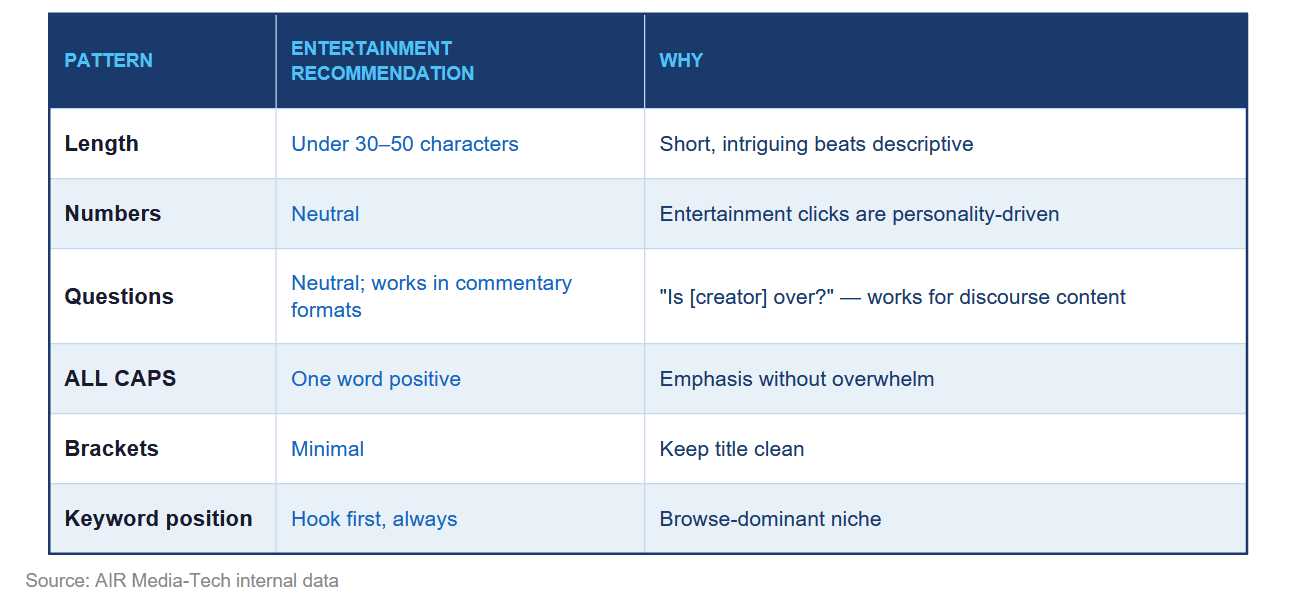
The question of sub-niche is what carries the most weight. At the 50M-100M tier, the data shows an anomalously high engagement figure for 5-10 minute entertainment content with short, punchy titles. This might carry true for meme compilations and viral clips, but most entertainment creators aren’t in this specific sub-niche.
Which means that it shouldn’t be interpreted as “short entertainment videos with short titles get 9% engagement" universally. Aside from the meme-adjacent content, entertainment titles thrive the most in 30-50 character brackets in terms of length.
What Works in Kids & Animation?
Kids’ content is a bit harder to judge, because the person reading the title isn’t always the one who ends up watching the video. Parents often browse YouTube Kids or YouTube’s main platform on behalf of their children, which means titles need to be clear, safe, and descriptive enough for a parent to approve the click.
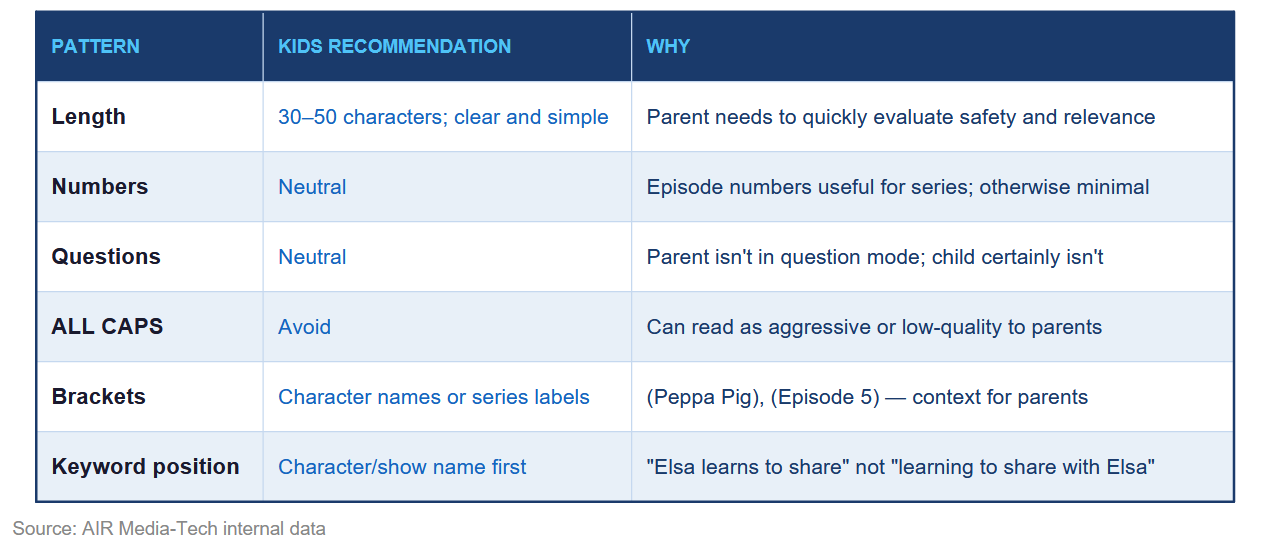
The most important finding for kids channels is also the simplest: engagement rate is the wrong metric to optimize for in this niche. As documented in our video length research, engagement rates in kids' content are structurally lower because YouTube Kids disables comments, and the viewer (the child) has minimal engagement behavior.
So, in other words, you can’t optimize your titles and overall metadata according to engagement rates. In fact, the title should be optimized for recommendation eligibility (which correlates with audience retention).
For recommendation eligibility, you need to help the algorithm understand and classify the content with your title (series naming, character-first naming, etc.). "Peppa Pig visits the farm, Kids Learning" is easier for YouTube's classification system than "What happens when Peppa goes to see the animals today?" even if the second might generate slightly more parent curiosity.
Credibility or Cleverness in Education Channels?
Education is the niche most sensitive to quality and credibility. Audiences seeking educational content are trying to avoid wasting time on low-quality or inaccurate material, and their title evaluation tends to be more skeptical than in other niches.
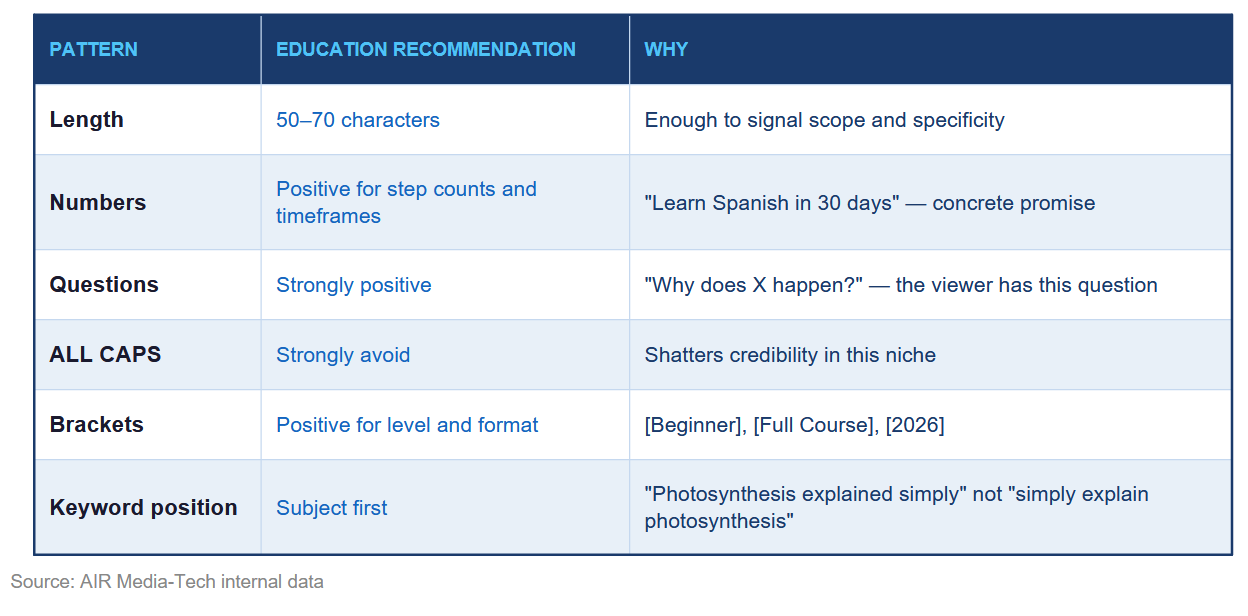
Education titles that work best have three things in common: they tell the viewer what the topic is (subject), how it’s covered (depth or method), and who it’s for (level or prerequisite). "Python for beginners. full course 2026" packs all three into 44 characters and targets a precise viewer.
The question format is the strongest positive pattern in education outside of 30–50 characters. An educational video with the title "Why do we dream?" or "How does the stock market work?" maps directly onto the viewer's pre-existing curiosity. The viewer clicked because they had that question. Question titles in education are direct answers to the viewer's intent.
Some YouTube Title Cases Behind the Data
Well, the numbers above describe correlations. But the cases below can demonstrate exactly what happens when creators act on the data.
How a Simple Title and Thumbnail Cleanup Caused CTR to Grow from 5.6% to 6.4%
This case is of a faceless narration channel, where they came to AIR with concerns about their growth stalling. After a review, we found the issue - their horror-like thumbnails and clickbait-ish titles that used buzzwords were the source of their problems. AIR gave them pointers for better thumbnails, away from the horror-bait aesthetics, and cleaner titles. The creator acted on those pointers.
The result: CTR climbed from 5.6% to 6.4%, a 0.8 percentage point gain. Engaged views grew 175% (from 356,998 to 983,393). Watch time grew 201%.
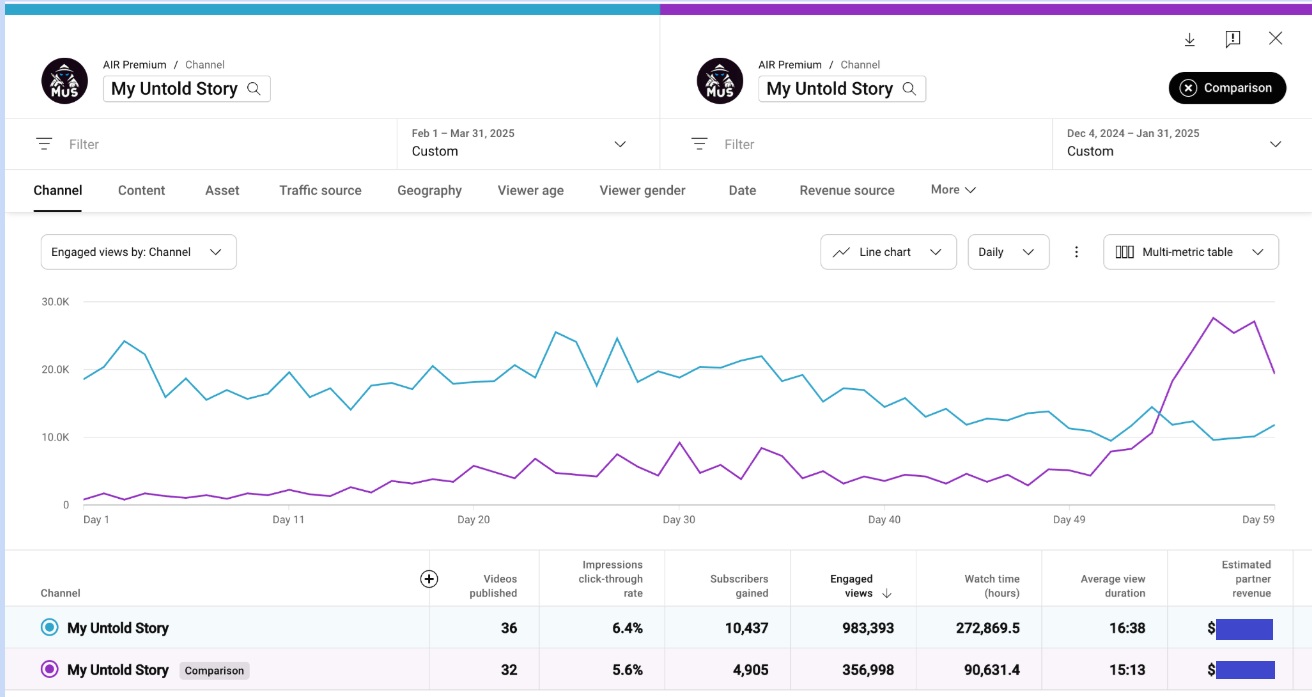
The counterintuitive mechanism: clickbait titles and thumbnails that are designed to maximize clicks often produce the opposite. YouTube's quality classifiers actively suppress content that exhibits low-quality packaging signals. So, the channel was penalized for titles and thumbnails that YouTube’s algorithm perceived as manipulative. As the problem was removed, the algorithm started treating the channel as credible, which increased distribution and the absolute number of clicks, even though the individual “shock value” of each title was lower.
Revenue up 97% with Flat Views From Title Rewrites
This partner came to us with three channels in the same network. After reviewing their channel, they have received recommendations for titles and thumbnails. The result across the network:
- Channel #1: +50% views, +97% revenue
- Channel #2: +3% views, +57% revenue
- Channel #3: −3% views, +23% revenue
The mechanism here was to get better views instead of “more” views. Title and thumbnail improvements shift which audience the algorithm serves. A better-matched audience has higher CPM demographics, better ad fill rates, and higher monetized playback rates. Revenue per view improves even when total views do not.
148% View Growth from Metadata Changes (Titles Included)
A Ukrainian DIY channel with visually self-explanatory content (so, silent-tutorial style, no spoken language) translated and cleaned up their metadata (including titles) into nine languages.
The result over six months: +148% total views, +97% subscribers, +46% ad revenue. Recommended traffic (Suggested Videos) exceeded 45% of all views post-translation.
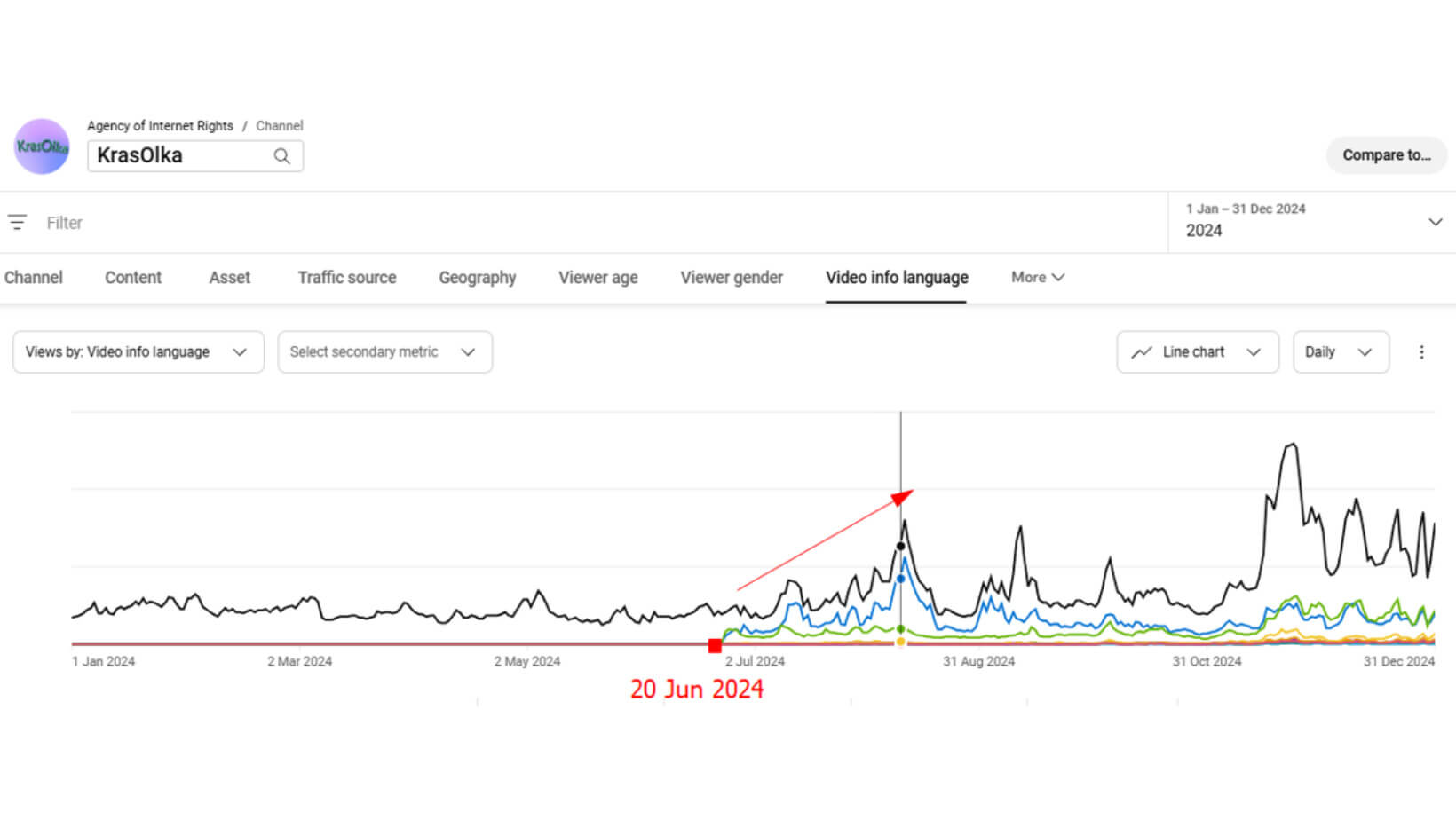
The mechanism here extends the title insight beyond the initial click: titles in the viewer's native language generate stronger recommendation signals for those language markets. A title that is descriptive and keyword-appropriate in English may be inappropriate or wrong in Japanese; translation makes the algorithm's routing job easier and expands the effective audience size without changing the content.
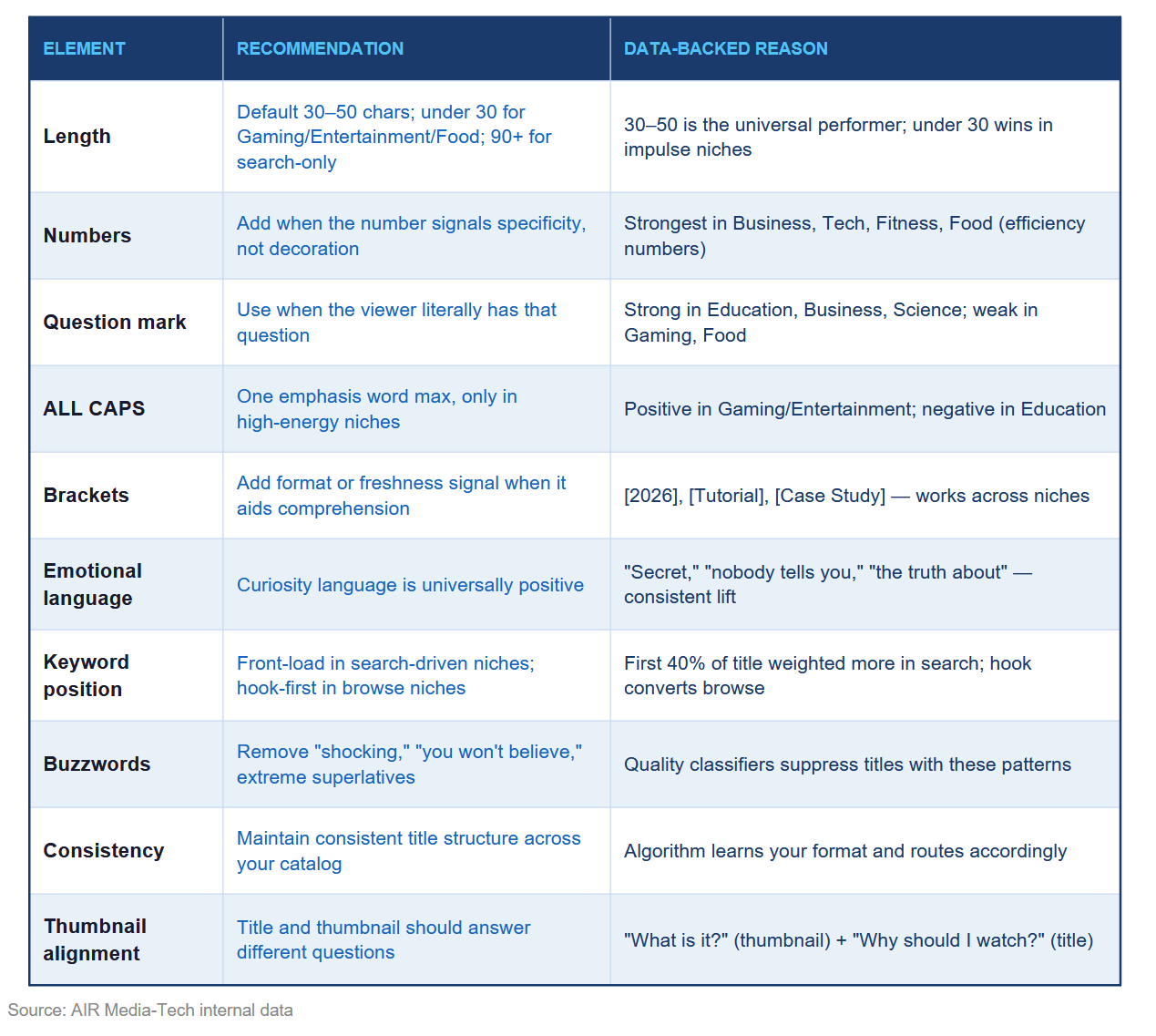
The YouTube Title Checklist
This checklist puts the findings above into a format you can run against any title before publishing.
Key Takeaways For Creators
- 30–50 characters is the closest thing to a universal answer.
Across niches and size tiers, this length range produces the most consistent performance. It avoids mobile truncation, allows keyword inclusion, and fits a complete value proposition. Start here and deviate only when your niche data clearly supports a different range.
- Short titles dominate three specific niches: Gaming, Entertainment, and Food.
In these niches, the under-30-character bucket outperforms 30–50 characters, often significantly. If you create content in these categories and your titles average 50–60 characters, you are leaving engagement on the table. The audience here wants confirmation or curiosity.
- ALL CAPS is a niche-specific tool, not a universal amplifier.
It helps in Gaming and Entertainment. It actively hurts in Education. Using it in the wrong niche reduces CTR by signaling low-quality packaging to both the viewer and YouTube's quality classifiers.
- Curiosity language is the most transferable positive pattern.
Unlike ALL CAPS, question marks, or numbers (all of which vary by niche), curiosity language ("what nobody tells you," "the real reason," "I finally found") performs consistently across niches. It works because it signals that the viewer doesn't already know the answer. If you make one language change, add a curiosity signal.
- Title optimization applies to your entire catalog, not just new uploads.
YouTube continuously re-evaluates videos against current audience preferences. Improving titles on existing videos can unlock recommendation traffic from content you published months or years ago. The Vietnamese farming channel case documented recommendation growth on videos where the creator had stopped uploading entirely, purely from packaging improvements to the existing catalog.
What The Data Can't Tell You About Your Channel
Title optimization can be scary to tackle alone. Not to mention, the data confirms that titles work in combination with thumbnails. Optimizing one half without the other leaves the other half's potential unrealized.
The patterns above cover 18,000 channels across four size tiers. They show what high-performing channels do with titles, but they cannot show what you can do to improve your channel’s performance and what could hold your channel back, because the specific problem is different for every channel.
A channel with a weak CTR may have a title problem, a thumbnail problem, or a mismatch between title and thumbnail that makes neither work correctly. A channel with strong CTR and weak retention has a different problem entirely. The title is doing its job, but the video isn't. Knowing the benchmark doesn't tell you where you sit against it, and it doesn't tell you which of your specific title patterns are suppressing performance.
That's what the AIR Expert Audit identifies. Our team of 200+ strategists, backed by deep Studio access to 3,000+ channels and a 450K-channel training dataset, reviews your channel across 10 performance dimensions and hands you a specific, ranked action plan. Yup, full-on plan built from your data.
What you get:
- A structured analysis across packaging, retention, traffic sources, competitor gaps, format mix, revenue structure, and audience behavior.
- A 30-day action plan ranked by impact.
- A 45–60-minute live walkthrough with a senior AIR strategist to unpack the findings.