

YouTube Shorts pays between $0.02 and $1.48 RPM, depending on your niche, roughly 3–14% of what long-form earns per 1,000 views. These figures come from YouTube Analytics API data across 274 channels, full-year medians.
In this article, you'll get Shorts RPM figures by niche and channel size, the break-even calculation that shows how many Shorts views it takes to match 1,000 long-form views, and an honest answer on the long-form RPM question, including the methodological reason this study can answer it more cleanly than the comparisons you've seen before.
How We Ran This Study
This research draws on data from 274 channels across 13 niches, accessed directly through the YouTube Analytics API. Every figure comes directly from YouTube Studio.
What the dataset covers:
- Channel level: 274 channels producing 3,044 channel-month data points
- Video level: 17 channels (directional only; flagged throughout wherever used)
- Niches: News & Politics, Crafting and Handmade, Entertainment, Business & Finance, Gaming, Kids & Teens, Music, Education & Science, Lifestyle, Food & Cooking, Transport, Gadgets & Stuff, Health and Sport
- Size tiers: small (10K–100K monthly views), medium (100K–10M), large (10M–50M)
The question of whether Shorts damage long-form RPM required a specific methodological choice. The obvious approach would be to compare channels that post Shorts against channels that don't; it is contaminated from the start: those two groups are fundamentally different in audience composition, content quality, and monetization setup. Any gap between them might have nothing to do with Shorts.
The cleaner approach used here is a within-channel design. From the full sample, we isolated 149 "irregular" channels, aka the ones that published Shorts in certain months and went without in others. Comparing those channels to themselves across different periods removes the channel-identity variable entirely and leaves Shorts' presence as the primary differentiator.
Primary metric: RPM (Revenue Per Mille) from YouTube Studio, which is what the channel received per 1,000 views after YouTube's cut.
Secondary metrics: total monthly revenue, Shorts' share of that revenue, and the view split between short and long-form content.
Why Does Our Shorts RPM Differ From What You See Online?
The RPM figures you've seen elsewhere almost certainly come from one of three places: creators sharing their own Studio screenshots, estimation platforms like Social Blade extrapolating from public view counts, or advertiser-side reports from marketing agencies describing what brands pay to run campaigns. All three measure something different from what a creator receives, and all three skew high.
Here's why the gap exists:
- A single monetized playback can trigger between one and three ad impressions. YouTube Studio reports CPM per 1,000 monetized playbacks, not per 1,000 impressions, so the Studio number is structurally lower than anything quoted on the advertiser side
- Shorts views in a channel's total count dilute blended CPM; they add volume without adding proportional ad revenue
- Geography is a major variable. An English-language channel with a significant audience in Nigeria, Pakistan, or the Philippines will see $0.20–$1.50 CPM from those viewers. The same channel serving a US, UK, or Australian audience sees $8–$20. Many channels publishing in English are drawing from both pools simultaneously
- Q4 inflates the figures creators share publicly. December CPM can run 40–60% above January. The numbers that get screenshotted and posted tend to come from the peak of that curve
- February doesn't get posted. Our figures are medians across 12 full months of actual operation, including the slow ones
- A channel's blended RPM is a weighted average across ad formats: skippable TrueView, 6-second bumpers, display overlays. Each has a different rate. Advertiser quotes typically reference only the premium formats
- Adblock users and YouTube Premium subscribers don't generate standard ad revenue at all
- Large channels frequently negotiate minimum floor CPMs directly with advertisers. Smaller channels receive whatever the open auction produces that day
The 274 channels in this dataset are real partners with verified API access. The figures are full-year medians. That combination makes this data as close to ground truth as is currently available on the topic.
Why are other channels outgrowing you?
It's not luck. There's a specific reason — and our specialists who've audited 3,000+ channels will find it in yours.
Show me what to fix
The monetization answer is straightforward: Shorts generate 3–14% of what long-form earns per 1,000 views. In practical terms, a channel needs roughly 7,000 to 33,000 Shorts views to equal the revenue from 1,000 long-form views. For most channels, Shorts account for under 2% of total revenue, while often consuming a disproportionate share of production effort.
For what that gap means across a full million views, see YouTube earnings per million views.
That number alone, though, is the wrong thing to optimize for. So, when we ask, "What happens to the rest of my channel when I post Shorts?", the answer is this:
- Shorts expand who finds the channel.
- Long-form is where that audience generates revenue.
That sequence is the actual mechanism, and it holds because Shorts and long-form don't compete for the same position in YouTube's ecosystem. They serve different discovery surfaces and different viewer states. For what those Shorts views do to your subscriber count across 18,000 channels, the growth data is here.
What the data points to: channels running a Shorts ratio between 0.28 and 0.40, roughly one Short for every two or three long-form uploads, show the strongest combined performance on both subscribers and revenue. Channels that pivot hard toward Shorts, shifting the majority of their output to short-form, show a consistent and repeatable decline across both metrics.
What Is YouTube Shorts RPM in Your Niche?
Click yours to go straight to the numbers.
- Music
- Education & Science
- Gaming
- Entertainment
- Kids & Teens
- Lifestyle
- Crafting and Handmade
- Gadgets & Tech
Can't find your niche?
Get in touch with us. We'll analyze your channel with 21 AI-diagnostic tools against our 450,000-channel dataset to find what will work for your channel, including the Shorts question and what results you can expect from them. → Get the answers.
Music: the Only Exception to the General Rule?
Music is the categorical exception in this dataset. Small Music channels achieve Shorts RPM of $1.48 and reach 60% of their own long-form RPM. Medium Music channels hit $0.97 Shorts RPM at 41% of long-form.
No other niche comes close to this on either metric. The explanation is Content ID: when a Short uses copyrighted music, the rights holder receives a share of the revenue through the Content ID system. Music channels that own their rights (or have artist arrangements with distributors) receive this Content ID revenue on top of standard ad revenue. Shorts that go viral and accumulate millions of views generate real Content ID payouts, a mechanism unavailable to a Gaming channel, a Cooking channel, or an Education channel.
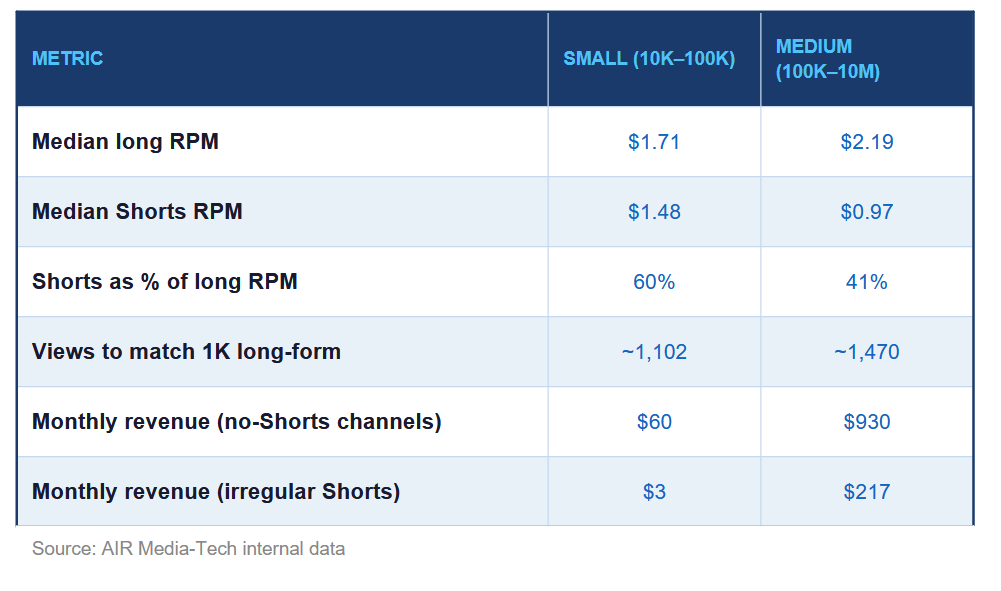
The within-channel data adds an important caveat: Music channels posting Shorts in some months show higher revenue in those months ($606 vs $175 for non-Shorts months). This reversal is likely explained by seasonality: Music channels may post Shorts in their most active content periods, which are also their highest-revenue periods. The relationship is confounded by production patterns.
The practical recommendation for Music: Shorts are more financially viable here than anywhere else. If you own your rights, Shorts RPM is within striking distance of long-form RPM, and the discovery benefits come on top of a monetization foundation that other niches cannot access. For long-form, live, and seasonal numbers next to these Shorts figures, see our YouTube monetization data for 2026.
The 2027 rule puts the most Shorts money at stake in Music. YouTube has announced that from February 1, 2027, channels will need 10 million qualified Shorts views over the trailing 90 days to share in Shorts ad revenue. At the $0.97-$1.48 Shorts RPM in this study, 1 million Shorts views bring a Music channel about $970-$1,480, far more than any other niche. Below the 10 million line, the channel's Shorts ad revenue share pauses until it crosses back, while long-form monetization and YPP status stay in place. YouTube's announcement doesn't spell out how the change treats Content ID payouts to rights holders, so Music channels should watch how their revenue splits in Studio after February 1. We broke down the full update in YouTube's new monetization rules.
Do YouTube Shorts Help Education & Science Channels?
Education has the highest long-form RPM in the entire dataset, with $14.97 at the medium tier and $18.23 at the small tier. No other niche comes close. Educational advertisers (software, online learning, financial products, SaaS tools) pay premium CPMs because they are reaching an actively learning, high-intent audience.
The data shows that Education channels classified as "transitional" (Shorts-heavy) show the sharpest subscriber underperformance of any niche, a 3.3× subscriber gap between mono-long and transitional channels at the 10M–50M tier.
The subscriber data from a wider 18,000-channel sample shows Education channels do gain subscribers from mixing Shorts in — but given the RPM differential, that growth comes at a significant revenue cost per view that most Education channels won't find worth it.
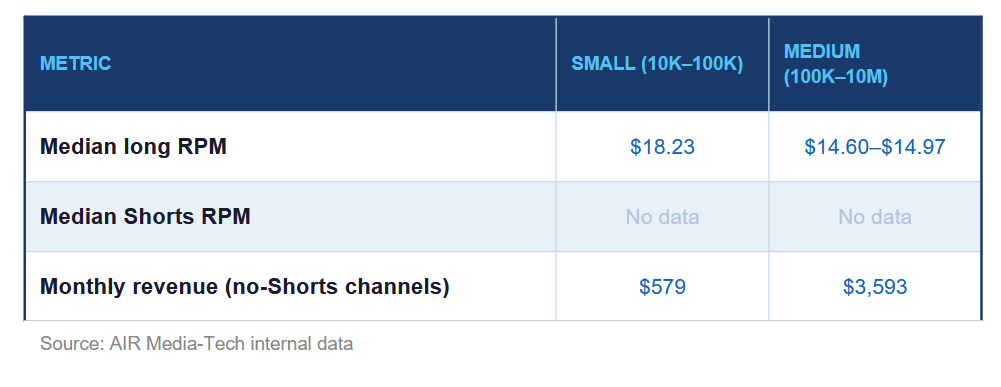
The strategic implication: an Education channel earning $18 RPM on long-form has an enormous opportunity cost for every view shifted to Shorts. If Shorts RPM in Education follows the pattern of other niches (3–8% of long-form RPM), the implied Shorts RPM would be $0.54–$1.44. To match 1,000 long-form Education views at $18 RPM, you'd need 12,500–33,000 Shorts views.
How Does YouTube Shorts Strategy Treat Gaming Channels?
Gaming shows the most stable long-form RPM in the within-channel analysis: $3.42 without Shorts versus $3.29 with Shorts, which is a 4% difference that is within measurement noise. This is the clearest signal in the dataset that Shorts do not suppress Gaming RPM the way they suppress Entertainment RPM.
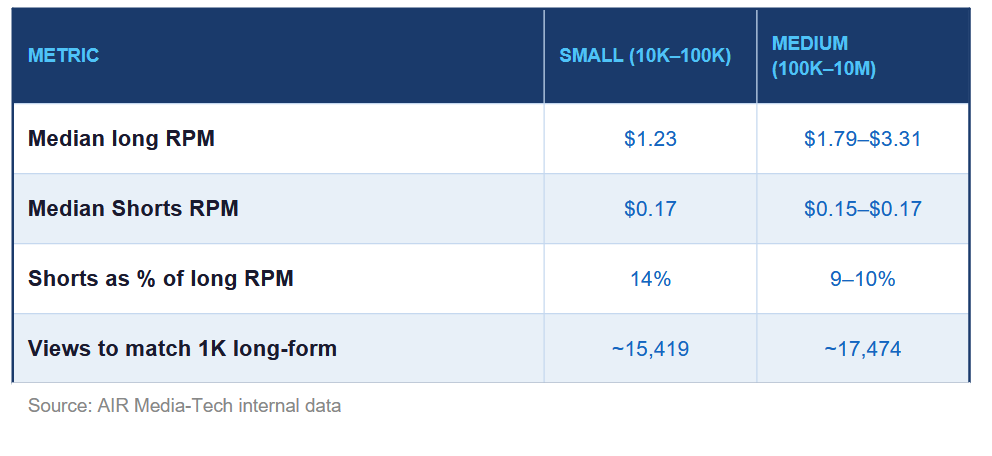
The dose-response pattern in Gaming is unusual: long-form RPM drops from $3.31 at 0 Shorts to $1.25 at 6–20 Shorts per month, then recovers to $2.11 at 21+ Shorts per month. The partial recovery at heavy Shorts volume likely reflects a cohort effect: channels posting 21+ Shorts per month in Gaming tend to be clip-focused channels with a different monetization profile than general Gaming channels that added Shorts to their strategy.
Gaming channels posting 1–5 Shorts per month show the largest RPM drop relative to 0 Shorts, which suggests the first Shorts introduction is where the RPM signal shifts. This is counterintuitive and worth watching in your own data before assuming.
How Do YouTube Shorts Influence Entertainment Channels?
Entertainment shows the sharpest Shorts effects in the entire dataset, in both directions. The cross-sectional revenue gap is 5.3× (no-Shorts channels at $2,979 versus irregular Shorts channels at $559). The within-channel RPM gap is 60% ($4.58 vs $1.84). The dose-response decline is the steepest of any niche ($4.99 at 0 Shorts to $1.15 at 21+).
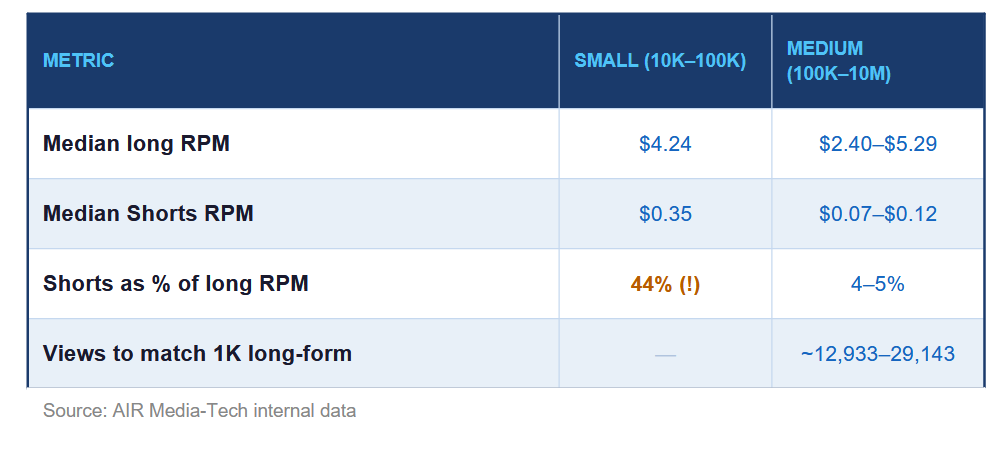
⚠️ The Entertainment small ratio (44%) is a data artefact: small Entertainment channels in the sample show median long-form RPM near $0, suggesting these channels are either unmonetized on long-form or have suppressed ad serving. The ratio is unreliable, so treat it as missing data.
The Entertainment medium finding is the most practically important: channels posting 6–20 Shorts per month earn $2.59 RPM on long-form versus $4.99 for channels posting no Shorts. At 21+, long-form RPM falls to $1.15. The dose-response effect is monotonic and large.
This does not prove Shorts cause the RPM decline, but the pattern is consistent enough to flag as a real strategic risk for Entertainment creators with high long-form RPM baselines. A channel earning $4–5 RPM on long-form has a lot to lose if heavy Shorts volume correlates with RPM compression, regardless of the causal mechanism.
How COPPA Shapes Everything In Kids & Teens Channels?
Kids & Teens has the most structurally unusual Shorts economics in the dataset, driven by COPPA's advertising restrictions. Long-form kids content faces strict ad-serving limitations; only 1 in 8 long-form views carries a monetized ad (12.1% monetized playback rate). Shorts show a 45.7% monetized playback rate. This structural difference means Shorts are proportionally more monetizable in Kids than their RPM suggests.
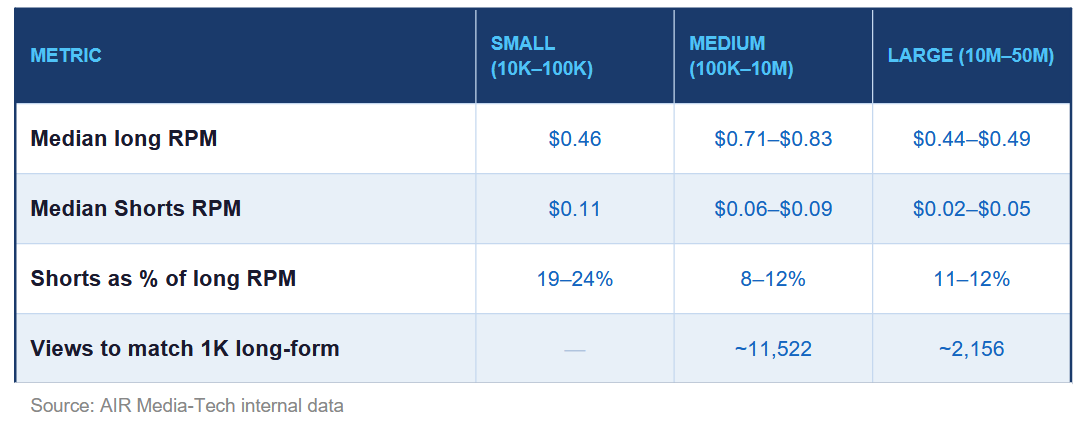
The large-tier Kids figure is notable: it takes only 2,156 Shorts views to match 1,000 long-form views. This is explained by the combination of very low long-form RPM ($0.49) and modest Shorts RPM ($0.02–$0.05). The gap between them is smaller than in higher-RPM niches, so fewer Shorts views are needed to match long-form revenue in absolute dollar terms.
The dose-response data at the large tier shows Kids channels posting 21+ Shorts per month, reaching a 41% Shorts revenue share, which is the highest in the dataset. For large kids' channels that have already maximized long-form production, Shorts can functionally become the primary revenue driver.
How Are Lifestyle Channels Responding to YouTube Shorts Strategy?
Lifestyle medium channels need approximately 26,000 Shorts views to match 1,000 long-form views, which is the worst exchange rate in the dataset. This is driven by relatively high long-form RPM ($3.87–$4.88) and low Shorts RPM ($0.16–$0.20).
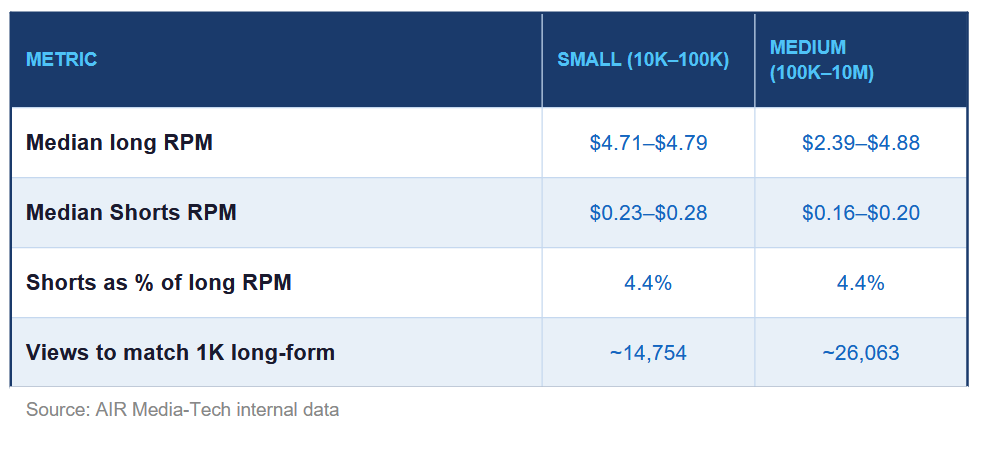
Lifestyle small irregular channels earn $40/month in total revenue versus $832 for Lifestyle medium no-Shorts channels. Even adjusting for size differences, the revenue gap illustrates that for Lifestyle creators with established long-form audiences, Shorts contribute almost nothing financially.
The Lifestyle Shorts RPM anomaly in the dose-response data ($1.05 at 6–20 Shorts per month for small channels) is worth noting because the unusually high figure likely reflects a small cohort of Fashion/Beauty-adjacent Lifestyle channels with active brand deals, not a representative Lifestyle Shorts RPM benchmark.
How Do YouTube Shorts Affect Crafting and Handmade Channels?
Crafting has the lowest Shorts-to-long RPM ratio in the dataset at 2.9%, meaning Shorts pay less than 3 cents per dollar earned on long-form. With long-form RPM at $3.53–$3.68 and Shorts RPM at $0.11, the break-even calculation produces approximately 34,000 Shorts views needed per 1,000 long-form views. No other niche in the dataset shows a wider gap.
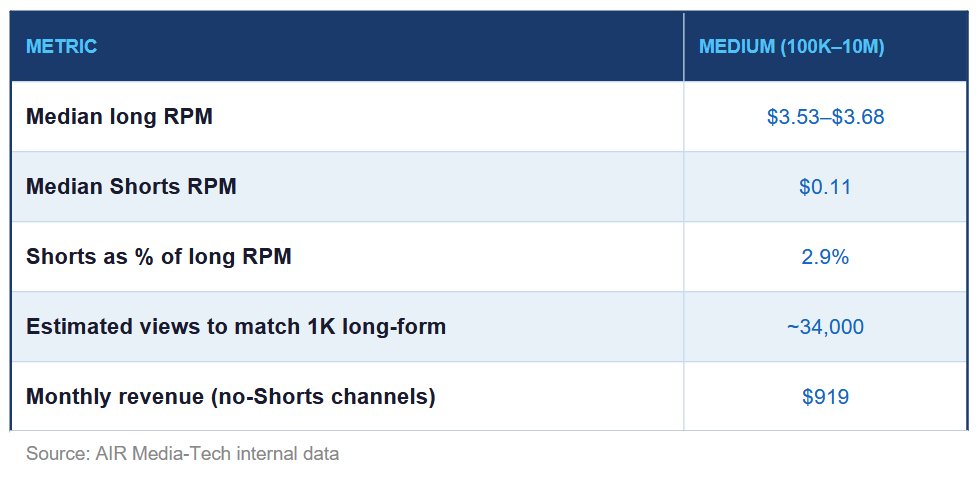
Despite this gap, the Arts & Crafts case (wAw Creator, +64% revenue) demonstrates that the break-even calculation is not the right frame. A Crafting channel generating $919/month does not need Shorts to replace long-form revenue, but it needs Shorts to expand the audience being served by its long-form content. The 64% revenue gain came from long-form views growing 41.8%, not from Shorts revenue itself.
The 34,000-view break-even is not a reason to avoid Shorts for Crafting creators. It is a reminder that Shorts' revenue on its own is irrelevant to the strategy decision.
Feel like your channel should be growing faster than it is?
That feeling is usually data. Something in your mechanics is capping the growth, and it's rarely obvious from inside your own Studio. We've diagnosed this across 3,000+ channels and will tell you exactly what to fix first. → Find what's holding you back.
If Shorts RPM Is That Low, Why Do They Still Improve Revenue?
Everything above documents the direct revenue picture: Shorts pay 3-14% of what long-form pays per 1,000 views. Direct Shorts revenue is negligible for most channels, accounting for 0.03-8% of total revenue while consuming 1-35% of total views.
But we don’t use Shorts for direct revenue. Let’s see how it works on a real example.
+33.4% Revenue with Shorts
A kids' channel with 7.5M subscribers wasn't broken. At this scale, the obvious growth levers had already been pulled. AIR's job was to find what still had room to move.
Three changes were made simultaneously:
- All new uploads moved to 4K to align with YouTube's ongoing shift toward TV viewership
- Our team ran a kids' content quality workshop focused on how YouTube evaluates children's content in 2026. You can grab a PDF with all 34 rules for kids' content here.
- And the publishing rhythm was deliberately rebalanced. Long-form output dropped from 21 to 11 videos in the quarter, a 47.6% reduction.
- Shorts went from 10 to 23, a 130% increase, assembled primarily by pulling the strongest moments from existing long-form content and reformatting them vertically.
Results for the quarter:
- Views: +5.5%
- Revenue: +33.6%
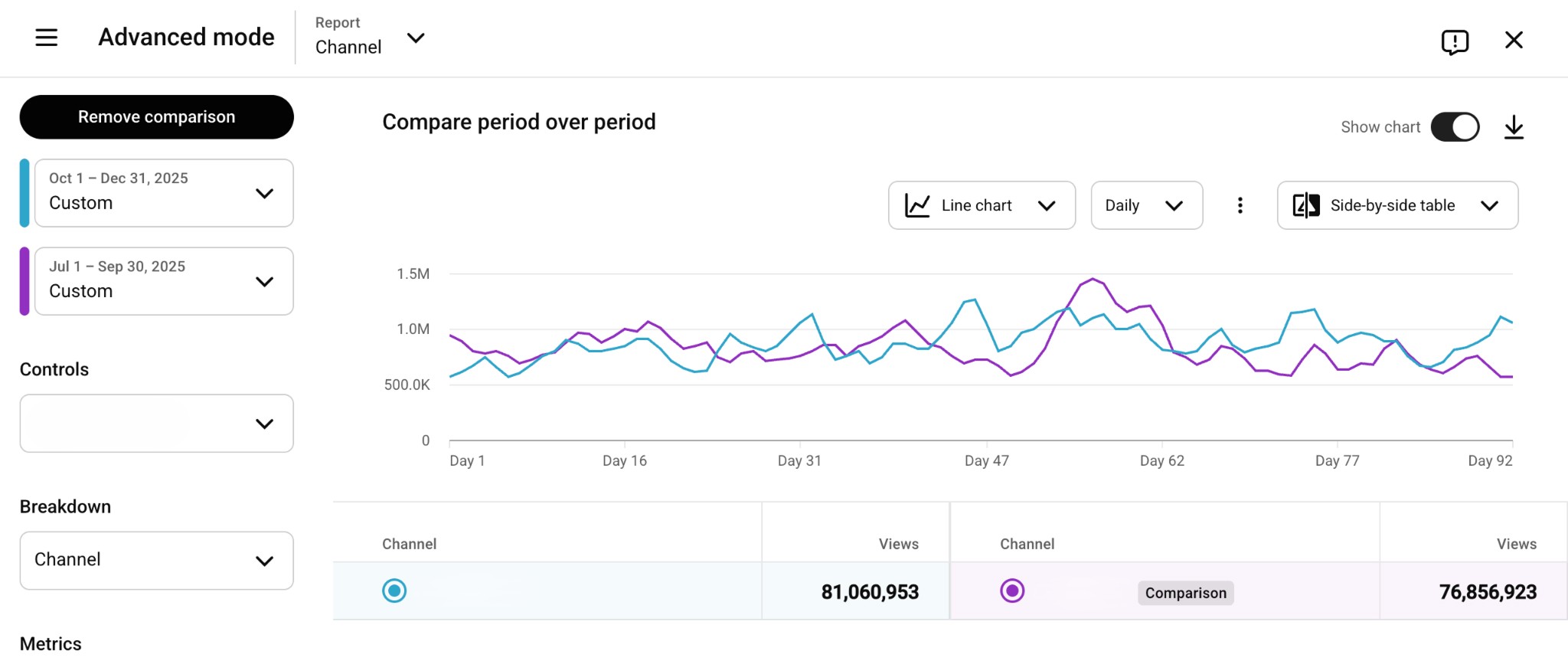
Revenue grew 6× faster than views. The Shorts expansion widened the discovery surface, which brought a more precisely matched audience into the long-form catalog. Because that audience was better matched, it generated more monetized watch time per view than the baseline did. The 5.5% view gain looks modest on paper, but at 7.5M subscribers and tens of millions of monthly views, that represents millions of additional views the channel wouldn't otherwise have reached. The revenue gain is what it always is in these cases: it came from long-form, not from Shorts. The Shorts created the entry point. The catalog did the rest.
+1M Views with Shorts
PlayToys & Play Dolls are two kids' channels sitting at 8.03M and 7.26M subscribers, respectively, both well past the scale where growth should be self-sustaining. Instead, both had stalled. The content was working, but the distribution wasn't. Two surfaces that drive the majority of discovery for kids' content were completely dark for both channels.
- No Shorts had ever been published.
- Neither channel appeared in the YouTube Kids search or suggestions.
AIR escalated the YouTube Kids placement to YouTube's internal review team on May 20 and recommended launching Shorts at the same time. The Kids app approval came through on June 18, four weeks later.
Results, starting from zero Shorts activity before April 2025:
- Play Dolls: 877,000 total views, 503,000 engaged views, 3,900 hours watch time
- PlayToys: 301,000 total views, 161,000 engaged views, 1,400 hours of watch time
- Combined: 1.17M+ views from a standing start
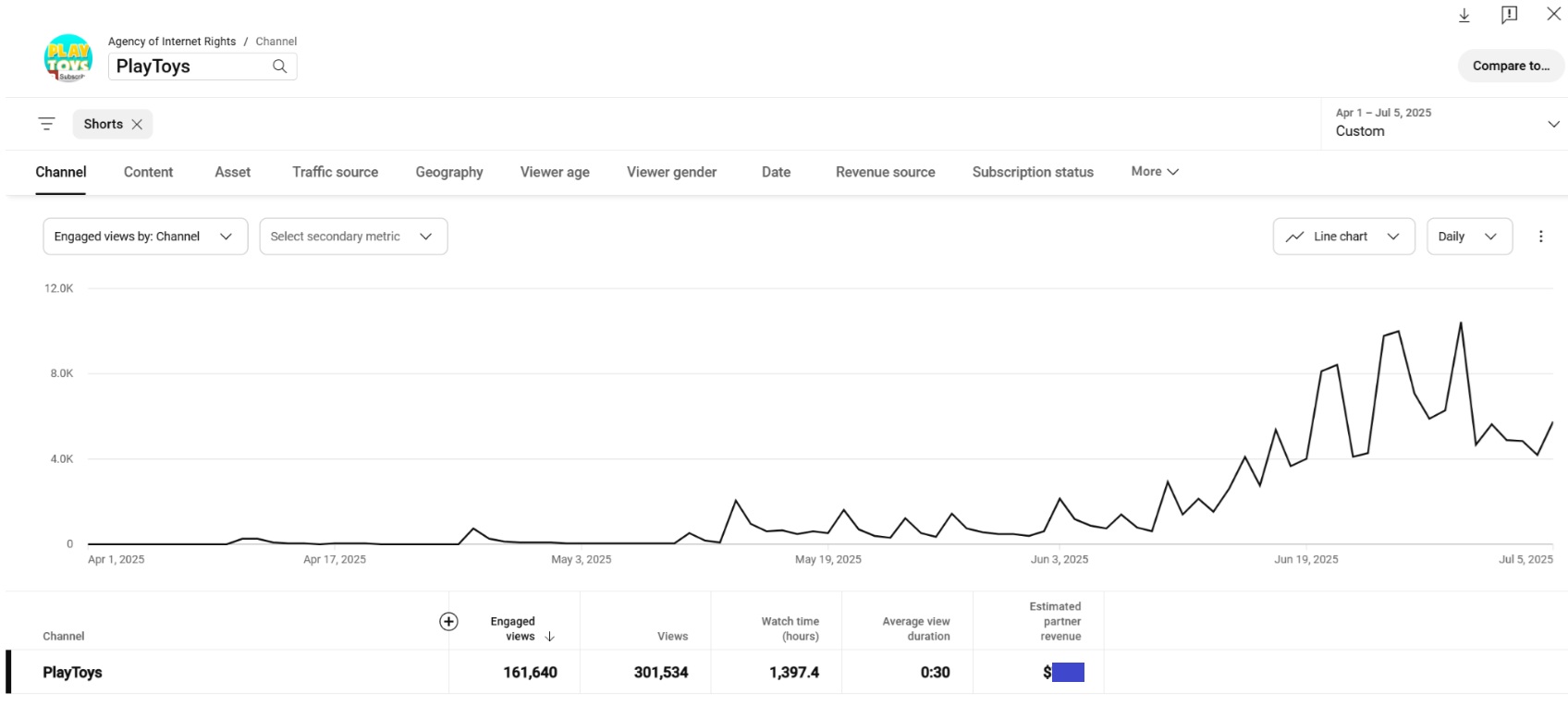
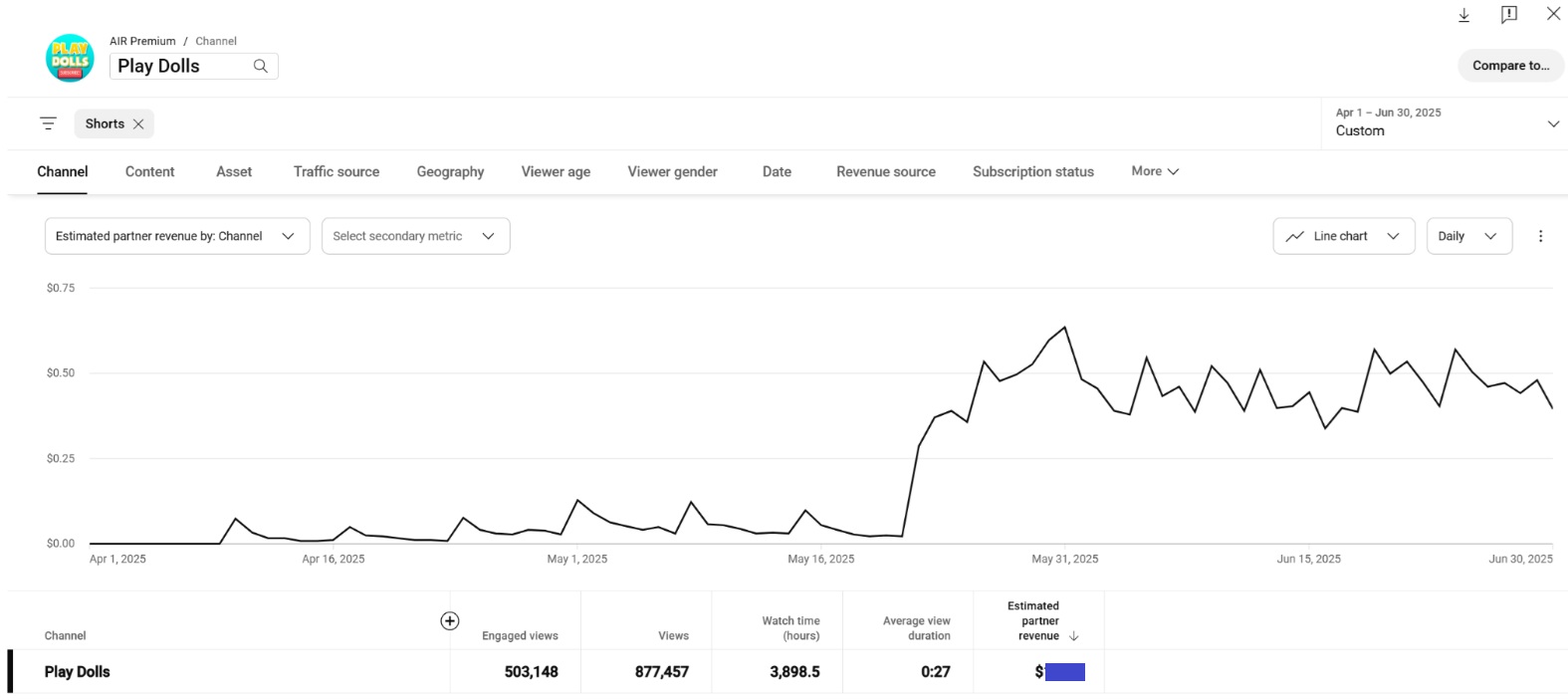
Nothing about the content changed. The channels already had millions of subscribers and years of catalog, which means that the raw material for growth was already there.
What was missing was surface-level presence: the channels existed on YouTube but were invisible on the two feeds where kids' content gets discovered. The Shorts launch opened the mobile-native entry point that new viewers use first. The YouTube Kids placement activated the cross-app signal that feeds back into recommendations on the main platform. Together, they turned two dormant distribution channels into active ones, using content that had already been made.
+64% Revenue in 30 days with Shorts
An arts and crafts channel specializing in clay sculpting and resin art had been producing consistently strong content through the summer of 2025, but the numbers told a different story. Views were declining, the recommendation engine had cooled, and revenue followed. AIR's recommendation: start posting Shorts. The creator pushed back for the exact reasons most creators do; the format felt like a mismatch, the RPMs were known to be low, and there was a genuine concern that Shorts would pull attention away from the long-form content that paid.
On September 4, they posted their first Short anyway.
Results over the following 30 days:
- Views: +41.8%
- Revenue: +64.1%
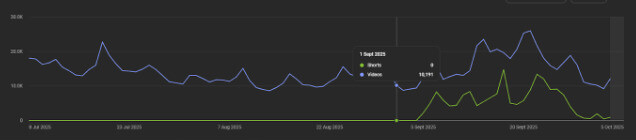
Revenue grew at 1.5× the rate of views, which only makes sense once you understand where the money came from. The Shorts themselves generated almost nothing in direct RPM. What they did was put the channel back in front of new audiences on the mobile feed, and a portion of those viewers kept watching. The algorithm registered that renewed interest, reactivated its recommendation behavior, and began distributing the channel's existing videos more broadly.
+153% Revenue with Shorts
A kids channel with 5.68M subscribers had already built a strong foundation with AIR, and localization alone had generated 400M+ views across translated content. The ceiling on that lever had been reached. The next phase required a different kind of work: tightening the structural mechanics of the channel itself.
AIR applied improvements across packaging, metadata, and seasonal publishing timing alongside a deliberate push into Shorts. The Shorts feed went from accounting for 6.2% of all traffic to 15.7%, which is more than doubling its share of incoming views. Q3 vs Q4 2025:
- Views: +76% (27.7M → 48.9M)
- Revenue: +153%
- Long-form uploads: −35% (82 → 53 videos)
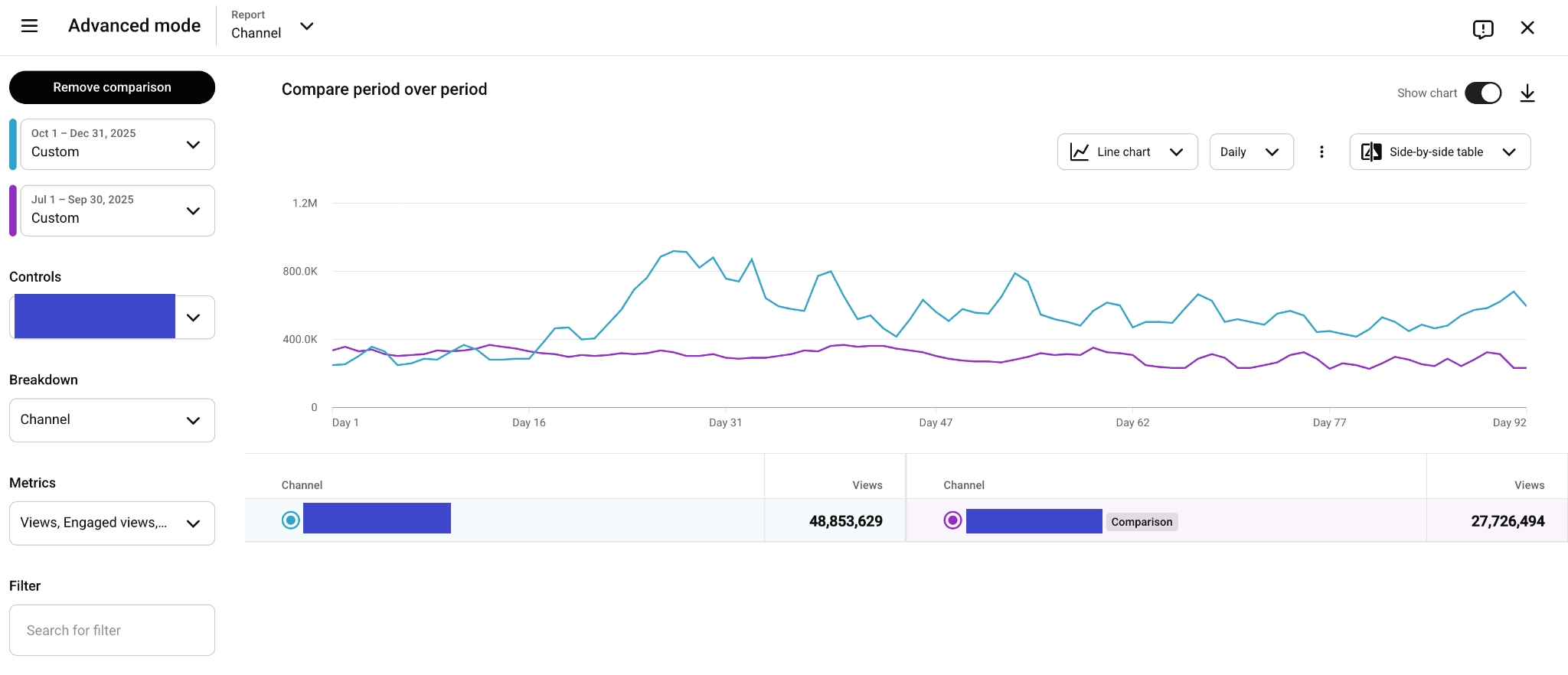
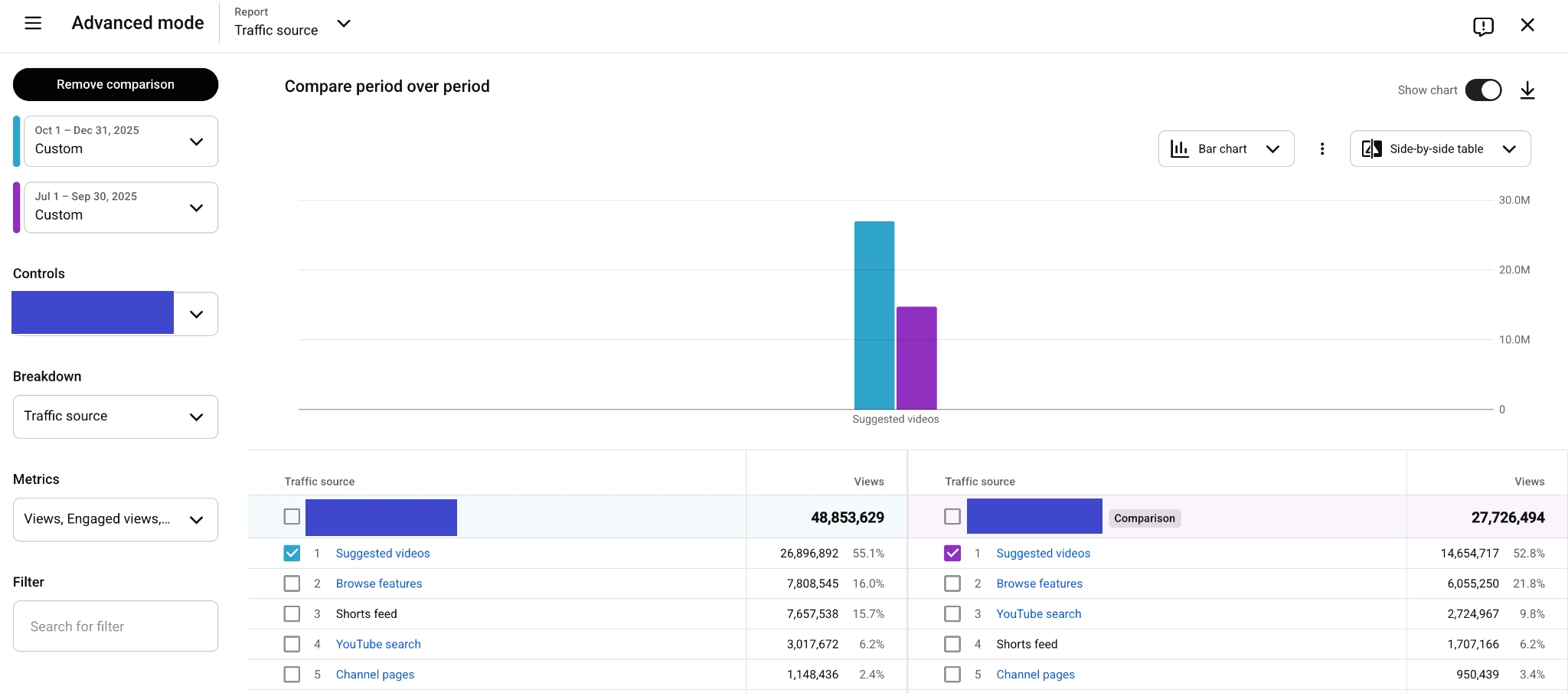
The underlying mechanism is identical to the Arts & Crafts case, but the numbers here show it operating at a different scale and with a cleaner production logic. Shorts brought in 6 million net-new views that the channel wouldn't have reached otherwise. That incremental audience fed into Suggested traffic, which grew 84% (14.65M → 26.90M). The Shorts themselves generated almost nothing in direct revenue. Every point of that 153% revenue gain traces back to long-form sessions.
The number worth sitting with: the team published 35% fewer videos and earned 153% more revenue. Less content, better distributed, to a better-matched audience. That is what the Shorts-as-discovery-lever looks like when it compounds with packaging and metadata work done at the same time.
The YouTube Shorts monetization checklist
|
Question |
What the data says |
|
Is Shorts RPM worth chasing for revenue? |
No — except in Music with Content ID |
|
How many Shorts views to match 1K long-form? |
7,000–33,000 for most niches; ~1,100 for Music |
|
Does posting Shorts hurt long-form RPM? |
Signal exists in Entertainment (−60%) and Kids (−26%); Gaming is stable; causality unproven |
|
Is 1–5 Shorts/month safe? |
In most cases, yes. Minimal RPM impact is visible in dose-response data across most niches |
|
What does heavy Shorts posting (21+/month) cost? |
Heavy Shorts posting decreases revenue in most niches. |
|
When is Shorts' revenue share meaningful? |
Kids large at 21+/month (41%); Music small (7%); otherwise <5% |
|
ill Shorts ads keep paying after February 1, 2027? |
Only for channels with 10M+ qualified Shorts views in the trailing 90 days |
What Can You Do With This Data?
- Shorts are a growth tool first, in almost every niche.
The direct revenue math does not work except in Music. What works is the indirect path: Shorts expand the audience reached by your channel, and that expanded audience generates long-form views at full RPM. Build your Shorts strategy around this mechanism, not around Shorts RPM.
- Music is the exception that proves the rule.
Content ID changes Shorts economics for Music channels in a way that is genuinely unavailable to other niches. Music small channels at 60% Shorts-to-long RPM are operating in a fundamentally different monetization environment. If you're in Music and own your rights, Shorts' viability as a direct revenue stream is real.
- The RPM compression signal in Entertainment is real and worth watching.
Entertainment channels in the within-channel sample earn 60% less long-form RPM in Shorts months. The dose-response shows $4.99 RPM at 0 Shorts falling to $1.15 at 21+. The causality is not proven, but the pattern is too consistent to ignore. Entertainment creators with high long-form RPM baselines should monitor their own Studio data carefully when scaling Shorts.
- Heavy Shorts production (21+/month) carries the most risk.
The dose-response data consistently show that the RPM and revenue gap between Shorts-active and non-Shorts channels is largest at the highest Shorts volumes. Low Shorts cadence (1–5 per month) shows minimal RPM impact in most niches. This is consistent with the data: the 0.28–0.40 shorts ratio range (roughly 1 Short per 2–3 long-form videos) is where mixed strategy outperforms both mono-long and transitional in subscriber growth.
- Kids & Teens channels have a unique Shorts case.
The 45.7% Shorts monetized playback rate (versus 12.1% for long-form) reflects COPPA's ad-serving restrictions and makes Kids Shorts proportionally more monetizable than their RPM suggests. At the large tier with 21+ Shorts per month, Shorts revenue share reaches 41%.
What Can't This Data Tell You About Your Specific Channel?
The patterns above describe what happens across 274 channels.
Your channel isn't 274 channels: it's one, with its own audience geography, monetization setup, content library, niche positioning, and traffic source history. Whether Shorts will help your specific channel, hurt it, or do nothing depends on variables this dataset can't see.
The only way to get a real answer is to look at your actual data, what's happening inside your Studio right now.
And that's what our team does.
Across 3,000+ channel audits, we've seen what Shorts produce at different channel sizes, in different niches, with different existing traffic mixes. We can tell you what to expect before you commit to a strategy.
The AIR Expert Audit goes into your channel across 10 performance dimensions, benchmarks you against the right channels in your niche specifically, and runs your data through 21 AI diagnostic tools trained on a 450K-channel dataset.
Here's what you walk away with:
- A structured report covering packaging, retention, traffic sources, format mix, revenue structure, and audience behavior.
- A 30-day action plan ordered by impact, what to address first, and why.
- A 45–60-minute live session with a senior AIR strategist to walk through the findings and answer your questions directly.