


Most traffic issues stem from more than one singular definitive problem. Sometimes it can be the reach, sometimes it’s because of packaging, and sometimes the real problem is invalid traffic, a rights dispute, or something entirely different. Creators oftentimes fail because they diagnose the wrong problem and start fixing content when the issue is somewhere else entirely. So let us go through possible problems, their solutions, and the examples of the real recovery processes.
The Short Answers First
Before we get into the full breakdown, here are the answers to the questions creators usually ask first. The evidence and cases are below.
Why Did My YouTube Views Suddenly Drop?
There is more than just one definitive reason for the views dropping. It can stem from the competition on the platform increasing, your packaging getting weaker, your channel triggering a policy or quality-related caution, or something technical breaking on YouTube’s side. The problem is that all of it looks identical from the outside: a traffic cliff. But each one needs a completely different fix. In this article, we break down examples.
Are Shadowbans Real On YouTube?
Usually not in the way creators mean it. Most “shadowbans” turn out to be recommendation suppression caused by weaker thumbnails, lower-quality metadata, sensitive-topic handling, or shifts in how YouTube classifies the content. A large Arabic kids’ channel we worked with lost over 91% of recommendation traffic, and the real cause was not a mysterious ban. It was the thumbnails that the system started reading as low quality.
Can Thumbnails Really Cause Traffic Drops?
Yes, and much faster than most creators think. A weak thumbnail does not just lower CTR. It can also change how YouTube reads the quality and clarity of the video itself, especially in sensitive categories like kids’ content. We have seen channels recover major traffic and multiply revenue after replacing problematic thumbnails on existing uploads, without changing the content at all.
Can Old Videos Drag Down A Channel?
Yes. Older videos are often where traffic problems hide longest. Metadata, titles, thumbnails, captions, and even old borderline packaging can quietly work against the rest of the channel. That is why traffic recovery should almost always include a back-catalog audit. Some channels do not need a new strategy first. They need their archive cleaned up.
Do Sensitive Topics Hurt Recommendations Even If The Video Is Allowed?
Yes. On YouTube, staying public and being widely recommended are not the same thing. A video can remain fully visible on the channel and still get less recommendation traffic if the topic is treated as borderline, sensitive, or risky for advertisers. That is why creators covering war, tragedy, politics, or public-health topics need stronger packaging discipline than entertainment channels, not less.
Can Traffic Drops Be Caused By Glitches?
Yes. Not every traffic issue comes from content quality or policy. We have seen channels in full compliance experience sharp drops because of recommendation-system errors or unexplained platform-side issues. In those cases, the correct move is not immediate creative reinvention. It is escalation, review, and making sure the drop is not technical before rewriting the content strategy.
What Fixes Traffic The Fastest?
Usually, the fixes improve performance on content that already exists. Thumbnail replacements, metadata updates on older videos, removal of policy-risk packaging, and escalation of false flags or system-side errors tend to move faster than waiting for new uploads to pull the channel out on their own. In many cases, the fastest recovery does not come from publishing more. It comes from removing what is suppressing what is already there.
So, let’s break down what traffic drops look like and how to tell which kind you are dealing with.
Why YouTube Views Are Dropping in 2026
As of 2026, most people who place greater emphasis on creating long-form content have seen a massive drop in viewership. Even MrBeast, the largest YouTuber on the platform, had experienced 50% decrease in some videos. Some creators described it as ‘YouTube snapping fingers and eliminating half the views’. But really, why is that happening? There are several theories.
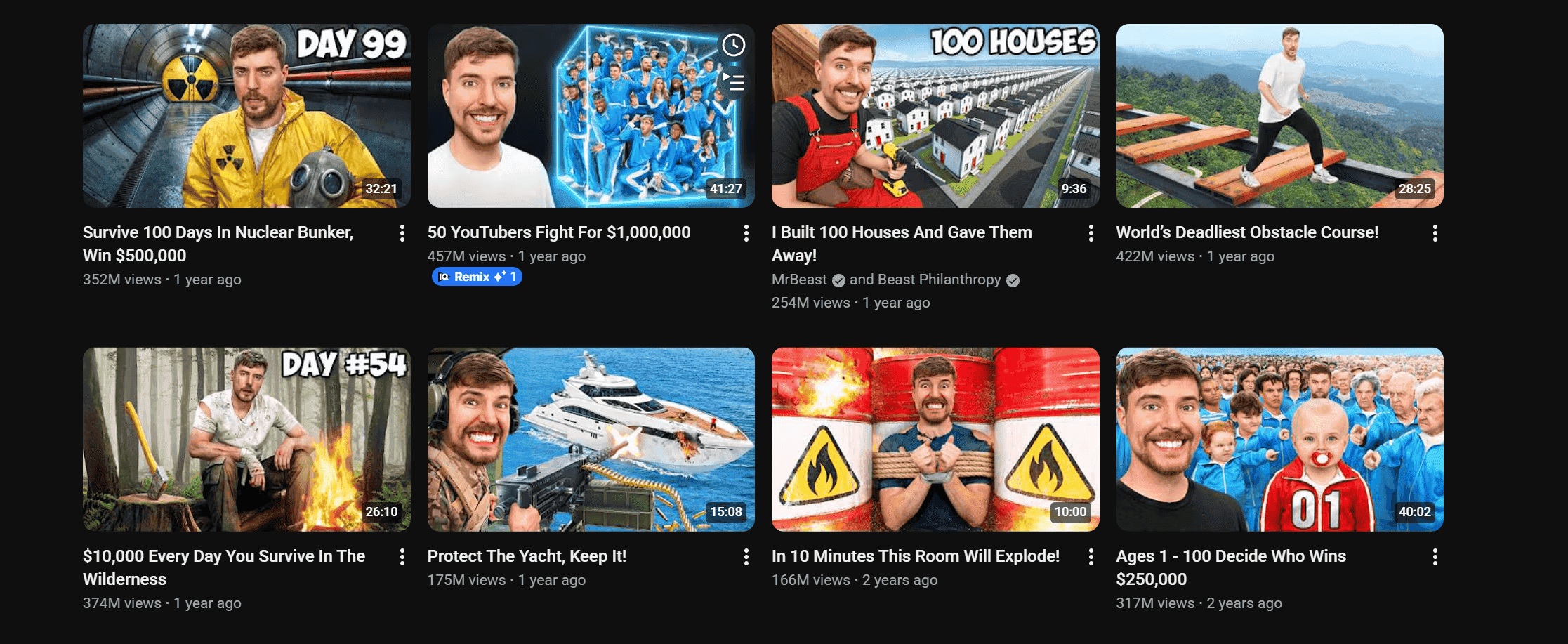

While, in general, traffic issues can be connected to a whole plethora of problems that we will look into down below, the ‘fall of 2025’ is a bit more complex than that.
As some people explain, as of now, the biggest competition for YouTube is TikTok and Instagram, both of which thrive on short-form content. As mentioned by YouTube’s CEO, Neil Mohan, in his ‘vision for 2026’, Shorts are gaining traction and average at 200 billion daily views, which is a massive number, and massive growth since 2024’s 70 billion daily views. Therefore, YouTube is trying to promote more short-form content and make it more visible so that more people stay longer on their platform and pump those daily views up even more.
Hence, came the homepage change. It appears even more contrasting when we compare how it looked in 2016.
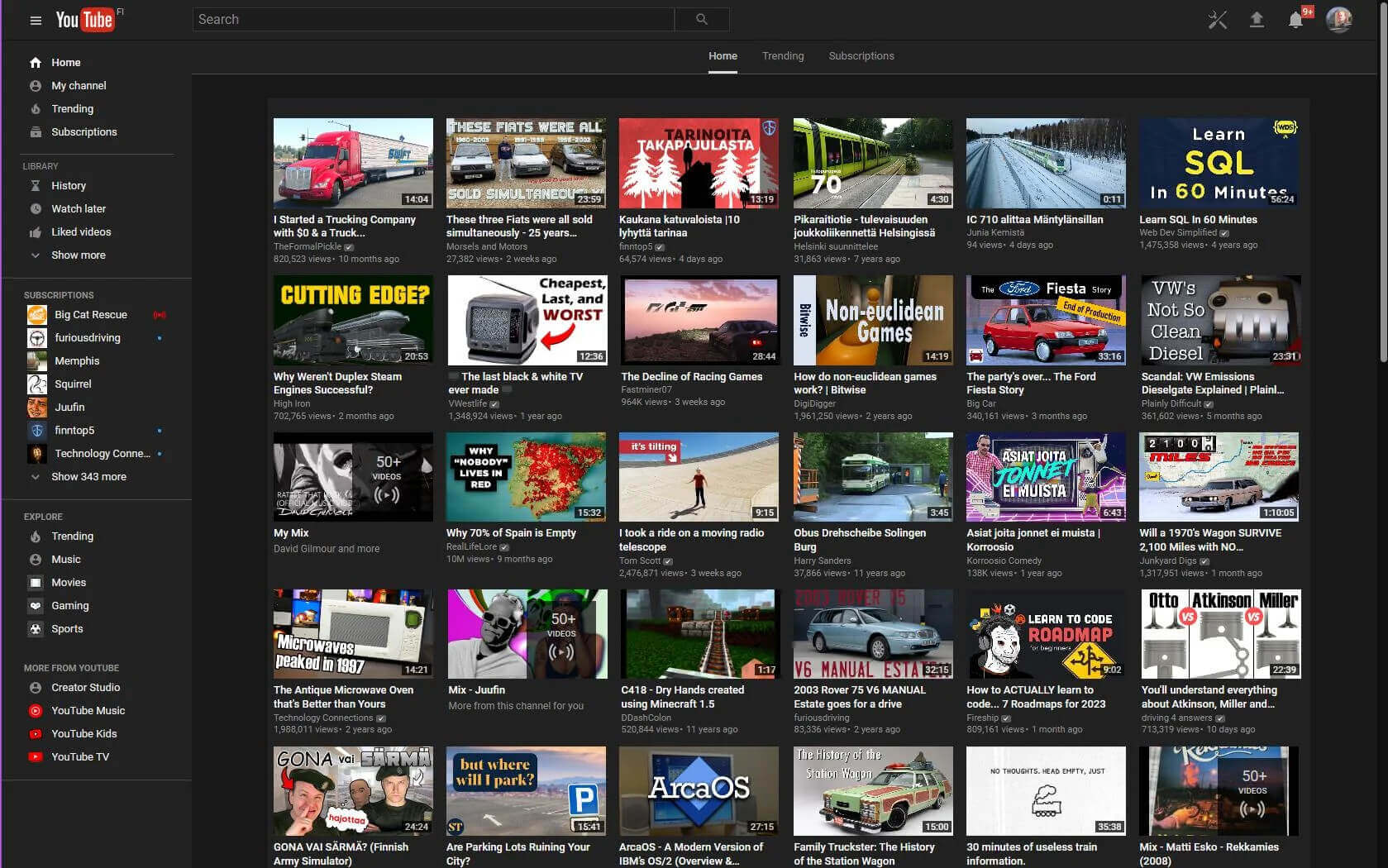
As you can see, in 2016, long-form videos were the only focus. It was the priority, so it was promoted more to appease three categories of people interested in YouTube: creators, viewers, and advertisers.
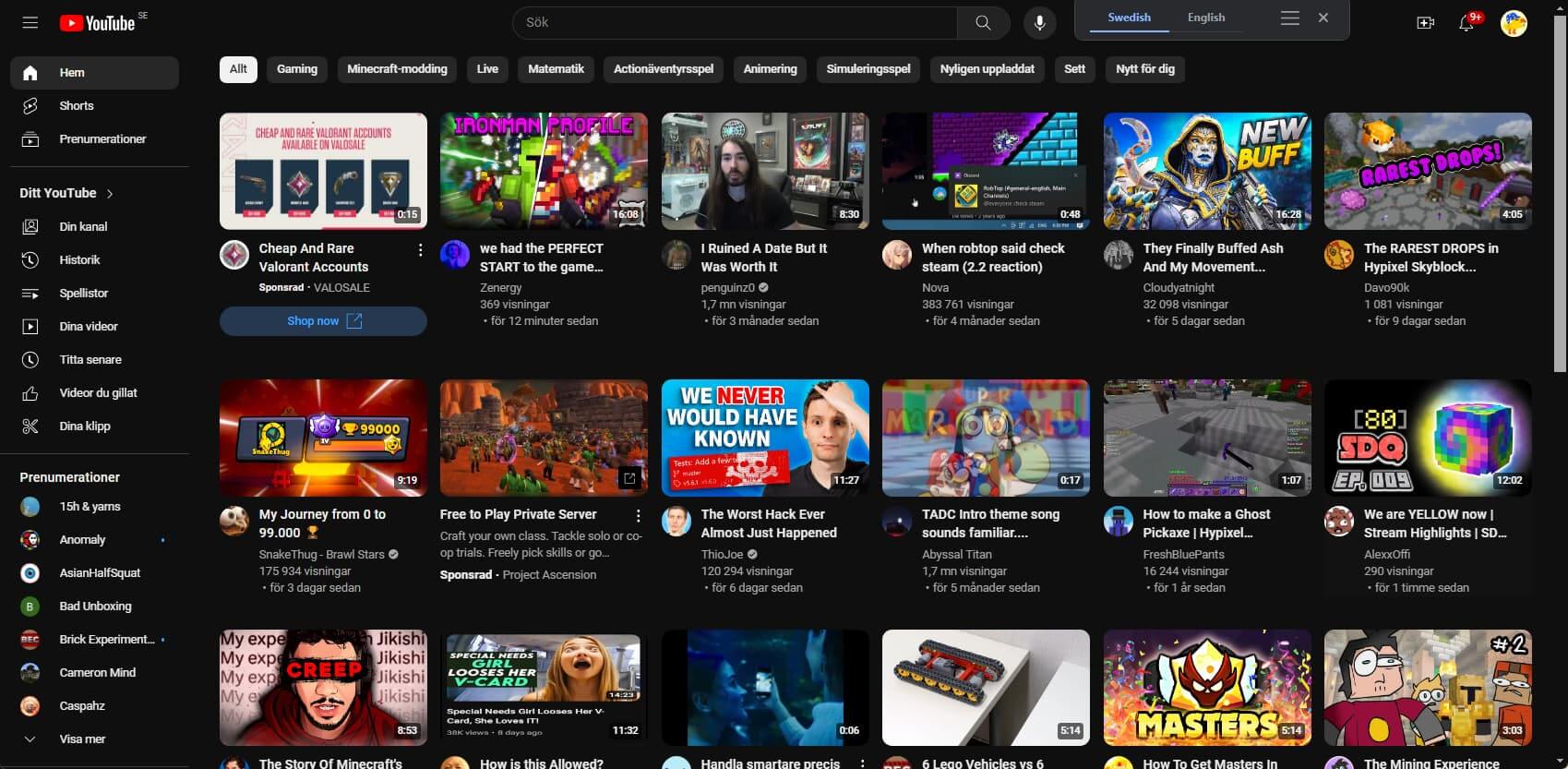
In 2020, after Shorts had made its introduction, the change wasn’t as noticeable. Shorts had their separate feed that the viewers had to manually click on. YouTube still promoted and thrived on long-form.
Now, cue 2026, and the current homepage looks like the following:
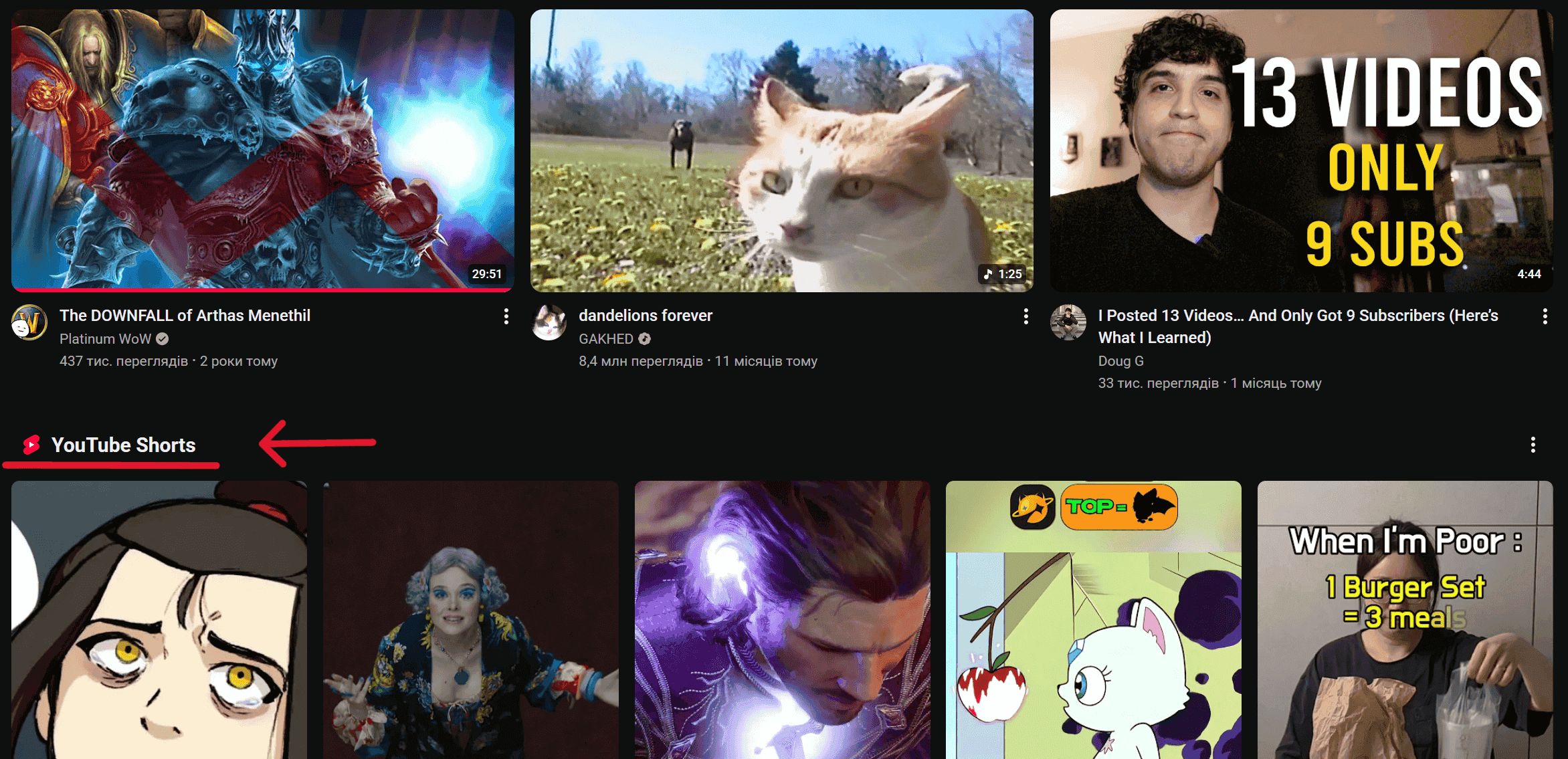
Notice the change?
Some creators argue that since Shorts have proven to be effective and rather lucrative, they have started appearing both on homepages and in searches. This seemingly small change on the platform and how it operates led to massive drops on some channels, because their videos were no longer as visible as they had been before.
Other people argue that since 69M active creators upload 500 hours of content per minute, it means that attention is distributed more thinly. Hence, the traffic drops.
Another theory claims that since YouTube has become a living room platform, competing with Netflix, Disney+, and other similar platforms, YouTube is prioritizing more ‘leaned back’ content, conversations, podcasts, and similar.
All of these theories have their logic and footing, but there’s a deeper truth to it. All of this is simply an indicator of change. The platform cannot stay stagnant forever; it needs to adapt to the shifting consumer needs to stay relevant. Therefore, to keep relevancy on such a big platform, you need to be able to adapt at a moment’s notice.
If your long-form views dropped in 2026…
Check your impressions source breakdown in YouTube Analytics. If Home feed impressions fell but Search held steady, the algorithm shift is likely the culprit.
Then compare the day the drop started with the dates in our list of 2026 YouTube algorithm updates. A drop that begins before an update wasn’t caused by it.
The algorithm adapts to what the consumer wants to see more of, and those algorithm shifts produce an organic reaction (traffic drops) that even out eventually, and the views can bounce back to normal on their own.
This is something that creators of all sizes need to keep in mind. Now, with this out of the way, let’s dive into some other real traffic-related issues and how they can be reversed, with examples.
YouTube Shadowbans: What's Suppressing Your Traffic
It’s no secret that many creators describe their traffic issues as ‘shadowbans’. Now, is it a legitimate term? Not really. When a video is uploaded, and it suddenly gets fewer views than an average video, the first reaction of the creator is to blame the mysterious forces of shadowbans. Which, nine times out of ten, isn’t what is happening. Let’s review the real reasons why ‘shadowbans’, aka traffic drops, might occur:
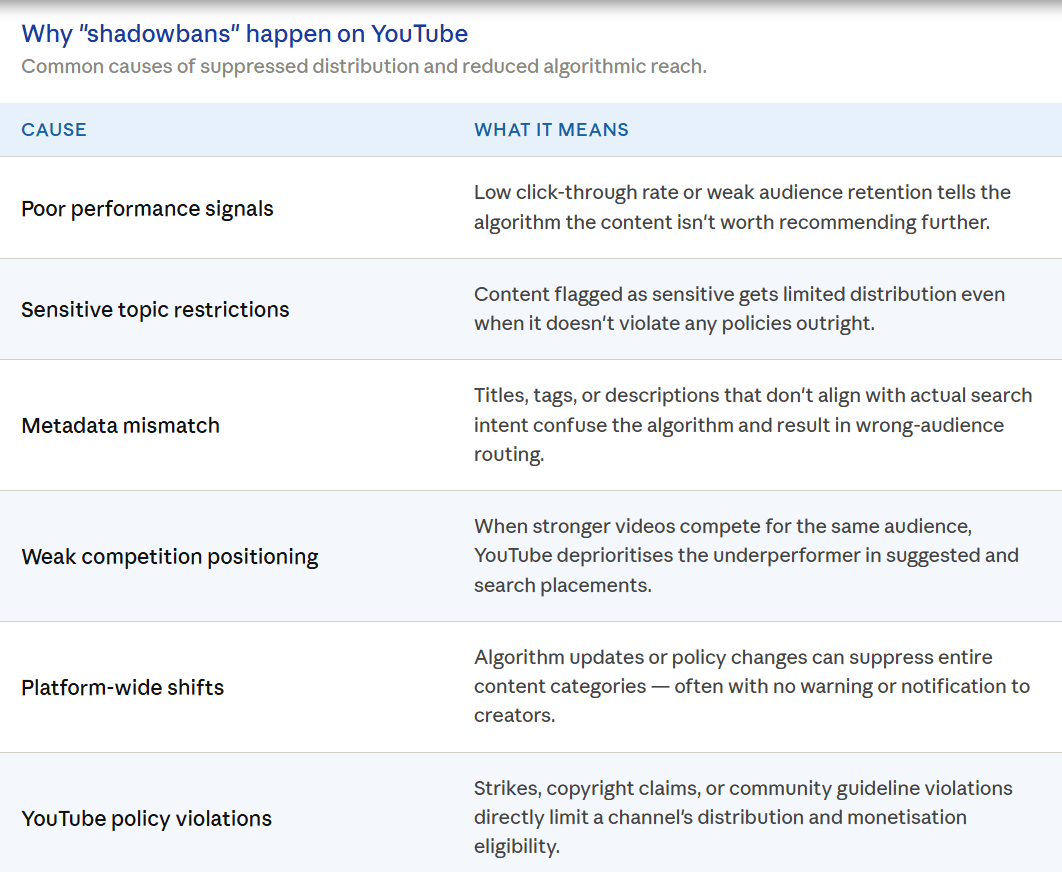
“Shadowbanned” sounds better than “our new thumbnail style is weaker on Home.” We hear you loud and clear: “How does a weak thumbnail influence traffic drops”?
Let’s see, one of our partners, a massive Arabic kids’ channel with over 7M subscribers, reported a sudden traffic drop that happened for seemingly no reason. Recommendations dropped by more than 91%.
![A YouTube Analytics screenshot of our partner’s video info CTR breakdown.]](/storage/8fnSNrAuYLdRyHSQqTmWgglCXL7f8zFgLSIeJt3u.jpg)
So, we looked under the hood and, as a certified YouTube partner, asked YouTube itself. And when moderators haven’t found anything out of the ordinary, we went in with surgical precision and found the dreaded thumbnail issue: the system flagged our partner’s thumbnails as low quality. Hence, all the newer videos were pushed down in recommendations. Almost every video used clickbait-style imagery: open mouths, exaggerated pouting, and facial distortions.
We replaced all problematic thumbnails, and the revenue alone surged x6.6.
That’s how a simple change can turn around the traffic drop into a traffic surge. But YouTube’s own examples make another good point. A CTR drop can be a sign of failure or a sign of success. In its CTR guidance, YouTube shows a case where CTR falls from 9% to 3.5% while impressions grow tenfold. In that example, the lower CTR is not a red flag. It is simply what happens when the video expands beyond your core audience to less familiar viewers.
Need help restoring your YouTube traffic?
We’ll help you identify the issue, protect performance, and get your viewers back on track. Tell us where your drop started, and we'll show how to fix it.
Why AI-Heavy Channels Are Losing Traffic in 2026
There's one more reason your traffic can fall off a cliff. It has a lot to do with how YouTube classifies your content in the first place.
Since mid-2025, YouTube has been running a systematic cleanup of AI-generated content farms. The January 2026 wave was the biggest: channels earning tens of millions of views vanished overnight. YouTube's detection got significantly more precise.
But the most bothersome thing is that you don't have to be a farm to get caught in the filter.
YouTube now reads AI content on three levels. First, metadata embedded by tools like Sora or Runway that flags the video's origin automatically. Second, audio and video signals, robotic rhythm, unnatural pacing, and voices that no human naturally produces (that’s all regarding deepfakes). Third, and this is the one most creators miss: channel behavior. Posting at machine-like frequency. Never engaging. Zero variation in upload patterns. That's what a bot looks like, and that's what gets flagged.
The content types that trigger it consistently:
- Static AI image slideshows over music with an AI voiceover
- Template clones: same structure, different title or character name
- Mass uploads with no variation in pacing, format, or style
- Faceless compilations with no commentary, no presence, no point
- Text scrolling over music, no voice, no human signal at all
If any of those describe videos sitting in your back catalog right now, that's where to start looking. Not at your newest uploads. At the ones that might be sending the wrong signal about what kind of channel you are.
The fix is not to abandon AI tools. YouTube's own auto-dubbing feature is AI, along with the Inspiration tab and lots of other YouTube AI tools. Half the editing tools in professional workflows are AI. The line is between AI as a tool and AI as the entire operation.
If you type into an AI tool "generate me a script, audio, and video on TOP facts about the Eiffel Tower," that content will not pass the filters. But if you use those same tools to help you create a video about your own experience visiting the Eiffel Tower? Completely different story.
The first is fine. The second is what the system was built to catch.
How Old Videos Can Drag Down Your Entire Channel
Your newest videos can gain traction and attention, but the traffic drops happen nonetheless. Why’s that? Because your older inventory often creates the drag. When you’ve been on YouTube for years, you’ve then lived through lots of algorithm shifts and changes. And those old videos that were okay back in 2018 aren’t okay now.
They need to be reviewed, reuploaded, their metadata optimized, and adjudged to the modern viewer. That is why traffic recovery should always include a back-catalog audit.
Start with:
- your top-viewed older videos
- videos with abrupt performance changes
- videos with old clickbait packaging
- videos that attracted copyright or Content ID issues
- videos that sit in sensitive or borderline topics
- videos whose captions or descriptions now look sloppy or misleading
When a channel’s current uploads are decent, but traffic still feels sticky and unreliable, the older library is often where the real story might be hiding.
YouTube’s own creator blog still recommends a practical move that too many creators ignore: refresh packaging on videos that have already been public for weeks or months. That matters because traffic recovery does not always need new content first. Sometimes it needs old content to become legible again.
Like in the case of our partner, a Spanish-speaking kids’ content channel, which had seen a massive traffic drop for seemingly no reason.
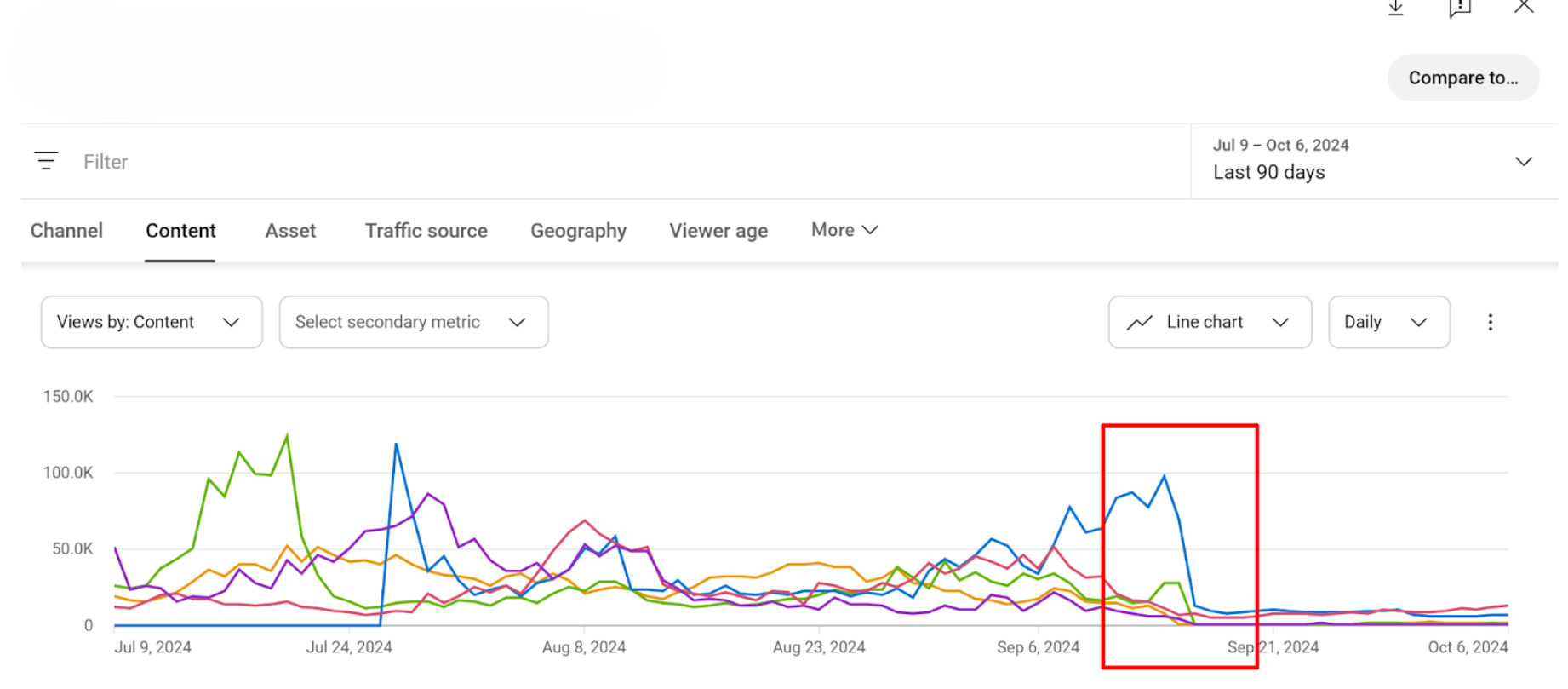
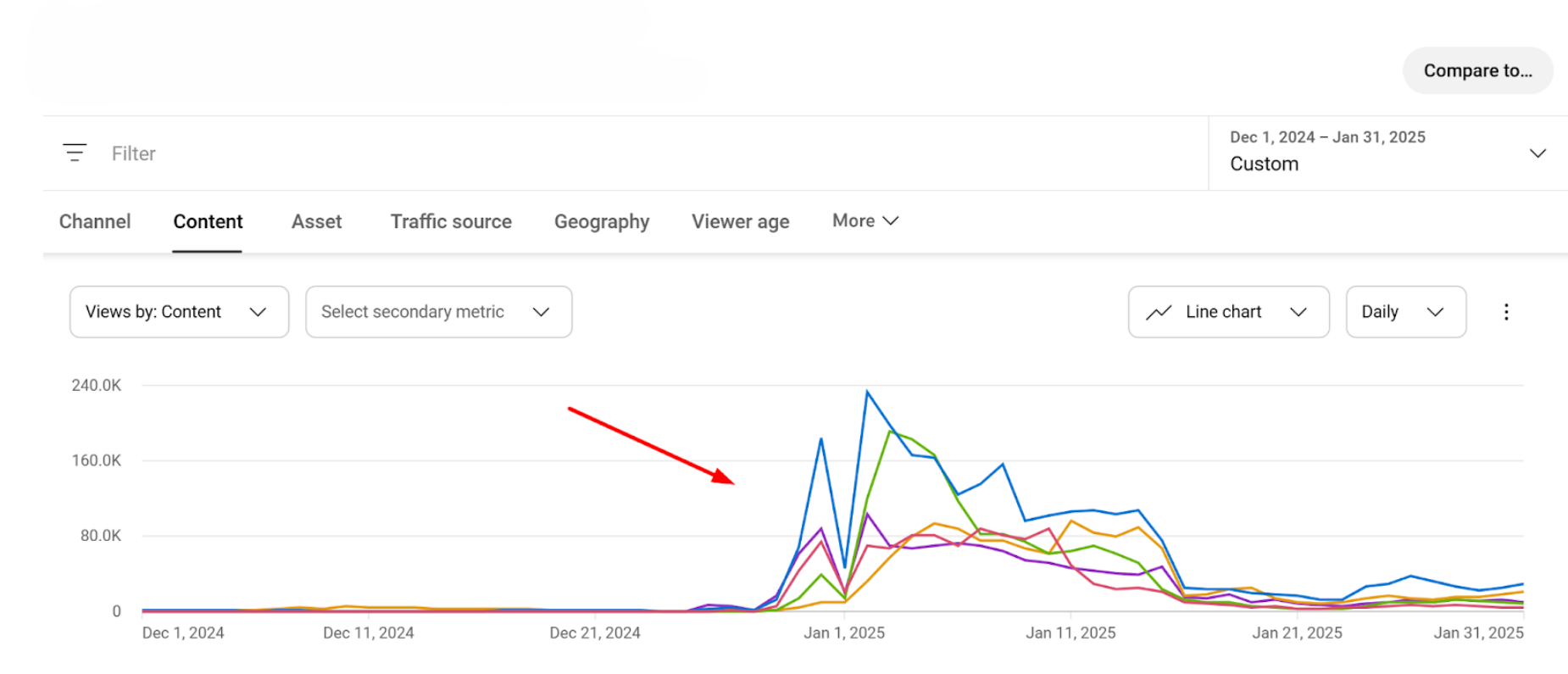
We contacted YouTube’s moderation team to get to the bottom of this issue, and quickly located the issue: older videos weren’t up to date with the optimization. Metadata on those videos was dragging the whole channel down with it. So, we’ve reviewed it, and we updated it. And these were the results of our work.
Sensitive Topics and How They Can Lead to Traffic Drops
On YouTube, not violating policy and being widely recommended aren’t the same. A video can stay public and still lose momentum because YouTube treats sensitive subjects with extra caution in both recommendations and monetization. On the recommendation side, YouTube says it reduces borderline content and raises more authoritative information around breaking news and sensitive subjects.
On the monetization side, YouTube’s advertiser-friendly guidelines say content that profits from or exploits a sensitive event may get no ad revenue, and even using sensitive-event keywords just to drive traffic is a problem.
Sensitive doesn’t mean forbidden.
YouTube does not ban every video that touches a tragedy, controversial issue, political flashpoint, public-health scare, or violent real-world event. In its advertiser-friendly guidelines, YouTube says some content about sensitive events can still earn ad revenue when it is clearly news reporting, documentary, or discussion with discernible user benefit.
That sounds reassuring, and it should. But it also creates the exact trap experienced creators fall into. They hear “context matters,” assume their commentary is obviously legitimate, and then package the video like a high-adrenaline entertainment upload, which is where the trouble usually starts.
YouTube stated, on its blog page, that the videos classified as borderline are demoted in recommendations. Why?
It gives examples of the kinds of content that trigger this treatment: inaccurate, misleading, deceptive, insensitive, intolerant, harmful, or potentially harmful material.
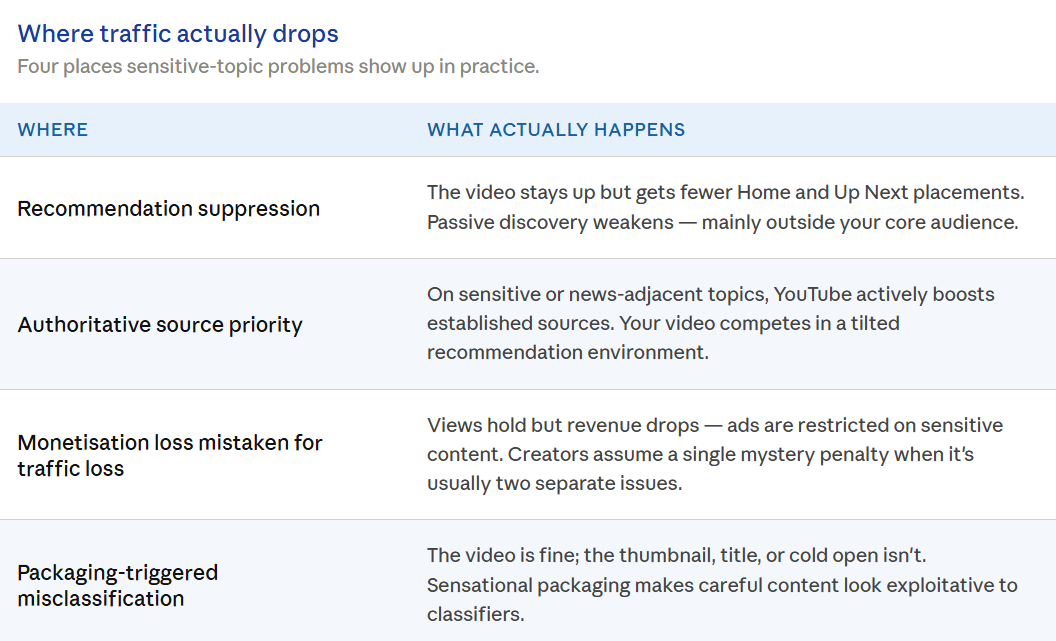
But the fix isn’t to “stop covering hard topics forever.” For example, our partner, a channel with over 2M subscribers that covered the full-scale invasion of Ukraine, UNITED24, had worked with us since the start to safeguard their channel from potential moderation issues. A channel like that is always under the microscope in the eyes of the algorithm, because of its heavy topics.
To keep the channel stable and performing, we focused on three key areas: content certification, policy compliance, and monetization stability. YouTube’s rules shift frequently, and what’s acceptable today might not be tomorrow. We built a structured compliance process: tracking policy updates, adjusting content strategies, and refining metadata to meet changing standards. This helped avoid strikes, minimize content restrictions, and keep the channel running without interruptions.
When YouTube Glitches Are the Cause of Traffic Drops
Sometimes, the answer is far more trivial than we would like it to be: glitches. Yup, that simple and that annoying. One of our partners, Vania Mania Lima Anak, experienced that firsthand. At a glance, their content was in full compliance with the community guidelines. But still, one day, their videos experienced a massive drop in traffic.
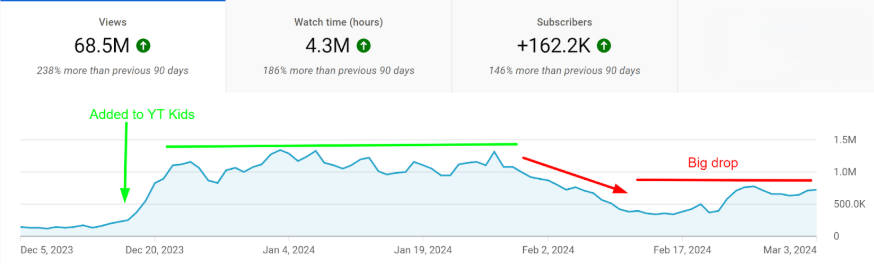
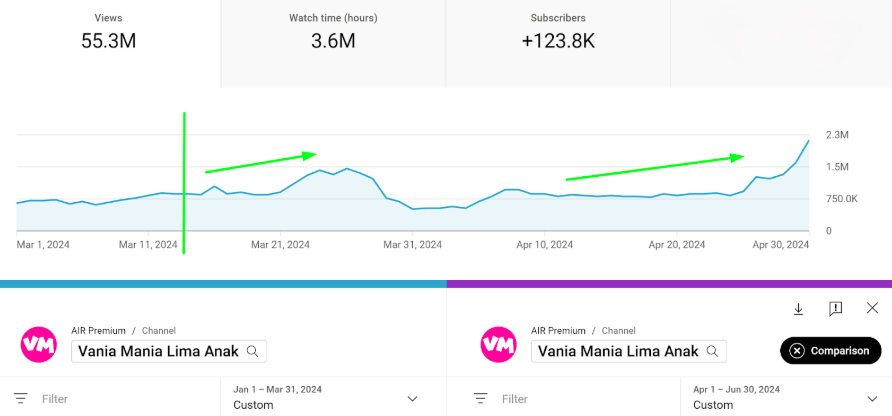
We took a closer look and escalated the case directly to YouTube. Still, no errors or clear violations, but the drop was still there, clear as day. Regardless, within a week of pushing for a review, traffic started to recover. A month later, the numbers were even better than before.
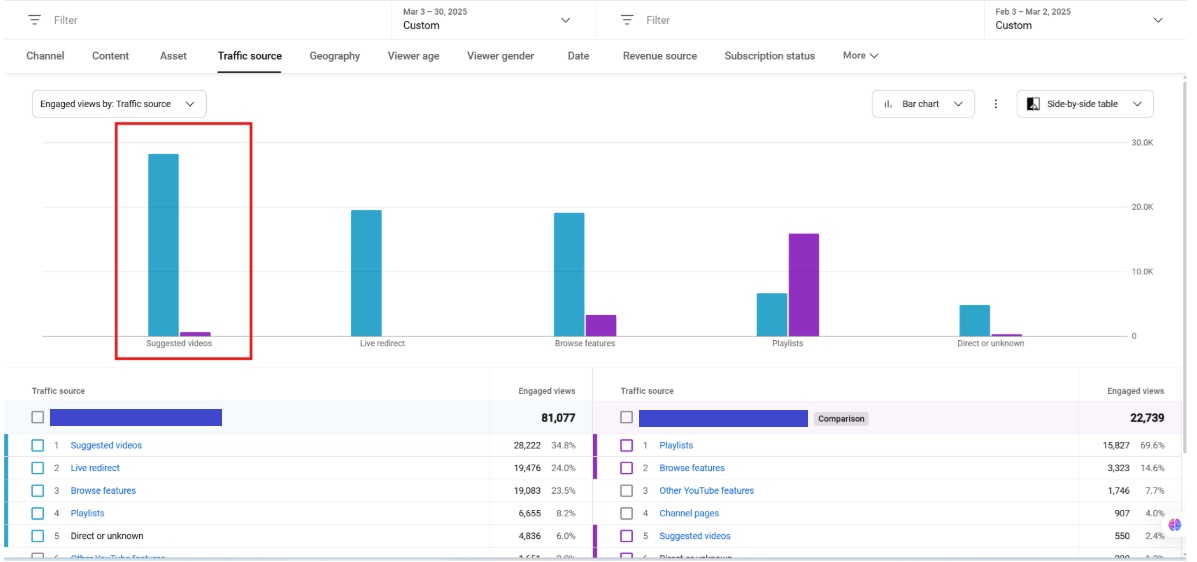
That, as expected, isn’t the only case of glitches stunting growth. Our other partner, a localized kids’ Spanish channel, saw several unexplained dips in both viewership and CTR. Even after we restored the monetization, the views still weren’t bouncing back up.
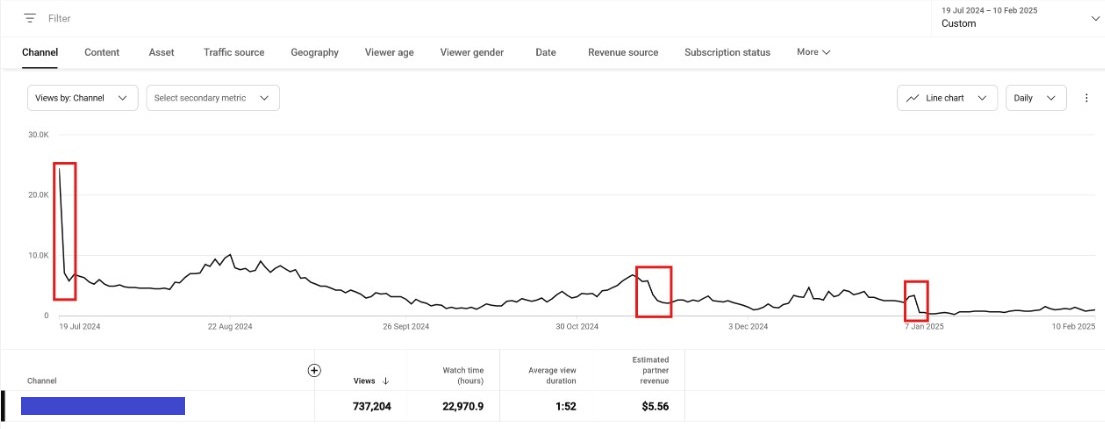
When we escalated things to YouTube, we learned that the channel was falsely hit by the change in their recommendation system. Once that flag was lifted, the results were immediate.
In less than 30 days:
- Views: From 22,739 → 81,077 (+3.6× increase)
- Watch Time: From 1,388 hours → 43,178 hours (+31× increase)
- Recommendations: From 550 → 28,222 (+51× increase)
- Revenue: +7.5× growth
The problems don’t stem from the mysterious ‘shadowban’, most of the time. The problems are very much solvable. That traffic drop might be sitting in one traffic source, one wrong opening minute, old metadata, or the things that the creators don’t even think about checking.
There is good news here, too.
Because if the problem is invisible to the creator’s eye, our trained insight and experience with over 3,000 channels have taught us where to look for those problems. And once we find them, we can fix them.
Not sure what is actually suppressing your views? Request a traffic audit, and we’ll tell you where we’d look first.