


TikTok pays more per view (typically $0.40 to $2.00 per 1,000 qualified views, compared to $0.01 to $0.33 for YouTube Shorts), but its eligibility bar of 10,000 followers, 100,000 views in the last 30 days, and only videos over one minute locks out most channels that haven’t first built an audience elsewhere. The more complicated answer is that YouTube Shorts and TikTok’s Creator Rewards Program pay through completely different models (a shared ad pool vs a per-video rate).
YouTube Shorts opens at 1,000 subscribers and 10 million Shorts views in 90 days for full ad revenue, or 500 subscribers for a lower fan-funding tier in 2026. Across 3,000+ AIR partner channels, the bigger earner is the long-form and Shop revenue that Shorts and TikTok traffic feed into. In this article, you’ll get the real RPM ranges for both platforms, the exact eligibility requirements for TikTok Creator Rewards, and a country-by-country Shorts RPM breakdown.
How Does YouTube Shorts Monetization Work in 2026?
YouTube pays Shorts through a pooled ad-revenue model, which is a mechanical difference from TikTok that explains almost everything else about why Shorts RPM looks the way it does.
Ad revenue from the Shorts feed gets collected, a cut goes to music licensing, and what's left is split across eligible creators based on their share of total Shorts watch time that month. A video's earnings aren't tied to its own ad performance the way a long-form video's are; they're tied to how big a slice of the whole pool a creator's Shorts collectively pulled in. How Shorts pay next to long-form and livestreams over a full year is in our YouTube earnings statistics for 2026.
Two tiers control access:
|
Tier |
Requirements |
What it unlocks |
|
Full ad revenue |
1,000 subscribers + 10 million valid Shorts views in 90 days (or 4,000 watch hours) |
Shorts ad revenue share, full YouTube Partner Program |
|
Fan funding only |
500 subscribers + 3 million Shorts views in 90 days (or 3,000 watch hours) |
Channel memberships, Super Thanks, Super Chat, Shopping — no ad revenue share |
These numbers go up on February 1, 2027. New channels on the Shorts route will need 20 million Shorts views in 90 days, and partners will need 10 million every 90 days to keep getting paid from the Shorts pool. Here's what changes for Shorts creators in 2027.
Country RPM and niche RPM measure two different things, and conflating them is where most Shorts-monetization comparisons go wrong. Country RPM reflects advertiser demand for a given audience's location. US, UK, and Australian viewers carry higher ad rates simply because more advertisers bid for them.
Niche RPM reflects what category of content an ad is running against, independent of geography. Here's the country breakdown from AIR's partner data:
|
Country |
Shorts RPM per 1,000 views |
|
United States |
$0.328 |
|
Switzerland |
$0.205 |
|
Australia |
$0.193 |
|
South Korea |
$0.185 |
|
United Kingdom |
$0.166 |
|
Canada |
$0.165 |
|
Germany |
$0.163 |
Big-view markets skew the other way: India at $0.008, Indonesia at $0.012, Brazil at $0.045. 1 million Shorts views from a US-heavy audience generate approximately $300 in direct revenue. 1 million Shorts views from a mixed global audience typically generate $150–$250. This is why direct Shorts monetization cannot substitute for long-form revenue.
In our research about RPM on YouTube Shorts by niche, most niches cluster in the $0.02–$0.20 range; Crafting sits at $0.11, Kids & Teens as low as $0.02–$0.05.
Music niche happens to be an outlier when it comes to their RPM. Small Music channels post Shorts RPM of $1.48, and medium Music channels hit $0.97. Why does that happen? All this is the result of Content ID. When a Short uses copyrighted music, the rights holder receives a cut of the ad revenue through YouTube’s Content ID system, on top of the standard pooled payout. Which is why a Music channel that owns its rights (or has a distributor arrangement) collects that extra layer on every Short that uses the track, and viral Shorts can generate real Content ID income that no other niche has access to.
Practically, this means a Music channel's Shorts RPM can already sit inside TikTok's $0.40–$2.00 range, which is why we say that the "TikTok pays more" conclusion doesn't hold uniformly once niche is accounted for.
Googling YouTube-related questions from time to time?
200+ AIR specialists check 3,000+ channels and every platform update daily. Add AIR to preferred sources, and Google surfaces our precise answer first. → Add AIR to preferred sources.
But if YouTube Shorts have such a low overall revenue, why even bother with them?
Direct RPM comparisons undersell what Shorts does for a channel, because Shorts revenue was never really the point. Across AIR's dataset, Shorts function as a discovery layer that feeds the much higher-RPM long-form catalog, and the two cases below show that mechanism at two different scales.
WOA Song Spanish Case illustrates the “why”. What they did was increase their YouTube Shorts frequency by 287.5% after thorough cleanup of their channel, and the results went ballistic:
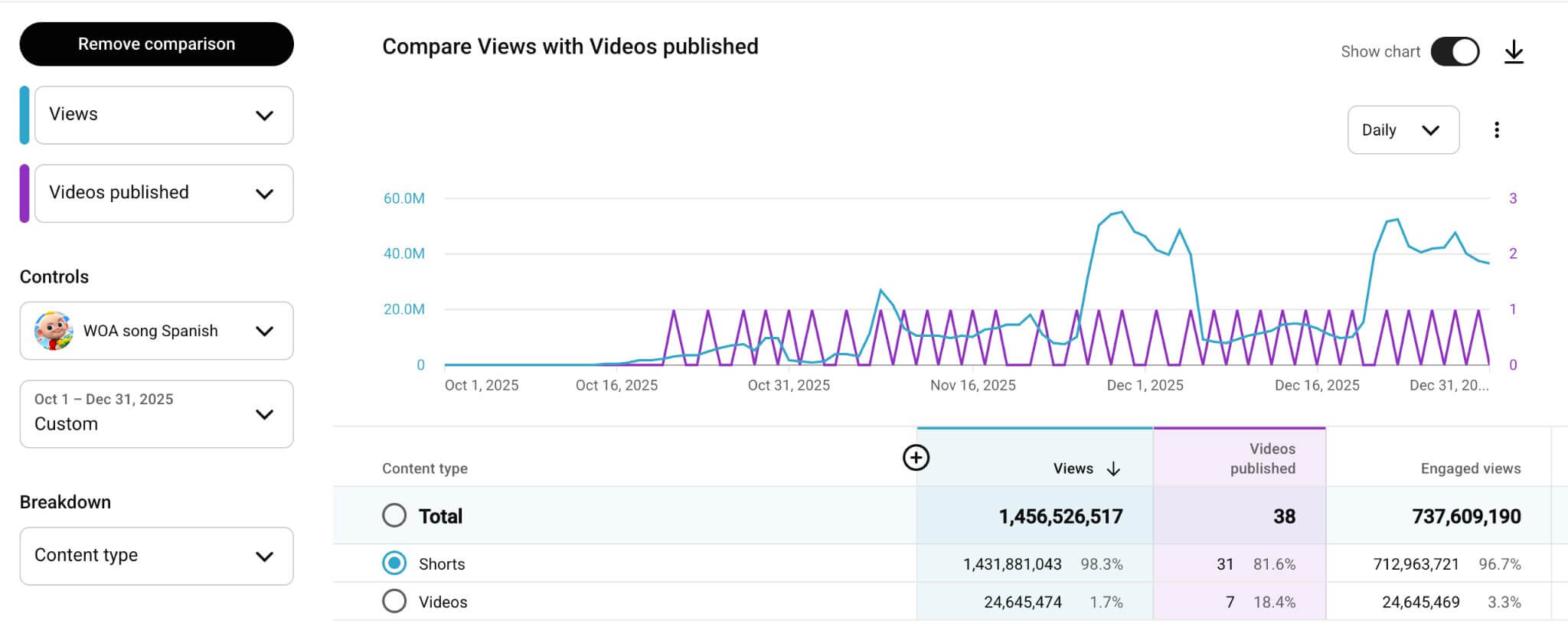
While they were rebuilding their long-form content strategy, Shorts took over the reach and attracted a new Spanish-speaking audience to their older content. And despite being only ~82% of uploads, they drove over 98% of all views. Regular long-form generated ~24.6M views vs. Shorts' ~1.43B. That’s a huge difference and a huge jump in awareness for the brand.
That alone caused their revenue to jump an astounding +345.3%.
Yes, direct Shorts revenue is under 2% of total channel revenue, even at high posting volume. But Shorts also do more than pay by the view: Shopping product stickers, live globally since June 2025, let viewers tap straight through to a product from inside the Short, and YouTube’s own testing found a 40% jump in product clicks over the older shopping-button format.
Still not sure what to do?
Get in touch with us. We'll analyze your channel with 21 AI-diagnostic tools against our 450,000-channel dataset to find what will work for your channel, including the Shorts question and what results you can expect from them. → Get the answers.
How Does TikTok's Creator Rewards Program Work in 2026?
Meanwhile, TikTok pays per video, closer to how long-form YouTube ad revenue works. What do you need to qualify for TikTok Rewards?
- 10,000 followers
- 100,000 video views in the last 30 days
- to be 18 or older
- have original videos over one minute, and each needs at least 1,000 FYP (For You Page) views
- residence in an eligible country (the US, UK, Germany, France, Japan, South Korea, Mexico, Brazil, and a handful of others)
RPM lands between $0.40 and $2.00 per 1,000 qualified views, but that range is driven by four factors TikTok weighs per video:
- originality (reposts and heavily templated content sit at the floor)
- watch-time depth (full completions and rewatches push the rate up)
- engagement (comments and shares specifically)
- whether the video answers something people are actively searching for on TikTok
Creator Rewards was built in part to reward content with search value inside the app. That last factor is why finance, business, and education content tends to land at the top of the range. Reposts, Duets, and template-driven trend content sit at the bottom, often closer to $0.40 than $2.00, even with high view counts.
Beyond Rewards, TikTok gives qualifying creators three more paths:
- TikTok Series: bundle up to 80 videos behind a paywall, priced by the creator. Requires 10,000 followers (or proof of premium content sold elsewhere), an account at least 30 days old, and 1,000+ views in the last month.
- LIVE gifts: unlock at 1,000 followers; viewers send virtual gifts that convert to cash.
- TikTok Shop affiliates: no follower minimum for basic affiliate links; commissions run 5–20% depending on category.
Does One Platform Pay More?
Yes, essentially TikTok wins on RPM for most creators, because outside of Music, YouTube Shorts RPM tops out around $0.20–$0.33 even in the highest-paying countries and niches, well under TikTok's $0.40 floor.
The gap disappears inside the Music niche, because a rights-owning Music channel’s Shorts RPM can match or exceed TikTok’s low end.
YouTube Shorts’ bar is much more accessible than TikTok’s, so if you’re pursuing both platforms at the same time, YouTube pays you sooner, but TikTok pays you more. Another important detail you need to consider is the possibility of creating long-form content, which TikTok doesn’t have. There, you can make videos for up to 10 minutes if you’re eligible.
So, the potential of earning on YouTube is higher. But picking one platform over another is closing yourself off from all the possibilities. Why choose one if you can make content for both for double the income?
Why are other channels outgrowing you?
It's not luck. There's a specific reason — and our specialists who've audited 3,000+ channels will find it in yours.
Show me what to fixWhere Should Creators Bet in 2026?
- Building an audience from zero. Start with YouTube Shorts. The 500-subscriber entry tier is reachable almost immediately, and every view feeds long-form discovery even before ad revenue kicks in.
- Already past 10,000 followers with a narrative or tutorial format. TikTok's Creator Rewards is worth the 60-second minimum: the RPM ceiling is meaningfully higher, especially in finance, business, and education niches.
- Selling products or affiliate links. Run both. Shopping stickers on Shorts and TikTok Shop affiliates are separate revenue lines that don't compete with each other.
- Global or multilingual channels. Test localized Shorts by region and compare RPM. High-view countries like Brazil and India can outperform high-RPM countries like the US purely on volume, and TikTok's regional availability is still expanding in the EU and LATAM.
Can Shorts or TikTok Help Your Channel?
Maybe. But maybe something more important is missing.
We audit channels across 10 pillars: packaging, retention, traffic, niche, portfolio, revenue, audience, forecast, risks, and roadmap, and hand you a fix for all of them.
What you get:
- A structured report covering all 10 pillars of channel performance
- A 30-day action plan ranked by impact
- A 45–60-minute live walkthrough with your strategist