There is no shortage of podcast growth advice. Most of it is the same recycled loop: hooks, hacks, posting cadence, "build your community," "10x your downloads." Useful in small doses. Hollow as a strategy.
After six+ years of building channels, I've learned that the things that actually create a durable show are rarely the things people post about. They're less sexy. They don't make good thumbnails. But they're the difference between a podcast that compounds and one that quietly fades after episode 40.
So here are three truths most creators won't say out loud — and, more importantly, what to do about each one this month.
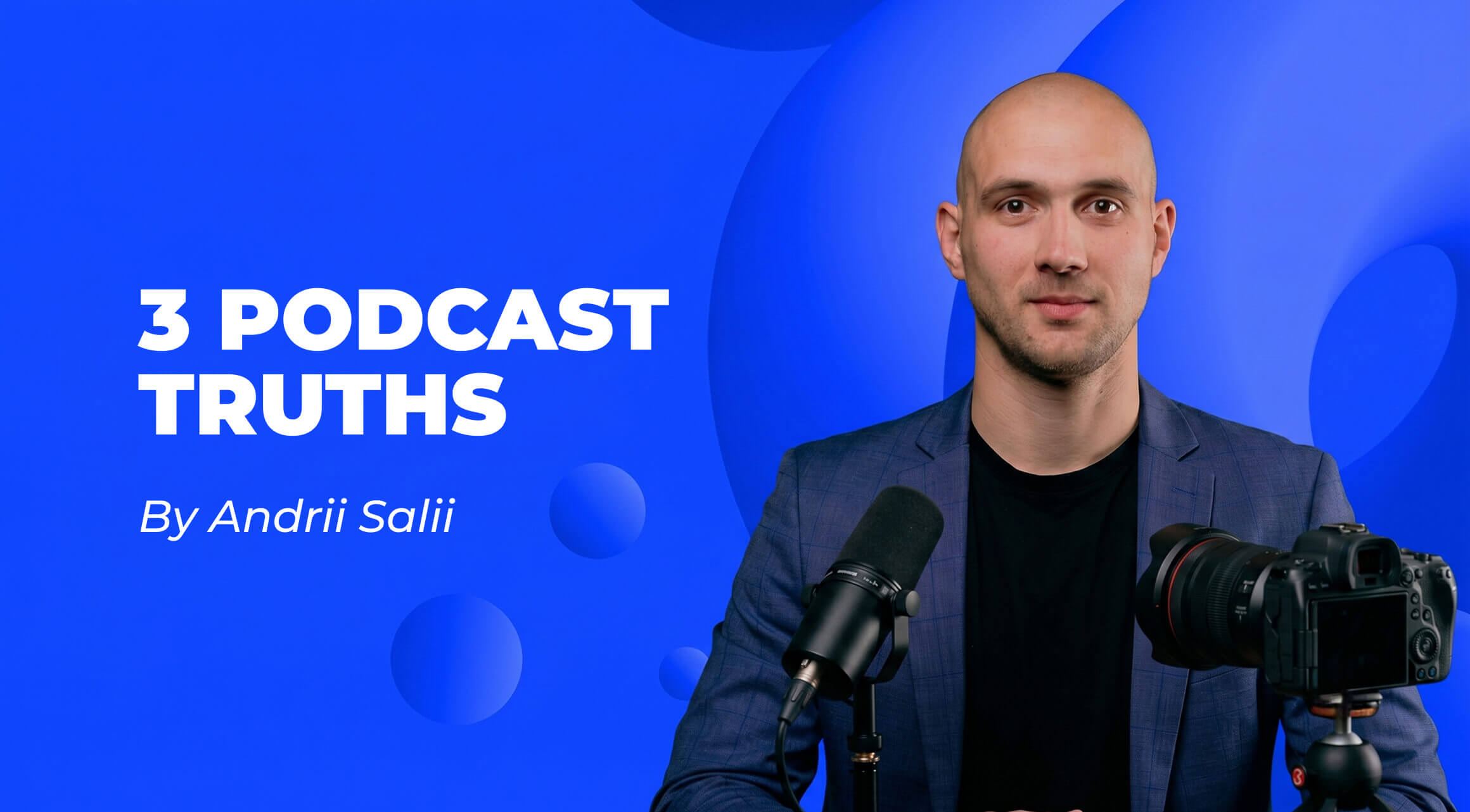
Contributed by Andrii Salii
Andrii is a YouTube & media strategist.
He has spent 6+ years building and advising 70+ channels across fintech, personal finance, green energy, and the creator economy, and currently works as a CTO and strategist for a finance-focused YouTube business. Based in Warsaw, he mentors creators and consultants on organic-first, value-led growth — and is allergic to vanity metrics. Find him on LinkedIn.
Truth #1: Offline Is Wildly Underrated
Your download dashboard can't answer the only question that really matters: Does this actually matter to real people?
A number can't. A face can.
The moment a listener shows up somewhere in person — an event, a meetup, a small live recording — something changes on both sides. You stop being a voice in their earbuds and become a person they've met. And you get the one signal no analytics tool will ever give you: proof that what you make matters enough for someone to leave the house for it.
Here's where I learned that the hard way:
I once helped a personal-finance channel run a paid in-person meetup — paid on purpose, so the room would be people serious enough to invest in being there. On paper, this was a channel for a middle-to-senior audience in knowledge about investments, and I walked in expecting questions about portfolio allocation, hedging, and tax optimization.
Instead, conversation after conversation circled back to the same place:
People didn't need another breakdown of a company's P/E ratio. They needed help with discipline — with the fear left over from a past loss, with not getting pulled off-course by every shiny offer, with simply knowing where to start. Roughly four out of five people in that room were quietly stuck on the basics. The dashboard had never hinted at it; watch-time looked healthy, and the advanced videos performed "fine."
It took listening in that room to hear what the analytics couldn't say — that the deep material we were proudest of truly served maybe one percent of the audience, while everyone else was asking, year after year, for the simple, repeatable practices they could actually apply on Monday morning.
That single afternoon reshaped the channel's content strategy more than a year of analytics ever did.
How to put this to work:
- Host one small in-person thing per quarter. It does not need to be a conference. A 15-person meetup in a café, a live recording with a Q&A, a listener dinner — small and real beats big and staged.
- Treat the room as research, not a vanity event. Who showed up? What did they quote back to you? What did they say they skipped? That feedback is worth more than a month of comments.
- Record it. A live episode or behind-the-scenes cut is some of the most authentic content you'll ever publish — and it converts new listeners better than anything polished, because they can feel the realness.
This is the part of the playbook no tool replaces. Keep it human, keep it small, and let it tell you the truth.
Truth #2: Not Every Podcast Needs to Become an "Ecosystem"
"Community" gets thrown around as if it's the goal every show should be chasing. Build the Discord. Launch the membership. Spin up the newsletter, the merch, the paid tier, the app.
But your listeners already have full lives. They're parents, employees, business owners, members of a dozen other groups. Sometimes they just want to listen to you — without being recruited into yet another server they'll mute in a week.
Narrow focus and genuine consistency almost always beat a sprawling ecosystem nobody asked for.
Here's the part creators rarely admit: most sprawl isn't strategy — it's avoidance. It's easier to design a membership tier than to make episode 88 as good as episode 8. And a huge driver of that sprawl is the sheer operational load of running a modern show: monetization, channel safety, getting paid across borders, reaching new audiences. When you're drowning in all of that, building "more stuff" feels like progress.
I watched this play out the expensive way:
I once spent a year and a half on a channel built around a single idea: national identity — the culture, the cities, the economy, the things that make people a nation. After the full-scale invasion of Ukraine in 2022, it started covering the war as another content pillar.
Then it added a third strand: long-form interviews with the writers, scientists, and public figures shaping the national conversation. Three genuinely different promises, all stacked on one channel.
At the level of mission, one North Star connected them — all about the national idea. But at the level of execution, it was chaos, and the audience felt it: people who came for one thing kept being handed two others.
So we made the hard call and split it into three focused channels — one for identity and culture, one purely for the interviews, and one for the war and its documentaries.
Here's the part that matters for this truth:
Only after each channel had narrowed did the community arrive on its own. Within months, each one launched its own Membership, and it worked, not because anyone begged, but because once the focus was sharp, supporting the work became an obvious choice for the people who valued it.
For an organization running on a non-profit footing and forever hunting for production funding, that became a real, recurring income line. The ecosystem didn't build the audience. Focus did, and the ecosystem followed.
That's the sequence almost nobody follows: get narrow first, and let the community be the consequence, not the plan.
How to put this to work:
- Write your show's one-sentence promise and tape it above your desk. If a new initiative doesn't serve that promise, it's a distraction wearing a strategy costume.
- Earn the ecosystem; don't assume it. Don't build the membership until listeners are already asking how to support you. Demand first, infrastructure second.
- Stop building the operational layer yourself. This is the unglamorous truth: you don't need to own an ecosystem, you need to plug into one. If you publish a video podcast on YouTube, a creator platform like AIR exists precisely so you don't have to assemble monetization, channel safety, cross-border payments, and audience tools yourself. Offloading that back-end is what lets you stay narrow and consistent on the one thing only you can do: the show.
The goal isn't to do more. It's to protect your focus so the work that matters stays excellent.
Truth #3: A Consultant (or a Platform) Is Not a Magic Wand
A good producer, creative director, or growth partner is genuinely valuable. They bring shortcuts — patterns they've seen work, mistakes they've watched others make, context they can read fast because they've been exactly where you are. A strong outside audit can spot in twenty minutes what you've been staring at for a year.
What they cannot do is guarantee results or take responsibility for the execution. That still sits entirely on your side. You still press record. You still ship on the weeks you don't feel like it.
The best partnerships — with a person or a platform — start the moment both sides understand that.
How to put this to work:
- Hire for patterns, not promises. If someone guarantees you a subscriber count, walk away. If they can tell you why your retention dips at the 40% mark and what usually fixes it, lean in.
- Use outside eyes for diagnosis, then own the cure. This is the honest way to use a platform's expert services, too. Expert Channel Audit and Creator Success Experts can show you where you're leaking retention or leaving monetization on the table — but the discipline to act on it is yours. That division of labor is the relationship working correctly, not failing.
- One more underused lever while we're here: your back catalog is an asset you've already paid for. Dubbing, subtitles, and multi-language audio can multiply the reach of episodes you've already made — often the highest-leverage growth move a podcaster can make, and one that doesn't require you to create a single new thing.
A partner gives you the map. You still have to walk it. Creators who internalize that get far more out of every expert, tool, and platform they touch.
The Thread That Ties These Together
A sustainable media business isn't built on growth hacks. It's built on three quieter things: real connection (truth #1), ruthless focus (truth #2), and honest partnerships (truth #3).
Show up for real people. Refuse to confuse motion with progress. And work with experts and platforms the way they're meant to be used — for leverage, not for rescue.
Do that consistently, and you won't need to chase the algorithm. You'll have something far more durable: a show that actually matters to the people who hear it.
Your YouTube Podcast Checklist
Truth 1 — make it real
- Book one small in-person thing this quarter (15-person meetup is plenty)
- Treat the room as research: note what listeners quote back and what they skip
- Record the event — turn it into your most authentic episode
Truth 2 — Protect your focus
- Write your show's one-sentence promise and tape it above your desk
- Don't build a membership/Discord until listeners ask how to support you
- Offload the operational layer (monetization, safety, payments) to a platform
Truth 3 — Use partners for leverage
- Hire for patterns, not promises — walk away from guaranteed-numbers pitches
- Get an outside audit for diagnosis, then own the execution yourself
- Multiply your back catalog with dubbing/subtitles before making new content
If the operational side of your show is eating up the time you should be spending on the work itself, AIR Media-Tech is the company I point serious podcasters and video creators toward. It handles monetization, safety, payments, and global reach so you can stay focused on the episodes. If you want to start by simply seeing where your channel stands, their expert channel audit is a low-commitment first step.