


A Short goes viral when it holds attention past the first three seconds, keeps a stay-to-watch rate above 70%, and is packaged so the algorithm can confidently match it to an audience. None of that grows a channel on its own. Across 18,000 channels tracked for a full year, the ones that grew fastest kept Shorts to 25–40% of total uploads and used every one of them to route traffic into long-form, where the revenue lives. Shorts RPM runs 3–14% of long-form RPM in almost every niche according to AIR data.
What Makes YouTube Shorts Work in 2026?
This table covers more than virality. There are 16 hacks you can use to make sure Shorts lift your overall channel performance.
|
Lever |
What moves it |
Data point |
|
Long-form funnel |
Pin the related video, cut teasers on purpose |
Revenue can grow 2–6x faster than views |
|
Hook (0–3s) |
Delay the payoff, don't resolve the premise early |
Completion is the top ranking signal |
|
Retention |
Stay-to-watch above 70%, AVD at or above length |
Loop editing pushes AVD past 100% |
|
Title |
30–50 characters, curiosity language |
Under 30 wins in Gaming, Entertainment, Food |
|
Question hooks |
Open with a question that challenges a belief or sounds unusual |
Works across any content type |
|
Captions |
On-screen text, a few words at a time |
Keeps pacing fast, keeps people watching |
|
Cover frame |
Choose it yourself or recreate from viral hits. Do not copy |
Same CTR mechanism as long-form thumbnails |
|
Topic choice |
Views per hour, not total views |
A velocity metric beats a vanity metric |
|
Metadata |
Keyword once in title, twice in description |
Weak metadata gets misclassified |
|
Metadata translation |
Multilingual titles and descriptions |
Real cases show 40%+ revenue lift |
|
Posting rhythm |
Consistency over volume |
Over-posting costs up to 55% of subscribers |
|
Trending music |
Remix a trending sound, or pull from the Audio Library |
Mirrors the TikTok discovery mechanic on YouTube |
|
Shareability |
Pass the informative/entertaining/inspiring test |
Missing all three is usually why a good edit doesn't travel |
|
AI structure |
Borrow structure, not content; disclose realistic AI |
Undisclosed AI gets auto-labeled since May 2026 |
|
Shorts ratio |
25–40% of total uploads |
Above 55%, long-form audiences thin out |
|
Channel setup |
Keywords and feature eligibility on |
Controls algorithmic trust, not just views |
|
TV placement |
Design for a blurred, remote-controlled screen |
TV is YouTube's fastest-growing surface |
Everything below unpacks each row — with the numbers, the mechanism, and real cases from channels our managers have worked with.
Can YouTube Shorts help you?
Maybe not. Show us your channel — we'll tell you what will work for yours, like we did for 3,000+ creators.
Request the channel auditWhat Are the Best YouTube Shorts Hacks for 2026?
These 16 are ranked by what our managers see move the needle first when a channel is stuck, not by what's easiest to explain.
1. Turn Every Short Into a Doorway to Your Long-Form Videos
Shorts RPM sits at $0.07 to $0.20 per 1,000 views in most niches — a fraction of what long-form pays. Treating a Short as a revenue product on its own is the fastest way to waste it. Treat it as a doorway instead, and the numbers change completely.
Do this:
- Pin the long-form video to the Short using the Related Video feature in the YouTube Studio: Content → Short → Related Video → Add.
- Cut Shorts from existing long-form footage on purpose, using the sharpest 30–60 seconds as a teaser rather than a random clip. We have a selection of tools for picking the best moment for Shorts for you.
- Say the next step out loud once — a single spoken line costs nothing and gives the viewer a reason to click through
One of our channels at 5.68M subscribers grew its Shorts share from 6.2% to 15.7% of total traffic in one quarter, and Suggested traffic — YouTube actively routing viewers to other videos on the channel — grew 84%, from 14.65M to 26.90M. Revenue grew 153% while views grew 76%, because the audience Shorts pulled in was better matched, not just bigger.
And one more case was a clay-sculpting channel that added Shorts after months of hesitation over this exact concern — format mismatch, low RPM, fear of pulling attention from what paid. Thirty days later, views were up 41.8%, and revenue was up 64.1%, almost none of it from Shorts RPM directly.
|
Niche |
Shorts views needed to match 1,000 long-form views |
|
Music (rights holders, via Content ID) |
~1,100 |
|
Kids & Teens (large channels) |
~2,156 |
|
Crafting & Handmade |
~34,000 |
|
Most other niches |
11,000–26,000 |
Source: AIR Media-Tech, YouTube Analytics API data across 274 channels and 13 niches, full-year medians verified July 2026.
2. Delay the Payoff So the First Three Seconds Work
Our managers flag the same mistake on nearly every audit: a creator sets up an interesting premise, then resolves it five seconds in, and the Short dies right there because there's nothing left to stay for.
Do this:
- Open on the premise, not the resolution — introduce the question without answering it
- Build toward the payoff across the middle of the Short instead of resolving it early
- Deliver the resolution in the final seconds, so completion becomes the only way to get it
AIR’s 11,000-subscriber entertainment channel had steady content and completely flat growth. Nothing about the topics changed — the hook structure did, alongside a repositioning of Shorts as a funnel into long-form. Shorts views went from 169,724 to 615,683 in one quarter, watch time up 624%.
Googling YouTube-related questions from time to time?
200+ AIR specialists check 3,000+ channels and every platform update daily. Add AIR to preferred sources, and Google surfaces our precise answer first. → Add AIR to preferred sources.
3. Edit for the Replay
Two numbers matter more than the view count: stay-to-watch above 70%, and average view duration at or above the Short's actual length, which means people are rewatching the loop. Both live in YouTube Studio under the Short's own analytics tab, and the retention curve underneath tells you where people bail — a drop at second 2 is the hook, a drop mid-video is pacing, a drop right before the end means the payoff took too long.
Do this:
- Change something visually every 3–5 seconds — a cut, an angle shift, on-screen text — instead of holding one static shot
- Design the last frame to flow back into the first one so a rewatch feels natural, not jarring
- Check the retention graph before the topline stats every time, since it shows the exact second people leave
4. Pick Words For a Shorts’ Title Carefully
Titles mean a lot not only for regular videos but for Shorts as well. The first step to finding the perfect title is to come up with the idea of a title and type it into the YouTube search bar. Then, navigate to Shorts, apply a filter for the last 30 days, and look to see if there are Shorts with similar titles that hit the mark. If you don't spot videos with the desired view count, it could signal two things:
- The audience for that topic might be too small.
- You might need to tweak your title keywords.
Even a one-word difference in your title can significantly impact search results. If your initial search doesn't yield satisfying results, keep refining until you understand what works best. But remember to avoid clickbait. The YouTube Shorts algorithm doesn’t appreciate that.
|
Title length |
Where it wins |
|
30–50 characters |
Universal default across most niches |
|
Under 30 characters |
Gaming, Entertainment, Food & Drink — brevity creates curiosity instead of resolving it |
The one pattern that transfers across every niche without exception: curiosity language. "What nobody tells you" or "the real reason" outperforms decorative numbers or generic labels almost everywhere, because it signals the viewer doesn't already know the answer.
5. Hook With a Question
Viral Shorts often start with a question in the first three seconds. The most successful questions challenge common beliefs or just sound unusual, like: "Did you know that you can learn while you sleep?" Here are just a few examples of questions for different topics:
- How do you make the perfect dessert without using sugar?
- How can you experience a dream vacation on a budget?
- What's the secret to maximizing your smartphone's productivity?
- How can you achieve a full-body workout without going to the gym?
- How do you create a stunning home decor piece from everyday items?
The good thing is that questions go with any type of content, so you can definitely leverage its potential.
Channels in your niche are outperforming you?
They stumbled on something you haven't yet. We'll put your channel next to the right benchmarks and show you the specific gap and how to close it, step-by-step. → Show me what to fix.
6. Add Captions and On-Screen Texts
As you scroll through YouTube Shorts, notice how most popular videos have words or captions on the screen. Using closed captions is a big deal because it makes your video feel speedy, keeping people watching.
Display only a few words at a time, maintaining a fast-paced and engaging video.
7. Grab Your Own Cover Frame Instead of Letting YouTube Choose
The pencil icon in upload lets you pick the exact frame to use as a Short's cover — most creators leave it on autopilot. A frame with a visible reaction, a red circle, or an arrow around the interesting detail lifts click-through from Search and Browse the same way a strong long-form thumbnail does.
Our faceless narration channel had plateaued for a reason that had nothing to do with its content: horror-bait thumbnails and clickbait-style titles, the exact pattern YouTube's quality classifiers are built to suppress. Cleaning up packaging alone took CTR from 5.6% to 6.4%, engaged views up 175%, and watch time up 201%.
8. Judge a Topic by Views Per Hour, Not Total Views
A video with 73,000 views over two weeks looks stronger on paper than one with 11,000 views in two days until velocity enters the picture. The second video is pulling roughly 140 views an hour against the first one's 12–15, which means it's on track to outperform the older upload within days. Total views reward what already happened. Views per hour show what's happening right now, which is the number that should decide your next topic.
Do this:
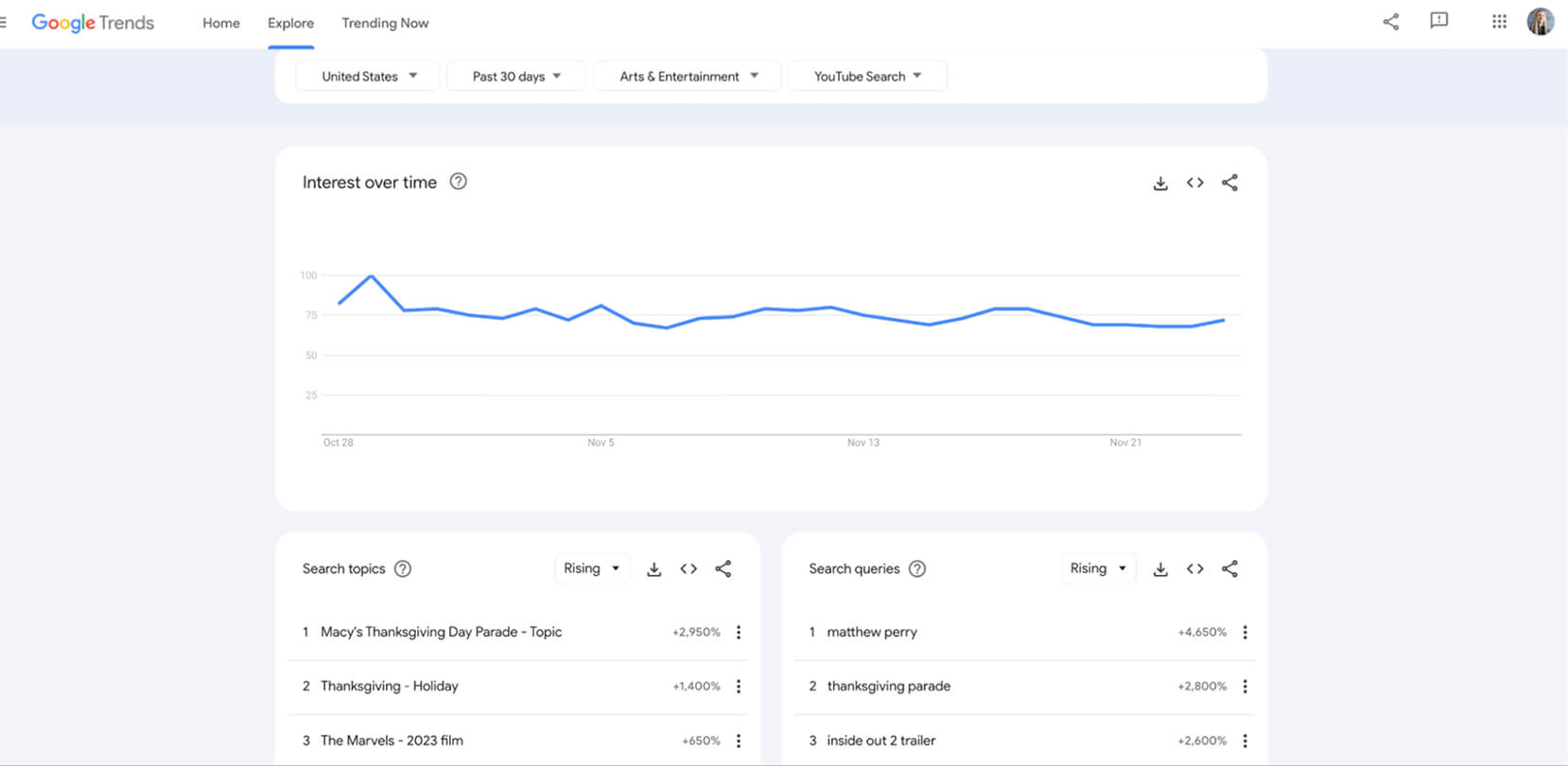
- Check Google Trends, filtered to YouTube, for your niche or content pillars before filming
- Inside YouTube Studio, use the Trends section under Analytics to see what length and topic Shorts are performing best on right now
- Treat a rising velocity curve as a stronger signal than a high but flat total, since rising means the audience for that topic is still growing
9. Write Your Metadata Like the Algorithm Is Reading It Word by Word
YouTube routes content based heavily on past-viewing patterns — someone who watched a video about growing a channel gets shown more of the same. Weak or vague metadata makes that routing worse.
Do this:
- Use your target keyword once in the title
- A couple of times in the description, and speak it within the first few seconds of your voiceover or captions
- VidIQ (the Pro plan is free for AIR users) can help you find relevant keywords with high volume and low competition to hit as many views as possible.
Stay inside YouTube's hashtag policy, which ignores every hashtag on a video past 60 — but the practical sweet spot is 3–5 tightly relevant tags, since only the first three ever display above the title
Avoid stuffing — present and specific beats repeated and generic
10. Translate Your Metadata Before You Translate Anything Else
This is the highest-leverage move almost nobody makes for Shorts. YouTube increasingly surfaces Shorts directly in Google Search, not only the Shorts feed, which means metadata is now competing in a global search index instead of a single-language vertical scroll.
A Ukrainian DIY channel, KrasOlka, tested this directly: translated metadata into nine languages using AI Metadata Translation, about a minute per video, and picked up 148% more views as the algorithm started matching them with audiences that never encountered English-only metadata. Across AIR's broader partner base, the average lift is 40% revenue and 27% international views once translated metadata goes live.
If a Short doesn't lean heavily on spoken dialogue, this is one of the fastest wins available and one of the least crowded.
11. Post Less Often, But Never Break the Rhythm
Posting four times a day doesn't outperform posting once. Past a niche's natural ceiling, over-posting channels showed up to 55% fewer subscribers than channels posting at the optimal rate, because an unpredictable schedule reads as a channel the Shorts algorithm can't safely recommend on repeat.
Do this:
- Open Analytics inside YouTube Studio, go to Audience, and find the window where the chart shows most of your viewers online — post inside that window
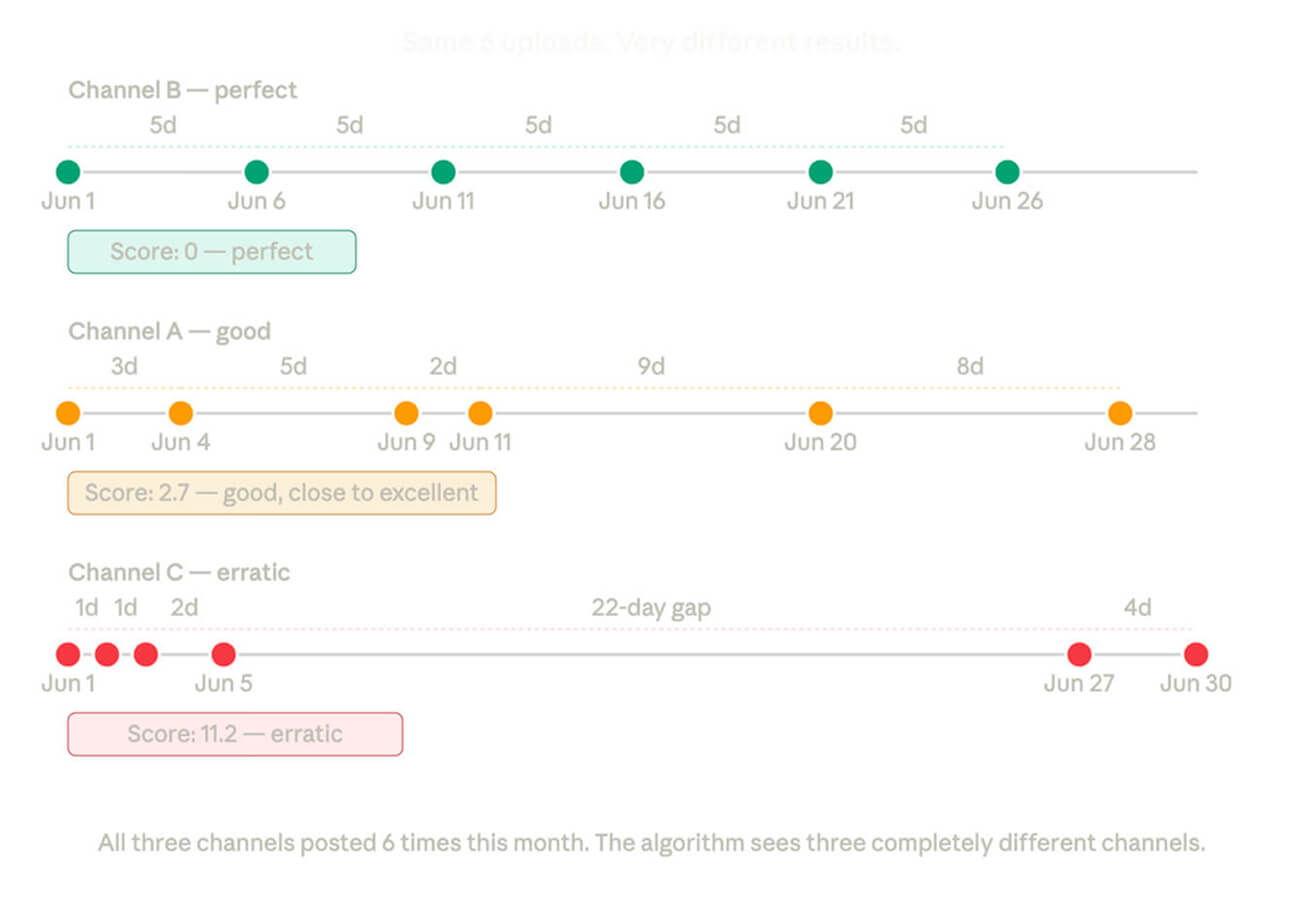
- List the gaps between your last 20–30 uploads, then find your Consistency Score. It will tell you if your schedule is chaotic (YouTube can’t predict you) or well-paced (standard gaps between uploads, and YouTube is ready for your next drop)
- Hold the schedule even when it feels slower than posting on impulse, since consistency compounds faster than any single hack on this list
12. Use Trending Music
Do you know how on TikTok, using popular music can boost your views? Well, you can do the same on YouTube! Just head over to the 'trending' tab and click on "music." Here you'll find all the latest trending songs and music videos.
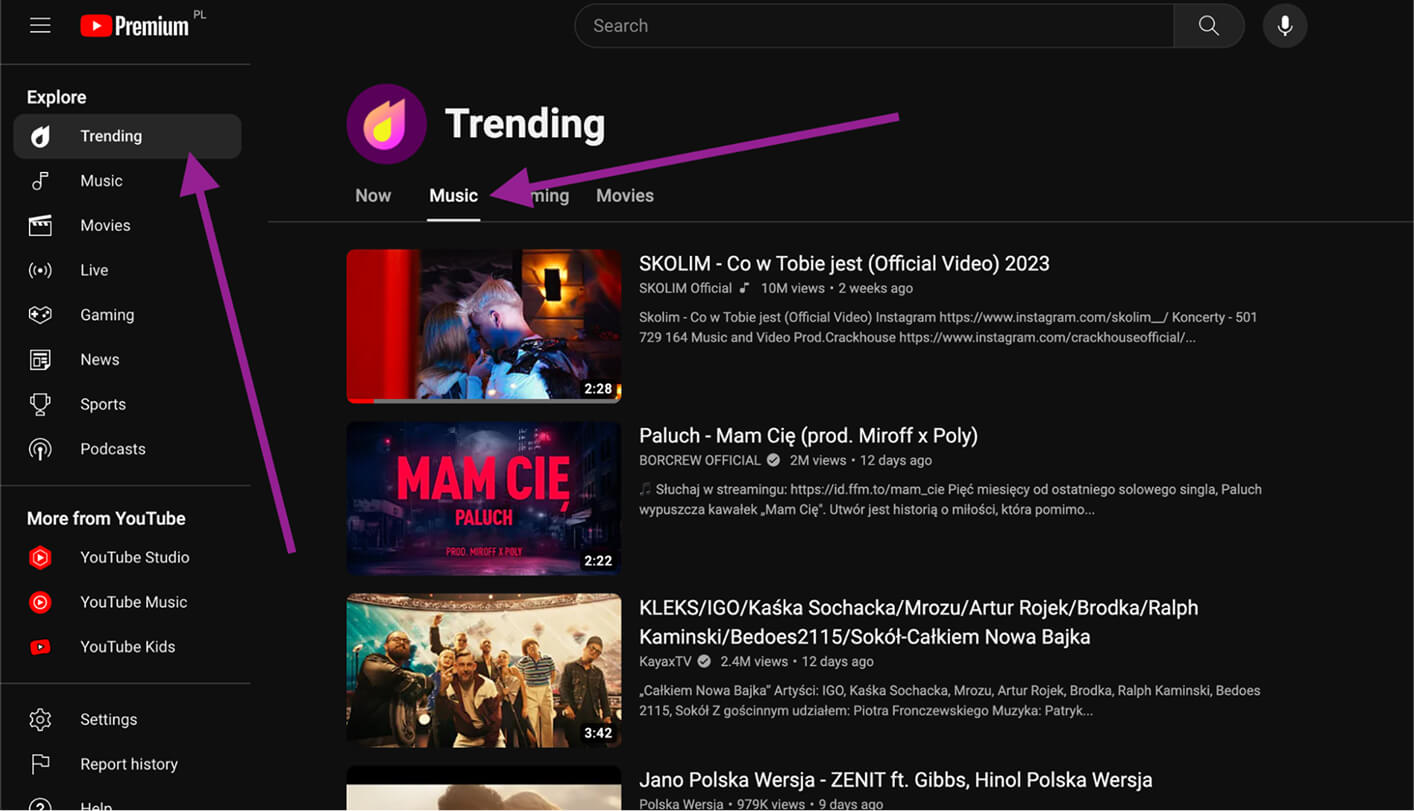
Now, check out the descriptions of the music video you like. Scroll down, and you'll spot Shorts remixing that video. To use that music in your Shorts, find the music video on your phone, hit the remix button, and click on the sound. Follow the steps, and voila, that music's now your background groove, generating more views for you!
You can also use copyright-free music for your Shorts from the YouTube Audio Library.
13. Give People a Reason to Share, Reply, or Come Back for Part Two
A technically well-made Short can still underperform if it fails a simple test: is it informative enough to make someone say "wait, I didn't know that," entertaining enough to earn a real reaction, or inspiring enough that someone wants another person to see it.
Missing all three is usually the actual reason a good edit doesn't travel.
Do this:
- Reply to comments early, especially the newest ones — a reply often draws the commenter back for a follow-up, and twenty replied-to comments can become forty visible ones
- Build a short series instead of a one-off when a topic has more than one angle, and say explicitly that there's more coming
- Run the informative-entertaining-inspiring test before publishing, and rework the Short if it doesn't clear at least one
Feeling stuck on YouTube?
Our specialists have found the exact block across 3,000+ channels using 21 AI diagnostic tools. We'll find yours and hand you a ranked plan.
Diagnose your channel14. Borrow Structure With AI, Never Fake the Disclosure
Our managers see this work when it's done deliberately: find a Short that's already proven, ideally in a different niche so it isn't direct competition, pull its structure — pacing, hook style, where the beats land — and rebuild that structure with your own topic and voice. The shape gets borrowed. The content doesn't.
Do this: Keep any borrowed B-roll or gameplay footage fully copyright-clear, since a strike costs more than the time saved.
Disclose realistic AI-generated or AI-altered content — since May 2026, undisclosed content gets automatically labeled by YouTube, and on Shorts specifically that label now shows as an on-video overlay, not buried in the description.
Reimagine is now built-in, and it lets a single frame from an eligible Short regenerate into a new AI clip, and Shorts Remix was upgraded to Gemini Omni in mid-2026 with prompt-based scene and style changes. Every remix links back to the source and carries a visible watermark, so a distinctive Short can pick up a second wave of reach through other people remixing it.
15. Match Your Shorts Ratio to What Wins in Your Niche
Across 18,000 channels tracked for a full year, the winning strategy splits hard by niche — mixing Shorts in isn't universally correct, and neither is avoiding them.
|
Niche |
What wins |
Gap |
Sweet-spot ratio |
|
Health & Fitness |
Mix Shorts in |
up to 41% more subs |
~37% |
|
Business |
Mix Shorts in |
up to 39% more subs |
~29% |
|
Education |
Mix Shorts in |
up to 37% more subs |
~38% |
|
Food & Drink |
Mix under 10M, long-only at scale |
31% / 47% |
~27% |
|
Home & DIY, Travel |
Either — low differentiation |
under 10% |
~27–33% |
|
Kids Entertainment |
Long-only small, either at scale |
up to 63% |
~37% if mixing |
|
Beauty |
Long-form only |
up to 52% more subs |
test cautiously |
|
Science & Tech |
Long-form only |
up to 16% more subs |
— |
|
Gaming |
Long-form only |
up to 85% more subs |
strongest long-only case |
|
Entertainment |
Long-form only, sharply at scale |
up to 90% at 10M+ |
test freely when small |
Source: AIR Media-Tech, 18,000 English-language channels, March 2025–March 2026, median subscribers per group.
The Gaming and Entertainment gaps aren't a warning to skip Shorts there — they're closer to an opening. Almost nobody in those niches runs Shorts well yet, so an early, well-built funnel is a real edge rather than a risk.
One of our kids' channels (7.5M-subscriber) had already built what most creators spend years chasing — recognizable format, loyal audience. The move that still worked at that scale: long-form uploads dropped from 21 to 11 videos in a quarter while Shorts went from 10 to 23, repurposing the strongest long-form moments into vertical format. Views up 5.5%, revenue up 33.6% — revenue grew six times faster than views.
On the direct funnel side, the clay-sculpting channel referenced earlier posted its first Short on a hunch after months of resistance — 30 days later, views were up 41.8%, and revenue was up 64.1%.
One thing consistently underperformed everyone: 1,247 channels that shifted their Shorts ratio by more than 30 percentage points mid-year underperformed both Shorts-heavy and Shorts-light channels in every niche measured. Pick a ratio and hold it.
Tried a stack of these hacks and still not moving?
That usually means the block is structural, not tactical — packaging, traffic routing, or a format mix issue invisible from inside your own Studio. We've found it across 3,000+ channels. → Find what's off.
16. Fix the Studio Settings Capping Your Reach
This is the part where our managers start when a channel isn't getting traction despite strong content. Check three things in YouTube Studio, under Settings and then Channel:
Do this:
- Keywords field — list your channel name, 2–3 direct competitors, and the actual terms your content covers, since this shapes which audience cluster YouTube assigns you to
- Feature eligibility — confirm every listed feature shows enabled; anything that doesn't means YouTube can't confidently classify your content yet
Advanced settings — turn on Hype if you're under 500K subscribers. It's YouTube's own viewer-boost feature for smaller channels, live in 39+ countries, built so audience size isn't the only path to distribution. You can’t use Hype for YouTube Shorts, but it can help with the overall boost for vertical videos.
How Do You Optimize YouTube Shorts for TV in 2026?
Shorts started rolling out to TV screens in December 2025, and the shift changes more than the screen size. Shorts were built vertical, mobile-first, and swipe-based; TV is horizontal, shared, and controlled by a remote — so YouTube's design solution plays one Short at a time, requires manual navigation instead of a swipe, and fills the rest of the screen with a side panel and a color-sampled, blurred background pulled from the video itself.
That last detail matters more than it sounds. A cover frame or opening shot that looks fine on a phone can look washed out or illegible once it's the source for a blurred background fill and a smaller side-panel view.
Do this:
- Design cover frames with high contrast and a clear focal subject, since the same frame gets sampled into the blurred background behind it
- Front-load the hook even harder than usual — TV navigation is a deliberate remote click, not a passive swipe, so the opening has to justify a manual "next" press instead of coasting on scroll momentum
- Size captions and on-screen text for a couch-distance screen, not a phone held at arm's length — fewer words per frame, larger type
- Keep vertical framing legible when it's not filling the whole screen, since Shorts sit in a side panel next to the blurred fill rather than edge to edge
YouTube has described TV as its fastest-growing surface, which lines up with what our managers see across the portfolio — channels that treat their content strategy as mobile-only are increasingly losing to those who don’t. For a deeper breakdown of how viewing habits are shifting across devices, see Mobile vs. TV: How Device Trends Shape Your Content Strategy.
Can YouTube Shorts Help Your Channel?
Maybe. But maybe something more important is missing.
We audit channels across 10 pillars — packaging, retention, traffic, niche, portfolio, revenue, audience, forecast, risks, and roadmap — and hand you a fix for all of them.
What you get:
- A structured report across all 10 pillars
- A 30-day action plan ranked by impact
- A 45–60 minute live walkthrough with a senior AIR strategist