

The YouTube channel you already have can become the first of many, all under one Google login. YouTube builds this in through Brand Accounts – up to 100 extra channels you create from your existing account, each with its own name, subscribers, and analytics.
Setup takes two minutes, but the harder part is the judgment: when a topic deserves its own channel, how to give an editor access without your password, how monetization works across several channels, and how to stop one hacked login from taking all of them down. This guide walks each decision in turn, with the numbers drawn from AIR's work across 3,000+ audited channels.
How Do You Create a Second YouTube Channel on the Same Email?
You add a second channel by creating a new Brand Account under your existing Google login, with no new email required. Here is the current flow:
- Sign in to YouTube on a computer or the mobile site, with the Google account you already use.
- Open your channel list. Click your profile picture, go to Settings, open the Account section, and select “Add or manage channel(s).”
- Click “Create a new channel.” This starts a Brand Account, separate from your personal channel, that a team can share later.
- Add a name, Handle, and picture. Choose a name that stands on its own, since viewers see the channel as a distinct brand.
- Click “Create channel.” YouTube sets up the Brand Account and switches you into it.
- Verify by phone. This enables uploads over 15 minutes, custom thumbnails, and live streaming.
- Add owners and managers. Give teammates a role instead of your password, and keep one backup owner in case you lose access.
If your main channel is still a personal channel tied to your name, you can move it onto a Brand Account under Settings → Advanced settings → Move channel, which then lets you add managers. Do this carefully: a mishandled transfer can delete the wrong channel and drop the verification badge, so read YouTube's steps before you start.
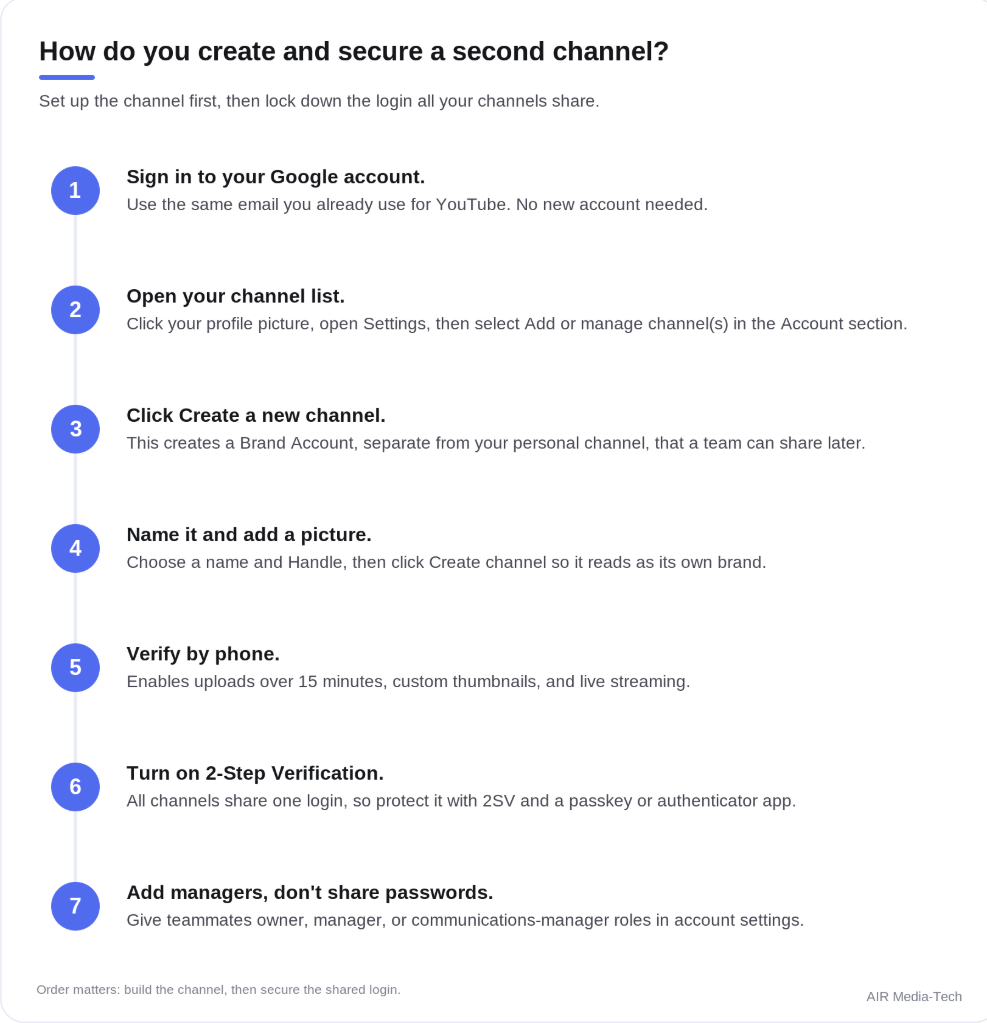
Create and secure a second channel, in order. Source: YouTube Help, current July 2026.
Googling YouTube-related questions from time to time?
200+ AIR specialists check 3,000+ channels and every platform update daily. Add AIR to preferred sources, and Google surfaces our precise answer first. → Add AIR to preferred sources.
Personal Channel vs Brand Account: Which Should You Use?
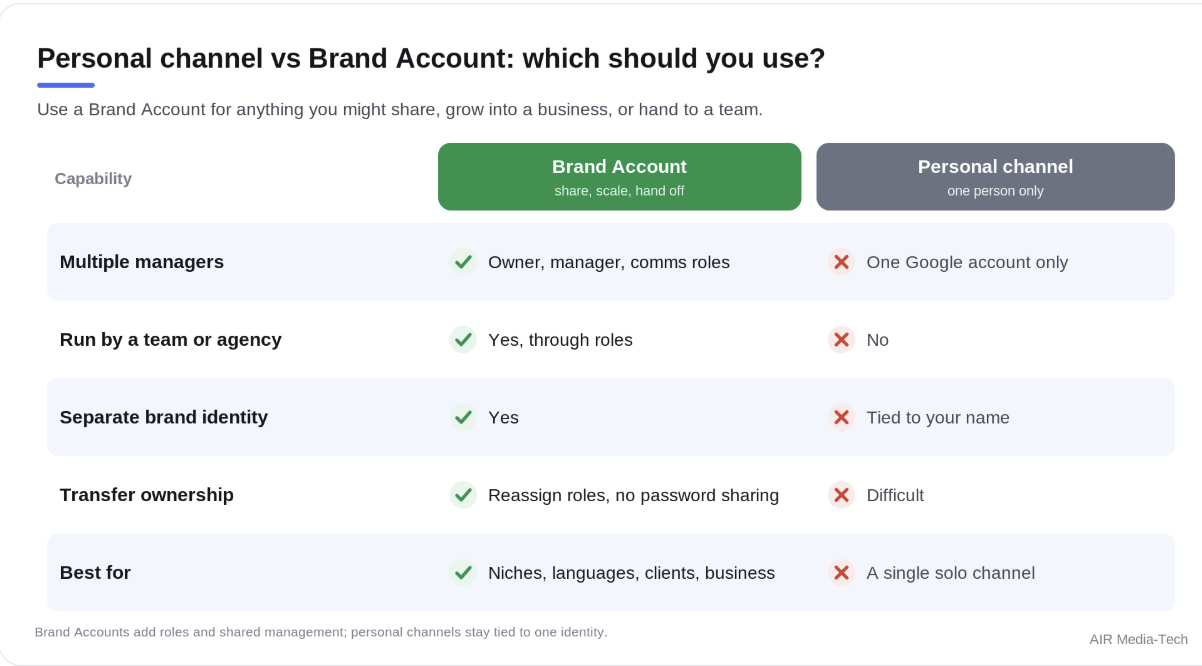
Use a Brand Account for any channel you might share, grow into a business, or hand to a team. Keep a personal channel only for one channel tied to your name. The difference comes down to who can manage the channel.
|
Capability |
Personal channel |
Brand Account |
|---|---|---|
|
Managed by |
One Google account only |
Several people through roles |
|
Add team members |
No |
Yes: owner, manager, communications manager |
|
Tied to |
Your personal Google identity |
A separate brand identity |
|
Best for |
A single solo channel |
Niches, languages, clients, and business channels |
|
Transfer ownership |
Difficult |
Reassign roles, no password sharing |
Brand Accounts use three roles. An owner has full control, including billing and the power to add or remove people. A manager can upload, edit, and change most settings. A communications manager can respond to comments and interact with the community without editing videos. Assign the smallest role that lets someone do their job, and keep at least one backup owner in case you lose access.
Brand Account vs personal channel across five capabilities. Source: YouTube Help, current July 2026.
Maybe your current channel is underperforming?
It probably is, and that gap is usually invisible from inside your own Studio. We've found it across 3,000+ channels.
Get the diagnosisHow Many YouTube Channels Can You Have on One Email?
One Google account can hold up to 100 YouTube channels, and every channel after your first is a Brand Account. You will run out of good reasons to add channels long before you reach that ceiling, so this number is more of a headroom rather than a target. The rules below decide how those channels behave.
|
Rule |
What applies in 2026 |
Why it matters |
|---|---|---|
|
Channels per account |
Up to 100, created as Brand Accounts |
One login covers all of them; you rarely hit the limit |
|
People per channel |
One owner plus multiple managers and communications managers |
A team or editor can run a channel without your password |
|
Monetization (YPP) |
Assessed per channel, not per account |
Each channel qualifies on its own; one earner does not carry the rest |
|
Community strikes |
Applied to the channel that received them |
A strike on one channel does not automatically hit the others |
|
AdSense payments |
All channels link to one AdSense payee |
Earnings from every channel pay out to a single account |
|
Verification |
Phone verification for long uploads, custom thumbnails, and live |
One number can verify several channels within Google's limits |
Source: Google Account Help and YouTube Help, current July 2026.
The shared account is the real constraint. All your channels sit on one Google login, so a few limits apply to the whole group instead of each channel.
- Payments run through a single Brand Account structure and one AdSense payee, which keeps accounting simple but also means a severe or repeated policy violation on the shared account can put every channel linked to it at risk.
- One phone number verifies only a limited number of channels per year, generally two, so plan verification before you spin up several at once.
- For a sensitive or experimental niche you want fully walled off, use a separate Google account rather than another Brand Account on the same login.
Monetization trips up most multi-channel plans, because the 2026 YouTube Partner Program has two tiers and judges each channel on its own:
|
YPP tier |
What it enables |
Requirements (either path) |
|---|---|---|
|
Tier 1 — Fan Funding |
Memberships, Super Thanks, Shopping |
500 subscribers + 3,000 watch hours in 12 months, OR 500 subs + 3M Shorts views in 90 days |
|
Tier 2 — Ad revenue |
Watch Page and Shorts ad revenue |
1,000 subscribers + 4,000 watch hours in 12 months, OR 1,000 subs + 10M Shorts views in 90 days |
2-Step Verification is required for both tiers, and eligibility is checked per channel. Source: YouTube Help, Partner Program eligibility, current July 2026.
Which Multi-Channel Setup Fits Your Goal?
|
Your goal |
Best setup |
Watch out for |
|---|---|---|
|
A new niche that does not fit your main audience |
A new Brand Account on the same login |
A fresh channel starts cold; your main subscribers will not follow automatically |
|
A second language or localized version |
One Brand Account per language, dubbed or subtitled |
Keep naming and branding consistent; an audio track grows localized channels faster |
|
A new format (Shorts hub or 24/7 live stream) |
Same channel by default; a new Brand Account only if the audience is different too |
Splitting off a format on reflex; audience overlap is the only thing that should decide it |
|
A business or brand channel apart from personal |
A Brand Account you own, with staff as managers |
Never run a company channel from a personal channel tied to your name |
|
Client or agency channels at scale |
One Brand Account per client under a single owner |
Track ownership with manager roles, not shared passwords |
|
Content for kids |
A separate channel set as Made for Kids |
COPPA rules apply; personalized ads and some features switch off |
Which multi-channel setup fits each goal, and the one thing to watch. Source: AIR Media-Tech, 2026.
How Do You Set Up Channels for Each Goal?
Each goal below is its own decision. A few genuinely need a new Brand Account, several don't, and the line right after each heading tells you which is which before any steps.
A New Niche or Second Channel
This is the one goal here where a new Brand Account is almost always the right call, because the new topic needs to build its own watch history with a real audience instead of riding on the one you already have.
- Create a fresh Brand Account under your existing login, separate from your main channel.
- Give it a name, handle, and thumbnail style that stand alone. Don't lean on your main channel's branding; viewers need to read it as its own thing in one glance.
- Build a separate upload schedule from day one. Copying your main channel's format signals to YouTube that this is the same content, which slows how fast it learns who the new audience is.
- Cross-promote sparingly, a post or two pointing viewers to the new channel. A permanent funnel from your main channel keeps the new one dependent on it instead of letting its own recommendation graph form.
- Test the niche against real numbers before you commit. Pull two or three channels already in it and compare their last 30 days of views to their last 90; a channel pulling ahead of its own trailing average is gaining ground, one falling behind it is already declining. Do the same for views per 1,000 subscribers against a couple of similarly sized channels in the space. A niche where the better channels are shrinking isn't one worth a second channel yet.
Watch out for a cold start. Your main channel's subscribers do not follow automatically, and the new channel competes for recommendations with zero watch history behind it. Budget for a slow first 60–90 days before judging whether the niche works. Once the channel is live, the packaging and SEO rules are the same as for any channel; AIR's guide to promoting a YouTube channel in 2026 covers the current benchmarks in detail.
Competitor and niche data across 3,000+ channels can point you toward the audience and revenue potential before you commit, plus the formats already working there. → Find my niche.
A Second Language or Localized Channel
A channel per language and an audio track on your existing videos solve the same problem two different ways: one gives each market its own subscriber base and its own numbers, the other keeps everything under a single upload.
- Create one Brand Account per language if you want each market to build independently, or add multi-language audio tracks to your current videos if you'd rather manage one channel with several languages attached. AIR's own walkthrough of the setup is here.
- Translate metadata, not just captions or audio. Titles, descriptions, and tags need to work in that market's own search behavior, not read as a direct translation.
- Keep branding consistent across languages so the network reads as one operation, even though each channel or track runs its own numbers.
- If you go the dedicated-channel route, check “Views by audio track” in YouTube Studio regularly once tracks are live.
The dubbing method matters as much as the channel structure around it. Auto-dubbing is a fast way to test whether a market responds at all, but AIR's side-by-side tests across three channels found average view duration dropping 4–5x when a track switched from a professional voice actor to an AI dub, in one case from over 5 minutes down to 54 seconds. Auto-dubbing is worth using to find out which languages are worth investing in; a real voice is what keeps the audience once you know.
Amelka Karamelka grew to 18 localized channels in a year, adding more than 1M subscribers and 436M+ views across languages. Brave Wilderness launched 9 localized channels in six months and pulled 27.2M views and 135K subscribers across that push. Separately, on that same channel, AIR tried uploading Portuguese audio tracks onto the Polish-market channel while the dedicated Portuguese channel was still finding its footing, and that specific move is what pulled Brazilian traffic in, a tactic worth trying if a new-language channel is off to a slow start.
Watch out for audio tracks disappearing without warning. YouTube has had a recurring bug that drops multi-language tracks from a video; a sudden country-specific view drop on a dubbed channel is usually a tracking issue before it's anything else.
A good AI dub can hold an audience close to a human one; a bad one has dragged average view duration down 4–5x in the cases we've tracked. Having localized 400+ channels, we can share the tactics that can work for content. → Find out how to get localization right.
A New Format: Shorts or 24/7 Live Streams
This bundles two different decisions. Only one of them ever gives you a reason to think about a new channel.
Streaming stays on the channel you already have. It's a way to pull extra watch time out of your existing catalog by keeping the channel on air between uploads, built entirely around the audience you've already got, on rights-cleared content you already own. AIR's own streaming data puts the typical lift at roughly +10–30% of revenue for a channel that's a good fit, usually one with a monetized history and a deep enough back catalog to sustain hours of programming; strong cases go higher. DONA English added continuous streams of existing content to their main channel, no second channel involved, and lifted views 42%, with streaming growing from 20% to 72% of channel revenue over three months. If you're setting this up, enable live streaming on the channel you already have first: YouTube's live streaming requirements call for phone verification and no live-stream restrictions in the past 90 days.
Shorts is the only format on this list where a separate channel is ever worth considering, and even then only when the audience genuinely differs. YouTube fully decoupled the Shorts and long-form recommendation systems in late 2025, so a weak Short no longer drags down your long-form reach, and the old worry about mixed formats confusing the algorithm has eased with it.
YouTube's own Director of Discovery, Todd Beaupré, gave the actual rule in seven words: “Same audience? Same channel. Different audience? Different channel.” Split off a Shorts channel only when it pulls in a genuinely different audience, a clips channel repurposing a podcast for viewers who'd never watch the full episode, for example. For Shorts staying on your main channel, the growth lever is the bridge back to long-form: set the Related Video field on every Short to point at the parent video, and close with a verbal cue like “full explanation in the linked video.” Most channels convert under 0.05% of Shorts viewers into long-form viewers; a properly bridged Short can reach 0.5–1%, and AIR's promotion guide walks through the setup.
Watch out for treating “new format” itself as the trigger for a new channel. Audience decides this for Shorts and for streaming alike; the format on its own stays neutral.
A Business Channel vs a Personal One
Who else needs access to the channel decides this, more than how big the channel is. Get it right at creation, and you skip a conversion headache later.
- Create a Brand Account named for the company, not for you.
- Set yourself as owner. Add staff as managers, who can upload and edit, or communications managers, who can handle comments but can't touch upload tools. Assign roles through channel permissions, not a shared password.
- Connect business AdSense and tax details separately from any personal channel earnings.
- Keep a backup owner from day one. If you're the sole owner and lose access, there's no fast path back in.
- Once you've got a handful of videos to compare, find the one that converts new viewers into subscribers at the highest rate and set it as the channel trailer for non-subscribers, then route your end screens toward it. That single video becomes the front door for every cold visitor the channel gets.
Watch out for starting this on a personal channel and converting later. Google's own guidance on moving a channel to a Brand Account warns that transferring into a Brand Account that already has a channel deletes that existing channel outright, and can drop the verification badge along the way. Starting on a Brand Account from day one avoids the whole problem.
Client and Agency Channels at Scale
This is where the shared-account math bites hardest, and where good structure and drift look identical right up until something breaks.
- Create one Brand Account per client, all under a single agency-owned login.
- Assign roles through channel permissions, not shared passwords. Clients or their staff get manager or communications-manager access; your agency keeps ownership.
- Plan phone verification before onboarding, not during. One number verifies roughly two channels a year, so a batch of new client signings needs multiple numbers lined up in advance.
- Remember that AdSense allows one account per payee, and a second account under the same name gets disapproved as a duplicate. Every client channel monetized through your own AdSense account shares that single payee’s standing.
- Track each client channel's 30-day view average against its 90-day average once a month. A ratio above 0.7 means a channel is gaining ground; several channels sitting under 0.4 at once is a structural problem worth catching before a client asks about it.
Watch out for treating client channels as isolated. They share your AdSense payee, so a severe or repeated policy violation on any one of them can put that payee under review, which freezes monetization on the rest of the roster too.
A Channel for Kids
This is the one goal here where the restrictions come from law, and the setup decision follows directly from that.
- Set the channel or each video as Made for Kids.
- Know what turns off before you commit: personalized ads, comments, the notification bell, Super Chat and Super Thanks, memberships, end screens and cards, and more. This changes your monetization ceiling from the start; plan the revenue model around it rather than discovering it after launch.
- Set thumbnail and title rules stricter than instinct suggests. YouTube's classifiers act on packaging before any human reviewer sees the video, and can override your own audience setting if the content looks child-directed regardless of your label.
- Set up daily moderation if you're running more than one kids' channel; compliance mistakes compound faster in this category than any other.
As one AIR kids'-channel expert put it in a partner case covering four channels in one network: “Thumbnails for YouTube Kids require utmost attention to detail.” Exaggerated fear, panic, or shocked expressions all read as risk signals to the classifier, even when a human viewer would read them as playful.
The rules reach further than one toggle. Our guide to COPPA 2.0 and GDPR-K covers what kids-content creators have to get right in 2026.
How Do You Switch Between Your Channels?
Click your profile picture, choose Switch account, and pick the channel; YouTube keeps every channel signed in under the same login.
On mobile, tap your profile picture and use Switch account. Whatever channel is active is the one that uploads, comments, and shows analytics, so check the top-right avatar before you post.
How Do You Manage Multiple Channels at Scale?
Running several channels well is a workflow problem, not a login one. The switching menu handles two or three. Past that, a system is what keeps them from drifting, and a few habits do most of the work:
- Keep one way to switch. Use Studio's account switcher, or give each channel its own browser profile so you never post to the wrong one.
- Plan on one calendar. A single content calendar across channels stops you starving one to feed another.
- Schedule and batch. Upload and schedule ahead so one owner can cover several channels without daily firefighting.
- Separate the research. A dedicated research tool tracks each channel's keywords and competitors on its own.
- Read the numbers together. A combined analytics view, Looker Studio for example, shows which channels earn their slot and which stall.
- Do not over-cross-promote. Each channel has its own algorithm, and heavy cross-linking can blur the audience signals recommendations rely on.
Assign a backup owner on every Brand Account before you scale; one failed login should never take the whole group offline. For keyword and competitor research across a portfolio, vidIQ tracks each channel from one place.
How Do You Keep Multiple Channels Secure?
Protect the one Google account your channels share, because a single breach can reach all of them at once. That shared login is your only real point of failure. Start with 2-Step Verification, which monetization requires anyway, then harden the rest:
- Use a passkey or an authenticator app, not SMS codes alone, which can be intercepted.
- Review connected apps and remove anything you do not recognize.
- Assign manager roles instead of handing out the account password.
- Keep your recovery email and phone current so you can regain access quickly.
If a channel is ever lost or removed, act fast, because recovery windows are short. A deleted Brand Account can often be restored from Google's Brand Account Manager within a limited window, and our guide on restoring a deleted YouTube channel walks through the steps.
When Should You NOT Create Another Channel?
Skip a new channel when the same audience would watch the content. A playlist or a series on your main channel does the job with less overhead, and it keeps your watch time in one place. Add a channel only when the audience or language is truly different; a new format alone, like Shorts or 24/7 live, usually belongs on the channel you already have.
|
Situation |
Better move |
|---|---|
|
A new topic for the same viewers |
A playlist or series on your main channel |
|
A new format (Shorts, 24/7 live) for the same audience |
Add it to your main channel; Shorts and long-form no longer share one recommendation pool |
|
One more language, same content |
A new Brand Account, localized |
|
A fully separate business with its own billing |
A new, separate Google account, not just a Brand Account |
|
You cannot post consistently on the channels you have |
Fix output first; another channel splits your time |
|
Testing an idea |
A few videos on your main channel before committing |
The one case for a separate Google account, rather than a Brand Account, is a business you want fully walled off with its own billing and recovery details. Everything else belongs under your single login.
![Best Day and Time to Post on YouTube, by Niche [2026 Data]](https://air.io/storage/btdT0DhMUQogLmZ9u7viBNOJTlPeJPYWzkMM0Kbd.png "Best Day and Time to Post on YouTube, by Niche [2026 Data]")
