Before dancehall veteran Papa Michigan released his album So Many Roads in August, TuneCore turned down one of its songs as AI-made. He had recorded it with live musicians, and the album came out without it. You can upload AI music to Spotify in 2026 through a distributor, with the AI part declared. The checks on the way are where releases stop, and they catch human-made tracks too.
AIR Music checks tracks for artists before release, and in 2026 more than 1,500 of them had AI in them. Up to 100 didn't get through because of sound quality, a free AI plan that doesn't allow commercial release, or an AI remake of a popular song. So we've prepared answers to the questions artists ask most about releasing music made with AI, with the rules taken from the help pages of Spotify, Apple Music, DistroKid, TuneCore, and CD Baby.
On Spotify, an AI credit on a song and an AI Persona badge on a profile do very different things, and only one of them keeps your music out of recommendations. The same Suno beat that DistroKid delivers gets a track refused at CD Baby, even when only part of it is AI. And when we asked ChatGPT, Claude, and Gemini whether AI mastering has to be declared, they didn't agree. We'll get to all of it.
Key takeaways
- Spotify, Apple Music and Deezer accept AI-assisted music. Spotify's AI credits are optional and in beta. Apple Music asks for AI tags where AI made a material part of a track. Deezer tags fully AI tracks and keeps them out of recommendations.
- Distributors decide first, and they disagree. DistroKid accepts AI music with AI credits. TuneCore only takes music from AI models trained on licensed data. CD Baby refuses a track even when only part of it is AI.
- An AI credit and an AI Persona badge do different things. The credit describes one song. The badge marks a profile whose public identity is an AI-generated person, and Spotify keeps that music out of editorial and personalized recommendations.
- AI mastering and pitch correction don't need an AI credit at DistroKid. A Suno instrumental does.
- Human-made tracks get flagged too. In 2026, TuneCore turned down a song by dancehall artist Papa Michigan as AI, though he recorded it with live musicians.
- AIR Music checked more than 1,500 tracks with AI in 2026 and turned down up to 100. The reasons were sound quality, a free AI plan, or an AI remake of a popular song.
In this guide:
- What Spotify, Apple Music, and Deezer allow
- Which distributors accept AI music
- AI credit vs AI Persona badge
- What to declare at upload
- Flagged as AI by mistake
- Songs made entirely in Suno
- Before you upload
AI Music on Spotify, Apple Music and Deezer: Allowed, Labeled, Sometimes Buried
In June 2026, more than half of all new music uploaded to Deezer was fully AI-generated, nearly 90,000 tracks a day. Deezer tags every track its detector catches, and those tracks drop out of its algorithmic recommendations and editorial playlists. Fully AI music still makes up only 1–3% of what people stream there, and Deezer says up to 85% of those streams in 2025 were fraudulent. Since July, it has also taken down AI tracks used for fake streams and AI tracks nobody has played for six months.
50%+
of new music uploaded to Deezer in June 2026 was fully AI
~90,000
fully AI tracks uploaded a day
1–3%
of streams on Deezer go to fully AI music
Up to 85%
of those streams were fraudulent in 2025
Deezer is the strictest of the big services, and it still lets AI music in. None of the big streaming services ban music made with AI. What differs is who declares the AI part and what happens to a track once it's labeled.
The other big services each draw the line in a different place.
- Spotify draws its lines at impersonation and spam. A cloned or imitated voice is only allowed when the artist it imitates has authorized it, and Spotify's spam filter tags mass uploads, duplicates, and artificially short tracks, then stops recommending them. AI credits sit apart from both. They're optional, and still in beta, only some distributors can send them, and listeners see them in Song Credits on mobile. When Spotify announced the credits, it said they're not about "down-ranking tracks for disclosing."
- Apple Music started with a lighter touch. Its AI Transparency Tags launched in March 2026 for artwork, a track, a composition and a music video, and providers could choose whether to use them. In August, Apple told partners the tags would be required wherever AI made a material portion of the content, and that listeners would see Made With AI labels later in 2026, Billboard reported.
- YouTube Music takes the AI label from your distributor too. In AIR Music's deliveries, a track is marked as AI or not AI, and YouTube can also detect AI on its own and label the track, AIR Music's team says. Videos you upload yourself go through a separate AI question in YouTube Studio, covered in our YouTube AI disclosure guide.
Here's what each service does with AI music as of October 2026.
| Streaming service | AI as a production tool | Fully AI tracks | How the AI part gets declared | What happens to a labeled track | Source (checked October 2026) |
|---|---|---|---|---|---|
| Spotify | Allowed | Not banned. Spotify acts on voice impersonation and spam | AI credits sent by your distributor for lyrics, vocals, instrumental performance or production. Optional, in beta | Credits show in Song Credits on mobile. A profile with an AI Persona badge is left out of editorial and personalized recommendations | AI credits, AI Persona badges |
| Apple Music | Allowed | Not banned | Transparency Tags sent by your distributor for artwork, track, composition and music video. Required where AI made a material portion, per Apple's August 2026 note to partners | Made With AI labels for listeners, announced for later in 2026 | Billboard |
| YouTube Music | Allowed | Not banned | Marked as AI or not AI in the delivery from your distributor | Labeled as AI. YouTube can also detect AI and add the label itself | AIR Music team, October 2026 |
| Deezer | Allowed | Not banned, but tagged | Deezer's own AI detector, whatever the distributor sends | Left out of algorithmic recommendations and editorial playlists. AI tracks used for fake streams or not played for 6 months get taken down | Deezer, July 2026 |
Every service on this list gets your AI information from the same place: your distributor. And the distributor is the first place an AI track can get stopped.
Which Music Distributors Accept AI Music, and Where a Suno Beat Stops
Take one track. You wrote the lyrics, sang the vocal, and built the song on an instrumental you made in Suno on a paid plan. DistroKid will deliver it with an AI credit on the instrumental. TuneCore will take it only if the AI model behind Suno was trained on fully licensed data, and the one tool TuneCore names as meeting that bar is Google's Flow Music. CD Baby won't take it at all, even though most of the recording is yours.
The split is over audio that AI generated, and here's where each distributor draws the line, taken from their own help pages and, for AIR Music, from our team, in October 2026.
|
Distributor |
Part of the audio made with AI (a Suno beat under your vocal) |
Fully AI track |
What you declare at upload |
Limits and exclusions |
Source |
|---|---|---|---|---|---|
|
AIR Music |
Accepted after an AI check |
Not accepted |
The AI parts, plus proof you paid for the AI tool. A track with undeclared AI that the check finds isn't accepted |
No infringement, no imitating a person without permission, no mass spam. AI instrumentals get an extra check before Content ID |
AIR Music team |
|
DistroKid |
Accepted with an AI credit |
Accepted. Pick "All of the audio," and the form asks whether the artist is a human or an AI persona |
AI credits for AI-generated audio, lyrics, or composition. AI-assisted mixing, mastering, and pitch correction don't need one |
100% of the rights, no impersonation, no mass-generated spam |
|
|
TuneCore |
Only if every AI tool used was trained on fully licensed data |
Same rule |
Not described on the page |
Google Flow Music is the one approved partner. TuneCore Publishing won't register fully AI songs and runs AI detection on its publishing catalog |
|
|
CD Baby |
Not accepted, even when only part of the recording is AI |
Not accepted, even with a commercial license |
— |
AI content found later is removed, and repeated attempts can end the account |
|
|
LANDR |
Accepted |
Accepted up to 20 or 60 AI tracks a month, depending on the plan |
AI elements at upload. Proof of rights if a track is flagged |
Uses AI detection. No AI covers. No delivery to YouTube Content ID, Meta, TikTok, Deezer, Pandora, Tencent, or Lissen |
|
|
Ditto Music |
Accepted |
Accepted, but some stores may refuse fully AI releases |
Not described on the page |
May be refused by Apple Music, Shazam, Beatport, iTunes, Audiomack, Meta Rights Manager, Pandora and YouTube Content ID |
|
|
UnitedMasters |
Accepted |
Accepted |
Stores may label AI tracks themselves |
No AI voices of famous artists, no AI beats that copy songs. Suno tracks must come from an active paid plan. Heavy AI uploading can be flagged as spam |
|
|
RouteNote |
Some accepted, after extra review |
Some accepted |
Links to the AI tools if moderators ask |
No delivery to Content Recognition, Amazon, or the Korean stores Melon, Genie, Bugs, Flo and Vibe |
Two things this table doesn't show. A distributor can accept a track that a store then refuses, which is why LANDR, Ditto and RouteNote list the platforms they won't send AI music to. And the rules move fast. LANDR and UnitedMasters both updated their AI pages at the end of September, and RouteNote rewrote its own in August.
AIR Music takes tracks where a person and AI worked together. Every track goes through AI detection first, and the artist declares the AI parts and shows proof of paying for the AI tool. In 2026, AIR Music checked more than 1,500 tracks with AI in them and turned down up to 100. The ones it turned down had poor sound quality, came from a free AI plan, or were AI remakes of popular songs.
The UMG Lawsuit Against DistroKid: What It Targets
On September 15, 2026, Universal Music Group sued DistroKid in federal court in Delaware. UMG accuses it of "flooding platforms with AI-generated 'slop'" and of distributing tracks that infringe UMG's rights, Music Business Worldwide reported. The complaint also says it's "not about the distribution of AI-generated music when clearly disclosed as such." It points to high-volume accounts such as Lofi Chill that release hundreds of tracks a month and, according to UMG, are mostly raw output from Suno. DistroKid disputes the claims. In October, it said "a very small number of recordings" had been removed in response to UMG, without saying how many. Independent artists' original music came down in the same sweep, Rolling Stone reported.
If you release through DistroKid, the lawsuit is one more reason to keep your AI credits accurate and the proof of your rights in one folder. We cover what goes into that folder in the appeal section below.
Not sure your AI track will pass? Check it for free before you release
An AIR Music manager checks your track's rights, samples, metadata, and AI use before release. In 24–48 hours, you get a Safe, Fixable, or High Risk verdict and a plan to fix what we find.
Check my track for free →An AI Credit, an AI Persona Badge, a Rejection: Three Different Things
Ask Google whether you can put AI music on Spotify, and its AI Overview says AI-generated artist profiles and labeled AI music are both kept out of Spotify's recommendations. Spotify's own pages say something narrower, and the gap matters to anyone who used AI on a track.
Three things that can happen to a track with AI in it
Distributor level
Rejection
Your distributor or a store stops the track, before or after release, over its AI policy or the rights. Listeners never see it.
Song level
AI credit
You set it through your distributor. Listeners see it in Song Credits and Now Playing on mobile. Optional and in beta. Spotify says disclosing isn't a reason to push a track down.
Profile level
AI Persona badge
You set it in Spotify for Artists, or Spotify applies it after a review. Music is left out of editorial and personalized recommendations unless a listener engages on purpose. Spotify's badge can be appealed.
Source: distributor help pages and Spotify for Artists help pages on AI credits and AI Persona badges, checked October 2026.
A rejection comes first, and it comes from your distributor. The track doesn't go out, or a store takes it down later, and the reason sits in the distributor's policy or in the rights. Listeners never see it.
An AI credit is what you declare about one song. You set it in your distributor's form, and on Spotify it shows up in Song Credits and the Now Playing view on mobile, not on your profile and not as a label on the track. The credits are optional, and Spotify said when it announced them that they aren't a reason to push a track down. Spotify also says a song without a credit may still have AI in it.
An AI Persona badge is about the profile. Spotify gives it to artists whose public identity is a photorealistic person made by AI, either because the artist said so in Spotify for Artists or because Spotify reviewed the profile and labeled it Likely AI Persona. Music from those profiles stays out of editorial and personalized recommendations unless a listener follows the artist or plays them on purpose. Spotify’s help page lists the cases where the badge doesn't apply.
- You only use AI tools to make your music.
- Your profile shows a real person.
- It shows a stage name or a fictional character that isn't a photorealistic AI person.
A badge Spotify applied can be appealed in Spotify for Artists, and one you set yourself can't be switched off.
An AI credit describes how one song was made. An AI Persona badge describes who's behind the profile, and of the two, only the badge takes music out of Spotify's recommendations.
So if you sing your own songs, your profile photo matters more than the checkbox. A photorealistic AI portrait is what Spotify's review looks at, and an honest AI credit on a track doesn't put you in that group. AIR Music hasn't seen an AI Persona badge on its artists' profiles so far, since their tracks combine human work and AI.
The credit is the part you control, and the upload form is where it gets decided.
What to Tick in the AI Credits Form: a Suno Beat, AI Vocals, AI Mastering
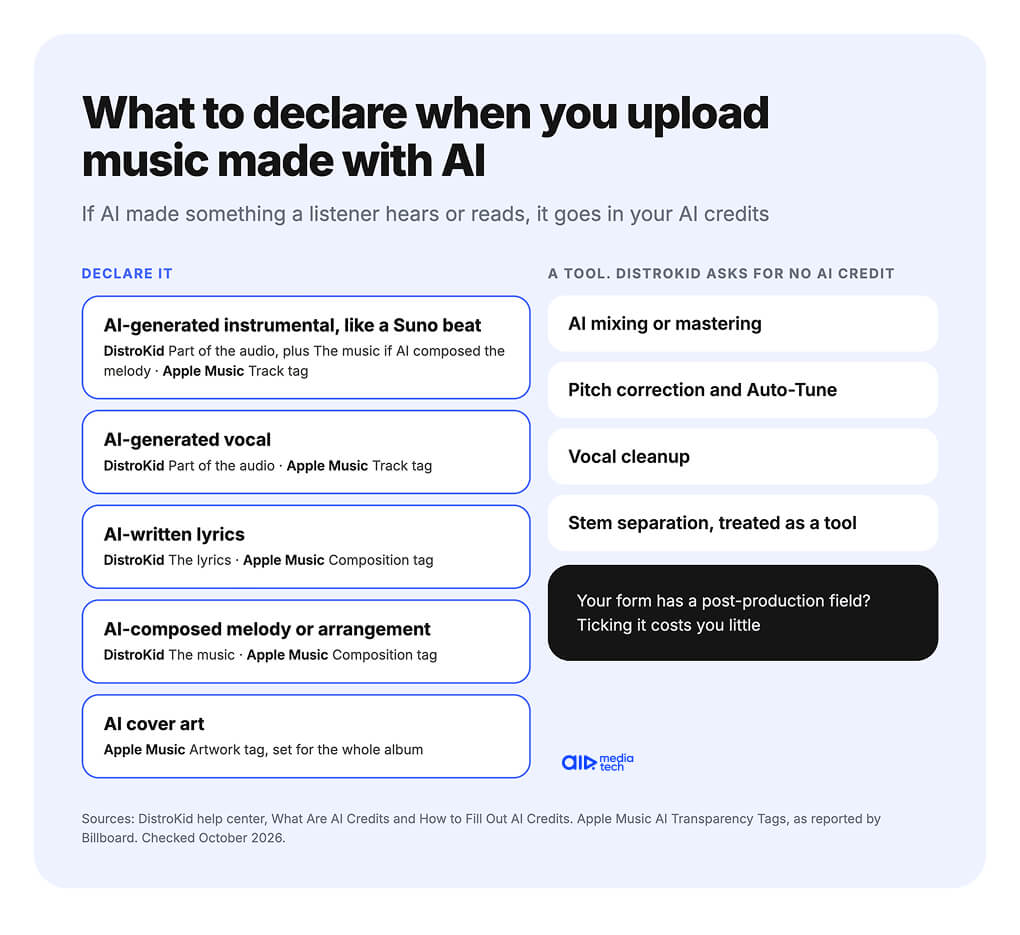
We asked ChatGPT, Claude, and Gemini whether AI mastering has to be declared. ChatGPT and Gemini said no, and Claude said to lean toward declaring it as post-production. For DistroKid, its own page settles it. AI-assisted mixing or mastering, pitch correction, and other AI-assisted workflows don’t need an AI credit. Audio, lyrics, or a melody that AI generated do.
Apple Music sorts it differently, with separate tags for the track, the composition and the artwork, and leaves it to the distributor to decide when AI made a material portion. Spotify shows whatever credits your distributor sends, and only some distributors can send them yet. Here's how each kind of AI use maps onto those forms.
|
What AI did on your track |
DistroKid's AI credits form |
Apple Music tag |
What we'd do |
|---|---|---|---|
|
Generated the instrumental, like a Suno beat |
"Part of the audio," plus "The music" if AI composed the melody |
Track |
Declare it |
|
Generated the vocal |
"Part of the audio" |
Track |
Declare it. A voice that imitates a real artist also needs that artist's permission |
|
Wrote the lyrics |
"The lyrics" |
Composition |
Declare it |
|
Composed the melody or arrangement |
"The music" |
Composition |
Declare it |
|
Mixed or mastered the track |
No credit needed |
Left to the distributor |
DistroKid doesn't ask. If your form has a post-production field, ticking it costs you little |
|
Corrected pitch or cleaned up the vocal |
No credit needed |
Left to the distributor |
Keep your raw takes in case a detector flags the track later |
|
Split a recording into stems |
Not named. AI-assisted workflows don't need a credit |
Left to the distributor |
Treat it as a tool, the same as mixing |
|
Made the cover art |
Not part of the form |
Artwork, set for the whole album |
Declare it where your distributor offers the Artwork tag |
The rule that fits all three is short. If AI made something a listener hears or reads, declare it. If AI only processed something you made, DistroKid doesn't ask for a credit, and ticking a post-production box where a form has one costs you nothing. At DistroKid, you can add or change AI credits after the upload too.
At AIR Music, the artist declares the AI parts at upload and attaches proof of payment for the AI tool. If a track comes in without a declaration and our AI check finds AI in it, we don't accept it.
When Your Distributor Rejects a Song as AI: Why Human Tracks Get Flagged, and How to Appeal
Papa Michigan recorded "Who Can Be Against Me," track 7 on his album So Many Roads, with live musicians, and TuneCore still turned it down as AI, the Jamaica Gleaner reported. He appealed, and the album came out on August 14 without the track.
Papa Michigan's flagged track at a glance
The track
"Who Can Be Against Me," track 7 on So Many Roads, recorded with live musicians
What TuneCore said
Its review found signs of AI tools trained on data that wasn't properly licensed, so the release wasn't eligible "at this time"
What he did
Posted photos of the studio and the musicians, appealed, and asked for a person to review it
Result
The album came out on August 14 without the track. The Jamaica Gleaner didn't report how the appeal ended
He isn't the only one. Evon Mullings, general manager of the Jamaica Music Society, told the Gleaner that human music flagged as AI is getting more common. Streaming services push distributors to screen for AI, and many of them use automated detection. To those tools, very clean production can look machine-made, and Mullings named perfectly quantized drums and heavy Auto-Tune as examples.
Detection gives odds, not a verdict, and AIR Music's own AI check says so on the result itself. In the example below, one track came back as human-made with 61% confidence, while the temporal analysis put a human-AI hybrid slightly ahead, 42% to 39%.
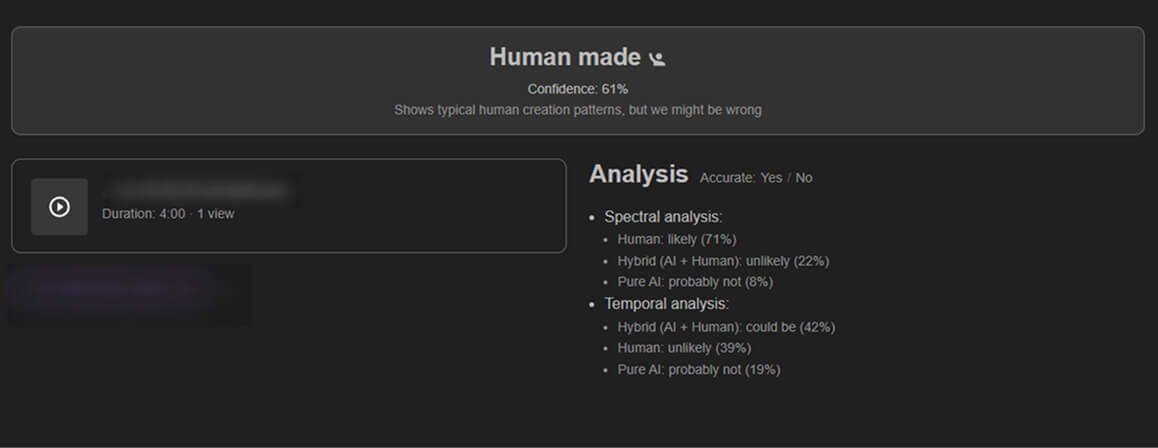
Ditto is one of the few distributors that publishes what it wants in an appeal. It asks for proof of a real artist behind the release and proof of the work itself, and says it reviews them within 7 days. Here's what that proof looks like, whatever your distributor.
What to send when a human-made track gets flagged as AI
01
The session
Your DAW project with the multitrack, raw takes, and stems, with their original file dates.
02
The recording day
Photos or video from the session, a screen recording of you working on the track, a studio booking or invoice.
03
The people
Names and roles of everyone who played or sang, a short written confirmation from each, and the split sheet.
04
The artist
Social accounts with a long history, live performance videos, interviews or press about you.
Add a list of every plugin and service you used, AI ones included. If AI mastered the track, say so. A song performed by people and mastered with AI is easy to explain, and a claim of no AI at all falls apart on review if there was some.
While the appeal is open, leave the track where it is. Uploading the same audio again under a new title, or sending it to a second distributor, looks like dodging the review. Downtown Music's policy for CD Baby and FUGA bans re-uploading the same recording under a different ISRC. A track a distributor rejected has no codes yet, AIR Music's team notes, so it gets its ISRC when it's delivered for the first time. Tools that promise to strip AI traces from audio are a bad idea too, since a track altered to get past a check reads as one with something to hide.
A streaming service can also flag a track as AI after release, so we asked Diana Martuk, Head of AIR Music, whether that can happen to human-made tracks.
“
This can happen. When a platform flags a human-made track, the artist’s manager on our team takes it up with that platform.
Diana Martuk, Head of AIR Music
A human track can usually prove where it came from. A song made entirely in Suno has a harder time, and it runs into more walls.
Releasing Suno Songs on Spotify: Where a Fully AI Track Hits Walls
At DistroKid, picking All of the audio in the AI credits form brings up one more question, whether your artist is a human or an AI persona. From that point on, a song made entirely in Suno gets treated differently from one where AI only helped.
Suno lets you distribute songs made on its Pro or Premier plans, and a subscription you start later doesn't cover songs you made on the free one, its help center says. Since September 3, 2026, those rights also come with a download limit of 20 songs a month on Pro and 60 on Premier. Suno says its current models will be retired once new ones, built in partnership with the music industry, launch, per its August update.
What to keep for every Suno song
Your plan receipt and the date each song was made and downloaded. UnitedMasters recommends keeping them in case a release gets questioned, and that's good advice at any distributor.
Even when a distributor takes a fully AI song, part of the money a human-made song earns stays out of reach.
|
Where the money comes from |
A song made entirely in Suno |
Source |
|
Streams on Spotify, Apple Music and YouTube Music |
Yes, through a distributor that accepts fully AI tracks. CD Baby doesn't, and TuneCore only takes licensed AI models |
|
|
Songwriting royalties through ASCAP, BMI or SOCAN |
No. They register partly AI songs only |
|
|
Publishing administration at TuneCore |
No. TuneCore Publishing also runs AI detection on its catalog |
|
|
YouTube Content ID |
Not through LANDR, Ditto or RouteNote. At AIR Music, an AI instrumental gets an extra check first, since a paid plan doesn't prove the audio is exclusive |
|
|
US copyright protection |
Not for parts made entirely by AI |
"A commercial license from an AI generator doesn't prove on its own that an instrumental is exclusive," says Diana Martuk, Head of AIR Music. Suno's own terms warn that other users can get the same or similar output, so at AIR Music a track like that gets an extra check before Content ID rather than an automatic no.
Volume is where fully AI catalogs most often get in trouble. One of the AI models we asked gave a limit of two singles a month. Spotify doesn't publish any limit, and its spam filter looks for mass uploads, duplicates, and artificially short tracks. AIR Music doesn't set a release pace either. Its team recommends spending the time on finishing each track instead.
Whichever way your track was made, the checks are easier to pass when you prepare for them before the upload.
Before You Upload: How to Release a Track Made With AI Clean
In April, Spotify said it was already getting tens of thousands of AI credits every day. Declaring AI has become a normal part of a release. Whether a track gets through depends on what you prepare before you upload it, and here's the check we'd run two weeks before release day, slow steps first.
- Read your distributor's AI page before you pay, and if your track sits in a gray area, ask support in writing. LANDR, UnitedMasters and RouteNote all changed their AI rules in the last two months.
- Put the proof of your rights in one folder. That means plan receipts and download dates for any AI tool, licenses for beats and samples, and the split sheet.
- Declare AI for each part of the track, the way the form table above shows, and keep your answers the same in every field.
- Save the session. Keep the DAW project, raw takes, and stems where you can find them on the day a flag comes.
- Look at your artist profile the way Spotify's review would. Use a real photo or clearly stylized art, not a photorealistic AI portrait.
- Check for borrowed audio. A sample hidden in a leased beat is its own problem, and our guide to uncleared samples shows how to catch one.
- Release at a pace you'd keep without AI, and never pay for streams. Fake plays get tracks removed and can cost money, as our guide to Spotify’s artificial streaming penalty explains.
- A few days after release, open Song Credits on Spotify and check that your AI credits came through. If they didn't, tell your distributor.
“
AI can help you bring a musical idea to life, but the artist is still responsible for the final track. Listen to the result critically, add your own vision, and check that you have the rights to use the generated material before release.
Diana Martuk, Head of AIR Music
AIR Music runs this kind of check for artists before release, for free. Along with rights, samples, and metadata, it now includes AI detection that rates a track as human-made, a human and AI hybrid, or pure AI. A manager sends back a Safe, Fixable, or High Risk verdict with a plan to fix what could stop the release.
Want a person to check your track before an automated filter does?
An AIR Music manager runs a free Track Safety Check and tells you what could get your release rejected, flagged, or taken down. You get
- A review of samples and third-party sounds that can trigger Content ID
- A check of your licenses and metadata, from ISRC to credits
- An AI check that shows whether the track reads as human-made, hybrid, or pure AI
- A Safe, Fixable, or High Risk verdict in 24–48 hours
- A plan to fix what we find before release day