If your track has a few seconds of someone else's recording in it, you need permission to release it. That's true even if you never sampled anything yourself and the sample came inside a beat you leased. Without that permission, your distributor can reject the track, Spotify can take it down and hold its royalties, and YouTube's Content ID can send its income to whoever owns the original.
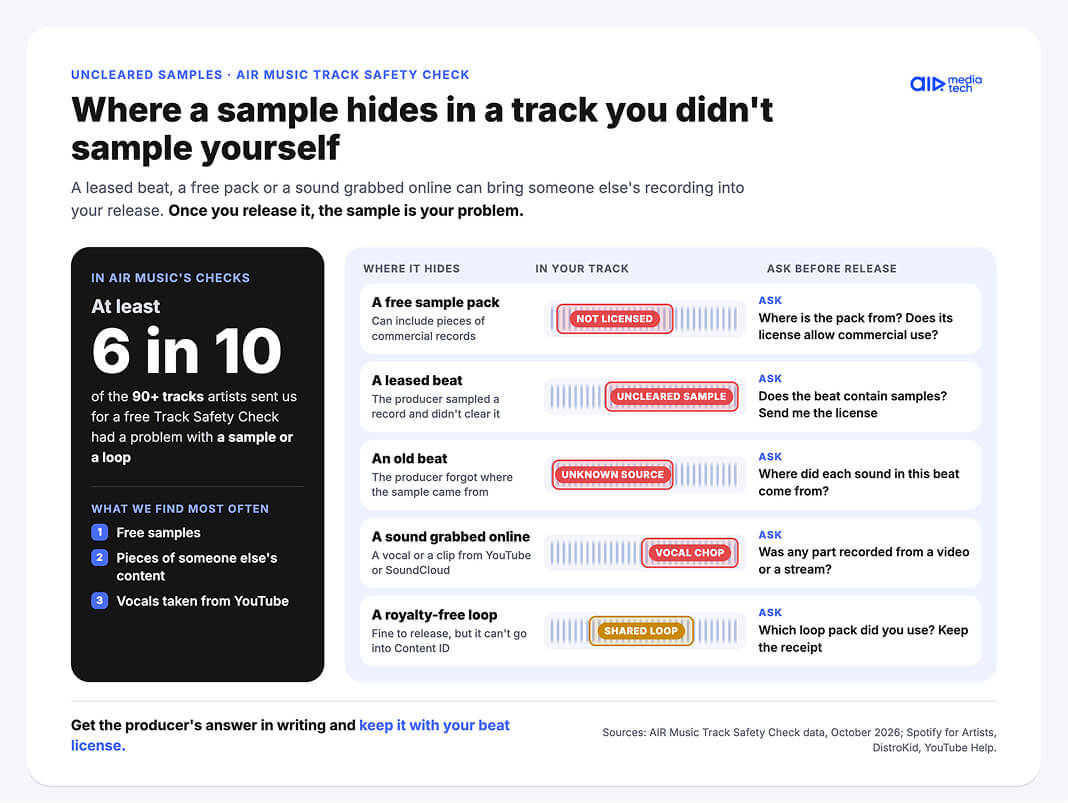
Of the more than 90 tracks artists have sent AIR Music for a safety check, at least 6 in 10 had a problem with a sample or a loop.
So we've prepared answers to the questions artists ask most about uncleared samples, with the rules taken from DistroKid, TuneCore, CD Baby, Spotify, and YouTube's own help pages. Here's where a sample hides in a track, what happens when a platform finds it, why a few seconds still count, how to check a track before release, how to clear a sample or replace it, and what to do if your release is already flagged.
A $30 Beat With a Nine Inch Nails Sample: Where Uncleared Audio Hides in a Track
"Old Town Road" started as a $30 beat with an uncleared sample. Lil Nas X bought it from YoungKio, a Dutch producer who built it on a chopped piece of Nine Inch Nails' "34 Ghosts IV." When the song started climbing Spotify's viral charts, Lil Nas X's manager called Trent Reznor's team to ask for clearance. Reznor later told Rolling Stone the sample should have been cleared and wasn't, and he said yes. Reznor and Atticus Ross are now credited as songwriters on the song.
Most artists aren't that lucky. If you lease a beat, the sample inside it becomes your problem the day you release the song. A beat lease only covers what the producer owns, and the producer never owned that record. Your distributor holds you to it, not the producer. TuneCore, for one, won't distribute anything you don't hold 100% of the rights to.
In the tracks artists send AIR Music for a check, the most common trouble comes from free samples, pieces of someone else's content, and vocals taken from YouTube. Here's where uncleared audio hides in a track you didn't sample yourself:
|
Where it hides |
How it gets there |
What to ask before release
|
|---|---|---|
|
A free sample pack |
Packs shared for free online can include pieces of commercial records, and "free" doesn't come with a license to release |
Where is this pack from, and does its license allow commercial use? |
|
A leased beat |
The producer sampled a record and sold the beat without clearing it |
Does this beat contain samples? Are they cleared, and can you send me the license? |
|
An old beat |
"A lot of producers create beats, and then they forget where they got the sample from," Deborah Mannis-Gardner of DMG Clearances told Spotify for Artists |
Where did each sound in this beat come from? |
|
A sound grabbed online |
Producers sometimes sample a song from YouTube or SoundCloud without knowing whose it is, Spotify for Artists warns in the same guide |
Was any part of this beat recorded from a video or a stream? |
|
A royalty-free loop |
Loops from Splice, Loopcloud and similar libraries are fine to release, DistroKid says. But the same loop sits in many other tracks, so YouTube doesn't accept loops as Content ID references, per its Help Center |
Which loop packs did you use? Keep the receipt or license |
If another artist's Content ID claims your track over a loop you both bought, ask your distributor to dispute it and send the loop's license as proof.
So before you upload, get one answer from the producer in writing: does this beat contain samples, and are they cleared? Keep that message with your beat license. If a claim comes in later, those two are your proof.
What Happens If You Release a Song With an Uncleared Sample
Ye's sample never made it onto the album, and it still cost him $438,558. In May 2026, a jury found Ye and his companies liable for using "MSD PT2," a demo by four musicians, in an early version of "Hurricane." That version was played at a 2021 Donda listening event for 40,000 fans and posted on Instagram. The album version used recreated parts instead. "There was no deal, no agreement, no license, and no clearance," the musicians' lawyer said, Rolling Stone reported.
For an independent artist, the trouble usually starts with the platforms. On every platform, the artist who uploads the track answers for every sample in it. Here's what each one says in its own rules:
|
Platform |
What its rules say |
What it means for your release
|
|---|---|---|
|
DistroKid |
"Stores do not allow you to use another artist's stem or sample without their permission." DistroKid sells cover-song licenses but can't approve samples |
Don't upload a track with an uncleared sample. A cover license won't cover it |
|
TuneCore |
A sample needs a Master Use license from the owner of the original recording, and a third-party licensor can't issue it. "If you have any concerns that you may not have rights to any audio… please do not upload," TuneCore says |
You clear it with whoever owns the record, directly |
|
CD Baby |
Every sample "must be legally cleared and/or paid for," and you supply the agreement or the receipt, per CD Baby's rights policy. A sample counts as a derivative work, so the cover-song process can't clear it |
Keep the paperwork for every sample and loop |
|
Spotify |
"If you use samples in your music, make sure they're cleared with the owner first." Spotify can remove content delivered without the rights holder's permission, hold related payments, and cut off access for repeated violations, per its prohibited content policy |
The track can come down with its royalties held, and a repeat can cost you the platform |
|
YouTube |
Content ID matches uploads against rights holders' files, and the owner chooses to block, monetize, or track the video. A claim isn't a strike: claims "usually don't impact your channel," per YouTube Help |
Your video or Art Track can start earning for the owner of the original, or get blocked |
From the help pages of DistroKid, TuneCore, CD Baby, Spotify for Artists, and YouTube, checked in October 2026.
So the cheapest time to deal with a sample is before you upload.
Is there a sample hiding in your beat? Check your track for free before you release
An AIR Music manager checks your track for samples, loops, and anything else that can trigger Content ID or a takedown. In 24–48 hours, you get a Safe, Fixable, or High Risk verdict and a plan to fix what we find.
Check my track for free →A Few Seconds Still Count: How Much of a Sample You Can Use Legally
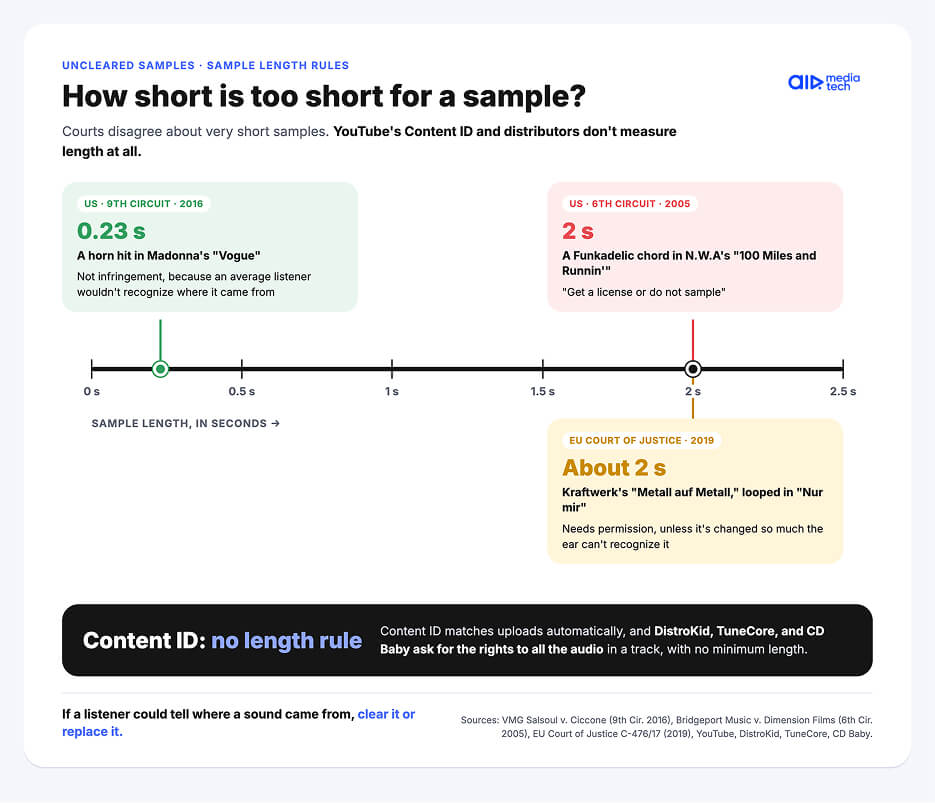
The horn hit Madonna's "Vogue" borrowed from a Salsoul Orchestra record lasts 0.23 seconds. In 2016, a US appeals court ruled that was too little to count as copying, because an average listener wouldn't recognize where it came from. If you've heard that a few seconds is fine, this is the kind of case behind it.
It's one court. Eleven years earlier, another US appeals court ruled on a two-second Funkadelic guitar chord that N.W.A looped in "100 Miles and Runnin'." Its answer was "Get a license or do not sample." The two rulings still disagree, and no sampling case has reached the Supreme Court yet, UC Law Review noted in 2025. Here's where each rule applies:
|
Where |
Is a very short sample OK without permission? |
The case
|
|---|---|---|
|
US, 6th Circuit: Michigan, Ohio, Kentucky, Tennessee |
No. Copying any part of a recording needs a license |
Bridgeport Music v. Dimension Films (2005): a two-second Funkadelic chord in N.W.A's "100 Miles and Runnin'" |
|
US, 9th Circuit: California and eight other western states |
Only if an average listener wouldn't recognize it |
VMG Salsoul v. Ciccone (2016): a 0.23-second horn hit in Madonna's "Vogue" |
|
European Union |
Only if it's changed so much the ear can't recognize it |
Pelham v. Hütter (EU Court of Justice, 2019): about two seconds of Kraftwerk's "Metall auf Metall," looped in "Nur mir," per the court's press release |
|
YouTube Content ID and distributors |
No length rule. Content ID matches automatically, and distributors ask for rights to all the audio |
YouTube's 2019 claiming update; DistroKid, TuneCore and CD Baby rules |
Platforms don't wait for a court. In 2019, YouTube stopped manual claims from monetizing very short or unintentional uses of music. In the same post it said claims from the automated Content ID system, "which are the vast majority," aren't affected, per its announcement. DistroKid, TuneCore, and CD Baby ask for the rights to all the audio, and none of them names a minimum length.
"It's only a few seconds" is an argument for a courtroom, and you'd make it after the claim and the takedown. Even the friendliest rule above protects only a sample nobody can recognize. So if a listener could tell where a sound came from, clear it or replace it.
How to Check a Track for Samples Before You Release
A clean copyright check on YouTube doesn't mean your sample is cleared. YouTube says so in its upload guide: "Copyright check results aren't final." The check looks for matches in Content ID, so a record that isn't there won't show up, and a manual claim or a takedown can still come later.
Here's what to check before you upload:
- Get the producer's answer in writing. Ask whether the beat contains samples, whether they're cleared, and ask for the license. If the producer says it's a loop, ask which pack it came from.
- Read your beat license. Check whether it's exclusive or non-exclusive, and whether it caps streams, views, or time. TuneCore warns that some beat licenses limit the "term, number of plays, views and streams," and that the original publisher usually has to be credited.
- Keep a receipt or a license for every loop and sample. CD Baby, for one, asks for them before it distributes a track with samples.
- Keep non-exclusive material out of Content ID. YouTube only accepts material you hold exclusive rights to, so a leased beat sold to many artists or a royalty-free loop can't go in. DistroKid won't add tracks with royalty-free samples to its Content ID extra for the same reason. If another buyer of your beat puts it into Content ID anyway, that's a claim you can dispute. At AIR Music, only 100% original tracks go into Content ID.
- Get the track checked by someone who does this every day. At AIR Music, we run every track through detection tools, and when something matches, a manager asks the artist for the documents behind it. As of October 2026, artists have sent us more than 90 tracks for a free Track Safety Check, and at least 6 in 10 had a problem with a sample or a loop. Every AIR Music partner can run the same check from their dashboard. Each check ends with a Safe, Fixable, or High Risk verdict and a plan for what to fix. The same check now runs AI detection too, for artists who release music made with AI.
“
Check every sample before you release. If you didn't make it yourself, make sure you have the right to use it commercially. Even a few seconds of uncleared audio can get a release blocked or taken down. And always keep the invoices for the licenses you bought, along with the licenses themselves.
Daria Marchenko, Artist and Label Relations Manager, AIR Music
How to Clear a Sample, or Replace It
A sample owner can say no, and doesn't have to explain why. CD Baby puts it plainly: "The copyright holder has the right to deny permission for any reason." So start before you set a release date. Mara Kuge of Superior Music Publishing told Spotify for Artists to allow "at least a couple of months."
Clearing the original sample takes four steps:
- Find both owners. The label owns the recording, and the publisher owns the song: these are the two copyrights every track has. The label is in the release credits. For the song, TuneCore points to the public repertories of ASCAP, BMI, HFA, and SongDex.
- Ask both in writing. Name your song and the original, give the sample's length and timestamps, say how you use it, and share your release plans.
- Agree on the price. "If you've got a song with one publisher and one label, the publishers charge between $1,500 and $3,000 as a non-negotiable fee, plus a piece of the new copyright," Deborah Mannis-Gardner of DMG Clearances told Spotify for Artists in 2019. That's only the publisher. The label sets its own price for the recording.
- Sign before you upload, then update the credits. Get both licenses signed, then add the original writers to your songwriter credits and splits. CD Baby asks that songwriting ownership match the license you negotiated.
If that's too slow or too expensive, there are cheaper routes:
|
Route |
What you need to clear |
Good to know
|
|---|---|---|
|
Replay the part yourself (interpolation) |
Only the song, with its publisher |
"If you re-record, you only need a sample license for the composition," TuneCore says |
|
Sample from a pre-cleared catalog like Tracklib |
Nothing more, the license comes with the sample |
Tracklib says over 90% of its catalog clears for $50 plus a 2–20% revenue share. On DistroKid you add [email protected] to Splits with that share, per DistroKid |
|
Use a royalty-free loop |
Nothing, just keep the license |
The track can't go into Content ID |
|
Replace the sample with your own sound |
Nothing |
You own the whole track and can put it into Content ID |
If Your Release Already Got Flagged
After release, the sample's owner sets the terms. "Once the album's already out, you have absolutely no leverage," Mara Kuge of Superior Music Publishing told Spotify for Artists. What you can do depends on what came in:
|
What came in |
What it means |
What to do
|
|---|---|---|
|
Your distributor rejected the release |
Nothing went live, so nothing got claimed or taken down |
Clear, replay, or replace the sample, then submit the release again |
|
A Content ID claim on YouTube |
The video stays up but can earn for the claimant or get blocked. A claim isn't a strike |
Dispute only with a license in hand. YouTube warns that repeated abuse of disputes can bring penalties on your video or channel. Without a license, trim, mute, or replace the claimed part, or ask the owner for a license |
|
A copyright removal request on YouTube |
The video comes down, and your channel gets a copyright strike. Three strikes can end the channel |
Ask the person who filed it to retract it. File a counter notification only if you hold the rights, per YouTube Help |
|
A takedown on Spotify or another store |
The track comes down, and related payments can be held |
Ask your distributor who sent the notice and what it covers. Then license the sample from its owner or release a version without it |
Re-uploading the same audio under a new title counts against you again. Spotify can cut off access for repeated violations.
When a claim hits a track released through AIR Music, your manager takes the dispute to the platform. Copyright disputes take anywhere from a day or two to a year, depending on the other side. Not every case can be saved. One artist who releases through AIR Music got a copyright strike over a free sample, and the only way out was to take the track down completely.
Release day coming up? Get your track checked for free first
An AIR Music manager runs a free Track Safety Check and tells you what could get your release rejected, claimed, or taken down. You get:
- A review of samples, loops, and third-party sounds that can trigger Content ID
- A check of your licenses and metadata, from ISRC to credits
- A Safe, Fixable, or High Risk verdict in 24–48 hours
- A plan to fix what we find before release day