If you run a label, one artist's fake streams land on your account. Spotify charges the label or distributor that delivered the track, and distributors pass the fee on to the account the track came from. On a label account, that's you.
So in October 2026 we went through Spotify's artificial streaming policy, what distributors say about the fee, and the flags in AIR Music's own catalog. Spotify doesn't publish the amount. Distributors put it at €10 per flagged track, and a flag isn't always right: 4 of the 6 tracks flagged in our catalog in 2026 had real streams.
Here's what a label needs: how a flag on one track reaches your account, when a whole catalog comes down, where fake streams on a roster come from, what to do in the first 48 hours after a notice, what to put in artist contracts, and how to protect the roster before it happens.
How a Spotify Artificial Streaming Flag Reaches Your Label
Spotify sends the flag and the fee to the label or distributor that delivered the track. On a label account, the chain looks like this:
- An artist, or a promo service they paid, drives bot plays to a track.
- Spotify detects the streams and removes them from royalties, stream counts, and charts.
- If the rate of artificial streams on the track is very high, Spotify charges a fee per track. The policy took effect on April 1, 2024.
- The distributor passes the fee to the account the track came from. It can also warn you, suspend the account, or take the music down.
- The fee and any action land on the label, whichever artist caused them.
Here's what happens at each level, as of October 2026.
What Spotify's artificial streaming policy does to a stream, a track, and a label account. From Spotify for Artists and distributor help pages, checked in October 2026.
|
Level |
What happens |
Source |
|---|---|---|
|
The streams |
They don't earn royalties, don't count toward public stream numbers or charts, and don't influence recommendations. |
|
|
The track |
Spotify can remove it from its playlists. If a track looks like it exists mainly to collect artificial streams, Spotify can remove it from the platform. |
|
|
The fee |
Spotify charges it per track, only for very high rates of artificial streaming, and doesn't publish the amount. TuneCore and FUGA put it at €10 per flagged track for every month the track appears in Spotify's report. Billboard first reported the fee in 2023, for tracks where more than 90% of streams are artificial. |
|
|
The distributor account |
The distributor can issue a warning, charge a penalty fee, suspend the account, or remove the music. |
|
|
The label |
At FUGA, a distributor that works with labels, the fee comes out of the label's next royalty payment, whichever artist caused it. |
Spotify charges the account that delivered the track, so on a label account one artist's bot plays cost the whole label. A per-track fee is the smaller risk, though. The next section covers the larger one: a whole catalog coming down.
When a Whole Catalog Comes Down for Someone Else's Fake Streams
Spotify says the fee is there to stop labels and distributors from delivering music for known bad actors, according to its artificial streaming policy. Distributors pay that fee, so they move fast. Audora's guide to distributor takedowns says distributors often take tracks down or close whole accounts automatically, before a person looks at them, and when an account is closed, "entire catalogs come down at once."
That can hit a label from two sides:
- From your roster. One artist's flagged tracks can get your label account suspended at the distributor, and every artist on it goes offline. TuneCore says it can shut an account down completely, depending on how much artificial streaming it finds across it.
- From your distributor. Platforms also go after distributors whose catalogs keep getting flagged. Spotify says its fee is meant to stop distributors from delivering music for known bad actors, and Apple Music has penalized labels and distributors with high levels of stream manipulation since 2022, Billboard reported. A distributor under that pressure acts fast, and its sweeps can reach labels that did nothing wrong.
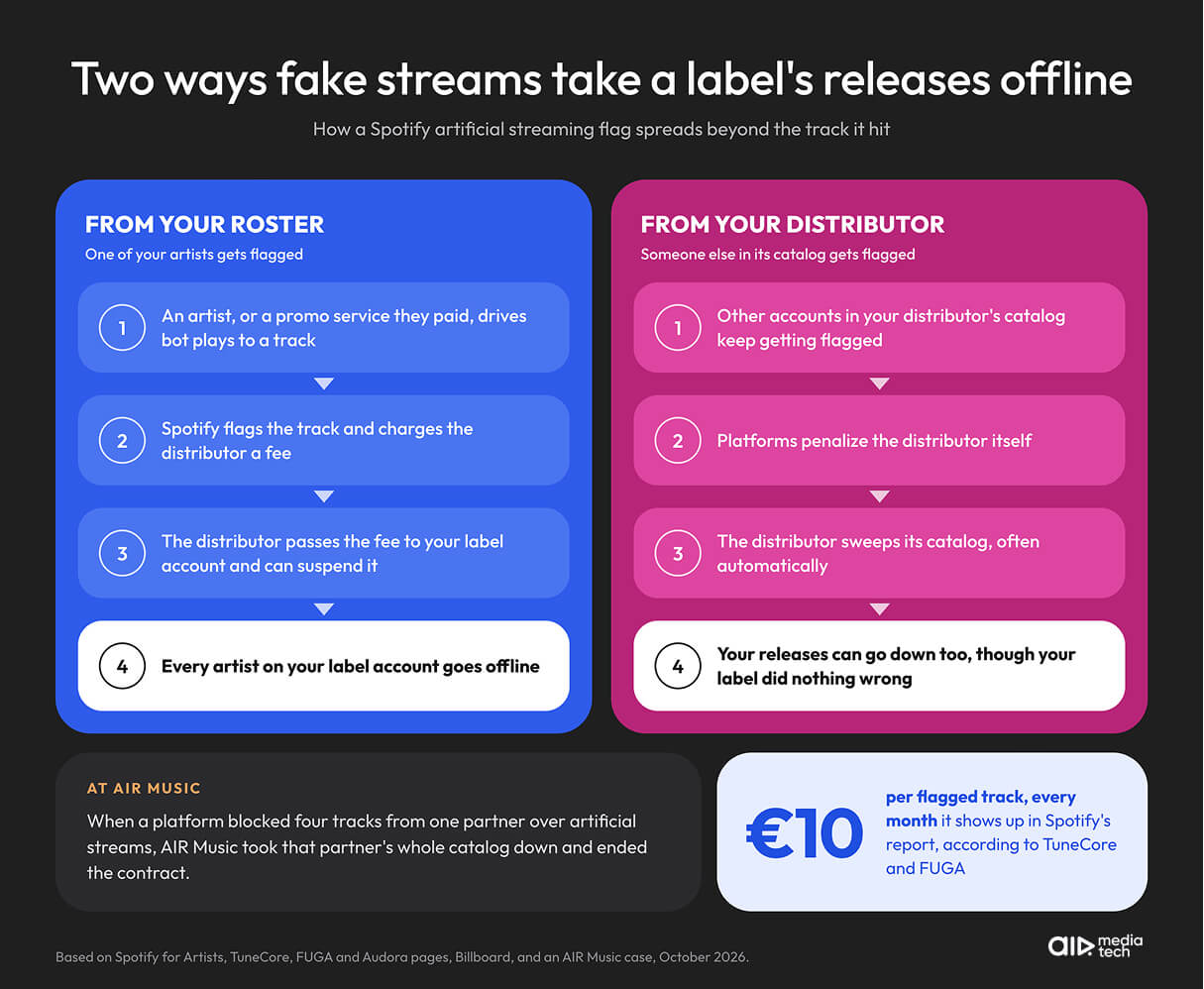
At AIR Music, we've been on the distributor's side of the first one. When a platform blocked four tracks from one partner in our catalog over artificial streams, we took that partner's whole catalog down ourselves and ended the contract.
The second one happened on September 2, 2026, at a European distributor that isn't AIR Music. Our team followed the case through artists who had releases there. A few tracks in that distributor's catalog were caught with artificial streams, and Spotify blocked its whole catalog: tens of thousands of tracks across every account. No warning came from Spotify or the distributor. The tracks turned grey and dropped out of search and artist profiles at once, and artists found out by checking their profiles or from listeners asking where the songs went. The distributor's official notice came later. As of October 2026, the tracks still weren't back.
The September 2026 catalog block at a glance
When
September 2, 2026
Distributor
A European distributor that isn't AIR Music
What came down
Tens of thousands of tracks across every account on the distributor
Warning
None from Spotify or the distributor
How artists found out
Tracks turned grey and vanished from search and profiles; listeners asked where they went
Status
Tracks still not back as of October 2026
A label can lose its releases over fake streams it never bought, if those streams sit in the same distributor catalog. That makes your distributor's catalog part of your risk too. The last section covers how to check a distributor before you sign. First, where fake streams on a roster come from.
Could someone else's fake streams take your releases offline?
A flagged catalog can take honest releases down with it. AIR Music reviews every application before it joins the catalog, to protect the artists already in it. Every label also gets its own personal manager, who replies within 4–24 hours.
Apply for a Personal Manager →Where Fake Streams on a Label's Roster Come From
Spotify's guidance describes four ways artificial streams reach a track. Here they are, with what a label can check for each, as of October 2026.
Where artificial streams on a label's catalog come from, and what a label can check. From Spotify for Artists guidance, checked in October 2026.
|
Where the streams come from |
How it happens |
What a label can check |
|---|---|---|
|
Paid promo that guarantees streams or playlist spots |
Spotify says paid services that guarantee streams aren't legitimate, and many of them use bots to play a song on repeat. An artist can hire one and think it's real marketing. |
Ask each artist which promo services they've paid for before a release campaign starts. |
|
Bot playlists nobody asked to be on |
Look for playlists you don't recognize in Spotify for Artists, and report them with Spotify's Playlist Reporter. |
|
|
Fans streaming on loop |
Spotify asks artists to discourage fans from streaming on loop, using bots, or joining coordinated campaigns to stream a track. |
Keep "play it on repeat" pushes out of your label's and your artists' fan posts. |
|
The label's own marketing vendors |
The same rules cover any agency the label hires. Spotify's advice is to research a service and ask how it promotes music before you pay. |
Ask every vendor, in writing, how they get streams, and keep the answer. |
An artist doesn't have to buy fake streams on purpose for a flag to land on your label: a paid promo service, a bot playlist, or a fan campaign is enough. The next section covers what to do when a notice arrives anyway.
What to Do in the First 48 Hours After an Artificial Streaming Notice
On a label account, the notice comes from your distributor. Spotify says the distributor can also issue a warning, charge the fee, suspend the account, or remove the music.
Some distributors expect the label to investigate first: FUGA asks its clients to review the playlists that played the flagged tracks and any marketing campaigns behind them, and to take a track down if the review confirms the streams were artificial.
Here's what to do in the first two days:
- Save the notice and list what it covers. Keep the email or dashboard message, and write down every flagged track with its ISRC, the release, and the dates in the notice.
- Ask the artist how the release was promoted. Get the name of every promo service, playlist pitching service, or ad campaign they paid for, with dates and invoices.
- Check the playlists the track was on. In Spotify for Artists, look at the playlists that sent streams during the flagged period, and report any you don't recognize with the Playlist Reporter.
- Send it all to the distributor in one ticket. If the streams came from real promotion, Spotify tells artists to share how the music was promoted with their label or distributor, which then works with Spotify on a review. If the ticket sits unanswered, our guide on what a label can do when its distributor stops responding covers how to escalate it.
- Hold off on re-uploading or switching distributors. A second delivery of the same release is one of the causes of duplicate artist profiles, SoundCloud says, and you'd have two versions to sort out. Our guide to fixing a wrong artist profile covers what to do if that's already happened. Wait for the distributor's answer first. Some distributors don't allow a re-upload at all after an artificial streaming removal. If you do switch later, move the catalog in an order that keeps its streams.
- Tell the artist what happens next. Say what was flagged, what you've sent the distributor, and when you'll write again.
Spotify reviews a flag through the distributor, so the promo history and playlist reports a label sends in the first two days are its case for that review. Collecting them is easier when the artist contract already asks for them. That's the next section.
What to Put in Artist Contracts About Artificial Streaming
Spotify's fee lands on the label first. The artist contract decides whether it stays there. These are the clauses to go through with your music lawyer:
Contract clauses that cover artificial streaming between a label and its artists. A checklist to review with a lawyer, not legal advice.
|
Clause |
What it says |
Why the label needs it |
|---|---|---|
|
No artificial streaming |
The artist agrees not to buy, arrange, or encourage artificial streams, including through paid promo services. |
It gives the label grounds to act if a flag turns out to be the artist's doing. |
|
Promo disclosure |
The artist tells the label about every paid promo or playlist service before using it, and keeps the invoices. |
It's the promo history a label needs in the first 48 hours after a notice. |
|
Fee recoupment |
The label can recover platform fees and clawed-back royalties caused by the artist's own promotion from the artist's future royalties. |
Without it, the label pays the per-track fees itself. |
|
Cooperation in a review |
The artist helps with any distributor or platform review and doesn't re-upload or move the release while it runs. |
It keeps one version of the release in the review. |
|
Termination after repeat flags |
The label can end the deal if the artist's tracks are flagged again after a warning. |
It protects the rest of the roster from a suspended account. |
Keep the recoupment clause to fees the artist's own promotion caused. A track can also end up on a bot playlist nobody on your side asked for, and Spotify says that happens.
Then read your own agreement with the distributor. Chase Lawyers, a music law firm, notes that many distributors can take content down for suspected artificial streaming, and some agreements allow it at the distributor's sole discretion, with little or no notice. Before you sign or renew, check:
- Whether the distributor warns you before a takedown, and how far ahead.
- Whether a takedown can cover your whole label account or only the flagged tracks.
- How the distributor passes on Spotify's fee, and whether it adds a charge of its own.
- How you appeal a flag, and who handles the appeal.
Talk to a music lawyer before you change either contract. Contracts cover what happens after a flag. The last section is about keeping flags off the roster in the first place.
How to Protect Your Roster Before a Flag Lands
Spotify charges labels and distributors so they screen who they deliver music for, its policy says. A label can do the same screening one level down:
- Check a new artist's numbers before you sign. Ask to see their Spotify for Artists data, and look for the two signs Spotify lists: a sudden spike in streams with no clear reason, followed by a drop, and a spike from a location where the artist's music hasn't been active before.
- Look for the same two signs across your roster every month. Distributors act on monthly artificial streaming reports from Spotify, Spotify says, so a monthly check keeps you on the same schedule.
- Approve paid promo before an artist buys it. Spotify calls any service that promises streams, playlist spots, or a place in its algorithmic recommendations for money a scam. Keep a short list of promo services your label has checked.
- Choose a distributor that screens who it takes on. When a distributor's catalog gets flagged, every label in it is exposed. Ask a distributor how it reviews new accounts before you move your catalog there.
At AIR Music, the music distribution service of AIR Media-Tech, every application goes through moderation before an artist or label joins the catalog. The team checks ownership, quality, brand safety, and release readiness to protect the artists already in it. A big gap between an artist's plays and likes is a red flag at this stage. After a track goes live, the checks continue:
- The team watches each new track's streams in the weeks after release. A sharp rise is compared with listeners, followers, and saves, because a spike on its own isn't proof of fraud.
- If the numbers don't add up, the label's manager asks how the release was promoted and checks the playlists it landed on with tools built to spot bot activity.
- If a platform flags the track, the platform charges AIR Music, and under the AIR Music contract the fee passes to the partner whose track was flagged. Whether the track stays up is the platform's call.
In 2026, 6 tracks in the AIR Music catalog were flagged for artificial streaming. For 4 of them, the team showed the platform that the streams were real. The other 2 had been placed on bought playlists run by bots and were taken down, and the partner stayed with AIR Music.
Diana Martuk, Head of AIR Music, has this advice for labels: "Don't use unverified playlist curators, and don't buy placements from them. Work with marketing services you've checked. Fewer streams from real fans are worth more than millions of bot streams. The damage to your reputation stays, because a history of artificial streams follows you, so it isn't worth experimenting."
A label can't control a distributor's whole catalog, but it can choose a distributor that controls who gets in.
Handling every platform problem on your roster by yourself?
With AIR Music distribution, your label gets:
- A personal manager for your label who replies within 4–24 hours, on WhatsApp or whichever channel suits your team
- A catalog where every application is reviewed before it joins, to protect the artists already in it
- Platform problems taken to Spotify and YouTube by your manager
- A manager who reviews a flagged track with you and disputes the flag when the streams were real
- Content ID with reupload protection, and claim disputes handled by the team
- Revenue share set in the contract, with your artists keeping 100% of their rights