A lot of feed viewing happens with the sound off, which makes your subtitles the version of the video many people read – and YouTube’s raw auto-captions aren't good enough to carry that. Well-made ones follow a short, fixed format: about 42 characters per line, two rows at most, timed to the voice and saved as an .srt or .vtt file you upload in YouTube Studio.
Some creators either ship the auto-captions untouched or fuss over styling that YouTube strips anyway. The better path is the standard in between – the readable specs below, which most subtitle tools already follow.
How Should You Format Subtitles So They Stay Readable?
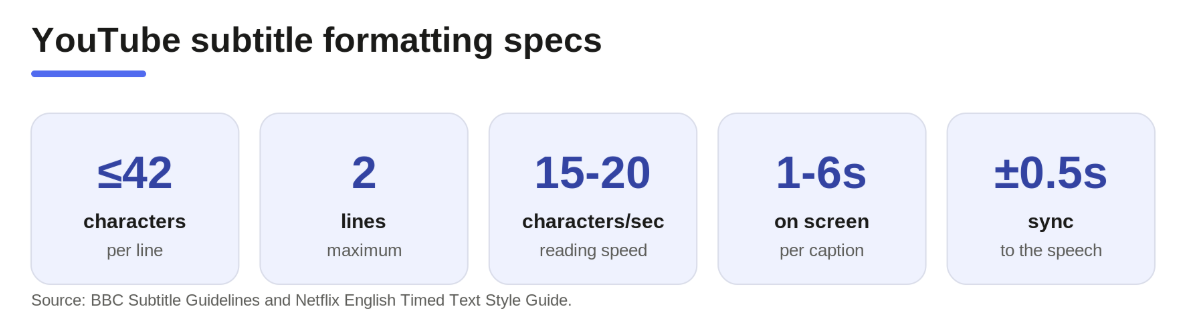
The specs that decide whether a caption is readable.
Keep every line to 42 characters or fewer, show at most two lines at a time, and hold each caption on screen for one to six seconds. Match the reading speed to 15-20 characters per second, and sync the text within half a second of the audio.
|
Rule |
Spec |
Why it matters |
|
Line length |
≤42 characters |
Longer lines pull the eye off the picture and truncate on mobile |
|
Lines on screen |
2 maximum |
A third line covers the frame and overloads the reader |
|
Reading speed |
15-20 CPS |
Past ~20 CPS, the average viewer can't finish the line in time |
|
On-screen time |
1-6 seconds |
Under 1s flashes past; over 6-7s the caption lingers after the audio |
|
Sync |
±0.5 s of speech |
Captions that drift break the link between sound and text |
|
Placement |
Lower center |
Clear of faces and lower-third graphics for long-form video |
|
Font & contrast |
Sans-serif, white on dark band |
Roboto, Arial, or Open Sans stay legible over any footage |
What Font, Size, and Contrast Work Best?
Use a sans-serif font at medium to bold weight. Roboto, Arial, and Open Sans stay legible at speed and ship with most editors. Skip cursive or decorative faces, which blur in motion.
White text on a semi-transparent dark band reads cleanly over both bright and dark footage; on mostly light video, black text on a light band works instead. Hold one caption style across the whole video so the viewer's eye never has to relearn it.
A standard .srt file stores no font data, so the player picks the typeface, and you control only italics, bold, and color.
YouTube's built-in caption editor goes further and strips styling altogether, so to bold, italicize, or color captions you upload a styled file or bake the look into the video.
If your video carries ads, confirm any custom font is licensed for commercial use.
How Do You Time and Break Subtitle Lines?
Each caption should track the speech within about half a second, or the lag becomes noticeable. Keep captions on screen one to six seconds and hold the reading speed in the 15-20 CPS range.
Break lines at natural pauses, such as the end of a clause, and never split a name or key phrase across two captions.
Hand-editing tools like Subtitle Edit display a reading-speed value per line, so you can catch captions that flash by too fast. A clean line break is one of the few subtitle fixes viewers feel without noticing.
Archive drag is one explanation. Packaging, traffic routing, and retention mechanics are three others. Most channels have a combination – and they're hard to see from inside your own Studio. We've found the actual blockers across 3,000+ channels. → Find what's off.
What is the Difference Between Subtitles, Closed Captions, and SDH?
Subtitles show spoken dialogue and assume the viewer can hear the audio. Closed captions (CC) assume the viewer cannot, so they add sound cues such as [music] or [door slams] and can be toggled on or off.
SDH (subtitles for the deaf and hard of hearing) combine subtitle-style formatting with those sound cues and speaker labels, and appear mostly on streaming platforms. Translated subtitles carry the dialogue into another language, covered later in this guide.
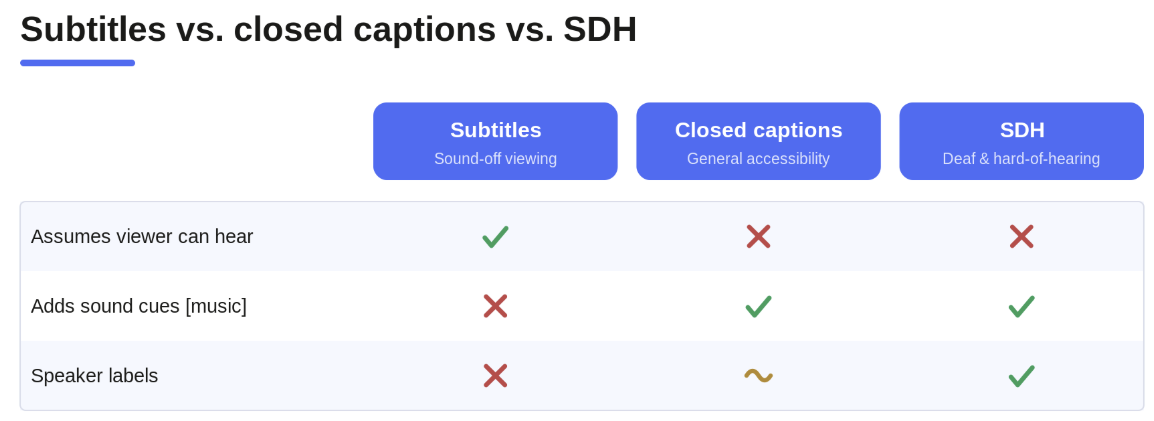
Subtitles, closed captions, and SDH side by side.
On YouTube, subtitles and closed captions both upload as caption tracks or generate automatically. YouTube has no separate SDH setting, so you deliver SDH as a caption track that includes the sound cues and speaker labels. Pick captions or SDH when accessibility is the goal, and translated subtitles when reach is.
How Do You Add Subtitles to a YouTube Video?
There are three ways. Generate YouTube's automatic captions and edit them, upload your own .srt or .vtt file for exact timing and wording, or burn styled captions into the video during editing. Most creators edit the auto track for their home language and upload a clean file when timing or styling has to be precise.
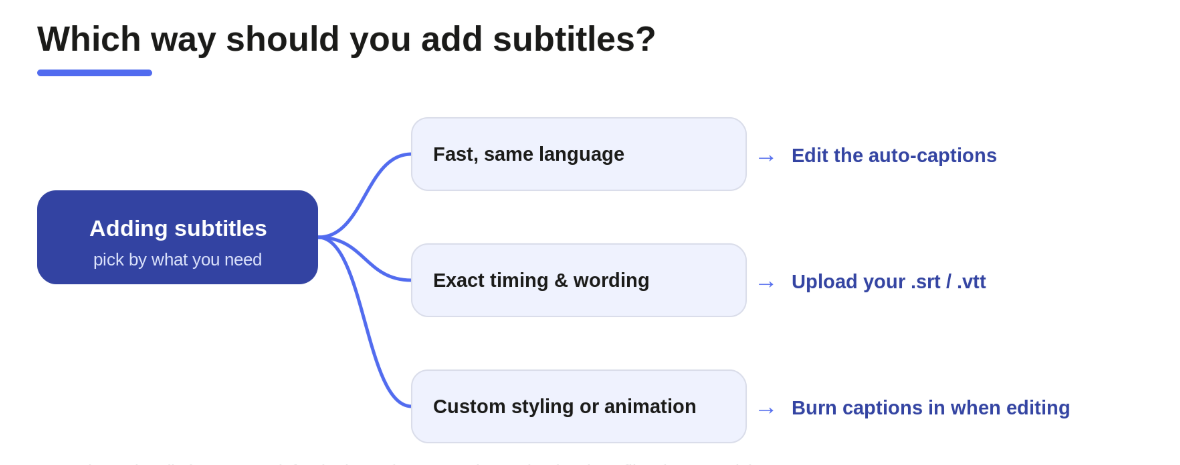
Pick an add method based on what the video needs.
- In YouTube Studio, open Subtitles and select the video.
- Click ADD next to the language you want, then choose Upload file.
- Pick With timing for an .srt or .vtt that already has timestamps, or Without timing to paste a plain transcript and let YouTube sync it to the audio.
- Review the captions against the audio in the preview, then Publish.
For a free transcript, dictate one:
Open Tools > Voice typing in Google Docs, play your video audio and let it transcribe, tidy the text, then upload it with the Without timing option so YouTube handles the sync.
It saves paying a transcription service on shorter videos.
Which Subtitle File Formats Does YouTube Support?
YouTube accepts SubRip (.srt), WebVTT (.vtt), SubViewer (.sbv), and several broadcast formats such as TTML and SCC. Use .srt for plain timed captions and .vtt when you want basic positioning or light styling. Save the file as UTF-8 so accented characters render correctly.
|
Format |
Extension |
Use it for |
Styling |
|
SubRip |
.srt |
The default for simple, timed captions |
Italics, bold, color |
|
WebVTT |
.vtt |
Web captions with basic position/styling |
Position + some styling |
|
SubViewer |
.sbv |
YouTube's own caption export |
Minimal |
|
Adv. SubStation Alpha |
.ass |
Multi-font styling in an editor before export |
Full: fonts, position, animation |
When Do You Need Advanced Styling?
Standard .srt and .vtt files carry only italics, bold, and color, not font changes inside a caption. To give different speakers different fonts, or to animate captions, use Advanced SubStation Alpha (.ass).
You define named styles in the file header and switch between them, or add inline override tags. Editors like Subtitle Edit, Premiere Pro, and DaVinci Resolve export .ass. YouTube won't render .ass styling on a normal caption upload, so bake styled captions into the video when the look matters.
Googling YouTube-related questions from time to time?
200+ AIR specialists check 3,000+ channels and every platform update daily. Add AIR to preferred sources, and Google surfaces our precise answer first. → Add AIR to preferred sources.
Should You Animate Subtitles?
Animation pays off mainly on Shorts, where motion holds attention in a fast feed; it stays optional for long-form. In Premiere Pro:
- select your caption clips
- choose Upgrade Caption to Graphic
- keyframe Position, Scale, or Opacity
- apply Ease In and Ease Out.
After Effects gives character-by-character control for complex work. Copy keyframe attributes across clips to keep the timing consistent.
How Accurate are YouTube's Automatic Captions?
YouTube's automatic captions land around 85-95% accuracy on clear audio, and drop to roughly 78-82% on videos with background noise, strong accents, or fast speech. Clean studio audio can reach the mid-90s; a manual transcript you upload gets you past 99%. The system still misreads names, technical terms, and homophones, so treat the auto track as a first draft and edit it before publishing.
- Sign in to YouTube Studio and open Subtitles.
- Next to the automatic track, click Duplicate and Edit (or More > Edit).
- Fix wording, punctuation, names, and timing. Press Enter to split one caption into two, Shift+Enter for a line break inside a caption.
- Publish, or use Upload file to replace the track with your own.
Clean audio is the cheapest way to raise accuracy before you edit a word – our guide on how to improve audio quality covers the setup.
How Do You Add Subtitles to YouTube Shorts?
Place captions in the middle third of the vertical frame, above the buttons and title along the bottom. Size the font larger than you would for long-form, around 24-32pt, and keep each caption to one to four words.
Skip YouTube's default auto-captions on Shorts; they use a bottom, long-form layout that fights the vertical frame.
Word-by-word animated captions earn their place here, since the movement holds attention while people scroll.
What Should You Check Before Publishing Subtitles?
Before you publish, confirm the subtitles are synced, readable, and saved in the right format. Run this list:
- ≤42 characters per line, 2 lines maximum
- On screen 1-6 seconds at a 15-20 CPS reading speed
- Synced within ±0.5 s of the spoken word
- Sans-serif font (Roboto, Arial, or Open Sans) at a readable size
- White text on a semi-transparent dark band, one style throughout
- Filler sounds (um, uh) removed, meaning preserved
- Line breaks at natural pauses, names kept on one line
- Saved as .srt or .vtt in UTF-8
When Good Subtitles Aren't Moving the Numbers
Subtitles are a hygiene fix. They win back the muted viewers you were losing in the first few seconds, but they can't correct a weak thumbnail, a slow open, or a video YouTube is routing to the wrong audience. If your captions are clean and the numbers still sit flat, the block is upstream.
An AIR channel audit reads your Studio data against niche benchmarks and tells you where that block actually is, and what to fix first. We've run it for 3,000+ channels, with a 450K-channel dataset and 21 in-house AI engines that surface what your own analytics can't.
What you get:
- A structured report across all 10 pillars of channel performance
- A 30-day action plan ranked by impact
- A 45–60 minute live walkthrough with your strategist