
Not Sure Which Languages to Choose?
Picture a creator who has perfected the craft: cinematic B-roll, tight storytelling, and a six-figure production budget. Yet, despite investing thousands of dollars per video, the growth curve has flattened into a frustrating plateau.
In 2026, even high-budget, high-quality content can stall once it saturates its available audience.
And at that point, growth is no longer a function of production; it’s a function of distribution. Our extensive data from thousands of channels shows three clear ways to do it: translation, alternative distribution, and continuous streaming.
The Plateau Isn’t a Content Problem. It’s a Surface-Area Problem.
So, why is your channel plateauing?
Our AIR team has supported YouTube creators on their way to success since 2010. When we first decided to investigate the problem, we were sure the key to solving it lay in optimizations (SEO, hooks, thumbnails, info cards & end screens, and so on). And, don’t get us wrong, those are great tools to boost a channel; we use them all the time.
But times changed. In 2026, to make a significant jump in earnings and break out of a growth plateau, you need more drastic measures.
Why? A plateau is often what happens when your content has already extracted most of the available value from its current environment. Your existing language audience has seen your format. Your home market is saturated. Your recommendation graph has matured. The algorithm understands who to show you, and that audience is no longer expanding fast enough to move the channel.
This is why small optimizations stop working after a certain point.
If your content is only discoverable in one language, monetized through one platform, and consumed only in upload-based bursts, your ceiling arrives faster than you expect.
Breaking that ceiling requires more than “optimization.” It requires adding new growth surfaces.
That is where the real gains begin.
1. The Global Scale: Breaking Borders with Translation & Localization
Over the past six months, YouTube has made its stance clear: localization is the future. With the mass rollout of native multi-language audio tools, AI-generated idea suggestions based on regional engagement, and the new ability to manually edit auto-generated dubs, YouTube is actively pushing creators to go global. And it is not stopping there.
Here’s what Buddhika Kottahachchi, Product Lead for YouTube AutoDubbing, has to say about the future of video translation on the platform:
“We have a pilot running right now of this feature called ‘lip sync’, where we take the subject of the video and reanimate their lips to match the translated audio. But there's so much else in the visual domain that can be translated. For example, there's text that's built into the screen. So, we're working on translating those elements in the visual domain so that, as a viewer, you get a completely immersive translation experience when you're watching a dubbed video.” Source: Creator Insider.
That means the YouTube team is actively working on eliminating the gap between original and translated content. And it’s definitely a long-term direction.
So, if creators want to be ahead of the curve, they need to start thinking about localization now. Because in a world where everyone is global, early adopters become the default choice for entire markets.
But many creators move straight to dubbing, skipping the layer that defines how their content is discovered in the first place.
1.1 Metadata Comes Before Voice
The first thing YouTube needs to understand is where the video belongs.
Titles, descriptions, tags, and now even thumbnails, are classification signals. They tell YouTube which search environments and recommendation clusters your content can participate in.
If your titles, descriptions, and tags exist only in one language, YouTube has no reason to test your content in another. The system indexes your videos within a single linguistic ecosystem, and that’s where they stay.
Once YouTube metadata is translated, that changes.
One of the clearest examples is our partner, Cozy Relaxing Jazz, an English-first music channel that wanted global reach without rebuilding the content itself. AIR localized the metadata across multiple languages, including German, French, Spanish, Portuguese, Japanese, Korean, Dutch, and Italian. No dubbing, no re-uploads.
Within months, the channel saw:
- +195% total views
- +169% ad revenue
- +126% subscriber growth
And the most revealing metric was this: 25% of the channel’s traffic started coming directly from translated metadata.
That means one out of every four viewers was finding the content because the channel had become visible in non-English discovery systems.
We’ve seen the same mechanism play out in more complex, voice-driven content as well. When the Ukrainian news and history channel UNITED24 hit an organic growth plateau, we applied metadata localization to expand its discoverability across regions.
It was immediate redistribution:
- Japan grew by +261.7% (from 1.5M to 5.6M views)
- France by +230.2% (from 1.5M to 4.9M)
- Germany by +169.4% (from 4.2M to 11.2M views)
With overall global views increasing by +131% and revenue by +52%. This happened because the metadata allowed folks from different countries who understand English to find the creator’s content. Before that, it was invisible to them.
And sometimes in cases like that, we stop at just AI metadata translation. But what about content where understanding the voice is the whole experience?
1.2 Human vs. AI Dubbs: The Retention Paradox
Once your metadata is localized, the next step is audio. While YouTube offers basic auto-dubbing, it often tanks audience retention. Viewers click away when translations sound robotic, culturally tone-deaf, or poorly timed.
And this is where the difference between AI dubbing and human localization becomes measurable.
On Brave Wilderness’s Spanish channel, switching from professional dubbing to an AI-generated track caused retention to collapse from 5:19 to 1:22. In a separate kids’ channel with over 5 million Italian-speaking views, the professionally dubbed version held 5–6 minutes, while the AI version dropped to 0:54. More importantly, the impact didn’t stay isolated. The AI track pulled down overall channel watch time, sending negative signals to the algorithm beyond just the translated content.
We saw the same pattern repeated across other channels.
On an Italian-speaking kids channel with over 5 million views, switching from professional dubbing to AI dropped average view duration from 5–6 minutes to 0:54. Again, a nearly 5x decline, despite the content already being validated in that market.
Another test on a multi-language channel made the gap even clearer. On the Serbian version, professionally dubbed content held 7:13, and the German version 5:51. The same content with an AI-dubbed English track dropped to just 0:43.
But what’s more interesting is the inverse case.
Our team tested high-quality human dubbing against standard AI voices on this huge entertainment creator with 100M+ subscribers on the main channel. We translated their content into 11 languages, and the localized versions outperformed the original.
- English (original): 6:26
- Spanish: 8:24
- Portuguese: 7:59
- Russian: 7:40
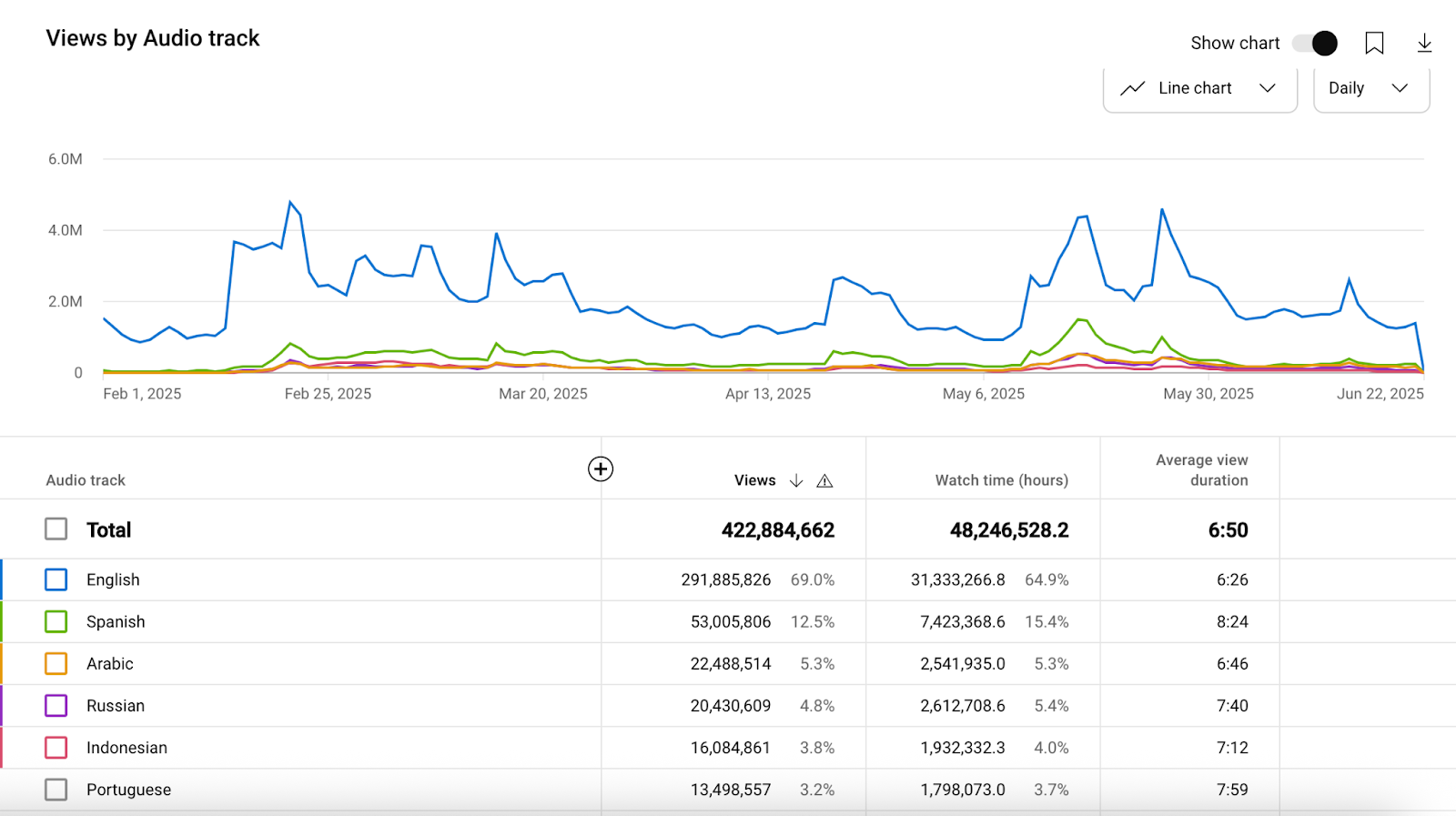
This reframes the entire discussion. We can see that the problem is not localization, but low-quality localization. Because pacing, tone, and emotional delivery determine whether a viewer continues watching or drops within seconds.
That doesn’t make AI irrelevant. It makes it a testing layer.
Used correctly, AI dubbing helps identify where demand exists. But the markets that actually scale (Japan, Germany, Brazil) almost always require human-level localization to sustain retention and unlock algorithmic growth.
The 2026 standard is not AI or human. It’s a hybrid system: AI for speed and coverage, human editors and native voice actors for performance.
1.3 Multi-Language Audio vs. Separate Channels
At first glance, the shift toward multi-language audio tracks seems like an obvious next step for global scaling. Here’s what MrBeast (aka Jimmy Donaldson) has to say about it:
“Having a lot of different channels is honestly a lot more work. It’s much easier just to run 1 channel than 12. You have to make 12 different thumbnails, reply to comments on 12 uploads… It’s just so much easier to have everything in one central place. And it’s also simpler for fans. Instead of being like ‘if you’re in this country, watch this channel,’ now it’s just one video with all the dubs. If you take 12 language channels and combine them into one with multi-language audio, it supercharges the heck out of the video.” Source: Creator Insider.
You might read it and think, “ok, if MrBeast chooses audio tracks, I should too, because this guy probably understands YouTube better than almost anyone.” But the thing is, he didn’t start with audio tracks. First, he had those huge separate channels for every language, gathered millions of subscribers on each, let the audience get to know him, built trust, built communities, and ONLY THEN redirected them to his main channel, switching to audio tracks.
He didn’t use audio tracks to discover new audiences. He used them to consolidate audiences he had already built.
That’s why we don’t recommend starting with MLA. Audio tracks are not the final step of a growth strategy. They’re a scaling layer. They work best after demand is already proven across markets.
The takeaway: Separate channels create signals. MLA amplifies them.
After working on 400+ channels, we don’t choose between MLA and separate channels. To unlock full potential, you need both.
Across hundreds of localized channels, we found that the real question isn’t “MLA or separate channels.” It’s how they work together.
Because dubbed audio doesn’t have to stay locked to one channel.
For example, a Spanish dub from a dedicated Spanish channel can be added as an MLA track to your German, Polish, or main channel. Spanish-speaking audiences exist across all markets where your content already performs.
We call it cross-seeding.
Instead of growing each channel in isolation, you layer demand across them.
The result: +45% average view growth compared to running channels independently.
The Vania Mania Kids case shows this clearly. After building strong Spanish, German, and Polish channels, we tested Portuguese as a separate channel… it didn’t work. Instead, we added Portuguese as an MLA track to existing channels.
No new content. Just redistribution.
Result: +5 million views in six months from an audience that was previously unreachable.
That’s the hybrid model:
Separate channels to prove demand. MLA to scale it across overlapping audiences.
Not sure which languages will actually grow your channel?
We’ll analyze your content and identify markets with the highest CPM, reach, and engagement potential. Contact us to build a localization strategy that scales.
2. Beyond YouTube: Maximizing Yield with Video Distribution
Relying entirely on YouTube AdSense in 2026 is risky and limiting.
Even strong channels face volatility. RPMs fluctuate seasonally. Algorithm shifts can suppress distribution overnight. Ad blockers continue to erode monetization. And most importantly, every video is competing inside one of the most saturated ecosystems on the internet.
So the question is no longer how to get more out of YouTube alone.
It’s how to get more out of the same content.
The creators scaling fastest right now are redistributing what already works into new environments, where competition is lower, and demand is still underserved.
2.1 The MSN Opportunity
One of the clearest examples of this shift is MSN, Microsoft’s content ecosystem.
Unlike YouTube, MSN is not a single platform. It’s embedded across multiple high-traffic surfaces:
- Bing search
- Microsoft Edge new tab feed
- Windows widgets and news panels
- Copilot
- The MSN app
This creates a different type of distribution layer.
Instead of relying on subscribers or channel authority, your videos are placed directly into existing traffic flows. And at scale, those flows are massive — 700+ million monthly users, around 1 billion daily page views, and hundreds of millions of minutes watched every day.
But the real difference isn’t just reach.
It’s a competition.
On YouTube, every niche is saturated. On MSN, creator density is still low. That imbalance creates a simple but powerful effect: content that struggles to break through on YouTube can perform immediately when placed into a less crowded ecosystem.
At the same time, MSN is not a “zero-history” platform.
Strong performance on MSN typically correlates with existing traction:
- Channels with 10,000+ subscribers perform best
- 7,000+ subscribers with strong views are often enough to qualify
- A library of 100+ videos provides scale
- Clear niche positioning and consistent engagement matter
In other words, MSN works best when there is already proven demand. It uses those signals to scale the distribution more efficiently, rather than starting from zero.
We’ve seen this clearly in practice.
One action-comedy channel we worked with was already generating 125M+ monthly views on YouTube, but wanted to reduce dependency on AdSense. After onboarding to MSN, we distributed their existing content across Microsoft surfaces.
Within the first month alone, the channel generated 677K views and 226K engaged views, entirely incremental, without affecting their YouTube performance.
For this creator, MSN was a second layer that extends the reach and monetization of content that’s already working.
2.2 Re-Monetizing Existing Assets
The most important shift here is how you think about your content. Your video library is a portfolio of assets that can generate value in multiple environments.
MSN allows you to syndicate your existing YouTube videos without any additional production. No re-editing, no re-upload strategy, no new filming. And unlike YouTube, monetization starts immediately. There are no thresholds to unlock revenue.
This changes the economics completely.
We’ve seen creators unlock entirely new growth curves from content that had already plateaued.
A handmade jewelry channel is a clear example. After exhausting growth on YouTube, they distributed their archive to MSN. In just 1.5 months, they generated 1.3 million views and $1,300 in additional revenue, effectively matching their lifetime YouTube performance — without uploading anything new.
A tech and inventions channel showed the same pattern. Over three months, their videos reached 1.5 million views on YouTube. On MSN, those exact same videos generated 6.9 million views. The content didn’t change. The environment did.
And in one of the clearest cases, a life hacks channel that had declined to 134,000 monthly views on YouTube pushed its content to MSN and reached 1.8 million views in just two months.
That means when your content hits a plateau, it’s often not because it lost value. It’s because it has exhausted its current distribution layer.
Move that same content into a different ecosystem, and performance resets.
Want to earn more from videos you’ve already uploaded?
We’ll help you turn your library into a multi-platform asset through MSN distribution. Reach out to us and multiply your content’s yield.
3. Infinite Retention: 24/7 Streams and TV Optimization
YouTube's 2026 algorithm heavily favors one overarching metric: session watch time. The platform wants to keep users on the app as long as possible. If your channel can facilitate long sessions, YouTube will reward you with massive Suggested and Home feed traffic.
"YouTube cares about sessions more than views now. A 24/7 stream is just the logical response to that." — Elina Samokhvalova, 24/7 Streaming Expert at AIR Media-Tech
3.1 The Power of 24/7 Continuous Streaming
So, if your growth has plateaued, one of the most effective strategies is to spin up a 24/7 continuous livestream using your top-performing archived content. This creates a perpetual engine for watch time, community engagement, and ad revenue.
We’ve seen channels stabilize their revenue and significantly increase total watch time without increasing upload frequency, simply by repurposing existing content into continuous streams.
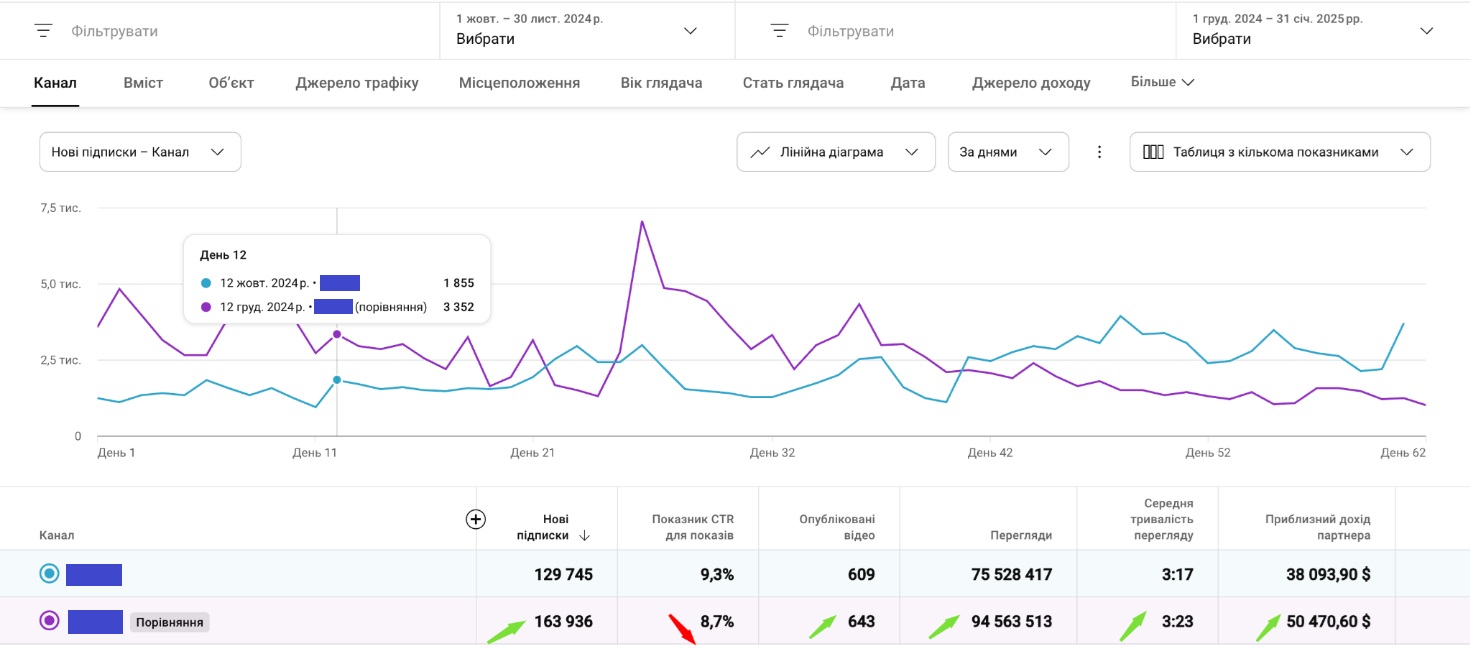
It’s exactly what happened to this major news channel (2.2M subscribers) that came to AIR Media-Tech, struggling with demonetization (yellow tags) and stagnant earnings. After cleaning up the metadata and appealing 53 yellow tags, we launched a 24/7 continuous stream of their best content. Here are the results:
- Gross profit increased by 49% month-over-month.
- The channel stabilized its income, creating a system that generated revenue even on days when no new videos were uploaded.
Not sure if this would work for your channel? Contact us, and we’ll map out the best streaming strategy based on your content.
3.2 Vertical Livestreams: The Shorts Bridge
If you are heavily invested in YouTube Shorts, vertical livestreams are the 2026 growth tool you cannot ignore. Users scrolling through the Shorts feed are highly likely to stop and interact with a livestream that matches their native vertical experience.
At AIR Media-Tech, analysis of thousands of partner channels shows that this setup is particularly effective for personality-driven content where the focus is on a single character, face, or close-up scene. Because the format aligns with consumption habits on Shorts, TikTok, and Reels, viewers are far more likely to stop scrolling and engage with a live broadcast that doesn't require them to rotate their phones.
Also, data across AIR partners shows that launching vertical livestreams on Shorts-heavy channels results in:
- Reach increases of up to 25%.
- Revenue growth ranging from 10% to 27%.
- Subscriber spikes of up to 10% as the stream pulls algorithm-driven viewers directly into a live community setting.
With YouTube now offering the option to stream multiformat (both vertical and horizontal simultaneously), it has never been easier to implement this strategy without disrupting your existing production workflow.
"Multi-format is one of the main strategies in 2025. Experiment with everything YouTube has to offer. Drive traffic from Short to long videos, try longer formats, optimize for TV, run vertical and horizontal streams, and always A/B test titles and thumbnails. Going down these roads gave our partners the best results." – Vlad Hvorostyanyi, YouTube Development Expert at AIR
3.3 TV-First Optimization
The fastest-growing screen for YouTube consumption is the living room TV. Viewers watching on smart TVs have significantly higher retention rates.
Here is what the CEO of YouTube, Neal Mohan, has to say about this:
“The living room continues to be an area of strength and investment for us. We're coming up on three years where we're the number one streamer here in the US. So, in order to continue to maintain that position, we're going to invest in the product.” Source: Neal Mohan on YouTube.
It means YouTube is becoming a TV platform, so creators should think beyond mobile content and start making videos that work well on the big screen in the living room. And it’s a great way to break a plateau, because we know YouTube is going to push such types of content.
Here’s how to optimize for the big screen:
- Visuals & Pacing: Slower, cinematic cuts perform better on TVs than the hyper-fast editing styles popularized on mobile.
- Playlist Architecture: TV viewers love to "binge." Structure your videos into highly thematic, sequential playlists with custom thumbnails. If you can hook a TV viewer into an auto-playing 5-video playlist, your session watch time will skyrocket, prompting the algorithm to aggressively push your channel.
Increase watch time without uploading more videos.
We’ll turn your existing content into a 24/7 streaming system that drives continuous engagement and revenue. Contact us to set up your always-on growth engine.
Escaping the Upload Treadmill
Breaking through a growth plateau in 2026 requires stepping off the traditional "upload and hope" treadmill. The creators who are doubling their revenue aren't necessarily working twice as hard on production; they are optimizing their existing assets.
By translating your YouTube metadata to unlock global algorithms, syndicating your library to high-yield platforms like MSN, and deploying 24/7 streams to farm watch time, you can trigger exponential growth.
Ready to implement this framework and scale your channel? Partner with AIR Media-Tech today to unlock enterprise-level tools, localization labs, and premium distribution networks.
Stop settling for a plateau, and let's build your global empire.