
Every distributor here gets your music onto Spotify, Apple Music, and TikTok. The difference is the money, and what happens to it when you stop paying. Some charge a yearly fee, some take a cut of every stream, and some keep 15–25% of your royalties once you cancel.
So we went through the pricing pages of 13 music distribution services in September 2026 and lined everything up: yearly fees, commissions, YouTube Content ID cuts, and what happens to your catalog after you cancel. AIR Music, our own distribution service, is in there too, pros and cons included. Then we'll walk through who each service fits, what to look for beyond the price, and why artists end up leaving the big DIY platforms.
In this guide:
- Music distribution services compared: prices and fees
- Top 13 music distribution services in 2026
- How to choose a music distribution service
- What happens to your music if you stop paying
- Why artists switch distributors
- Free vs paid music distribution
Music Distribution Services Compared: Prices and Fees in 2026
Here's the whole picture in one table. If you only have time for one column, read the one about what happens if you stop paying.Here's the whole picture in one table. If you only have time for one column, read the one about what happens if you stop paying.
Prices and terms checked on each service's official pricing and support pages in September 2026.
| Music distribution service | Price (September 2026) | Streaming royalties the artist keeps | YouTube Content ID terms | How support works | What happens if you stop paying | Best for |
|---|---|---|---|---|---|---|
| AIR Music | No upfront fee, no subscription | Revenue share set in the contract; artist keeps 100% of rights | Included, with reupload protection | A named personal manager who replies within 24 hours | No subscription to lapse; flexible contract terms | Artists and small labels who want a personal manager |
| DistroKid | $24.99–$89.99 per year | 100% | Paid add-on ($4.95 per single or $14.95 per album a year); DistroKid keeps 20% | Help center chatbot (DistroBot) that can hand you to a person | Releases come down unless you buy Leave a Legacy ($29 per single, $49 per album) | Frequent releases on a small budget |
| TuneCore | $24.99–$54.99 per year | 100% | Included; TuneCore takes a 20% fee on social and UGC revenue | Replies in 3 business days on Rising Artist, 2 on Breakout Artist, 1 on Professional | Releases come down the day the plan expires | Content ID and publishing in one place |
| CD Baby | $9.99 per single, $14.99 per album, one-time | 91% | Included in the release fee | Artist support team via help center requests; a year of priority support with FastForward ($29.99 per release) | Nothing changes: there is no subscription | One or two releases a year |
| LANDR | Distribution $24–$45 per year, or LANDR Studio $8.25–$16 a month billed yearly | 100% | Included but curated: AI-assisted tracks and non-exclusive samples aren't eligible | Email only, on weekdays; replies in 3 days, or 24 hours on Studio Pro | LANDR says releases stay live forever | Artists who also need mastering, samples, and plugins |
| Symphonic | Starter $29.99 per year; Partner by application | 100% on Starter | Unpublished percentage of YouTube, Meta, and TikTok revenue | Help desk on Starter, most replies in 24–48 hours; personalized support on Partner | Starter releases come down when the paid year ends | Artists growing toward a label-style deal |
| UnitedMasters | SELECT $59.99 per year | 100% | Not listed on pricing page | Request form and email; no phone line | Releases come down after SELECT ends | Brand deals and sync |
| Amuse | $23.99–$59.99 per year | 100% | 15% fee on Artist and Artist Plus; no fee on Professional | Chat in the help center and the app | Releases stay live; Amuse keeps 25% of future royalties | Managing releases from a phone |
| Ditto Music | $19–$109 per year | 100% of streaming; 85% of publishing and sync | Included from the Pro plan | Chat and email | Starter releases come down; Pro and Labels releases stay live | The cheapest yearly plan |
| RouteNote | Free, or Premium from $10 per release plus $9.99 per year | 85% on Free, 100% on Premium | Not listed on pricing page | Chat assistant (Luna), email, and tickets | Premium releases switch to Free (85%) | Starting without paying upfront |
| ONErpm | Free | 85% | ONErpm keeps 30% of YouTube revenue | Help desk tickets and email | Nothing changes: there is no subscription | Free distribution with marketing services |
| AWAL | Free, by application | 85% on AWAL Core | Not listed | No dedicated representative on Core; account rep on AWAL+ | Nothing changes: there is no subscription; 30-day rolling contract | Artists with proven streaming traction |
| Too Lost | $19.99 per year (Artist), $35.99 (Label) | 100% | Not listed on pricing page | Support tickets and a contact form | Releases stay live; the artist keeps 85% of royalties | A low-cost subscription |
Platforms can reject your track. Check it for free before you release it
An uncleared sample, a metadata error, or a rights conflict can get a release rejected at any distributor. A real AIR Music manager checks your track for free and tells you in 24–48 hours if it's safe to release.
Get a free Track Safety Check →Top 13 Music Distribution Services in 2026
Now the details. For each music distribution service: who it's for, what it costs as of September 2026, and the catches worth knowing before you sign up.
We put AIR Music first because it's the only service here where every artist gets a personal manager. Its cons are listed the same way as everyone else's.
1. AIR Music
AIR Music, the distribution service of AIR Media-Tech, suits artists and small labels who want a person managing their releases instead of a ticket queue.
Pricing (checked September 2026): AIR Music charges no upfront fee and no subscription. It works on a revenue share, and the artist keeps 100% of the rights.
Key features:
- Distribution to 100+ platforms, including Spotify, Apple Music, YouTube Music, TikTok, and Instagram.
- A personal manager who replies within 24 hours and plans releases with the artist.
- A free Track Safety Check before release: a manager reviews copyright, samples, and metadata and sends a report in 24–48 hours.
- Editorial and curator playlist pitching, plus paid promo campaigns.
- YouTube Content ID and reupload protection through AIR Media-Tech, an official YouTube partner, with claim disputes handled by the team.
- Help with setting up a YouTube Official Artist Channel.
- AIR Music for labels: one manager for the whole roster, from release plans to royalties.
- Per-track, per-platform earnings reports and monthly payouts.
Pros:
- AIR Music takes nothing before your music earns.
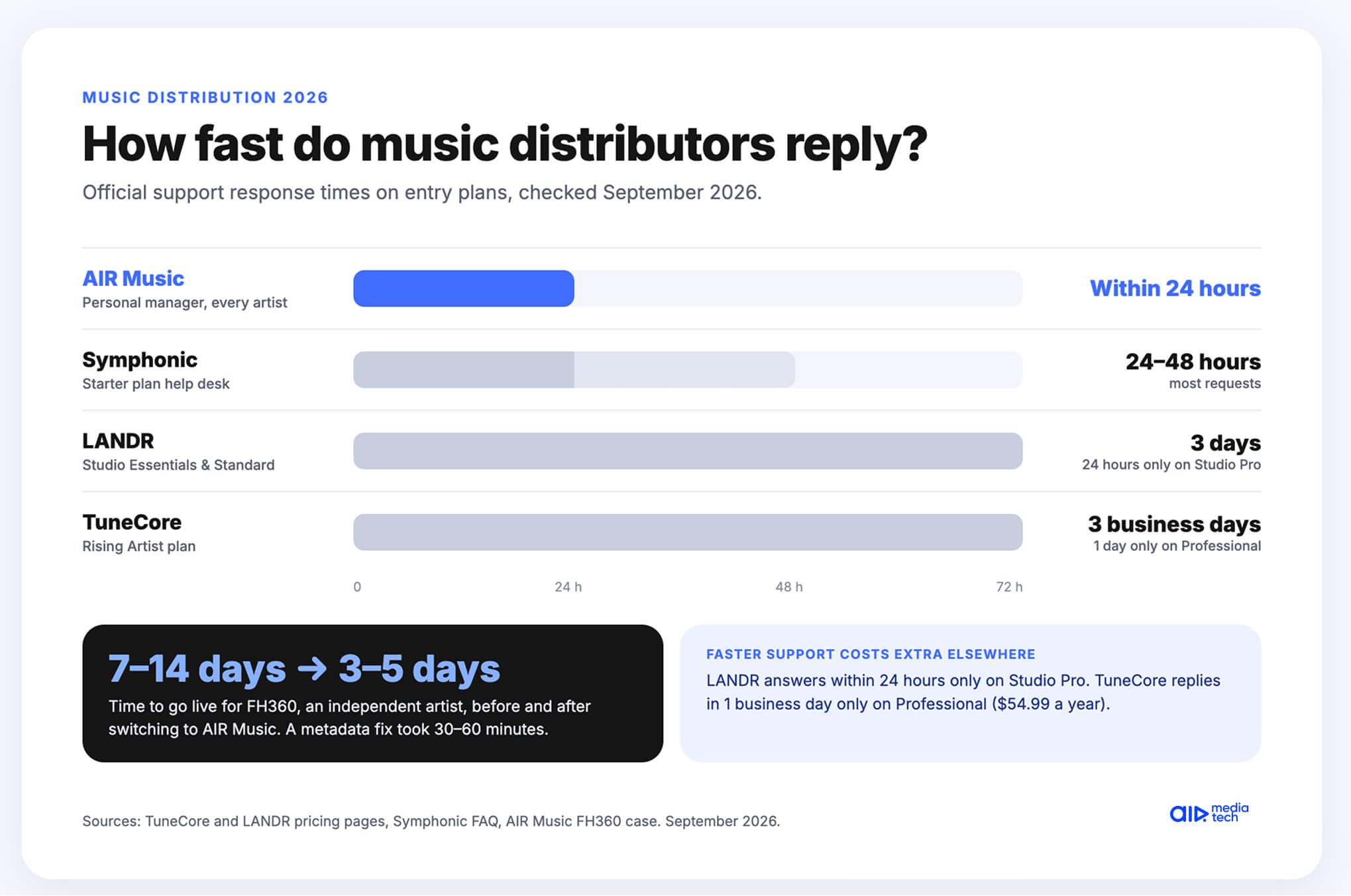
- AIR Music support works at release speed. FH360, an independent artist distributing with AIR Music, got a metadata fix in 30–60 minutes after 7–14-day waits at his old distributor (FH360 case).
- AIR Music protects ownership in practice. When a fake label uploaded one of Refaat Mridha's tracks, the AIR Music team checked his proof of ownership and returned the track to him (Refaat case).
- Kevin Kane's indie label Barvill Entertainment got help with its YouTube Official Artist Channel at AIR Music and now releases in about 3–5 days (Barvill Entertainment case).
- AIR Music works with 5,500 artists and has delivered 1.5B+ streams and 90K playlist placements.
Cons:
- AIR Music reviews each catalog before onboarding, so not every artist gets accepted.
- On a revenue share, AIR Music earns a percentage of royalties. An artist with a large, steady catalog may pay less on a flat subscription.
AIR Music, the distribution service of AIR Media-Tech, suits artists and small labels who want a person managing their releases instead of a ticket queue.
2. DistroKid
DistroKid suits artists who release often and want the cheapest way to keep unlimited tracks in stores.
Pricing (checked September 2026): Musician costs $24.99 a year for one artist, Musician Plus $44.99 for two, and Ultimate $89.99 for up to 100 artists, according to DistroKid's pricing page.
Key features:
- Unlimited uploads to 150+ stores and streaming services.
- Automatic royalty splits between collaborators.
- A Spotify registered artist profile on every plan.
Pros:
- DistroKid passes 100% of streaming royalties to the artist.
- The entry plan costs less than most subscriptions on this list.
Cons:
- YouTube Content ID is part of DistroKid's paid Social Media Pack ($4.95 per single or $14.95 per album a year), and DistroKid keeps 20% of the Content ID revenue DistroKid Help Center.
- If you stop paying for DistroKid, your music comes down unless you buy Leave a Legacy for each release ($29 per single or $49 per album, one-time).
- DistroKid support runs mostly through tickets and automated replies.
3. TuneCore
TuneCore suits artists who want Content ID and publishing administration from the same place as distribution.
Pricing (checked September 2026): Rising Artist costs $24.99 a year, Breakout Artist $44.99, and Professional $54.99 with unlimited artist profiles, according to TuneCore's pricing page.
Key features:
- Unlimited releases to 150+ stores.
- YouTube Content ID included in every plan.
- Publishing administration and revenue advances (advances on the Professional plan).
Pros:
- TuneCore passes 100% of streaming revenue to the artist on all subscription plans.
- TuneCore includes Content ID without an extra per-release fee.
Cons:
- TuneCore takes a 20% fee on revenue from social and UGC platforms.
- TuneCore's official support response time is 3 business days on Rising Artist, 2 on Breakout Artist, and 1 business day only on Professional.
- If a TuneCore plan expires, TuneCore takes the releases down, and bringing them back means distributing them again from scratch.
4. CD Baby
CD Baby suits artists who release a few times a year and don't want an annual bill.
Pricing (checked September 2026): CD Baby charges a one-time $9.99 per single or $14.99 per album, with no annual fee, according to CD Baby.
Key features:
- Pay once per release, and the release stays in stores.
- YouTube monetization included in the release fee.
- Optional CDB Boost ($39.99 per release) for sync, SoundExchange, and MLC collection.
Pros:
- CD Baby releases stay live without a yearly renewal.
- For one or two releases a year, CD Baby costs less than any subscription.
Cons:
- CD Baby keeps 9% of all digital revenue for the life of each release.
- Priority support costs extra: FastForward ($29.99 per release) adds faster inspection and a year of priority support CD Baby Help Center.
- Universal Music Group owns CD Baby since February 2026, when it closed its $775 million purchase of Downtown Music (Variety).
5. LANDR
LANDR suits artists who also need mastering, samples, and plugins and want them in one subscription with distribution.
Pricing (checked September 2026): LANDR Distribution costs $24 or $45 a year, according to LANDR support, and LANDR Studio, which adds mastering, samples, and plugins, costs $8.25-$16 a month billed yearly, according to LANDR's pricing page.
Key features:
- Unlimited releases to 150+ digital stores.
- AI mastering, sample credits, and plugins in every Studio plan.
- Release review in 5–7 days on Studio Essentials and 2–5 days on Standard and Pro.
Pros:
- LANDR passes 100% of digital store revenue to the artist.
- LANDR says releases stay live forever.
Cons:
- LANDR support works by email on weekdays and replies within 3 days, or within 24 hours only on Studio Pro.
- LANDR limits monthly uploads of AI-generated tracks.
- LANDR doesn't accept AI-assisted tracks or tracks with non-exclusive samples (including from LANDR Samples and Splice) for YouTube Content ID, TikTok, and Meta monetization.
6. Symphonic
Symphonic suits independent artists who plan to grow into a label-style deal, and labels.
Pricing (checked September 2026): Starter costs $29.99 a year for one primary artist. Partner is a custom revenue-share deal by application, according to Symphonic's pricing page.
Key features:
- Sync licensing opportunities.
- Music video distribution from $25 per video.
- Label services for artists accepted to Partner.
Pros:
- Symphonic Starter passes 100% of streaming DSP royalties to the artist.
- Symphonic offers a path from self-serve to a label-style deal without switching distributors.
Cons:
- Symphonic takes a percentage of YouTube, Meta, and TikTok revenue on Starter and doesn't publish the rate.
- Symphonic Partner terms aren't public.
- Symphonic takes Starter releases down when the paid year ends without renewal.
- Symphonic's help desk answers most Starter requests in 24–48 hours Symphonic FAQ.
- A release distributed through Symphonic can't move to another distributor until the end of the contract term.
7. UnitedMasters
UnitedMasters suits emerging artists who want brand deals along with distribution.
Pricing (checked September 2026): SELECT costs $59.99 a year and passes 100% of royalties to the artist, according to UnitedMasters support. Since October 2025, the free DEBUT plan no longer distributes music.
Key features:
- Unlimited releases to 35+ music services on SELECT.
- Access to brand partnership opportunities.
- Sync licensing.
Pros:
- UnitedMasters connects artists with brand campaigns, which most distributors don't offer.
Cons:
- UnitedMasters SELECT costs more than the entry plans of DistroKid, TuneCore, or Ditto.
- When a UnitedMasters SELECT membership ends, the artist's releases come down from all music services.
8. Amuse
Amuse suits artists who want to manage releases from a phone.
Pricing (checked September 2026): Artist costs $23.99 a year, Artist Plus $39.99, and Professional $59.99, according to Amuse's pricing page. All three plans are paid.
Key features:
- Unlimited releases to major streaming services and social networks.
- Mobile-first app with daily streaming insights.
- Royalty advances for subscribers.
Pros:
- Amuse passes 100% of streaming royalties to the artist on every plan.
- Amuse Professional includes YouTube Content ID with no fee.
Cons:
- Amuse takes 15% of Content ID revenue on the Artist and Artist Plus plans.
- On the Artist plan, Amuse charges a 15% fee on splits to collaborators without an Amuse subscription.
- If you cancel Amuse, your music stays live, but Amuse keeps 25% of all future royalties from it (Amuse support).
9. Ditto Music
Ditto Music suits artists who want the cheapest subscription with 100% of streaming income.
Pricing (checked September 2026): Starter costs $19 a year, Pro $59, and Labels $109, according to Ditto's pricing page.
Key features:
- Unlimited distribution on every plan.
- YouTube Content ID from the Pro plan.
- Publishing and sync royalty collection on Pro and Labels.
Pros:
- Ditto passes 100% of streaming income to the artist on every plan.
- Ditto Starter is the cheapest annual plan on this list.
Cons:
- Ditto Starter doesn't include Content ID.
- Ditto takes 15% of publishing and sync royalties.
- If you stop paying for Ditto Starter, your releases come down. On Pro and Labels, they stay live.
- Ari Herstand reports more reader complaints about Ditto than any other distributor he reviews (Ari's Take).
10. RouteNote
RouteNote suits artists who want to start free and pay only for releases that earn.
Pricing (checked September 2026): Free distribution keeps 15% of revenue. Premium keeps 0% and costs $10 per single, $20 per EP, or $30 per album, plus $9.99 a year per release, according to RouteNote support.
Key features:
- Free and Premium plans for each release.
- Releases can move between plans.
Pros:
- RouteNote lets artists release without paying upfront.
- RouteNote lets you move a release to Premium once it earns enough to cover the fee.
- If you stop paying for RouteNote Premium, the release stays live and moves to the Free plan (85%).
Cons:
- On the free RouteNote plan, the artist gives up 15% of revenue.
- RouteNote Premium charges a yearly fee per release, which adds up for a large catalog.
11. ONErpm
ONErpm suits artists who want free distribution with marketing services.
Pricing (checked September 2026): ONErpm charges no upfront fee, keeps 15% of store and streaming revenue, and keeps 30% of YouTube revenue, according to ONErpm.
Key features:
- Free distribution to major streaming services.
- Marketing and YouTube channel services.
Pros:
- ONErpm costs nothing upfront.
Cons:
- ONErpm's 15% commission costs more over time than a subscription with 0% commission.
- ONErpm keeps 30% of YouTube revenue.
12. AWAL
AWAL suits artists who already have streaming traction and want label-style services without signing to a label.
Pricing (checked September 2026): AWAL charges no upfront or annual fee and keeps 15% of royalties on its entry tier, AWAL Core, according to Ones To Watch. AWAL doesn't publish its terms or acceptance thresholds.
Key features:
- Distribution with real-time analytics.
- Label-style services for artists AWAL accepts to higher tiers.
Pros:
- AWAL costs nothing upfront.
- Artists accepted to AWAL get support closer to a label than a self-serve distributor.
- AWAL contracts can be ended with 30 days' notice.
Cons:
- AWAL rejects about 90% of applications, according to Ones To Watch.
- AWAL Core comes without a dedicated representative; account support starts at AWAL+.
- AWAL pays out only once your balance reaches $45.
13. Too Lost
Too Lost suits artists who want a low-cost subscription.
Pricing (checked September 2026): The Artist plan costs $19.99 a year and the Label plan $35.99 a year, both with 100% of earnings paid monthly, according to Too Lost's pricing page.
Key features:
- Delivery to 450+ stores and platforms.
Pros:
- Too Lost is one of the cheapest subscriptions with 100% of streaming royalties.
- Unlimited releases for one artist, or unlimited artists on the Label plan.
Cons:
- If you cancel Too Lost and keep your releases in stores, you keep 85% of royalties instead of 100%.
How to Choose a Music Distribution Service
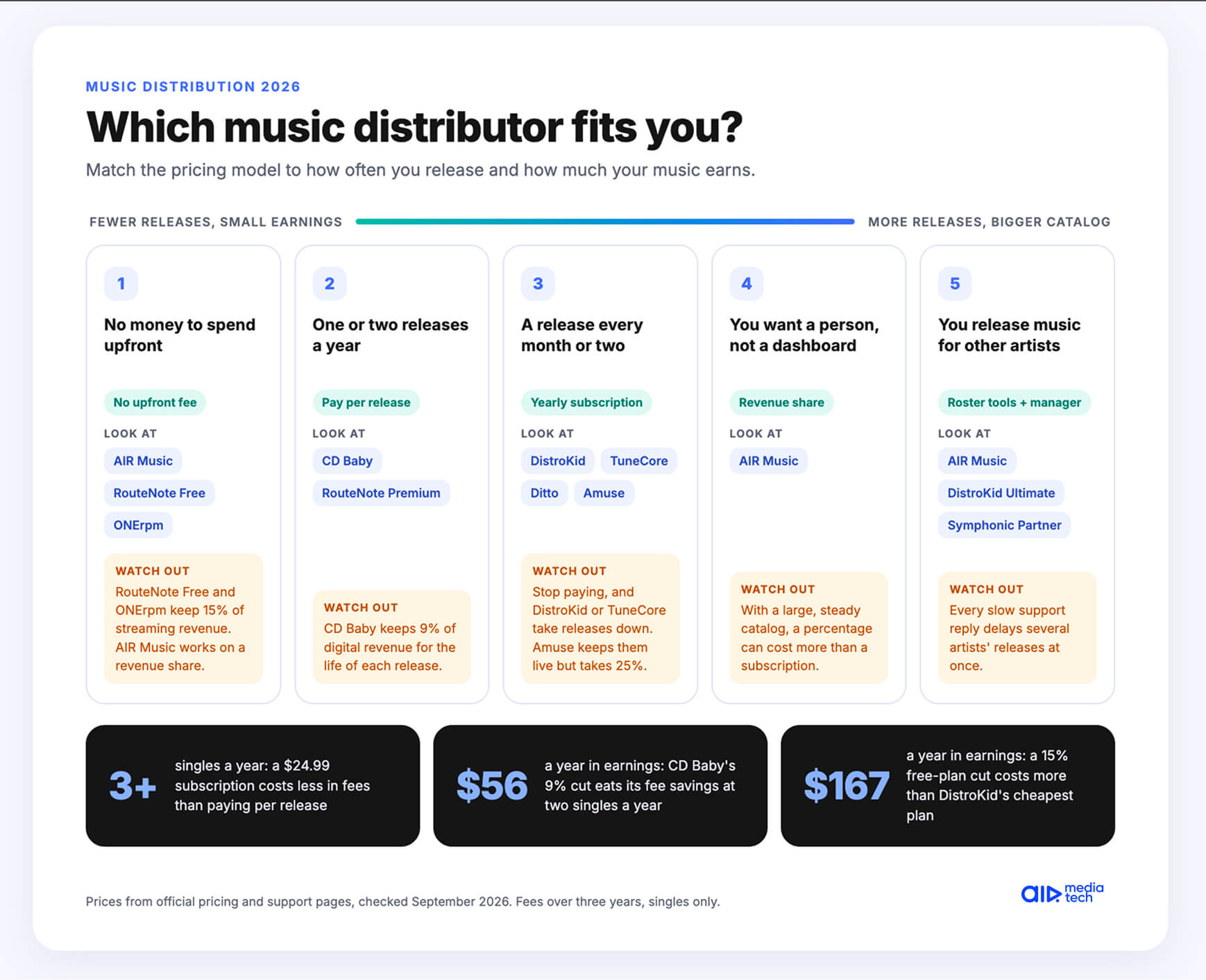
Price matters, but two services with the same price can do very different jobs for you. So start with what you need a distributor to do. AIR Music, the distribution service of AIR Media-Tech, covers all six needs below, and for each one we also name other services that do the job.
Six things artists need from a distributor
- Get your music on every platform. AIR Music delivers to 100+ platforms, including Spotify, Apple Music, YouTube Music, TikTok, and Instagram. DistroKid and TuneCore reach 150+ stores.
- Pay nothing upfront. AIR Music charges no upfront fee and no subscription, and it earns a share of royalties only when your music earns. RouteNote Free and ONErpm are also free to start, but both keep 15% of streaming revenue.
- Earn from YouTube and protect your tracks. AIR Music includes YouTube Content ID and reupload protection and handles claim disputes. TuneCore includes Content ID in every plan, and Amuse charges no Content ID fee on its Professional plan.
- Get playlist pitching and promo. At AIR Music, your personal manager pitches your releases to editorial and curator playlists, and AIR Music artists have 90K playlist placements so far. ONErpm offers marketing services, and Symphonic Partner offers label services by application.
- Talk to a real person. AIR Music gives every artist a named personal manager who replies within 24 hours. AWAL offers label-style support, but only to artists it accepts.
- Release music for other artists. AIR Music gives labels one manager for the whole roster, from release plans to royalties. DistroKid Ultimate covers up to 100 artists on a self-serve plan, and Symphonic Partner accepts labels by application.
What self-serve plans cost over three years
If you go self-serve, the cheapest option comes down to one number: how many releases you put out a year. The table counts fees only, for singles, at September 2026 prices. DistroKid Musician stands in for subscriptions and CD Baby for pay-per-release.
|
Singles released per year |
CD Baby (pay per release): fees over 3 years |
DistroKid Musician (subscription): fees over 3 years |
|---|---|---|
|
1 |
$29.97 |
$74.97 |
|
2 |
$59.94 |
$74.97 |
|
3 |
$89.91 |
$74.97 |
|
6 |
$179.82 |
$74.97 |
From three singles a year, a subscription costs less in fees than paying per release. Fees aren't the whole bill, though. CD Baby also keeps 9% of digital revenue. At two singles a year, CD Baby saves you $15.03 in fees over three years, and its 9% cut eats that saving once your music earns more than about $56 a year.
Subscriptions have their own catch. Stop paying DistroKid, and your music comes down unless you've bought Leave a Legacy for each release ($29 per single).
Once you've picked a distributor, our step-by-step checklist for uploading music to all major platforms covers the release itself.
Distributing music for other artists too?
Past 8–10 artists, every stuck release and every royalty question you can't answer lands on you. A personal manager takes that off your plate.
Apply for a Personal Manager →What Happens to Your Music If You Stop Paying
A pricing page tells you what you pay while you're paying. It doesn't always tell you what happens when you stop, and for a catalog you've built over years, that part matters more. The 13 services above fall into three groups.
Your music comes down
- DistroKid takes releases down unless you've bought Leave a Legacy for each one ($29 per single).
- TuneCore takes releases down the day the plan expires. According to TuneCore support, a removed release can't be restored, so you'd have to distribute it again as a new release.
- Ditto Music takes down releases on the Starter plan. Releases on Pro and Labels stay live after you cancel.
- Symphonic takes down Starter releases when the paid year ends.
- UnitedMasters takes releases down from all music services when a SELECT membership ends.
Your music stays, but the distributor keeps a bigger cut
- Amuse keeps releases live and takes 25% of all their future royalties.
- Too Lost keeps releases live and takes 15% of their royalties.
- RouteNote moves a Premium release to the Free plan, where the artist keeps 85%.
LANDR says releases stay live forever after you cancel. Its pricing page doesn't say whether the royalty split changes.
There's no subscription to stop paying
- CD Baby charges once per release and keeps 9% of digital revenue for as long as the release is live.
- ONErpm and AWAL take a 15% commission instead of a fee.
- RouteNote Free takes 15% instead of a fee.
- AIR Music works on a revenue share, with flexible contract terms that let artists leave early.
If you plan to switch distributors, don't cancel your old plan first. Upload the same recordings through the new distributor with the same ISRC codes and identical metadata, wait until they go live and the play counts match, and only then take them down at the old one. Streaming services match recordings by ISRC, so stream counts and playlist placements usually carry over (Ari's Take).
Moving a label's whole catalog takes a few more steps, covered in our guide to switching distributors without losing streams.
Why Artists Switch Distributors
Most artists start on one of the big self-serve platforms, and that makes sense at the beginning. Once the catalog grows, some of them move. The stories below come from artists who moved their music to AIR Music, the distribution service of AIR Media-Tech, so yes, they show one side of the switch. They also match what artists complain about on Reddit and in reviews of DIY distributors.
Support replies take days
On a self-serve platform, a support ticket can sit for days, and a release date doesn't wait. FH360, an independent artist who blends mouth sounds with AI, waited 7–14 days for releases at his old distributor. With AIR Music, his track "Deeper (ft. Sara A)" went live in 3–5 days, and a metadata fix took 30–60 minutes (FH360 case). Refaat Mridha, an artist who runs his own label, waited 5–7 days for ticket replies before he moved his catalog to AIR Music (Refaat case).
Official response times on self-serve platforms run in days: 3 business days on TuneCore's entry plan, 3 days on LANDR Studio Essentials and Standard, and 24–48 hours for most requests at Symphonic.
If your distributor has already gone quiet, here's what a label can do while its music distributor isn't responding.
Content ID costs extra
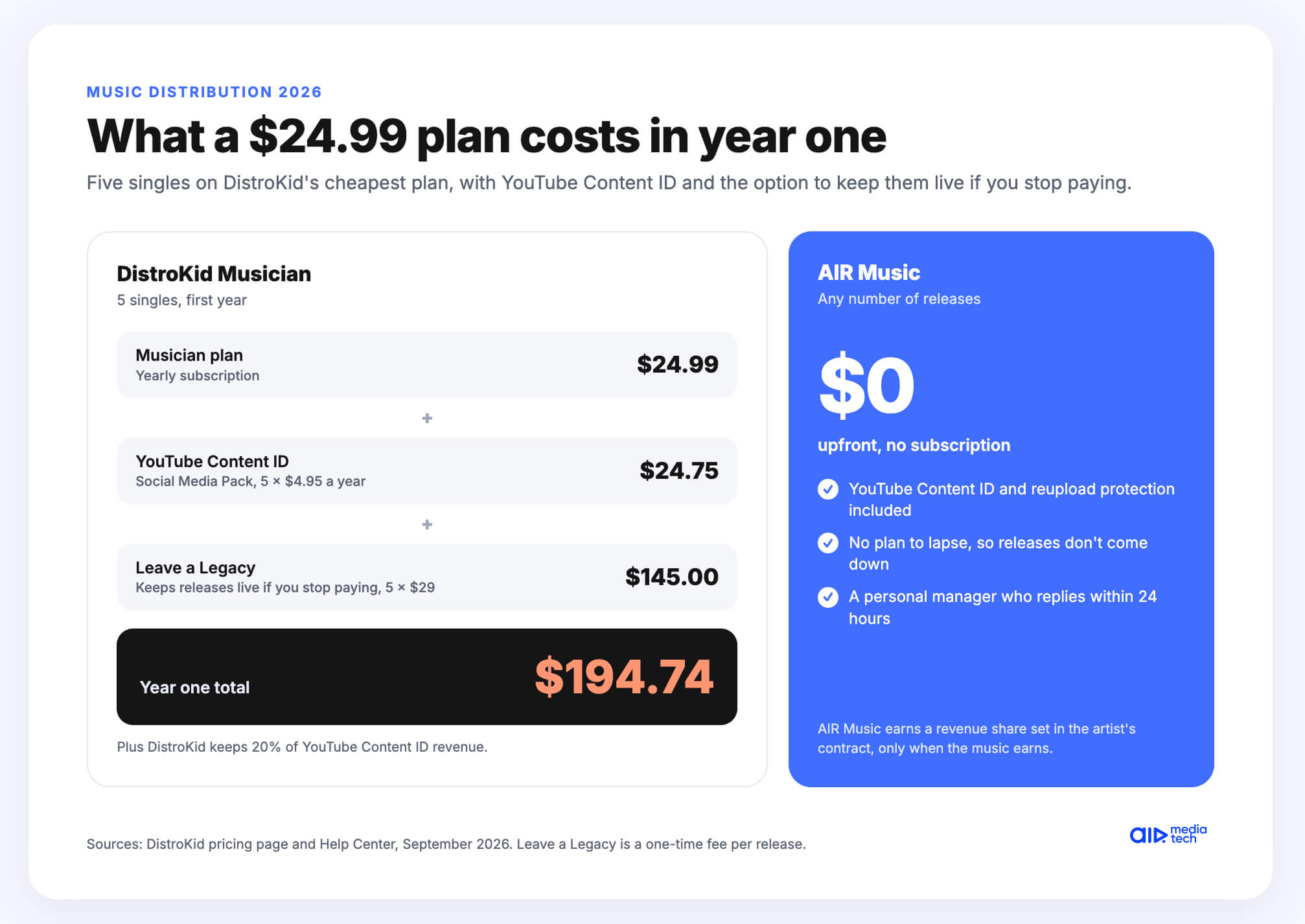
Many distributors sell YouTube Content ID as an add-on or take a cut of it. DistroKid charges from $4.95 per single per year and keeps 20% of Content ID revenue. For Kevin Kane, an Indonesian artist and founder of the indie label Barvill Entertainment, paid upsells for Content ID and the YouTube Official Artist Channel were one of the reasons to leave his old distributor (Barvill Entertainment case).
Here's how the add-ons stack up: five singles on DistroKid Musician with YouTube Content ID and Leave a Legacy cost $24.99 + $24.75 + $145 = $194.74 in the first year, before DistroKid's 20% cut of Content ID revenue.
AI-assisted tracks get rejected without a clear reason
Artists who produce with AI tools often hit rejections with no explanation. Banban, an independent artist with around 40 AI-assisted releases, had tracks rejected by standard distribution platforms after 2–3-day waits for replies, and he suspected AI use was the reason (Banban case). Angga, an independent artist with 40+ releases on Spotify and YouTube, had some tracks rejected because of his AI-based production (Angga case).
Some distributors spell this out. LANDR, for example, excludes AI-generated or AI-assisted music from YouTube Content ID, TikTok, and Meta monetization. We compared how DistroKid, TuneCore, CD Baby, and other distributors treat AI music in a separate guide.
Labels outgrow self-serve platforms
A self-serve dashboard works for one artist. With a roster, every slow reply delays several releases, and the artists blame the label, not the distributor. "When you run a label, you can't wait weeks for support," says Kevin Kane of Barvill Entertainment. After switching to AIR Music, his releases go live in about 3–5 days, and the label now distributes through AIR Music only.
Content ID gets harder with a roster too: features, leased beats, and tracks still claimed by an old distributor all have to be sorted before delivery. Here's Content ID for a record label's catalog.
What to ask a distributor before you switch
- How fast does support reply, and do you get a named person or a ticket queue?
- Is YouTube Content ID included, and what share of its revenue does the distributor keep?
- What is the policy for AI-assisted music?
- What happens to your releases if you cancel?
- What happens to your account if one of your tracks is flagged for artificial streaming on Spotify?
Free vs Paid Music Distribution
Free distribution isn't free. You just pay differently: instead of a fee, the service keeps part of every stream. It's the first of the music distribution myths artists still believe. Paid plans flip it around: you pay the fee and keep 100% of streaming royalties.
The free options on this list in September 2026:
- RouteNote Free keeps 15% of revenue.
- ONErpm keeps 15% of store and streaming revenue and 30% of YouTube revenue.
- AWAL keeps 15% on AWAL Core and accepts artists by application.
Two services dropped their free plans: UnitedMasters stopped distributing on its free DEBUT plan in October 2025, and all three Amuse plans are paid.
A free plan makes sense while your music earns little. At $50 a year in royalties, a 15% commission costs you $7.50, less than any subscription. Once your music earns more than about $167 a year, the same 15% costs more than DistroKid's cheapest plan ($24.99).
Tired of waiting days for your distributor to reply?
With AIR Music, a personal manager works on your releases with you, from delivery to promo. Here's what you get:
A manager who replies within 24 hours, not a ticket queue
Distribution to 100+ platforms with no upfront fee and no subscription
YouTube Content ID and reupload protection included
Editorial and curator playlist pitching
Per-track earnings reports and monthly payouts
100% of your rights stay yours
Apply for a Personal Manager →