

A good collaboration is the fastest borrowed audience on YouTube: one video that reaches two (or more) creators’ subscribers at once. And finding them is easy once you start looking for them where creators in your niche already gather: YouTube search and comments, subreddits like r/NewTubers, active Discord servers, Facebook creator groups, and creator networks like AIR. Pitch one specific, mutual idea by email or DM, then publish through YouTube's built-in Collaboration feature, which now lets up to 10 creators share a single video or Short across every partner's audience.
What Are the Best Places to Find a YouTube Collab Partner?
The quickest wins sit closest to YouTube itself: searching your niche and reading your own comments surface creators whose audience already likes what you make. Creator subreddits and Discord servers come next, where people post collab calls and reply within a day. Events and cross-promos take the most work but build the partnerships that last. The table ranks each option for 2026, from lowest effort to highest.
|
Where to look |
Best for |
Effort |
Why it works |
|
YouTube search + comments and Community tab |
Creators in your exact niche |
Low |
You see their content and audience before you reach out |
|
r/NewTubers, r/youtubers, r/PartneredYoutube |
Small and mid channels seeking partners |
Low |
Creators post collab calls and reply fast |
|
Discord creator servers |
Ongoing relationships and quick Shorts collabs |
Medium |
Real-time chat lowers the barrier to a first message |
|
X, Instagram, TikTok niche hashtags (#YouTubeCollab) |
Warm outreach after you engage |
Medium |
Public replies build familiarity before the pitch |
|
Facebook creator networking groups |
Similar-size channels by topic |
Low |
Members join specifically to find partners |
|
Creator networks and partner programs (e.g. AIR) |
Vetted matches and larger cross-promos |
Low for you |
The network handles matching and terms |
|
Creator events and meetups (VidCon, local) |
High-trust, longer-term partnerships |
High |
Face-to-face turns a cold contact into a warm one |
What about dedicated collab-matchmaking sites? Platforms like CollabSpace, Grapevine, and Channel Pages were popular a few years ago, but most have shut down or gone quiet. YouTube is building its own version for live streams: from early 2027, Go Live Together will let you pick a co-host from creators who are live at that moment, or join a quick match queue and let YouTube pair you with a similar creator you don't know yet (YouTube Blog). Until then, the venues above plus a creator network cover the same job with people who are still active.
Build a shortlist from those places, then check each name is worth your time before you pitch. Our list of YouTube collaboration ideas covers formats that travel well between audiences, and our guide to promoting a YouTube channel shows where a collab fits alongside your other growth moves.
Guessing which collab would grow you?We analyze your content and the broader market, not just your niche, to point you toward specific creators and formats that fit.Help me with collabs
How Do You Vet a Partner Before You Reach Out?
Check four things before you spend time on a pitch: size fit, engagement, niche fit, and brand safety. A channel with the right subscriber count but a passive or mismatched audience sends you viewers who never subscribe.
|
Check |
What to look for |
Red flag |
|
Size fit |
Roughly 0.5 to 3 times your subscriber count |
Ten times larger, so they gain little, or tiny, so little comes back |
|
Engagement |
Likes and comments that stay active for the view count |
Few comments, or generic ones unrelated to the video |
|
Niche fit |
Adjacent or complementary to your topic |
A direct competitor chasing the same uploads |
|
Brand safety |
Watch their last few videos, skim comments, search their name |
Content or history you don't want beside your channel |
Adjacent beats identical. A cooking channel and a kitchen-gear channel share viewers without competing for the same uploads, so each audience has a reason to subscribe to the other.
How Does YouTube’s Built-In Collaboration Feature Work?
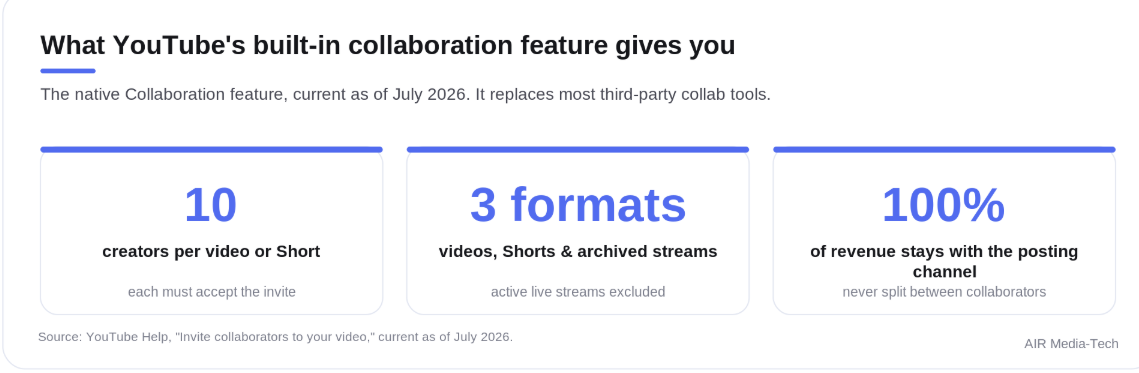
YouTube's built-in Collaboration feature at a glance. Source: YouTube Help, July 2026.
YouTube's Collaboration feature lets you invite up to 10 creators to a single video or Short. Once each one accepts, their name and a Subscribe button appear under the video, and YouTube recommends it to every collaborator’s audience. You set it up in YouTube Studio: upload or edit a video, open the Audience area under Details, and choose Invite a collaborator.
|
Detail |
Specification |
|
Collaborators per video |
Up to 10 creators |
|
Content types |
Long-form videos, Shorts, and archived live streams (not active live streams) |
|
Where viewers see it |
Desktop, mobile, and TV, under the video title |
|
What appears |
Each collaborator's name and a Subscribe button, after they accept |
|
Discovery |
The video is recommended to every collaborator's audience |
|
Revenue |
Goes entirely to the posting channel; not split between collaborators |
|
Setup path |
YouTube Studio → Details → Audience → Collaboration → Invite a collaborator |
Source: YouTube Help, "Invite collaborators to your video" (support.google.com/youtube/answer/16554898), current as of July 2026.
Before you pitch cold, AIR's network of 3,000+ creators can already tell you who's likely to say yes. Show me fitting collab options
How Do You Collab Live with Go Live Together?
The Collaboration feature doesn't cover active live streams. For a live collab, YouTube has Go Live Together: you invite a guest, and their camera appears next to yours in one stream.
|
Detail |
Specification |
|
Guests on screen |
One at a time; you can rotate guests during the stream |
|
How you invite |
Send an invite link to any creator with a YouTube channel |
|
Where you go live |
Mobile; you can schedule from Live Control Room on desktop |
|
Ad revenue |
Goes to the host channel |
|
Policy responsibility |
The host answers for anything the guest says or shows, and can remove the guest at any time |
|
Analytics |
Visible to the host only |
Source: YouTube Help, "Invite a guest to your live stream with Go Live Together", current as of September 2026.
Two updates announced at Made on YouTube (September 23, 2026):
- Creator matchmaking, early 2027. Browse creators who are streaming right now, or join a quick match queue and let YouTube pair you with a similar creator.
- Live Showdown, 2027. Once you're in a co-hosted stream, you and your co-host can start a head-to-head match. Viewers send chats, gifts, and Super Chats to push their creator's score on screen in real time.
Since the host keeps the ad revenue and carries the policy risk, agree on who hosts before you go live, and brief your guest on what they can't show, such as copyrighted music.
How Do You Reach Out for a YouTube Collab?
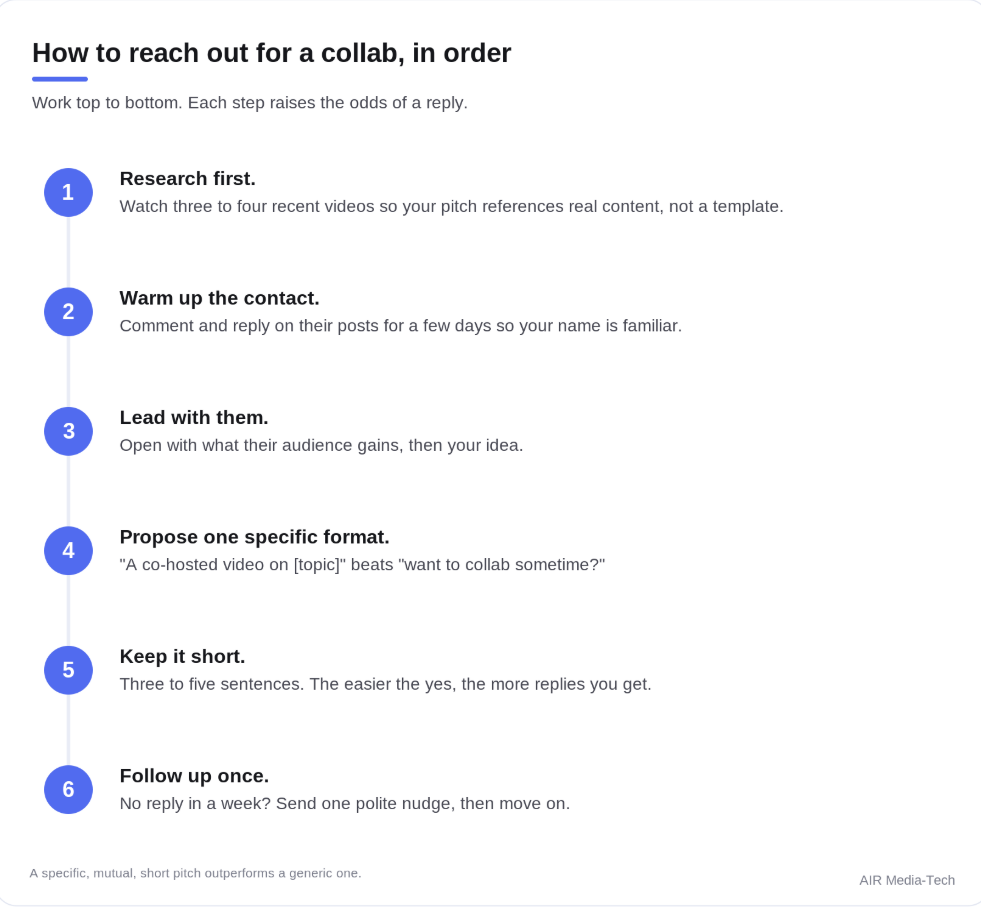
The collab outreach sequence, in order.
Reach out with a short, specific message that names something you like about their channel, proposes one concrete idea, and shows how it helps their audience, not only yours. Work the steps in order.
- Reference real videos. Pull one specific detail from a recent upload so your pitch reads personal rather than templated.
- Warm up the contact. Comment or reply on their posts for a few days before you message, so your name is familiar when it lands.
- Lead with them. Open with what their audience gains, then your idea. A creator reads the first line and decides in seconds.
- Propose one specific format. "A co-hosted video on [topic]" beats "want to collab sometime?" because it needs a yes, not a plan.
- Keep it short. Three to five sentences. The easier the yes, the more replies you get.
- Follow up once. No reply in a week? Send one polite nudge, then move on to the next name on your list.
What Does a Strong Collab Pitch Look Like?
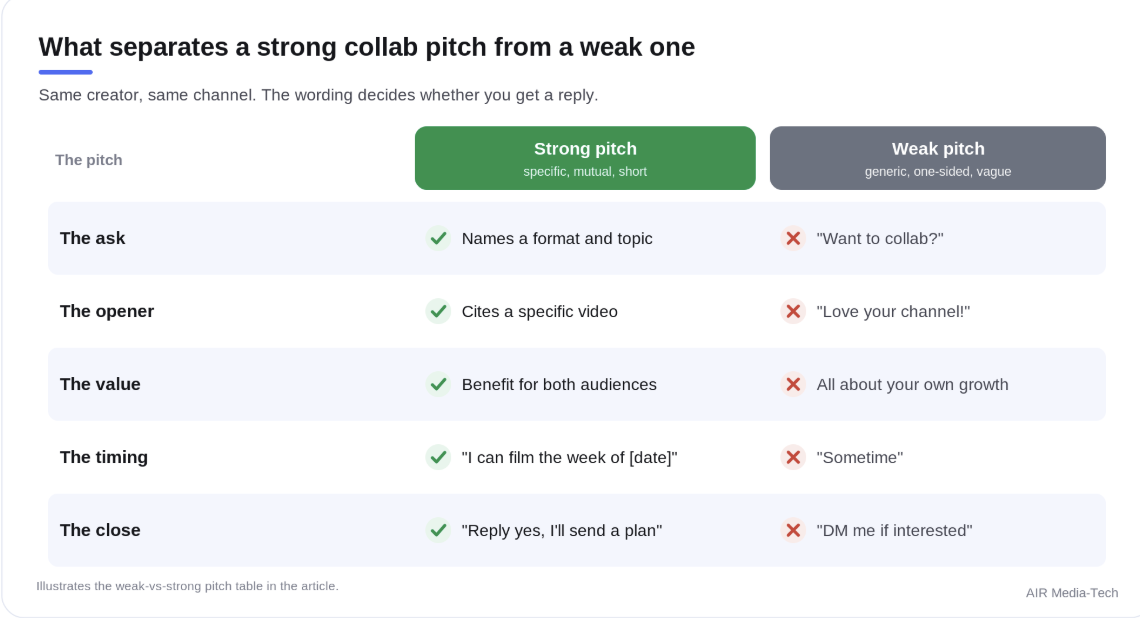
A strong collab pitch versus a weak one, line by line.
A strong pitch is specific, mutual, and short. A weak one is generic, one-sided, and vague about the format. The difference decides whether you get a reply, and the table below shows it line by line.
You Can Copy Collab Pitch Email Template
|
Weak pitch |
Why it fails |
Strong pitch |
Why it works |
|
"Hey, want to collab?" |
No idea what you're proposing |
"Want to co-host a 10-min [topic] video?" |
Names the format and topic |
|
"Love your channel!" |
Every creator gets these daily |
"Your video on [X] was sharp, especially [detail]" |
Proves you watched it |
|
"It would help me grow" |
One-sided, all about you |
"Your audience gets [benefit], mine gets [benefit]" |
Shows value for both sides |
|
"We could do something sometime" |
No commitment, easy to ignore |
"I can film the week of [date]" |
Makes it concrete and real |
|
"DM me if interested" |
Puts the work on them |
"Reply yes, and I'll send a two-line plan" |
Lowers their effort to say yes |
Googling YouTube-related questions from time to time?
200+ AIR specialists check 3,000+ channels and every platform update daily. Add AIR to preferred sources, and Google surfaces our precise answer first. → Add AIR to preferred sources.
Which Collaboration Format Should You Choose?
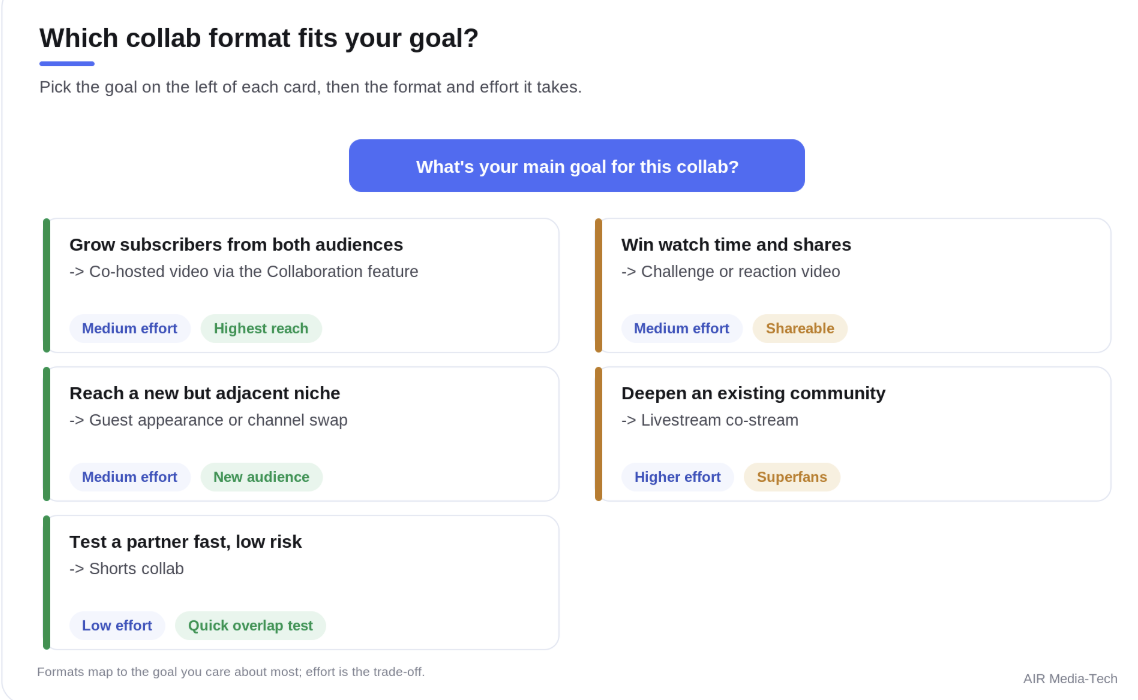
Which collaboration format fits which goal?
Choose the format by your goal: co-hosted videos for subscriber growth, guest swaps for reaching a new niche, Shorts collabs for a fast low-risk test, and livestreams for deepening a community you already have.
|
Format |
Best for |
Effort |
|
Co-hosted video |
Subscriber growth from both audiences |
Medium |
|
Guest appearance or channel swap |
Reaching a new but adjacent niche |
Medium |
|
YouTube Shorts collaboration |
A fast, low-risk first collab |
Low |
|
Challenge or reaction |
Watch time and shareability |
Medium |
|
Livestream co-stream (Go Live Together) |
Deepening community and superfans; from 2027, fan-funding showdowns |
Medium-High |
A YouTube Shorts collaboration is the easiest entry point, since a Short costs both creators little and still tests audience overlap. For even less coordination, a Shorts remix or response lets you build on another creator's Short without a formal agreement, and Shorts distribution rewards the response regardless of your channel size.
How Do You Run a Collab That Grows Both Channels?
Agree on the format and publish date up front, publish through the Collaboration feature so both audiences see it, and cross-promote from both channels in the first 24 hours. Split the work so neither creator carries the whole project.
Write the plan down, even informally: who hosts, who edits, when it goes live, how each side promotes, and who can reuse the footage, including for AI-generated edits. The feature sends all earned revenue to the posting channel and splits nothing between collaborators, so settle any money arrangement separately and in writing before you film.
Publish both videos the same day when you can, so each end screen and pinned comment can point viewers to the other channel while interest is high. Match the video to the smaller channel's usual style, so its audience recognizes the content and stays. Post supporting Shorts or Community updates from both channels on launch day, while the algorithm is still deciding who to show it to.
Measure against your solo baseline, not raw views. Open Collaboration Analytics and compare audience retention to a normal upload, count the subscribers each side gained, and read the comment sentiment. Borrowed growth only holds if the rest of the channel keeps the new viewers, which is a retention problem more than a collab one.
Why are other channels outgrowing you?It's not luck. There's a specific reason — and our specialists who've audited 3,000+ channels will find it in yours.Show me what to fix
Want Your Next Collab to Work?
We can analyze your channel and the wider market, including creators outside your niche, to help with the two things that decide whether a collab works:
- What type of collab fits your channel right now
- Which creators are worth reaching out to first
That's backed by 16 years and 3,000+ partner channels' worth of data on what makes a collab pay off across 70+ countries.