
Audiences can forgive mediocre video quality, but there’s no forgiving bad sound. But how do you make yourself sound good? Well, there are a few tricks that work, and we’re going to discuss them in more detail below.
The Editing Chain, According to Pros
Audio processing has its own order and vibes. There are plenty of exciting techniques out there, including The Radio Technique (which is editing the sound first).
Source: Gaku Lange
The exact editing process and order depend on many variables, and on many people, but the approximate process is this:
1. Recording and Importing
You’d think the audio quality starts at the editing part, but you’d be wrong. It starts at the recording stage. For example, did you know that if you have multiple hosts on your channel, you need to record separate tracks for each? Yeah! It’s done because, in case each host speaks at a different pitch or volume. Or, for example, if you’re playing a game, you’ll need to record the in-game sound and your voice separately for audio quality purposes.
Some people speak naturally louder than others, and to avoid the issue of ‘it’s either too loud or too quiet,’ make separate tracks and edit them so they are the same volume.
How do you do that?
There are tools (including AI ones, like Resound, Auphonic, and Soundful) that can manage to track several participants, recording directly to each person’s device.
Source: ConCon
What you’re recording with doesn’t matter as much, but regardless of the software, you head to the multitrack editor. Perhaps, if your microphone isn’t the best quality, you could use an auto enhancement tool for a quick touch-up at this point.
Then, we move on to editing.
2. Cleaning Up the Recording
Now that you have your separate audio tracks recorded and imported, it’s time for a basic cleanup! What do you usually start with? Well, that one’s simple - you trim all the bad takes and awkward silences out of the final product. You can use AI to simplify both tasks. What else to look out for in this phase?
- Remove obvious bumps, mic hits, cable crackles, etc.
- Reduce background noise lightly
- Fix plosives (“P” pops) and harsh “S” sounds if needed
Source: Vince Opra
3. Sound Design
Now that you have the clean recording, you can get to work. There are a few interesting tricks to the sound design process that other editors use. For example:
- Layer interesting noises with different frequencies;
- Have a coherent sound library;
- You can make your music transitions easier by layering in sound effects.
Source: Herman Huang
First of all, to avoid audio recordings ending up flat, uninteresting, and just monotone, layer in interesting noises. Think of it as a cake. Layer in background music, add in interesting transition sounds (like a ‘whoosh’ or a meme sound). The sky’s the limit.
Secondly, layering sounds with different frequencies will help you achieve fuller, dynamic sound and avoid the feeling of ‘flatness’.
And, finally, having an extensive sound library under your belt can be a lifesaver in such situations. So, where do you get them?
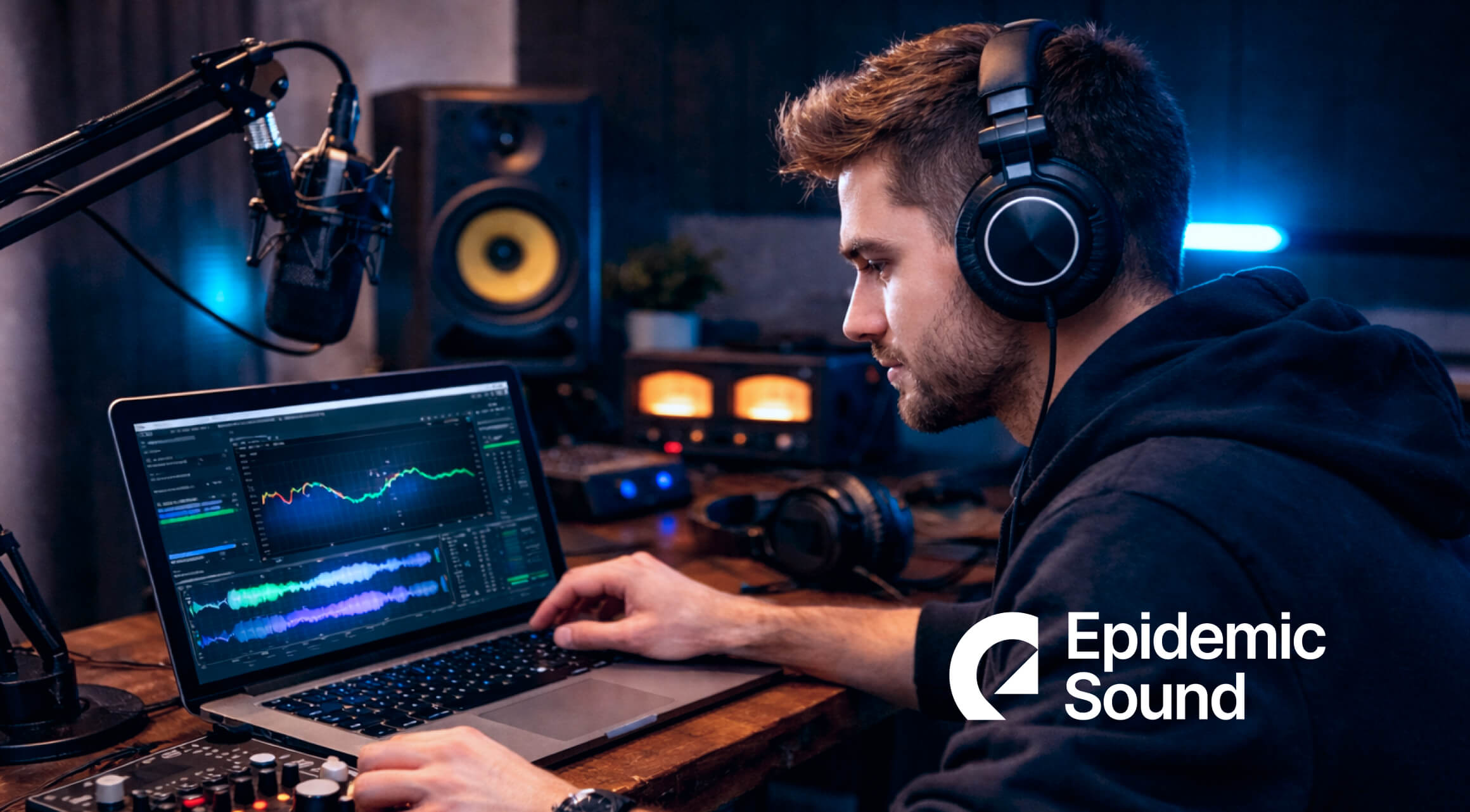
Via Epidemic Sound! AIR partners can use it for free.
Epidemic Sound not only contains a whole list of royalty-free music you can use for your videos for the best edits possible, but also holds over 200,000 unique sound effects and their variations. You don’t have to search the entirety of the internet to get them.
All you need to do is reach out to us, and we’ll tell you more! Our partners get free access to the Epidemic Sound library. So, there’s not a moment to lose!
To make your videos sound interesting, you don’t need to insert every sound known to mankind. It’s enough to make the sound design coherent and soulful.
4. Loudness + limiting (final polish)
Now set your final loudness so it plays well across devices.
- Add a limiter to catch peaks
- Don’t slam it for volume. Shorts creators often do this and end up with harsh audio
Common Audio Mistakes That Kill Retention (Even With Great Content)
Now that we know what to do, let’s see what common mistakes people make that actually kill retention. It always comes down to these:
- Over-noise reduction: The “underwater” sound actually messes with your perception, which our brains automatically don’t like.
- Inconsistent volume: Viewers leave when they’re forced to ride the volume knob.
- No separation between voice and music.
- Removing every breath and pause: Some creators “clean” their voice to the point that the result is uncanny.
A Practical “Creator Workflow”
Here’s how we keep audio edits fast without sacrificing quality:
- Build a default voice chain preset (EQ + compression + de-ess + limiter)
- Apply the preset
- Fix problems only where needed, clean up the basics with AI to save time
- Design your unique sound
- Final loudness pass
When you have a set editing routine, it works wonders. You gain your own unique voice. And that is ‘the voice people love’.
The Real Payoff
Yeah, we know, editing can be really time-consuming. But, it’s totally worth it! When your audio is right, you notice:
- longer average view duration
- fewer drop-offs in the first minute
- more “I could listen to you all day” comments
- better performance on TV and mobile speakers
And all of that is definitely worth the investment of effort. But if you have more specific questions in mind, or have trouble with YouTube.
We have helped over 3,000 channels, so we can help you! Stop guessing what works and what doesn’t on YouTube, and implement the stuff that has worked across numerous other channels and platforms.