



The channel in this case study is an established US-based home & DIY channel — a decade of home decor tutorials, crafting walkthroughs, repair guides and quick lifehacks, built for a US and Canadian audience. At the creator's request, we're keeping the channel name private and referring to it throughout as "the channel."
Most of its 1,600 videos were several years old and earning very little. Between December 2025 and May 2026, that same library paid the channel $74,951 on MSN. The creator kept the same upload schedule and changed nothing about their YouTube setup. The videos simply started appearing somewhere else, in front of people who had never come across the channel.
Before MSN, the channel was earning between $1,000 and $3,000 a month from YouTube AdSense. Their strongest month on MSN, April 2026, came to $26,679 on its own.
A Decade of Videos, Income From 5% of Them
The channel has spent a decade building a library of home decor tutorials, crafting walkthroughs, repair guides and quick lifehacks – 1,600 videos in all, for an audience across the US and Canada. The format has stayed consistent: 10–15 minute step-by-step tutorials, plus Shorts.
On YouTube that library brought in $1,000–$3,000 a month from AdSense. Most of it came from the top 5% of the catalog – recent uploads and a handful of evergreen hits.
The other 95% barely registered. YouTube's recommendation system rarely puts older videos in front of new audiences, and search traffic on its own doesn't move the revenue number much.
What they wanted was a way to get that archive in front of new people without making new videos, signing anything exclusive, or touching their YouTube setup.
What Six Months on MSN Paid
Since the channel started distributing with us, MSN has out-earned their YouTube AdSense every single month. In April it did so nearly nine times over.
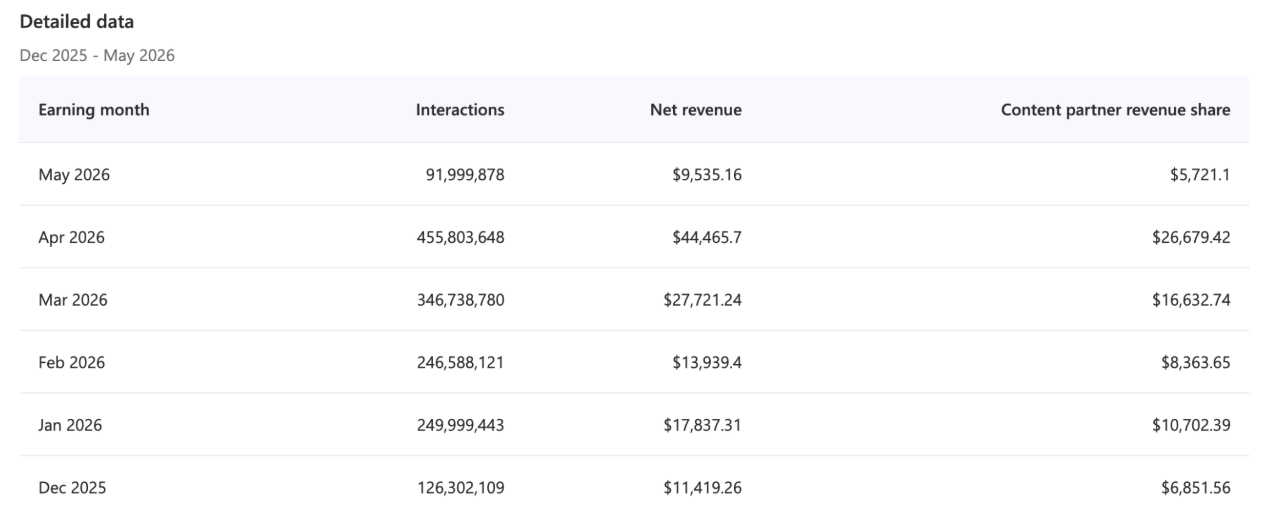
The channel’s MSN dashboard — six months of payout data (Dec 2025 – May 2026)
A few things stand out in this data:
- Total creator earnings over six months: $74,951. This is the channel's own share of MSN revenue, after the split with AIR.
- Peak month, April 2026: $26,679. That came from 455 million interactions in the month.
- Growth trajectory: from $6,852 in December 2025 to $26,679 in April 2026, close to four times in five months as MSN's system learned which videos matched user intent.
- May 2026: $5,721. A step down from the April peak. MSN traffic for home-improvement content tends to soften in late spring and early summer.
- Total interactions across six months: more than 1.5 billion. That is the scale MSN operates at, with videos surfacing to millions of users rather than a handful.
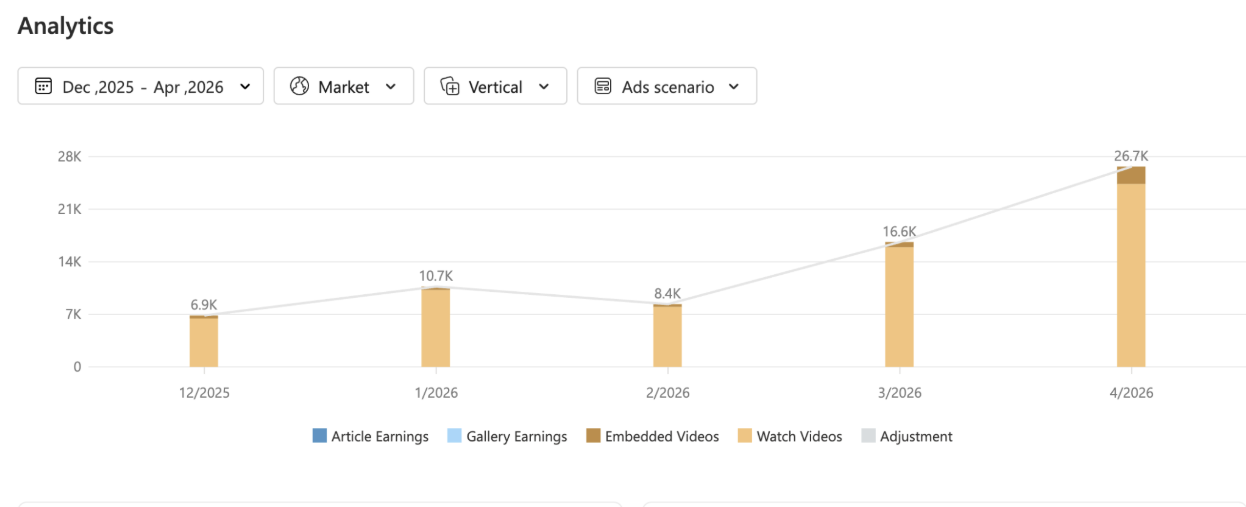
Monthly creator earnings, December 2025 – April 2026 — $6.9K to $26.7K, with a dip in February.
If you have an established YouTube channel with a similar library of evergreen content, you can check whether it qualifies for MSN Distribution.The application is free, takes 15 minutes, and carries no upfront cost.Apply for MSN Distribution →
From Application to First Payout in 65 Days
The work on the channel’s side came down to one form and one signature. Everything after that ran on our end and Microsoft's, and the whole sequence took just over two months from application to money in the account.
- Applied through air.io — January 2025. A form on channel details, monetization status and content type. Takes about fifteen minutes.
- Signed one non-exclusive contract — January 14, 2025. There was no upfront cost, and nothing about their YouTube setup had to change. The revenue share applies only to MSN earnings; AdSense stayed entirely theirs.
- Microsoft review — about three weeks. A check on content standards, IP compliance and quality across the channel and its library.
- Distribution started. Our team at AIR Media-Tech planned and published their existing 1,600 videos across MSN.com, Bing Videos and the Microsoft Start feed. Nothing was re-edited or re-uploaded.
- First payout — March 20, 2025. 65 days after signing.
Why the Oldest Videos Earned the Most
The videos earning the most on MSN were the older tutorials – projects filmed years ago that had already done their numbers on YouTube and dropped out of circulation there.
MSN's recommendation system works on user intent. When someone in the US or Canada searches for “how to fix a leaky faucet” or “small bathroom decor ideas,” it surfaces step-by-step tutorials that match. The DIY channel’s library, 1,600 videos built up over a decade, is exactly the kind of catalog that system rewards.
Two mechanics make MSN economics work differently from YouTube for this type of content:
- Audience demographic. MSN skews toward US and Canadian users — older, higher household income, actively researching purchases (home improvement, tools, appliances). Advertisers pay a premium for this demographic, which flows through to creator RPM.
- Intent-driven discovery. MSN doesn't rely on subscribers or recency. If your video matches a search or a topic someone is reading about, it surfaces — regardless of when it was uploaded. Evergreen content is disproportionately rewarded.
Where the Videos Show Up
MSN is Microsoft's consumer content platform. It sits inside msn.com, Bing search results, Microsoft Start (the news feed built into Windows 11) and the Edge browser's new-tab page. Combined, those surfaces reach 1.29 billion unique users a month. MSN doesn't host the videos, it distributes them: they appear in the feeds, Microsoft monetizes the views, and the revenue comes back to the creator through AIR.
The channel's 26.7K followers on MSN are a separate audience from the 150K on YouTube — Windows and Bing users who found the channel in the feed and followed it there.
The thing to keep in mind is that MSN is invite-only for creators. You can’t apply directly. Microsoft works with a small number of official partners who handle onboarding, contracts, and payouts. AIR Media-Tech is one of 13 content partners in Microsoft’s directory.
Who This Works Best For
MSN Distribution isn't a fit for every YouTube channel. Based on data across AIR's creator network, the channels seeing the strongest results tend to have these in common:
- Established library, not just new uploads. Channels with 100+ videos see the biggest incremental lift. The archive is the asset.
- Evergreen content types. How-to tutorials, cooking recipes, tech reviews, travel guides, sports highlights, DIY, home improvement. Content that stays relevant for years.
- English, Spanish, or Portuguese audiences. US, UK, Canada, Latin America, Brazil, and Spain are the strongest MSN markets currently.
- Monetized YouTube channels 10K–500K subscribers. Below 10K subs typically don't meet MSN's content quality bar. Above 500K works, but the incremental lift is proportionally smaller.
- Original content only. Reaction videos, compilation channels, and re-uploaded content don't pass Microsoft moderation.
If Your Library Looks Like This
The channel's result came out of content they had already paid for. The videos were made, edited and published years ago, and the only new thing was where they ran. That is the question worth putting to your own channel – whether the archive you already own is reaching everyone it could.
How much a given library earns depends on the niche, the geography and how much of the catalog clears Microsoft's review. The channel's numbers are theirs, not a benchmark. What travels from this case is the mechanic: an archive that has stopped moving on one platform can still be new to another. The same mechanic, including what it takes to qualify and how MSN pays out, is broken down in MSN for YouTube creators.
If your own channel is monetized and has 100+ evergreen videos behind it, there's a good chance MSN can do something similar with that archive.
