


Not Sure Which Languages to Choose?
Some YouTube creators think global growth requires more content, bigger budgets, or full-scale dubbing. In reality, it often starts with something much simpler: translated metadata. And Asian markets remain one of the most promising directions.
One of the reasons: they’re still underutilized.
Across thousands of channels we’ve worked with, Asian markets consistently show a unique balance of CPM, reach, and engagement, often outperforming all expectations. The question is no longer whether these markets work, but how to identify the right ones for your content and scale them efficiently.
In this article, we’ll break down the numbers, analyze CPM across regions, and show how creators are already using metadata translation to unlock growth in Asian markets.
The CPM Illusion: Why “Low vs High” Is the Wrong Framework
Let’s start with what most creators obsess over: CPM.
At the top of the global spectrum, the hierarchy is clear. The United States sits at $14.67, Australia at $13.30, and Switzerland at $12.98, with most Western European markets clustering between $7 and $10. These are mature advertising ecosystems with deep budgets and predictable monetization.
But they come with saturation.
The English-speaking market alone combines over a billion users with millions of active creators. Every topic, every niche, every keyword is heavily contested. Growth here is all about outcompeting an entire industry.
Now compare that to Asia.
Japan operates at $5.68 CPM, South Korea at $5.73, Singapore at $5.98, Hong Kong at $5.46, Taiwan at $3.56, and the UAE at $3.87.
At first glance, these look weaker.
In reality, they sit in a far more strategic position.
These markets have mid-to-high CPMs and significantly lower competition density. You’re operating at roughly 40–60% of US CPM levels, but often with a fraction of the content saturation.
That imbalance creates leverage.
Because now on YouTube, maximizing the CPM-to-competition ratio is what separates strategic creators from those relying purely on algorithm luck.
And this is exactly where Asian markets outperform expectations.
AI Metadata Translation Case: Cozy Relaxing Jazz
And when our team worked with Cozy Relaxing Jazz to boost global reach, we translated the entire catalog into 8 languages, including Japanese and Korean (without changing a single video).
Within weeks, YouTube began redistributing traffic. Japan grew from 10.9% to 16.8% of total views, while South Korea increased from 2.3% to 5.7%. Japanese alone brought in 128K+ views (8.6%), showing strong retention.
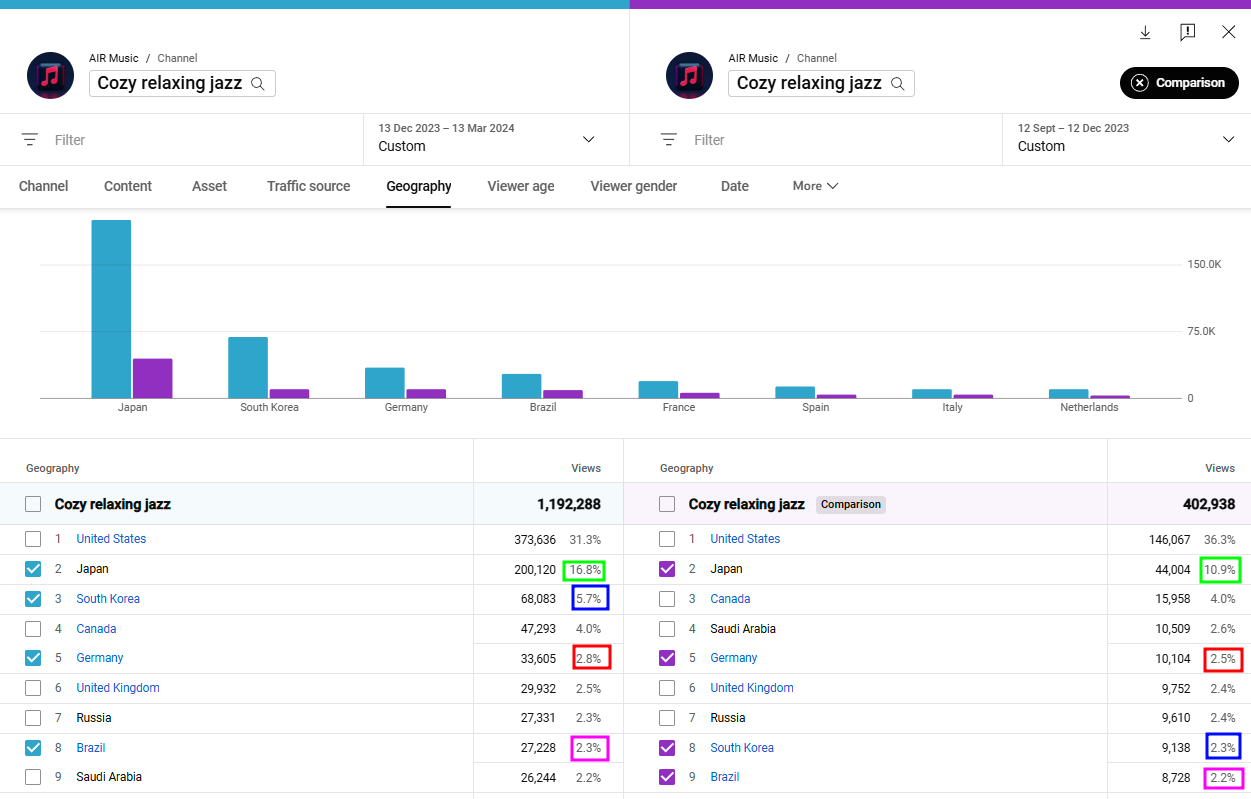
Revenue followed the same pattern. Japan contributed up to 7.7% of total revenue, outperforming several European markets like Germany (~4–5%).
Overall impact: +195% views, +169% revenue, +126% subscribers, with 25% of total traffic driven by translated metadata.
But not every translation strategy works the same on YouTube. Reach out to us, and we’ll help you figure out the best option for your channel. Our team has deep experience with how content performs across different languages.
The Second Layer: Volume Markets That Break the CPM Model
If we stopped at Japan and Korea, the argument would already be strong.
But Asia has a second layer, and this is where most creators miscalculate entirely.
India sits at $0.74 CPM, Indonesia at $0.84, Vietnam at $0.85, the Philippines at $1.12, Thailand at $1.30, and Malaysia at $1.57.
These numbers scare creators away.
But they shouldn’t.
Because CPM in isolation is meaningless without scale.
India alone represents one of the largest YouTube audiences in the world (~491M users). Indonesia (~151M users) is one of the fastest-growing video consumption markets globally. Southeast Asia as a whole operates as a massive, mobile-first ecosystem with extremely high daily watch time.
What this means in practice is simple:
A video that underperforms in the US can outperform globally when distributed across high-volume regions.
Lower CPM multiplied by significantly higher view counts often results in equal or higher total revenue, especially when combined with algorithmic amplification driven by engagement.
And this leads to the key insight from our AIR Translation Labs’ team:
Don’t choose between high CPM and high reach. Build across both.
Not sure which languages to prioritize?
Choosing the wrong markets slows your growth. Contact us, and we’ll identify the ones that actually work for you.
The Third Variable Everyone Underestimates: Engagement
There’s a third layer that doesn’t show up in CPM tables, but heavily influences performance: engagement behavior. Across many Asian markets, consumption patterns differ from Western ones. Mobile-first viewing dominates. Sessions are longer. Repeat consumption is higher.
And the data support it.
According to DataReportal, 70–85%+ of YouTube watch time in countries like India, Indonesia, and Vietnam comes from mobile devices, making these regions fundamentally mobile-first.
Engagement is also higher. Data shows that South Korean users spend ~69.6 hours per month on YouTube, one of the highest usage rates globally. In markets like India and Indonesia, Statista reports daily usage often exceeding 60–90 minutes per user.
But remember that discovery only brings the viewer in. Understanding keeps them there.
If your channel doesn’t rely on spoken language (like Cozy Relaxing Jazz), metadata translation alone is powerful. But in other cases, metadata + subtitles (or dubbing) can work together to drive even stronger results.
In one campaign, we added Bahasa Indonesia subtitles to the top 10 videos of a lifestyle channel. Within a month, views from Indonesia doubled, along with higher average watch time and stronger engagement.
We’ve seen this pattern clearly: channels that combine these two consistently outperform those relying on only one layer, sometimes adding tens of millions of additional views without changing the core content.
Contact us to choose the right strategy for your specific channel.
Language Groups: From Guesswork to Market Intelligence
Instead of thinking in individual languages, the more effective approach is to think in language groups.
There are three of them for selection:
- High-pay markets (Japan, Korea, Singapore)
- High-reach markets (India, Indonesia, Philippines)
- High-engagement clusters (Southeast Asia broadly)
Testing them individually can take months. But with the right tool, you can do this in minutes.
This is where AI Metadata Translation becomes your testing framework.
By translating YouTube metadata into entire language clusters at once, you allow YouTube’s algorithm to do what it does best: distribute, test, and optimize.
Instead of predicting outcomes, you observe them.
You see which countries generate views, which ones generate watch time, and which ones generate revenue. And those signals appear faster than most creators expect.
And instead of manual effort, you get:
- Bulk localization across entire catalogs
- Direct API integration with YouTube Studio
- Automatic translation for every new upload
- The ability to deploy across 200+ languages in minutes
It creates a persistent global discovery layer.
Every video becomes searchable in multiple languages. Every upload becomes immediately eligible for international recommendations. Every piece of content starts its lifecycle as global, not local.
Let’s see how the AI Metadata Translation tool is operating in real life.
More Cases: What Happens When Metadata Goes Global
Here are more of our cases showing how metadata translation consistently drives global growth across different niches, formats, and audience types. No matter the content, the pattern stays the same: once videos become searchable in multiple languages, YouTube starts pushing them into new markets.
UNITED24 Media
+261% in Japan | +230% in France | +169% in Germany
UNITED24 Media creates content about war, weapons, and politics. YouTube’s algorithm isn’t a big fan of such sensitive topics and often limits visibility for channels like that.
By translating their metadata into 10 languages, we helped the content become accessible to international search and recommendation systems almost instantly.
Within one month, the channel experienced +261% growth in Japan, +230% in France, and +169% in Germany, showing how fast YouTube can scale content once language barriers in metadata are removed.
KrasOlka (DIY)
+148% Views | +97% Subs | +46% Ad Revenue
KrasOlka is a silent DIY channel, which makes it highly compatible with global distribution. Instead of producing new content or adding voiceovers, the AIR team focused entirely on translating YouTube metadata into 9 languages. This allowed YouTube to correctly index and recommend the videos in multiple regions.
As a result, the channel saw a 148% increase in views, 97% subscriber growth, and 46% higher ad revenue, driven purely by expanded discoverability and algorithmic redistribution.
Music Channel
+377% Views | +297% Subs | Global Reach Extension
We helped this music channel to make their entire archive searchable across languages rather than changing the content itself. After metadata localization, YouTube began recommending videos in non-English markets, significantly expanding its reach.
The result was a 377% increase in views and 297% growth in subscribers, driven by new audience segments discovered through localized search and recommendations.
Entertainment Channel
+51M Views | Combined Metadata & Subtitles Strategy
This case highlights how discovery and retention work together. Metadata translation expanded reach into new regions, while subtitles ensured viewers could follow the content and maintain watch time.
By combining both layers, the channel generated 51 million additional views and transitioned from regional performance to consistent global traffic.
Asia Is a System, Not a Bet
Global growth on YouTube is no longer about picking one market and committing. It’s about testing multiple markets fast and scaling what works.
Asian regions make this clear:
- Japan and Korea offer strong monetization with lower competition
- Southeast Asia delivers massive scale and high engagement
- Together, they balance revenue and reach
Once metadata is translated, your content becomes searchable across markets. From there, YouTube does the heavy lifting: testing, distributing, and scaling based on performance.
That’s how local channels become global systems.
If you want to do it right, AIR Media-Tech can help you build the strategy, choose the right language groups, and scale your channel globally with AI-driven metadata translation.
Contact us to get started.