



No. YouTube says promotions don't affect a channel's or a video's organic performance, because organic recommendations are based on how a video does when YouTube recommends it, not when it runs as an ad. Poor targeting can waste the budget and pull down your blended stats in YouTube Studio, but the channel isn't penalized.

22 Steps to Grow from $500 to $10,000 on YouTube.pdf
Paid YouTube ads for creators are the ads you buy to promote your own videos, through YouTube Promote in Studio or Google Ads. The ad money YouTube pays you is a different topic. Paid ads work when a video already holds viewers. They waste money when you ask them to save a weak one.
Most creators we talk to ask the same thing first. Will ads hurt my organic reach? They won't. YouTube says promotions don't change how its system recommends your videos. They don't feed it either. Watch hours and subscribers you get from ads don't count toward the YouTube Partner Program.
What ads can do is bring in new people who keep watching on their own. YouTube calls these follow-on views, and they do count. In the two months after a $1,000 campaign set up by the AIR team, a European kids' channel we work with grew from 1.3 million to 5 million views.
Key takeaways
- Paid YouTube ads don't hurt organic reach. YouTube says promotions don't change how it recommends your videos. Bad targeting wastes money, but the channel isn't penalized.
- Ads don't count toward monetization. Watch hours and subscribers from ads don't count toward the YouTube Partner Program. Follow-on views from Audience Growth campaigns do.
- Promote videos that already work. Ads can't fix weak content. In AIR Promotion campaigns from March 2024 to October 2026, $100 bought about 4,500 views in the US and 8,500–9,800 in the UK, Canada and Australia.
- Judge a campaign by what happens after it. A European kids' channel AIR Media-Tech works with saw recommended traffic grow from 1.2 million to 3.7 million in the two months after a $1,000 campaign.
- Promote long-form first. In AIR Media-Tech's data from 274 channels, Shorts RPM is 3–14% of long-form RPM in most niches.
Paid YouTube Ads vs Organic Reach: What YouTube Says
A European kids’ channel AIR works with came to us after its first campaign, run on its own, went wrong. Views fell, engagement dropped, and the creator stopped trusting ads.
That fear is common. We hear versions of it all the time.
- “YouTube will think my video is low quality if I pay for traffic.”
- “Paid viewers will drag down my CTR and watch time, and the algorithm will stop recommending me.”
- “I won’t know what’s organic anymore.”
- “Paid views don’t count anyway.”
YouTube answers most of this on its Promote help page. Promotions don’t affect how a video or a channel performs organically. Organic recommendations are based on how a video does when YouTube recommends it, not when it runs as an ad.
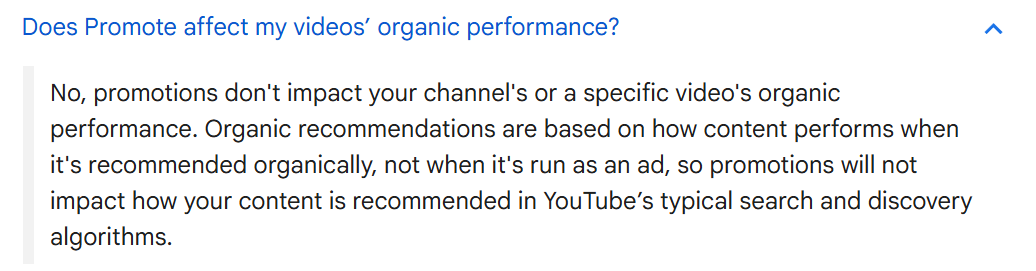
Source: YouTube Help
Two more rules from the same page matter if you’re not monetized yet.
- Watch hours and subscribers you get through ads don’t count toward the YouTube Partner Program thresholds.
- Follow-on views do count. These are organic views from people who watch more of your videos after seeing your promotion. You’ll find them in the Promotions tab in YouTube Studio, for Audience Growth campaigns only.
Your analytics stay readable too. Paid views show up as a separate traffic source called YouTube advertising, so you can still see your organic CTR and retention on their own.
So the risk isn’t a penalty. It’s paying for the wrong viewers. Ads shown to people who don’t care bring views that end in seconds and subscribers who never come back. That’s money lost, and it drags down your blended stats, but YouTube doesn’t punish the channel for it.
The AIR team saw this with that kids’ channel. For the second try, it put a $1,000 budget behind the channel’s best video (54% retention), built a custom audience from similar-sized kids’ channels, and fixed a few animated elements that looked out of place. In the two months after the campaign, views grew from 1.3 million to 5 million, recommended traffic from 1.2 million to 3.7 million, and revenue nearly tripled, as the x4 views case shows. The ads didn’t push the algorithm. They brought the right people, and the video held them once YouTube started recommending it on its own. We walk through each step of that campaign in how promotion services speed up organic growth.
Not sure which video is worth paying for?
An AIR channel audit shows which of your videos hold viewers best, compares them with channels in your niche, and gives you a plan for what to promote first.
Find my best video to promote →Fast and Expensive or Slow and Cheap: When Paid YouTube Ads Make Sense
When the AIR team relaunched ads for that kids’ channel, it didn’t promote the newest upload. It promoted the video that already held 54% of viewers. That’s the slow, cheap way to buy ads. There’s also a fast, expensive one, and each suits a different kind of channel.
Fast and Expensive: Ads the Day a Video Goes Live
Some creators start a campaign the moment a video is published. That makes sense when you have the budget and want one of these.
- A quick read on how a new video or format lands.
- Feedback from viewers outside your current audience.
- Early views for a launch, a premiere, or a sponsored video.
- Faster growth for a format you already know works.
We mostly see this on channels that already have five things in place.
- Stable monetization.
- A clear niche.
- A back catalog of videos that perform.
- Brand deals that need reach on a schedule.
- A plan for the budget, not just a hope.
You pay for speed here, and you know what the speed is for.
Slow and Cheap: Promote Only the Winners
This is the usual path for channels with a small budget. Publish first, watch the numbers, and promote only what works. You spend nothing until a video proves itself. If it takes off on its own, you’ve saved the budget. If it beats your channel average on retention and click-through rate, it’s a safer bet for ads. And you never pay to push a video your viewers don’t want.
Running ads on an unproven video is gambling. Running ads on a video with early organic traction is an investment.
Both ways can grow a channel. The right one depends on your budget, how established the channel is, and what you need the views for.
Long-Form First, Shorts Second
Promote works for both videos and Shorts. For most channels, the long video is the better buy, because that’s where watch time and ad money come from. On Dr Roto, a fantasy sports channel AIR Media-Tech audited, Shorts brought about 91% of the views and only about 6% of the watch hours, as the Dr Roto case shows. In AIR Media-Tech’s data from 274 channels, Shorts RPM is 3–14% of long-form RPM in most niches. Promote a Short when your channel lives on Shorts, or when that Short already sends viewers to a related long video. We compare the two formats side by side in Shorts views vs. long-form for channel growth.
When Paying for YouTube Ads Is a Waste of Money
The most expensive mistake is buying ads to get monetized faster. YouTube doesn’t count watch hours or subscribers from ads toward the Partner Program, so that budget doesn’t move you closer to YPP. Only follow-on views count.
The AIR Promotion team sees one kind of failure more than any other. The ad never runs because Google Ads declines the video. In one campaign, a photo of Donald Trump flashed in the background for half a second, and the video was rejected as political. In another, the host wore a T-shirt with a swear word on it. Politics, religion, and shocking content in a video stop a campaign before it starts.
Here’s when we’d skip ads.
- The content isn’t ready. No thumbnail fixes a boring video, and no targeting fixes low retention. Ads won’t save a weak video. They’ll just show it to more people who leave.
- You don’t know your audience yet. Without a niche, a consistent style or a clear reason to watch, ads spread your budget across people who won’t come back. Before you pay, find what’s holding the channel back. We collected the blockers we keep finding in channel audits, and some of them are not what creators expect.
- You want ads to create demand. Buying views doesn’t build an audience. Ads bring more people to a video that already works. They can’t make people want a video they’d skip.
- You’re promoting out of frustration. If views dropped and you want ads to beat the algorithm, wait. Paid views don’t change how YouTube recommends your videos, so they can’t undo an organic drop. Find the cause first, then promote when you want to grow faster.
“
If your channel is doing fine, you post regularly, and your videos already work organically, ads give you a boost. You can pick up a few more subscribers or push a video that’s taking off slower than usual. But if a channel is starting from zero, there are no miracles.
Andrey Shuvalov, YouTube Promotion Lead at AIR Media-Tech
Ready for Ads? Five Yeses First
You’re ready for ads if:
✔ You already know your niche.
✔ You publish consistently.
✔ You understand your analytics.
✔ You have a budget you can afford to test with, even a small one.
✔ You want faster growth and real data on what works.
You’re not ready if:
✘ You’re still experimenting with formats.
✘ You don’t know who your audience is yet.
✘ You treat ads as a magic fix.
✘ You only want bigger numbers.
✘ You’re promoting videos you’re not confident in.
How Much to Spend on YouTube Ads in 2026, and What $100 Gets You
Creators ask us this all the time. Is $20 enough? Do I need $200? $2,000? The answer depends less on the budget than on where your viewers are and how narrowly you target them.
In AIR Promotion campaigns from March 2024 to October 2026, a view cost about $0.02 in the US and about $0.01 in the UK, Canada, and Australia. Pricing guides list $0.03–$0.12 per view for skippable in-stream ads, so plan for a higher cost if you run in-stream ads only or target a narrow audience.
| Where your viewers are | Average cost per view, AIR Promotion campaigns | Views per $100 (estimate) | Views per $100 with a narrow audience |
|---|---|---|---|
| United States | about $0.02 | about 4,500 | about 2,300 |
| United Kingdom, Canada, Australia, France | about $0.01 | 8,500–9,800 | 4,300–4,900 |
| Germany | about $0.015 | about 6,700 | about 3,300 |
| Poland, Spain, Türkiye | $0.006–$0.008 | 12,000–17,000 | 6,000–8,400 |
| Ukraine, Kazakhstan, Nigeria, Kenya, South Africa | $0.002–$0.003 | 30,000+ | 15,000+ |
Source: AIR Promotion campaigns in Google Ads, March 2024 – October 2026, average TrueView cost per view. Estimates, not a guarantee of results.
These are averages across niches. The narrower the audience, the more each view costs. A campaign aimed at “women aged 35–45 who like recipes” can cost about twice the average, so expect roughly half the views.
Here’s how the AIR team thinks about budget sizes for one video.
| Budget per video | What it's good for | Expected views in the US (estimate) | Who it suits |
|---|---|---|---|
| $10–$30 | A first test of a video or a thumbnail | about 500–1,400 | Any channel trying ads for the first time |
| $50–$150 | Checking if a video is worth pushing harder | about 2,300–6,800 | Channels testing a new format |
| $200–$500 | Pushing a video that already holds viewers | about 9,000–23,000 | Channels with a format that works |
| $1,000+ | Scaling a video that beats your channel average | about 23,000–45,000 per $1,000 | Established channels in competitive niches |
Subscribers cost more than views. In AIR Promotion’s view campaigns, each new subscriber came as a side result and cost roughly $1-$10. A Demand Gen campaign set up for subscribers brought them in at about $0.30 each, but so far the team has run those only in Ukraine. Demand Gen also needs at least 10 days and a minimum daily budget that Google sets and can change.
Once you’ve picked a budget and a video, follow our step-by-step guide to setting up a YouTube ad campaign.
YouTube Promote vs Google Ads: Which to Use in 2026
The Promote button sits on the watch page of every video you upload, so most creators try Promote first. Some move to Google Ads later, when they need more than Promote offers. Both run on the same ad system, so the real choice is how much control you need.
Two ways to run paid YouTube ads in 2026
Inside YouTube Studio
YouTube Promote
A few clicks on a computer or Android. Goals for subscribers, views, or website clicks. Targeting by country, language, age, gender, and interests. Follow-on views for Audience Growth campaigns. Best for a first test.
The full ad platform
Google Ads
Advanced targeting, remarketing to people who already watched you, placement exclusions, and in-depth reporting. More setup and a steeper learning curve. Best for scaling a campaign that already works.
Based on YouTube Help, checked October 2026.
YouTube calls Promote a simplified ad tool powered by Google Ads, made for creators who don’t want to deal with complex campaign settings. You set it up in YouTube Studio on a computer or an Android device. You pick a goal, like more subscribers, views, or website clicks. Then you choose a video, the countries, languages, ages, genders, and interests to target, a budget, and an end date. Every promotion goes through an ad review first, which can take 1–2 days.

Google Ads is the full ad platform, and YouTube itself sends creators there for advanced targeting and in-depth analytics. That’s where you can show ads to people who already watched your channel, reach viewers of similar channels, exclude placements you don’t want, and test several versions of an ad.
A few details are worth knowing before you choose.
- Promotions created in YouTube can only be managed in YouTube. They don’t appear in Google Ads.
- Follow-on views, the number that shows whether paid viewers keep watching, are available only for Audience Growth promotions.
- If your promoted video is made or changed with AI, you can add a Promote AI label when you set up the campaign. Viewers see it only in the EU, India, and New York, and only when the video runs as an ad.
- Google stopped political ads in the EU on October 10, 2025. A promotion with EU political content still runs, but not for viewers in the EU. From April 2026, creators with EU impressions have to declare whether they promote EU political content.
The AIR Promotion team runs every creator campaign in Google Ads. It's faster to connect a channel and launch from one account the team manages than to set up access and billing in each creator's account.
If you're running ads yourself, Promote is the simpler place for a first test. Move to Google Ads when you need remarketing, audiences built from similar channels, or reporting that Promote doesn't show.
What to Track After a YouTube Ad Campaign: Follow-On Views First
The kids’ channel’s real result didn’t show up in its ad stats. It showed up in recommended traffic, which rose from 1.2 million to 3.7 million in the two months after the campaign, and views stayed higher even after the ads stopped. An ad report counts the views you paid for. What matters is what those viewers do next.
Before you launch, write down three baseline numbers for the video you’ll promote. Take its Suggested and Browse views for the last 28 days, its average view duration, and your channel’s returning viewers. Then compare the campaign against them.
| What to check after a YouTube ad campaign | Where to find it | What a good result looks like |
|---|---|---|
| Follow-on views | Promotions tab in YouTube Studio (Audience Growth campaigns only) | Paid viewers go on to watch your other videos |
| Cost per subscriber | Campaign spend divided by subscribers gained | Less than a subscriber is worth to you in ad revenue, sponsors or sales |
| Suggested and Browse views | Video analytics, Reach tab, traffic sources | Above your 28-day baseline and still up 1–2 weeks after the ads stop |
| Retention of paid views | Traffic source YouTube advertising | Not far below your organic average |
| Returning viewers | Audience tab in YouTube Analytics | New subscribers show up on your next 2–3 videos |
Ad views can look smaller in Studio than in your campaign report. YouTube Analytics counts a skippable ad as a view only after 30 seconds or a full watch, and non-skippable ads never count as views.
Here’s how to read the result. If views rise only under YouTube advertising and everything falls back to the baseline when the ads stop, you paid for one-time views. If Suggested and Browse stay above the baseline after the campaign, the video holds new viewers, and spending more makes sense. If organic traffic doesn’t move at all, look at the video before the next budget, because the problem is usually the content, not the ads.
The AIR Promotion team checks a campaign the same day or the next to make sure it launched, then judges it by cost per view against the target it set. As the team puts it, CPV is the one number an advertiser can control. What happens to the channel after that depends on the video.
Paid for ads before and got nothing back?
With AIR Promotion, our team runs the campaign for you and gives you a plan for the next one.
- A promotion strategy built around your goal and budget
- The right video and an audience from similar channels
- Setup, launch and optimization while the ads run
- A report on views, subscribers, and what happened after the campaign